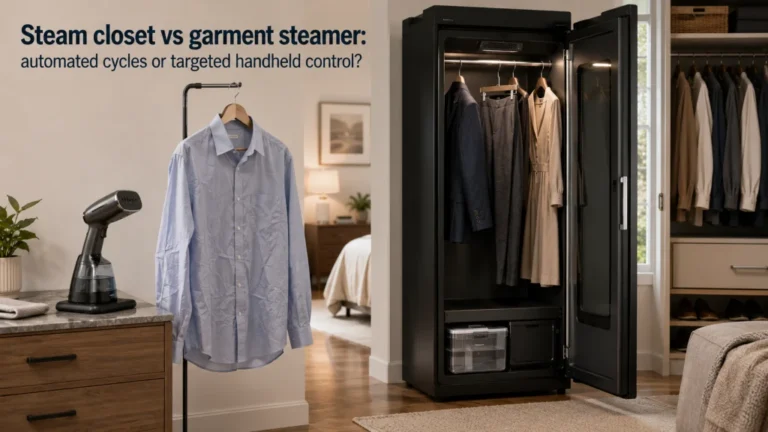
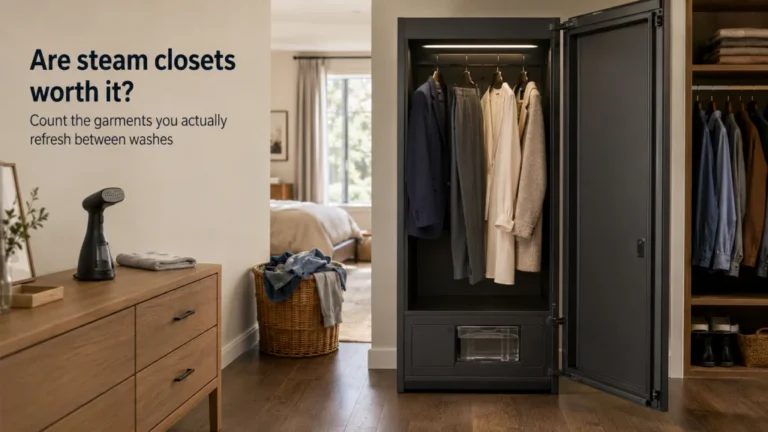
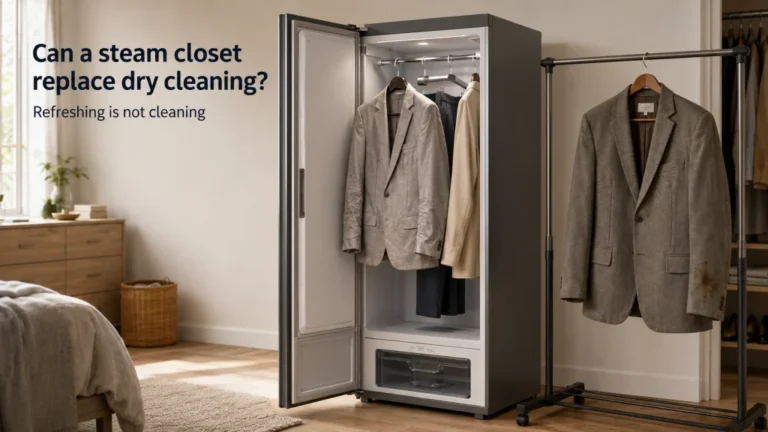
A steam closet can skip a water hookup and still be surprisingly demanding about where it lives. The safe location depends on the exact cabinet dimensions, delivery route, door swing, floor, ventilation space, grounded power, ambient conditions, tank access, and any anti-tip instructions for the model you are buying. Treat the manufacturer installation manual as the controlling document, not a retailer’s “no plumbing” badge. Measure the route and the operating space before ordering so delivery day confirms a plan instead of exposing a fit problem.
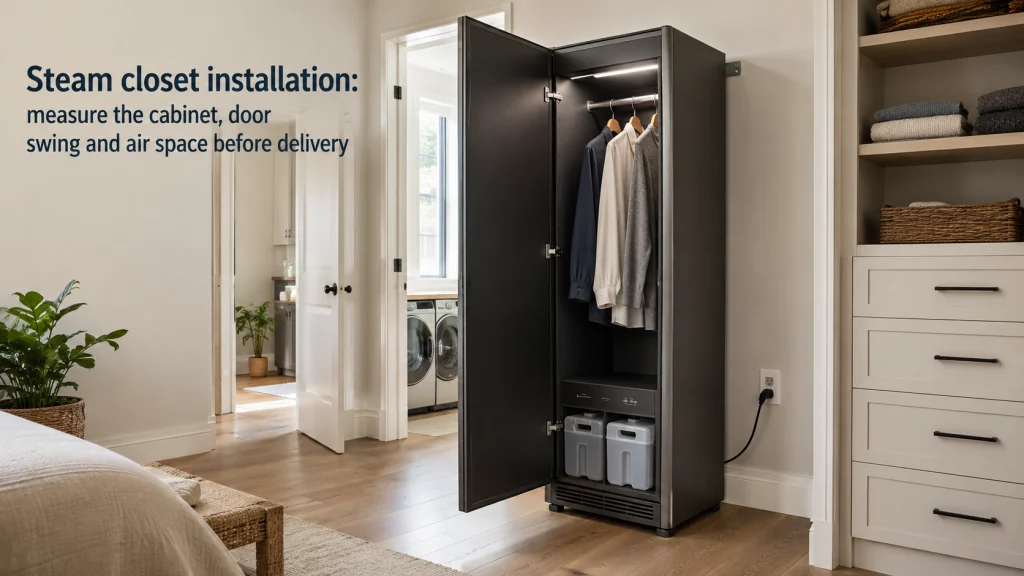
No plumbing does not mean no installation constraints
Steam closet installation starts with a useful correction: removable water tanks can eliminate a permanent water connection, but they do not eliminate placement requirements. A tall cabinet still needs room to arrive upright, stand level, open its door, breathe around the cabinet, reach a suitable outlet, and stay stable when the door is loaded or pulled. Manufacturer instructions vary enough that one brand’s clearance numbers should never be borrowed for another model. The exact manual matters before the room starts to look “close enough.”
This page is about buyer-level location planning, not electrical modification, carpentry, or internal appliance work. If the chosen location would require a new receptacle, circuit changes, wall alterations, nonstandard anchoring, or another task outside the owner instructions, stop at that boundary and use the appropriate qualified installer or electrician. That distinction keeps a simple placement check from turning into improvised installation work. For the broader question of what this appliance type does and where it fits in garment care, the steam closet overview covers the category without replacing the model-specific installation manual. A steam closet is one of the larger garment care products, so placement, power, access, and installation limits belong in the buying decision before features do.

HOTO pocket-size laser measure reaches up to 98 feet and supports feet, meters, and inches. The listing specifies ±2 mm accuracy, an OLED display, and USB-C recharging. It is compact for checking cabinet clearances, door swing space, and the room around a no-plumbing steam closet.
Check On AmazonIf you click this link and buy, we earn a commission at no additional cost to you.
Pull the exact installation manual before measuring the room
Do not begin with a tape measure and a generic product photo. Begin with the model number you are actually considering, then pull its current installation or owner’s manual from the manufacturer’s support page. That document separates cabinet dimensions from operating or service clearance, floor conditions, power, and enclosed-placement ventilation. It also shows when a seemingly flexible feature, such as a reversible door, is installer-only.
The value of model-specific documentation becomes obvious when current instructions are compared. Samsung’s US AirDresser installation guidance lists a 17-inch width, 72-inch height, 29-inch depth, plus its own top, side, and rear clearances, while GE’s PFH18 manual gives a different cabinet depth and a different set of recommended clearances. LG Styler support guidance likewise stresses a flat, sturdy surface and suitable space around the cabinet. These numbers are not interchangeable, so steam closet placement should follow the exact ordered model’s manual.
Record cabinet size, weight, and operating clearances
Cabinet width, height, and closed-door depth are only the first line of the measurement sheet. Add the unit’s weight, door-open depth, required space in front, required top and side clearances, rear clearance, outlet location, and any service-access allowance stated by the manufacturer. GE’s PFH18 instructions, for example, list a cabinet about 17 1/2 inches wide, 23 inches deep, and 72 13/16 inches high, with a door-open depth of 39 3/4 inches and a net weight of 172 pounds. The same manual recommends substantially more free space around the appliance than the bare cabinet dimensions alone would suggest.
That is why a floor rectangle is a poor substitute for a real fit check. A niche can be wide enough for the body yet still fail because a shelf blocks top clearance, molding steals side space, the open door crosses a walkway, or the power cord cannot reach the approved outlet position. Record the actual room measurements next to the manual requirement instead of keeping them in separate notes. The table below turns that comparison into a pre-delivery worksheet rather than a memory exercise.
| Measurement or requirement | Exact model requirement | Your location | Pass check |
|---|---|---|---|
| Cabinet width, height, and depth | Copy from manufacturer documentation | Measure the finished opening and trim | Required cabinet space is available |
| Door-open depth and swing | Use the door-open dimension or swing drawing | Measure nearby walls, doors, and furniture | Door opens without collision |
| Top, side, and rear clearance | Copy each clearance | Measure to shelves, walls, and trim | Required air and service space remains |
| Weight and floor condition | Use listed weight and leveling rules | Confirm a solid, level location | Floor meets the manual |
| Power and outlet position | Copy voltage, grounding, circuit, and reach rules | Verify the existing receptacle | Plug reaches the approved outlet |
| Enclosed-location ventilation | Copy closet or built-in vent requirements | Check door and enclosure openings | Ventilation matches the manual |
Keep this sheet with the delivery information and recheck it against the final model number before purchase. If a seller substitutes a finish, width class, or updated model number, do not assume the same measurements survived the change. A few minutes of rechecking is cheaper than discovering that a tall, heavy appliance fits the floor mark but not the space it needs to operate. The worksheet should end with a clear pass or a clearly identified problem, not “probably.”

The STANLEY 33-425 is a 25-foot tape measure in a chrome case. Its physical blade is useful for checking cabinet width, depth, trim, and nearby obstacles where a laser may be awkward. The compact format supports repeat measurements when filling out the pre-delivery clearance worksheet.
Check On AmazonIf you click this link and buy, we earn a commission at no additional cost to you.
Measure the delivery path, turns, doorways, and final door swing
The final location can fit perfectly while the appliance still cannot reach it. Measure the narrowest doorway, hallway pinch point, stair landing, elevator opening, and any turn where a tall cabinet has to change direction. Use shipping or packaged dimensions when the manufacturer or delivery provider supplies them, because the carton can be meaningfully larger than the installed cabinet. Also ask whether the unit must remain upright during the move, since current GE guidance specifically instructs movers to keep its Fabric Care Closet upright.
Then repeat the exercise at the final position with the appliance door open. Door swing can conflict with a room door, closet return, vanity, laundry machine, bed, shelving, or the aisle a person needs while loading garments. A reversible door can solve that conflict only when the exact model supports reversal and the prescribed procedure is followed. GE’s PFH18 documentation, for example, treats door reversal as installer work, so a buyer should plan that option before the unit is wedged into a tight location rather than assuming the hinge can be swapped later.

A 165-foot green-beam laser distance measure designed for fast indoor and jobsite measurements. The bright green laser improves visibility compared with standard red beams, while the color display keeps readings easy to check. It supports straightforward distance measuring in a compact handheld format and provides a longer working range than the Bosch GLM100-23 it replaces.
Check On AmazonIf you click this link and buy, we earn a commission at no additional cost to you.
Verify a level, manufacturer-approved floor before delivery
A tall garment-care cabinet is not a lightweight closet organizer, and leveling affects both stability and vibration. GE specifies a solid floor that can support the appliance and limits how much slope can exist under the unit before proper leveling becomes impossible. Samsung also calls for a solid, level surface and provides leveling feet as part of the setup process. LG’s support guidance similarly warns that an uneven installation can create vibration and tipping risk, which is a good reminder that “the floor looks flat” is not a measurement.
Carpet deserves its own manual check because instructions are not universal. GE provides model-specific carpet setup directions involving rear leveling feet and warns about moisture reaching carpet, while another model may impose different conditions or restrictions. Do not improvise a platform, shim stack, or soft base simply because it makes the cabinet look straight. The right owner-level step is to compare the actual floor with the exact model instructions, then hand off any structural floor work that falls outside those instructions.

The Klein Tools 935DAG can function as a digital level and measures 0 to 90 degrees and 0 to 180 degrees. Its magnetic base can attach to ferromagnetic surfaces, and the display is designed for high visibility. It helps verify whether the intended floor or reference surface is level before delivery.
Check On AmazonIf you click this link and buy, we earn a commission at no additional cost to you.
Verify grounded power and cord reach without extension-cord improvisation
“Standard outlet” is not enough information to approve a location. Check the exact voltage, frequency, grounding requirement, circuit guidance, outlet accessibility, and permitted cord reach in the model’s manual. GE’s PFH18 instructions call for a grounded 120-volt, 60-Hz supply on a properly rated circuit and state that the appliance should use its own outlet; the installation section also places the grounded receptacle within a defined distance of the cabinet. Samsung’s US AirDresser setup likewise specifies a grounded 120-volt, 60-Hz outlet.
Do not solve a bad location with an extension cord, altered plug, improvised adapter, or a receptacle modification. GE explicitly warns against using an extension cord and says the ground prong must not be removed, which is the kind of instruction that should end the discussion rather than start a workaround search. If the existing outlet does not satisfy the model instructions, the placement has failed until a qualified electrician provides a compliant solution. The buying decision should follow the electrical reality of the room, not ask the room to become electrically convenient after delivery.

The Klein Tools RT210 tests standard North American AC receptacles and GFCI outlets. It is designed to detect common wiring problems through its outlet-test indication. Use it only as an owner-level check of an existing receptacle, not as a substitute for the model manual or a qualified electrician.
Check On AmazonIf you click this link and buy, we earn a commission at no additional cost to you.
Check ventilation for open-room and enclosed placement
An open laundry area and a closed closet are not the same installation environment. A manufacturer may require general clearance around the cabinet and then add separate rules for a recessed or enclosed location because heat and moisture need a path out. GE’s PFH18 manual is a clear example: it provides normal surrounding clearances and also specifies ventilation openings for a closet with a door. That is why deciding where to put a steam closet cannot be reduced to one universal side-clearance number.
Use the checklist below to separate the two situations before choosing a room. A wall-facing placement still needs the model’s side, rear, top, and front space, while a closed enclosure may add vent-opening requirements that a solid door does not meet. Do not copy GE’s vent sizes onto a different model, and do not assume a louvered door is automatically sufficient without checking the exact instructions. The goal is not maximum air space for its own sake; it is the specific environment the manufacturer has approved for that cabinet.
- Open-room placement: verify cabinet clearances, door swing, floor level, outlet access, and unobstructed ventilation openings on the appliance.
- Recessed placement: verify the manual’s minimum side, rear, top, and front spacing plus service access around trim and moldings.
- Enclosed closet with a door: verify every required upper and lower vent opening, not just the room’s overall size.
- Built-in-looking cabinetry: treat appearance as secondary to the installation drawing and keep required air paths, clearances, and service space intact.
If the enclosure only works after covering a vent, shaving a clearance, or depending on a permanently open door, it is not a clean pass. Either change the location, change the enclosure in a way the manufacturer’s instructions permit, or choose a model whose documented requirements actually match the available space. This is one of the places where “no plumbing” creates the wrong mental shortcut. Air and service space can be the real limiting utilities even when water lines are absent.

The Komelon SL2825 has a 25-foot blade with a self-locking mechanism and push-button retraction. Its nylon-coated blade is housed in an impact-resistant ABS case with rubber overmold. It is a practical measuring tool for checking vent openings, surrounding clearances, and enclosure dimensions against the exact manual.
Check On AmazonIf you click this link and buy, we earn a commission at no additional cost to you.
Check ambient temperature, sunlight, and moisture restrictions
A garage corner, bathroom alcove, sunroom, or other marginal space can look attractive because it keeps a tall appliance out of the main living area. The manual may reject that location for reasons that have nothing to do with floor dimensions. GE’s PFH18 instructions set an operating-location temperature range, warn against exposure to water or weather, and prohibit a wet or damp installation area. Samsung’s US guidance also gives an ambient temperature range and warns against very hot or cold locations and direct sunlight.
Treat those limits as location requirements, not performance trivia. A space that freezes, overheats, gets splashed, traps heavy moisture, or sits in strong direct sun may fail even when the cabinet physically fits. If the manual gives a temperature range, compare it with the actual room conditions across normal household use rather than the temperature during one pleasant afternoon. Steam closet placement is approved by the worst ordinary condition the room reaches, not by the best moment in it.

The TempPro TP50 combines an indoor thermometer and hygrometer in one compact monitor. It shows temperature and humidity so you can observe the actual room conditions around a proposed steam-closet location. That is useful when comparing garages, bathrooms, sunrooms, or other marginal spaces with the model's allowed environment.
Check On AmazonIf you click this link and buy, we earn a commission at no additional cost to you.
Plan refill, drain-tank, shelf, and hanger access
Removable water tanks are exactly why many steam closets do not need plumbing, but they also create a recurring access task. Make sure the final location leaves enough room to open the main door fully, remove the supply and drain tanks, carry them without scraping walls, and wipe up small drips without crawling into a corner. Samsung’s current support material shows separate refill and drain tanks, and GE likewise places its water supply and drain tanks in the lower cabinet area. A tight location can make every refill or emptying cycle awkward.
Think about internal parts in the same way. Shelves, hangers, pants-care parts, and drip trays may need removal or cleaning, so the owner needs working room in front of the cabinet. This matters most when a steam closet sits in a narrow dressing area where another door or drawer occupies the same aisle. After installation, operating technique belongs in a separate how to use a steam closet article; before purchase, your job is simply to prove that the routine can happen without a daily wrestling match.

These Amazon Basics microfiber cleaning cloths measure 16 by 12 inches and come in a 24-pack. The listing describes them as absorbent, lint-free, streak-free, non-abrasive, reusable, and washable. They are useful for wiping small drips around removable supply and drain tanks during routine access.
Check On AmazonIf you click this link and buy, we earn a commission at no additional cost to you.
Follow anti-tip and anchoring instructions exactly
Stability is not the place to substitute hardware because another bracket looks similar. GE’s PFH18 manual says not to operate the unit without its anti-tip device installed and engaged, and it directs the installer to use the anti-tip device supplied with the appliance. Samsung’s US installation guidance also describes securing the AirDresser with its anti-tip strap when needed. The exact requirement, hardware, attachment point, and installation method therefore belong to the model documentation, not to a generic wall-anchor rule.
If the prescribed attachment requires wall or floor work that you cannot perform within the owner instructions, make that an installer task. Do not defeat the device because the chosen wall is inconvenient, shorten a strap, substitute a random fastener, or place the cabinet where the anti-tip hardware cannot be used as required. The location is only viable when the stability instructions can be completed correctly. A beautiful alcove that blocks required anchoring is a failed placement, not an invitation to improvise.

The Franklin Sensors ProSensor M210 uses 13 sensors to detect wood and metal studs and includes live-wire detection. Its LED display shows the full width of detected studs, helping identify wall structure before any permitted anchoring work. Follow the steam closet's supplied anti-tip hardware and exact installation instructions rather than substituting generic fasteners.
Check On AmazonIf you click this link and buy, we earn a commission at no additional cost to you.
Check reversible-door options only when the exact model supports them
Door reversal can rescue an otherwise good location, but it should be treated as a documented feature rather than an assumption. Some cabinets support it, some require a separate kit, and the procedure may be installer-only. GE’s PFH18 manual states that its door swing can be reversed but warns the owner not to attempt the reversal and directs the work to the installer. That makes the decision useful before delivery because the correct parts and labor can be planned while access is still easy.
Do not rely on a photo showing hinges on the opposite side or a retailer bullet that says “reversible” without checking the exact variant. Finish, region, generation, or model changes can alter the hardware and instructions even within one product family. If door reversal is what makes the location pass, verify it before ordering and treat the reversal process as part of installation planning. If the exact model does not support it, relocate the appliance or choose another model rather than inventing a hinge conversion.
Use pass, relocate, or choose-another-model outcomes
A good pre-purchase check should end in a decision, not a longer list of doubts. Start with the delivery route and final operating footprint, because a failure there usually means the current location is not viable before power or feature questions matter. If the route and footprint pass, move through floor, environment, ventilation, power, tank access, door operation, and anti-tip requirements in sequence. The first failed gate tells you whether to relocate the same model or choose another model instead of negotiating with a requirement.
A failed gate does not always mean the appliance itself is wrong. If another wall or room satisfies the same model’s documented requirements, relocate it and repeat the checks from the top; if the location is fixed and the model cannot pass, move to a different model with requirements that fit the space. If the reason for buying is still uncertain, the decision framework in are steam closets worth it can help separate a real garment-care need from a placement problem you are trying too hard to justify. The table below works as a sequential decision tree rather than three isolated outcome labels.
| Decision gate | If it passes | If it fails |
|---|---|---|
| 1. Can the exact model travel through the delivery route and fit the final operating footprint with the required door swing and clearances? | Continue to the location requirements. | Try another location. If the location is fixed, choose another model. |
| 2. Does that location meet the floor, ambient-condition, ventilation, grounded-power, tank-access, and anti-tip requirements in the exact manual? | Continue to the final model check. | Relocate if another location can meet every requirement. Do not loosen a requirement to make the location pass. |
| 3. Does the final order model still match the dimensions, door configuration, electrical requirements, and installation rules on the worksheet? | Pass. Keep the worksheet for delivery and setup. | Recheck the changed model. If it cannot pass the fixed location, choose another model. |
Treat these as pre-purchase requirements, not tolerances to negotiate on delivery day. A failed first or second gate sends you back to relocation before it sends you toward a different model, unless the location itself is fixed. When a number is close, remeasure the finished surface and include baseboards, trim, handles, nearby doors, and the real path of the power cord. A clean pass should be easy to explain gate by gate from the manual and the room measurements.
Recheck current model dimensions before purchase
Steam closets are still a relatively small appliance class, so a buyer may encounter older retailer pages, refreshed models, and similar-looking variants with different specifications. Reopen the manufacturer’s current support page immediately before purchase and verify the complete model number against your worksheet. Then recheck cabinet dimensions, weight, clearances, outlet requirements, ventilation rules, floor instructions, anti-tip requirements, and any door-reversal notes. Retailer dimensions are useful as a cross-check, but they should not override the installation manual when the two disagree.
Only after that fit check should you compare current steam closet options on features, capacity, garment-care programs, or price. This sequence prevents a premium feature list from distracting from a cabinet that cannot be installed correctly in the intended room. Once the unit is delivered, follow the exact manual for setup and leave electrical or structural changes to the appropriate professional. The purchase is ready when both the appliance decision and the location decision pass independently.

The LEXIVON LX-201 combines a 130-foot laser distance meter with a 16-foot auto-lock tape measure. Measurements appear on a backlit LCD and can be shown in feet, inches, fractions, meters, or millimeters. The dual measuring methods make it useful for rechecking both long room spans and close cabinet clearances before purchase.
Check On AmazonIf you click this link and buy, we earn a commission at no additional cost to you.
Final thoughts: verify the route, ventilation, and power before treating no-plumbing as easy placement
The practical advantage of a tank-fed steam closet is real: you may not need a permanent water connection. That convenience does not erase the tall cabinet, the heavy move, the door swing, the floor requirement, the air space, the outlet, or the stability hardware. Measure those items against the exact manual before you buy, and include the route into the house rather than only the final footprint. A location is good when it works for delivery, installation, operation, and routine access.
If any one of those checks fails, do not compensate by narrowing a required clearance, using an extension cord, ignoring anti-tip instructions, or assuming another model’s setup rules apply. Relocate the unit, choose a model that fits the fixed space, or bring in the appropriate installer when the manual places the work outside owner-level setup. That approach is less exciting than picking the finish first, but it is far more likely to produce a steam closet that actually belongs where you planned to put it. The best pre-delivery result is boring: the cabinet arrives, follows the measured route, and lands in a location that was already proven.
FAQs
🚰 Does a steam closet need plumbing?
Many floor-standing steam closets use removable supply and drain tanks, so they do not need a permanent water hookup. That does not remove clearance, ventilation, electrical, leveling, access, or anti-tip requirements, so check the exact model manual before choosing a location.
📍 Where should I put a steam closet?
Use a manufacturer-approved location with a solid level floor, required clearances, grounded power, acceptable ambient conditions, and room to service the water tanks. If you want to place it inside an enclosed closet, verify the model’s separate ventilation rules.
🔌 Can I use an extension cord to install a steam closet?
Do not assume so. Current GE instructions explicitly prohibit an extension cord, and the exact manual should control the electrical setup for any other model. If the approved outlet is not within reach, treat that as an electrical-location problem rather than an excuse to improvise.
🚪 Can the steam closet door be reversed?
Only when the exact model supports door reversal. Some models require a specific kit or installer procedure, so verify the model number and instructions before counting on reversal to solve a tight door swing.
🧱 Can I put a steam closet on carpet?
Some models provide carpet-specific setup instructions, but that is not a universal approval. Check the exact manual for leveling feet, drip-tray access, moisture precautions, and any carpet restrictions before treating the location as acceptable.
🌡️ Can a steam closet go in a garage?
Only if the exact model permits the actual temperature, moisture, and weather exposure of that garage. Manufacturer instructions can set temperature limits and prohibit wet, freezing, or weather-exposed locations, so a garage needs the same manual-based check as an indoor room.
References and sources
- GE Fabric Care Closet owner’s guide and installation instructions: verifies dimensions, clearances, floor, power, ventilation, door reversal, and anti-tip requirements.
- Samsung AirDresser installation support: verifies dimensions, clearances, leveling, ambient conditions, power, and anti-tip guidance.
- LG Styler reinstallation tips: supports floor and surrounding-space requirements.
- LG Styler model support page: confirms the current exact-model documentation path.