A steam closet can be worth its floor space when your household repeatedly refreshes lightly worn suits, jackets, dresses, coats, knits, or similar garments between washes. The useful question is how much manual steaming, gentle drying, odor refreshing, and garment handling it removes from your routine. It is a weak buy when most clothing goes straight to the washer or a handheld steamer already handles the few pieces that need attention. Count eligible garments, realistic loads, waiting, placement, maintenance, and the actual purchase price before deciding.
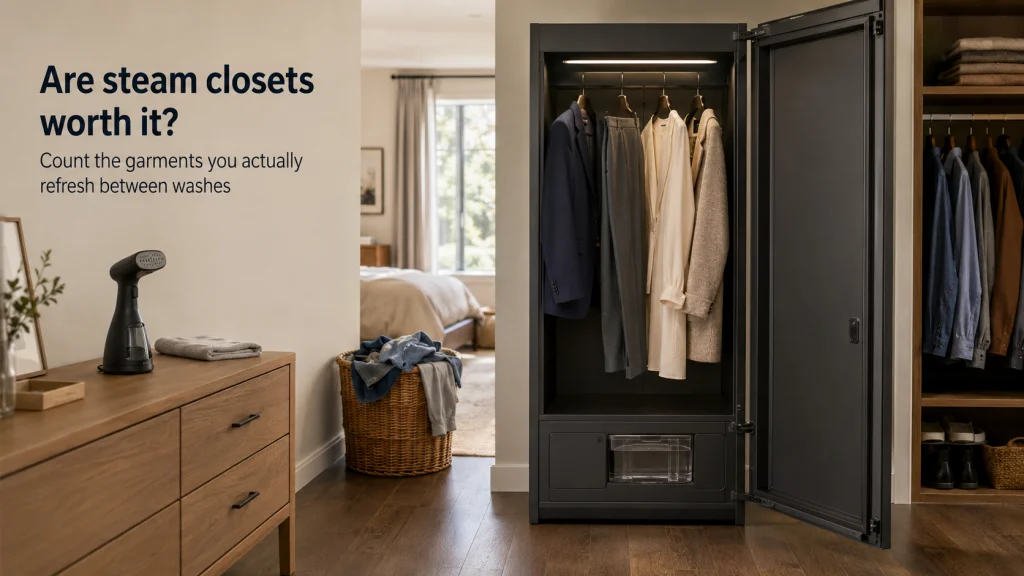
Are steam closets worth it? They can be when hands-off refreshing replaces work you already do often. A mirrored door, app control, and long cycle menu do not matter if the household rarely has lightly worn clothes that need steaming, airing, gentle drying, or similar care. Start with those garments, not the feature list. A small recurring pile points to a very different decision from an occasional one.
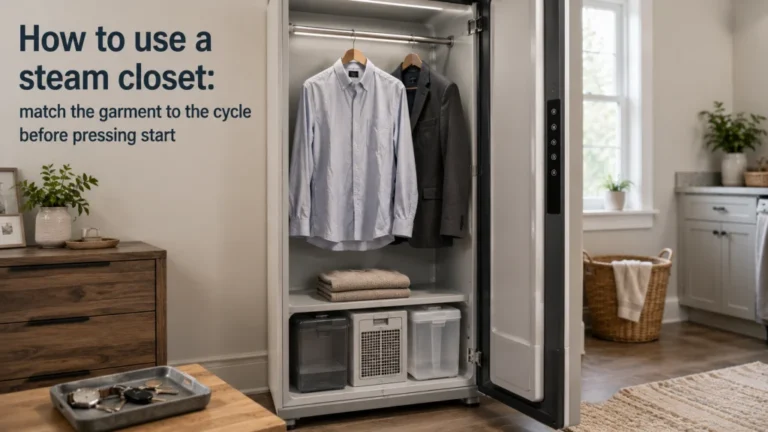
A steam closet is a refresh appliance, not a washer, stain remover, or universal pressing machine. Steam, warm air, moving hangers, shelves, and crease-care functions can reduce odors, relax some wrinkles, and gently dry compatible items, but results depend on fabric, loading, cycle, and model. Give the cabinet value only for tasks it can realistically take over. If the appliance class is still unfamiliar, start with steam closet requirements and ownership basics. A steam closet therefore belongs among garment care products only when its refresh workflow replaces enough recurring hands-on work to justify the footprint.
Define worth as repeated work removed, not feature count
Judge the cabinet by the chores it reduces, not by the number of functions on the control panel. Refreshing a jacket without holding a steamer is real work reduction; an app notification for a cycle you rarely run is not. A pants-crease feature matters only if dress trousers actually pass through your routine often enough to use it. Frequency gives features their value.
Start with tasks you already perform or postpone because they are annoying. Separate full removal from partial relief because loading, waiting, unloading, tank care, and occasional touch-up can remain. A useful function in one wardrobe can be irrelevant in another. That is also the practical way to ask whether clothing care closets are worth it for your household.
| Current task | How often it happens | Can the cabinet help? | Work that may remain |
|---|---|---|---|
| Refresh a lightly worn jacket | Record your real frequency | Often, if the care label and cycle are compatible | Load, wait, unload, return to closet |
| Steam light wrinkles | Record your real frequency | Sometimes, especially for softer wrinkles | Crisp pressing or spot touch-up may remain |
| Dry a delicate item gently | Record your real frequency | Often on compatible gentle-dry cycles | Longer cycle time and careful loading |
| Deal with stains or actual soil | Record your real frequency | No, not as a substitute for cleaning | Washing or professional care still remains |
What matters is how many recurring touchpoints become easier enough to change your behavior. A function used several times a week can matter more than five rarely used features. Count only work that genuinely disappears or becomes hands-off. That gives you a household-use threshold instead of a feature score.

The 1875-watt steamer heats in about 40 seconds and uses a 7.3-ounce water tank for up to 20 minutes of continuous steam. Its heated aluminum plate and built-in creaser can smooth wrinkles and help define creases. Three included attachments cover delicate fabrics, heavier fibers, and fabric tensioning.
Check On AmazonIf you click this link and buy, we earn a commission at no additional cost to you.
Count lightly worn garments that need refreshing rather than washing
Focus on clothes that sit between clean and dirty. A blazer worn for a short dinner, trousers used for a few hours, a dress carrying food odor, or a stale coat can create a refresh task without needing a full wash. Those pieces can generate repeat cabinet use. Gym clothes, stained shirts, and ordinary washable loads usually do not because they still need normal cleaning.
Count by week and look for a stable pattern. Several refresh-ready pieces across most weeks create a different workload from two pieces occasionally. Do not count every delicate item you own if you rarely wear it. What matters is clothing moving through the routine, not the size of the closet.
| Garment group | Pieces worn | Usually washed? | Usually refreshed? | Likely cabinet cycles |
|---|---|---|---|---|
| Suits, blazers, dress trousers | Fill in | Yes / no / sometimes | Yes / no / sometimes | Estimate from compatible pieces per load |
| Dresses, skirts, delicate tops | Fill in | Yes / no / sometimes | Yes / no / sometimes | Estimate conservatively |
| Coats and jackets | Fill in | Yes / no / sometimes | Yes / no / sometimes | Allow extra space for bulky items |
| Washable casual clothing | Fill in | Usually | Rarely | Often little or no cabinet demand |
Count only garments that actually enter a care routine. If most rows end in the washer, the cabinet is competing with a process that already works. If repeat-wear pieces accumulate because nobody wants to steam them, the case becomes stronger. Frequency is the first filter against buying a large appliance for occasional use.

This 50-pack includes slim velvet-coated hangers with notched shoulders that help keep garments from slipping. Each metal-core hanger is rated to hold up to 10 pounds and measures about 17.24 by 9.06 by 0.24 inches. Amazon lists the set for shirts, blazers, slacks, and other hanging garments.
Check On AmazonIf you click this link and buy, we earn a commission at no additional cost to you.
Separate wrinkle release from crisp pressing and stain removal
Steam can relax fabric without creating the sharp finish of an iron or press. Independent cabinet testing has shown useful improvement on some light creases and weaker results on heavier wrinkles, especially when garments are crowded or resistant to relaxation. Stains are a separate problem. If a shirt needs soil removal, spot treatment, washing, or professional cleaning, a refresh cycle does not remove that work.
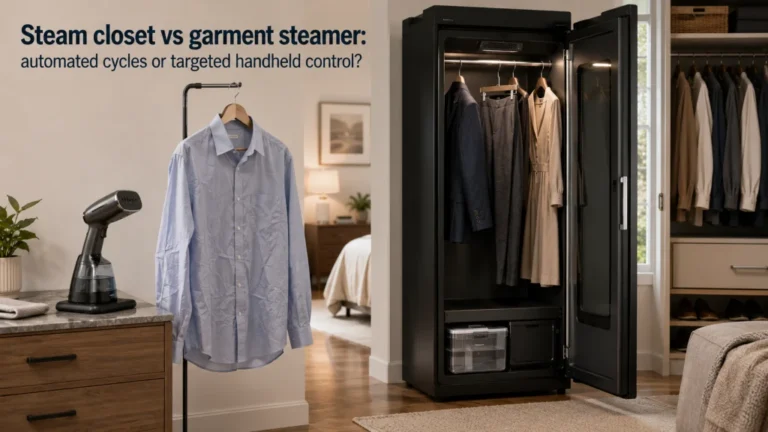
First-time buyers can easily overvalue the category by imagining one machine that refreshes odor, removes deep wrinkles, restores sharp creases, and returns every garment event-ready. A better expectation is hands-off refreshing with variable wrinkle improvement. If your main frustration is last-minute wrinkle removal, compare the trade-offs in steam closet versus garment steamer. The finish you actually accept matters more than the best-looking marketing photo.
- Good fit: light wrinkles, stale odors, gentle drying, and compatible repeat-wear garments.
- Partial fit: dress shirts and trousers where softer wrinkle release is acceptable.
- Poor fit: stains, heavy soil, deep creases, or items that conflict with the selected cycle.
Give the cabinet only the credit it earns. If a quick iron is still needed before every important wear, keep that touchpoint in the ledger. If the cabinet makes an everyday jacket wearable again without active steaming, count that as a real gain. The distinction keeps the value calculation realistic.

This 1725-watt steam iron uses a stainless-steel soleplate with more than 400 active steam holes for broad distribution. It provides variable steam, a steam boost for stubborn creases, and a precision tip for collars, seams, and other tight areas. Anti-drip, anti-calc, self-cleaning, and automatic shutoff functions support regular garment care.
Check On AmazonIf you click this link and buy, we earn a commission at no additional cost to you.
Count manual steaming and dry-cleaning touchpoints without assuming they vanish
Manual steaming is easy to count because the work is visible: fill the steamer, wait for heat, work across the garment, then cool or empty the tool. A cabinet can remove much of that hand motion when the task repeats. Sorting, care-label checks, loading, waiting, unloading, and occasional touch-up still remain. That trade can be worthwhile when active steaming is the main annoyance.
Dry cleaning needs more restraint because refreshing is not the same as cleaning. Stains, garment construction, pressing requirements, and care labels can still require professional care. If reducing those visits is central to the purchase, review steam closet and dry-cleaning limits before assigning savings to the cabinet. Count only care you can realistically avoid after seeing acceptable results on your own garments.
Key point: Do not invent a savings figure or a universal time-saving claim. A cabinet can free your hands while the cycle runs, but it does not make elapsed time disappear.
The timing question is whether the machine can work while you do something else. A longer hands-off cycle can fit well when garments are loaded in advance, but it can feel slow when a shirt needs attention immediately. Give the cabinet credit for unattended care only when that timing matches your routine. Otherwise, active steaming may still be the faster solution.

This 1000-watt handheld steamer heats in about 30 seconds and folds down for compact storage. Its 5.08-ounce removable water reservoir supports vertical or horizontal steaming with an electronic pump system. The 120-volt design is intended for use in the United States and Canada.
Check On AmazonIf you click this link and buy, we earn a commission at no additional cost to you.
Convert garment count into realistic cabinet cycles
Hanger count looks simple until real garments take up shoulder width and depth. One current narrow cabinet lists three clothes hangers, while a larger current cabinet is designed around five moving hangers. Do not assume every load should fill every stated slot. Bulky coats, long dresses, shelves, and crease-care accessories can reduce practical capacity.
Translate the worksheet into loads, not pieces. Several jackets may need more than one cycle even when nominal hanger count looks sufficient. If the weekly workload is only two compatible pieces, the cabinet may handle them easily but sit idle most of the time. Capacity matters when it reduces batching enough to change the routine.
| Your weekly refresh load | Likely ownership effect | What to verify |
|---|---|---|
| One or two light garments | Low cabinet utilization | Whether a handheld steamer already solves the task |
| Several compatible garments | Potentially useful repeat workflow | Actual fit per load, not hanger-slot count alone |
| Bulky coats or long garments | Capacity can shrink quickly | Interior height, depth, shelf use, and garment spacing |
| Mixed fabrics and care needs | More sorting and separate cycles | Cycle compatibility for each item |
Bigger is not automatically better. A wider cabinet can reduce batching but consumes more floor area and can be harder to place. A smaller cabinet may fit better when refresh volume is modest. Choose the smallest capacity that handles recurring loads without creating a queue.

This 30-pack uses slim velvet-coated hangers with notched shoulders to help prevent garments from slipping. Each metal-core hanger is rated to hold up to 10 pounds and measures 17.24 by 9.06 by 0.24 inches. Amazon lists the set for shirts, blazers, slacks, and other hanging garments.
Check On AmazonIf you click this link and buy, we earn a commission at no additional cost to you.
Add cycle waiting and your real set-it-and-return-later behavior
Hands-off does not mean instant. One current cabinet advertises a quick refresh in about twenty-two minutes, while deeper refresh, drying, or specialty cycles can take longer. That works when garments are loaded before they are needed. It is less helpful when the normal pattern is noticing a wrinkled shirt just before leaving.
Think in routines rather than timers. A cabinet beside the clothes it serves can be loaded, left to run, and emptied later with little friction. The same cabinet far from normal clothing storage adds trips and retrieval effort. Elapsed cycle time is only one part of the waiting cost.
- Do you usually know the night before which garments need refreshing?
- Can the cabinet run while you are doing something else?
- Will you remember to unload it and return garments to their normal storage?
- Does your routine often require immediate wrinkle correction instead?
If those answers favor advance planning, slow-but-hands-off care can be convenient. If garment-care problems are mostly urgent, active tools may remain faster despite requiring your attention. Judge the cabinet by whether its timing fits the household, not by a cycle-time comparison on paper. That distinction matters more than a fast-cycle label.

This freestanding garment rack uses an alloy-steel frame and measures about 71.65 inches wide by 60.67 inches high. Its rolling design and listed 110.2-pound load capacity provide temporary hanging space for garments waiting to be loaded or returned to storage. The rack uses a tool-free speed-lock assembly and caster wheels for mobility.
Check On AmazonIf you click this link and buy, we earn a commission at no additional cost to you.
Add floor footprint, door access, outlet placement, and noise
A steam closet is narrow compared with many full-size appliances, but it is still a tall, heavy cabinet with a permanent footprint. One current narrow model is about 17.5 inches wide, 72.75 inches high, and 23 inches deep; a larger model is roughly 23.6 inches wide, more than 77 inches high, and about 24.4 inches deep. Those figures do not include every required clearance or door-opening space. Safe leveling, anti-tip setup where specified, delivery access, and the correct grounded outlet also matter.
Placement changes how often the cabinet gets used. A unit beside the clothes it serves can join the repeat-wear routine, while the same machine across the house adds trips. Noise also matters near bedrooms or work areas because fans, pumps, steam generation, and moving hangers can be noticeable. One current cabinet lists a 40 dBA quiet rating, although room acoustics and loading still affect what you hear.
Key point: Measure the cabinet body, required clearances, door path, delivery route, outlet location, and access needed for tanks or filters. A narrow appliance is not automatically an easy fit.
If placement is uncertain, check the exact model instructions before buying. A cabinet is harder to justify when it blocks a walkway, crowds a door, or requires moving objects before use. Use the steam closet installation requirements for the full placement check. Prove floor-plan fit with the actual model rather than width alone.

This 25-foot tape measure provides 14 feet of reach and uses large markings for easier reading. The high-impact case has a nonslip rubber grip, while full-blade coating and BladeArmor reinforce the tape for repeated use. It is a practical tool for checking cabinet width, door path, clearance, and nearby outlet placement before installation.
Check On AmazonIf you click this link and buy, we earn a commission at no additional cost to you.
Add tank, filter, and interior care to the convenience ledger
A no-plumbing design moves water handling to the owner. Removable supply and drain tanks mean filling clean water and responding when a tank is empty, full, or misseated. One manufacturer’s guidance says its drain tank typically needs attention after about three cycles. Another current support page lists tanks around 1.7 and 1.8 liters, making water handling a normal ownership task.
Filters and interior surfaces add smaller recurring jobs. Instructions can call for lint-filter cleaning, tank cleaning, interior wiping, and leaving the door open after a cycle so moisture can escape. Some systems also use aroma holders or dedicated cleaning cycles. These jobs belong in the value calculation because skipped care can reduce convenience later.
- Use the water type specified for the exact model.
- Empty the drain tank when indicated and never defeat a full-tank warning.
- Clean accessible filters using the method in the manual.
- Wipe and dry accessible interior areas as instructed.
- Use qualified service for damaged cords, smoke, burning odor, electrical faults, or leaking into electrical areas.
Space and upkeep ownership check: The cabinet should have a permanent location with verified clearances, a workable door path, a compliant outlet, and easy access to the garments it serves. Supply tank, drain tank, filters, and interior surfaces should also be reachable without moving furniture or turning routine care into a project.
If the only available location is inconvenient or tank and filter access already sounds irritating, treat that as ownership cost. Convenient placement supports repeat use; awkward access can turn a capable cabinet into one you avoid.
If tank and filter care feels minor in the location you measured, it will probably stay minor. If you already resent filling and emptying water-based appliances, count that honestly. Upkeep should fit the same routine that makes hands-off refreshing useful. The cabinet only helps when it remains ready to use.

These microfiber cloths measure 16 by 12 inches and come in a 24-pack of blue, white, and yellow cloths. The material is non-abrasive and can be used dry or with liquid cleaners for lint-free, streak-free wiping. The cloths are machine washable and reusable for routine surface cleaning where the appliance manual permits wiping.
Check On AmazonIf you click this link and buy, we earn a commission at no additional cost to you.
Add the actual purchase price, warranty, service access, and longevity risk
Steam closets remain a four-figure appliance class, so use the real checkout price for the exact model you can buy. Add delivery, placement work, required accessories, and local service limitations. Do not invent a payback period from guessed cleaning bills or imagined time savings. Convenience can justify a purchase without financial payback.
Warranty and service matter because the cabinet contains pumps, heaters, fans, controls, moving systems, tanks, and sensors. Check written coverage, local service availability, parts support, and documentation for the exact model. A discount is less attractive when repair access is poor. A higher price is also harder to defend when your worksheet shows only occasional use.
Do not invent a universal lifespan. Decide how much uncertainty you will accept and how disruptive a failure would be. Frequent users have more reason to value parts and service. Occasional users should be more skeptical because the purchase cost is spread across fewer cycles.
Luxury can be useful without being necessary. Price should confirm a strong use case, not create one. A promotion cannot fix weak garment frequency, awkward placement, or maintenance you already know you will avoid. Treat a lower price as a better deal only after those conditions pass.
This 200-pack contains clear polypropylene sheet protectors sized for 8.5-by-11-inch letter documents. The top-loading sleeves are pre-punched for standard 3-ring binders, so receipts, warranty pages, manuals, and service records can be kept together without punching the papers. The clear finish keeps printed information visible while documents remain inside the sleeves.
Check On AmazonIf you click this link and buy, we earn a commission at no additional cost to you.
Turn wardrobe frequency and floor-space fit into buy, wait, or skip
Base the decision on the workflow you counted rather than the appliance you want to like. Add refresh-eligible garments, realistic loads, active hand work removed, tolerable waiting, and permanent space. Keep touch-up pressing, stains, professional care, tanks, filters, and retrieval in the same ledger. The result is a household fit judgment, not a feature score.
Use the three outcomes below without stretching your answers. The case is strongest when the cabinet sits near garments that already create recurring care friction and weakest when the household has to invent uses for it. The same check also shows when a smaller tool already solves enough of the problem. Follow the sequence in order.
- Do you repeatedly refresh lightly worn garments between washes?
- No: Skip.
- Yes: Check whether your current tools already handle the workload comfortably.
- Does a handheld steamer, iron, or existing routine already solve the problem with little friction?
- Yes: Skip.
- No: Check placement and upkeep.
- Can the exact cabinet stay in a convenient location with verified clearance, outlet, tank, and maintenance access?
- No or not yet: Wait.
- Yes: Check timing and finish expectations.
- Do hands-off timing and expected wrinkle release fit your routine?
- No or uncertain: Wait and track the real workload.
- Yes: Buying becomes reasonable.
This sequence keeps a premium feature list from deciding the purchase. Frequency comes first, real work reduction second, and room plus ownership fit third. Only then does buying become a credible household decision.
Buy when repeat-wear garment care is frequent and placement is easy
Buy when formal, delicate, outerwear, or repeat-wear pieces regularly need refreshing and the cabinet removes meaningful active handling. The best fit keeps the cabinet near garment storage and lets cycles run without urgency. You should also be comfortable with tanks, filters, and model-specific care.
Wait when placement, availability, or use frequency is still unclear
Wait if you like the idea but cannot prove a recurring workload. Waiting also makes sense when clearance, outlet access, door swing, delivery access, or local service is uncertain. Track real garments and steaming sessions instead of buying for imagined future use.
Skip when most clothes are washed or a handheld steamer already solves the problem
Skip if lightly worn garments rarely need anything between wearing and washing. Skip if your main need is crisp pressing, stain removal, or occasional steaming that a smaller tool already handles. The cabinet also loses its case when the available location is inconvenient enough to suppress use.

The 1100-watt steamer uses a 300-milliliter water tank and is rated for up to 20 minutes of continuous steam. Its handheld design supports vertical and horizontal steaming, and the product is intended for 110-120V power. The selected 5-white variant measures 10.8 by 4.7 by 6.2 inches and includes a fabric brush.
Check On AmazonIf you click this link and buy, we earn a commission at no additional cost to you.
If the cabinet earns its place, verify installation fit and the current market next
Once the use-frequency test says yes, move from appliance class to exact-model verification in the room you will use. Check width, height, depth, clearances, door configuration, delivery path, outlet requirements, weight, included hangers and shelves, cycle compatibility, tank access, and warranty before comparing extras. These details can change daily ownership more than app features, finish color, or a longer list of specialty cycles. A model that handles the right garments but does not fit the room is not a workable choice.
Availability can change, so avoid treating an old shortlist as permanent. Review the current steam closet market only after the buy-or-skip threshold is clear, then compare exact documentation rather than generic capacity labels. If the cabinet still looks right after installation and service checks, the purchase is grounded in a real routine. If those checks reopen doubts, waiting is cheaper than forcing a floor-standing appliance into the wrong household.

A 165-foot green-beam laser distance measure designed for fast indoor and jobsite measurements. The bright green laser improves visibility compared with standard red beams, while the color display keeps readings easy to check. It supports straightforward distance measuring in a compact handheld format and provides a longer working range than the Bosch GLM100-23 it replaces.
Check On AmazonIf you click this link and buy, we earn a commission at no additional cost to you.
Final thoughts: the cabinet earns its place only when refresh care repeats
A steam closet is easiest to justify when it solves a repeated garment-care problem that already exists. Count lightly worn pieces, convert them into realistic loads, and decide whether hands-off timing fits your routine. Include tanks, filters, floor space, service access, and actual price. Do not give it credit for washing, stain removal, crisp pressing, or professional care it cannot reliably replace.
If that routine is frequent and placement is convenient, buying can make sense. If the case depends on rare events, imagined savings, or future wardrobe changes, waiting is safer. A handheld tool may still be better when speed and occasional touch-up matter more than unattended care. Choose for the work you actually do now.

This 1600-watt steam iron uses a stainless-steel soleplate and separate controls for temperature and steam output. It includes an auto-clean system and automatic shutoff after unattended periods. The D3030 also supports vertical steaming for hanging garments and carries a two-year limited warranty.
Check On AmazonIf you click this link and buy, we earn a commission at no additional cost to you.
FAQs
👔 Is a steam closet worth it for suits?
It can be if suits are worn often enough to need regular refreshing between full cleanings. Count how many suit pieces you actually refresh and whether you accept light wrinkle release rather than a freshly pressed finish.
🧺 Can a steam closet replace washing clothes?
No. A steam closet is designed for refreshing, gentle drying, odor reduction, and related garment-care tasks, while stained or soiled clothes still need the appropriate cleaning method.
🧼 Does a steam closet replace dry cleaning?
Not completely. Some garments may stay wearable longer between professional cleanings, but stains, pressing needs, construction, fabric requirements, and care labels can still require professional care.
⏱️ Are steam closets good for last-minute wrinkles?
Usually not as the fastest option. Even quick cabinet cycles take time, and the finish may still need touch-up if you want sharp creases or crisp pressing.
📏 How much space does a steam closet need?
Use the exact model dimensions plus its required top, side, rear, and front clearances. Also measure the delivery path, door opening, outlet location, and access needed for tanks and filters.
💧 How much maintenance does a steam closet need?
Expect recurring water-tank, drain-tank, filter, and interior-care tasks that vary by model. Follow the exact manual rather than assuming every cabinet uses the same water, cleaning, or service routine.
References and sources
- LG Styler specifications: Supports current hanger capacity, cabinet dimensions, quick-refresh timing, and no-plumbing installation claims used for scale.
- GE Profile Steam Closet specifications: Supports current dimensions, noise rating, electrical requirements, included accessories, clearances, and warranty considerations.
- GE steam closet use and maintenance: Supports supply-tank, drain-tank, filter, loading, and routine maintenance details.
- Homes & Gardens AirDresser review: Supports the practical limits around stains, heavier creases, capacity, cycle waiting, and recurring cleaning work.