A steam closet can reduce some dry-cleaner visits when the garment is already clean enough to wear but needs odor reduction, wrinkle release, gentle drying, or a between-wear refresh. It does not perform the same job as professional dry cleaning when clothing has visible stains, oily soil, embedded grime, or a care requirement that calls for professional treatment. The garment care label and the appliance instructions still control whether a particular item belongs in a steam cycle. The useful buying question is therefore not whether the cabinet replaces dry cleaning, but how often your wardrobe actually needs refreshing rather than cleaning.
Start with the garment problem, not the promise
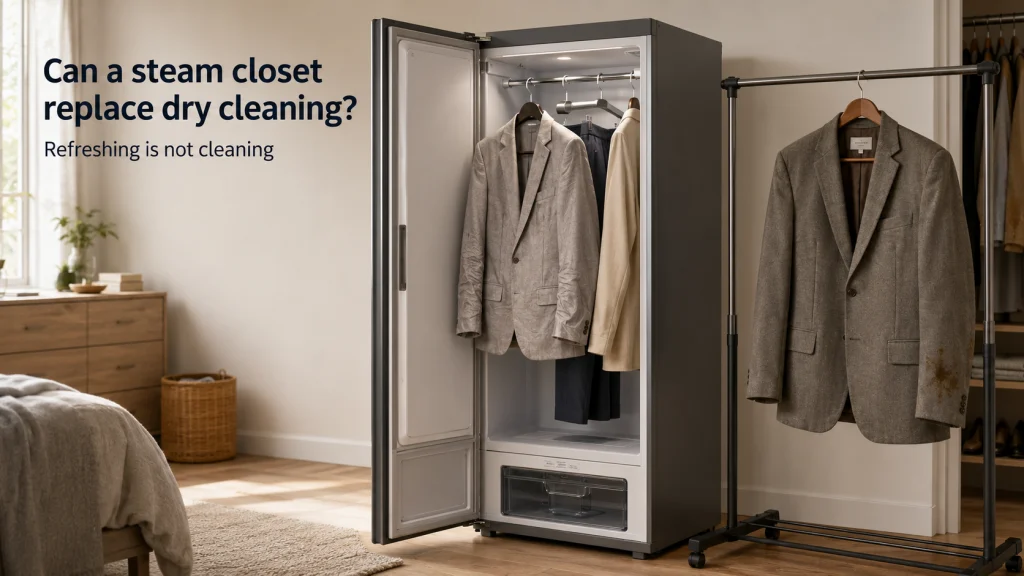
Can a steam closet replace dry cleaning? Put two jackets side by side and the answer gets much clearer. One was worn to dinner, still looks clean, but picked up food odor and a few soft wrinkles around the elbows. The other has a visible grease mark on the front and grime at the cuff. The first jacket has a refresh problem, while the second has a cleaning problem, and a steam cabinet should not be treated as if those are the same job.
That distinction matters before any cost-saving claim enters the conversation. Steam closets are designed around garment care tasks such as refreshing, reducing wrinkles and odors, gentle drying, and selected fabric-care cycles, not around extracting every type of soil from clothing. A household that wears suits, coats, dresses, uniforms, or other lightly worn garments repeatedly may find real value in between-cleaning care. A household hoping to put stained clothing into a cabinet and skip the cleaner entirely is asking the appliance to do work it was not designed to own. That boundary matters when comparing garment care products, because refreshing lightly worn clothing is not the same job as removing stains and soil.

This 22-ounce Shout prewash spray uses an active-enzyme, triple-acting formula for everyday laundry stains. Amazon lists common targets including foods, drinks, makeup, grass, and dirt. It is intended for machine-washable whites and colors, making it relevant when a garment has crossed from a simple refresh problem into actual stain treatment.
Check On AmazonIf you click this link and buy, we earn a commission at no additional cost to you.
Refreshing, laundering, and dry cleaning solve different jobs
Refreshing is the lightest of these jobs because it starts with a garment that is not meaningfully soiled. The goal may be to reduce a stale odor, relax light wrinkles, dry a damp item gently, or make something feel more presentable between full cleanings. Laundering goes further because water, detergent, agitation, rinsing, and drying are used to remove soil according to the garment’s permitted care method. Professional dry cleaning is another cleaning route with its own garment-specific process and finishing steps, so it should not be reduced to the idea of simply exposing clothing to steam.
This is why the phrase steam closet is more useful when understood as a garment-care category than as a home dry-cleaning machine. The cabinet may extend the wearable interval for some clothing, but that extension only makes sense while the garment remains in refresh territory. Once visible soil, oily residue, a spill, or a label-directed cleaning need appears, the decision has changed. The next step should be laundering or professional care as appropriate, not another cycle simply because the clothing still fits inside the cabinet.

This dryel starter kit is made for dryer-based care of special fabrics and dry-clean-only clothing. The five-load kit uses dryer-activated cleaning cloths, and Amazon states a cycle can refresh garments in about 20 minutes. It also includes odor-and-wrinkle spray, giving readers a distinct at-home care method to compare with steam-only refreshing.
Check On AmazonIf you click this link and buy, we earn a commission at no additional cost to you.
What steam closets generally target between wears
Across the category, the recurring jobs are wrinkle reduction, odor reduction, fabric refreshing, gentle drying, and cycle-specific care for certain garments or household textiles. Those jobs can matter after travel, after a jacket has spent an evening in a restaurant, or when a clean dress has been hanging long enough to pick up closet creases. A cabinet can also reduce the active hand time involved in treating several garments compared with working them one by one. None of that requires pretending that the garments have gone through a full cleaning process.
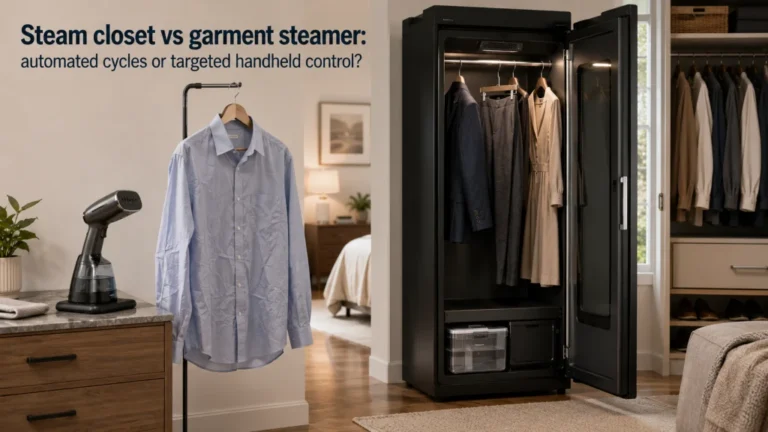
The practical value is strongest when the wardrobe repeatedly creates these light-care situations. Someone wearing business clothing several days a week may have more refresh opportunities than someone whose clothes go straight from wear to a normal wash load. If wrinkle control is the main reason for considering the appliance, the difference between a steam closet vs garment steamer also matters because one favors enclosed, lower-touch batch care while the other gives direct manual control. Match the equipment to the recurring job first, then decide whether the convenience justifies permanent floor space and maintenance.

This 1875W handheld steamer heats in about 40 seconds and uses a 7.3-ounce water tank. It can provide up to 20 minutes of continuous steam for wrinkle removal on clothing and other fabrics. The included three-in-one attachment combines a silicone band, delicate-fabric spacer, and bristle brush for different pressing tasks.
Check On AmazonIf you click this link and buy, we earn a commission at no additional cost to you.
What the cabinet should not substitute for
Visible stains and oily soil are the clearest stop signs because they are not just freshness problems. A steam cycle may change odor or appearance without actually removing the material that made the garment dirty, and heat or moisture can complicate some stains depending on the fabric and substance. Heavy soil, dirty cuffs, makeup transfer, food spills, body-oil buildup, and garments that are overdue for their prescribed cleaning method belong outside the refresh shortcut. Manufacturer support guidance also warns that heavily soiled or oily items may need washing before cabinet use when washing is permitted.
- Do not use a refresh cycle as a stain-removal treatment.
- Do not assume odor reduction proves that soil has been removed.
- Do not override a care label because a garment physically fits in the cabinet.
- Do not treat a sanitizing claim as proof that a visibly dirty garment is clean.
- Do not use repeated refresh cycles to postpone necessary laundering or professional cleaning indefinitely.
The list is intentionally conservative because the cost of a wrong decision can be a damaged garment rather than a merely disappointing cycle. Steam, heat, moisture, motion, trim, adhesives, coatings, dyes, and structured construction can interact differently from one item to another. When the garment is expensive, sentimental, heavily structured, embellished, or unfamiliar, the care label and exact appliance instructions deserve more weight than a broad category claim. A cabinet is most useful when it handles the jobs clearly inside its lane instead of being pushed into the ones outside it.

This OxiClean Max Force set contains three 12-fluid-ounce bottles of liquid laundry stain remover. Amazon identifies the formula as chlorine-free and dye-free and lists its specific use as stain removal. It is a practical companion for sections that distinguish visible soil and stains from the lighter wrinkle-and-odor work of a steam refresh cycle.
Check On AmazonIf you click this link and buy, we earn a commission at no additional cost to you.
Read the care label before using a steam cycle
A “dry clean only” label does not automatically mean that every form of steam care is safe. Care instructions can include warnings about procedures that may harm a garment, and some professional-care instructions specifically restrict steam or other parts of the normal process. That makes the label a compatibility check, not a decoration sewn into the side seam. The appliance manual then adds a second layer by identifying which fabrics, trims, items, and cycles are allowed for that specific machine.
Care-label check: Confirm the garment’s cleaning instruction, look for any steam, heat, drying, or handling warning, then verify that the exact appliance cycle permits that fabric and construction. If either source is unclear, do not guess with an expensive or delicate garment.
This is also why two similar-looking jackets may deserve different treatment. One may be a simple wool blend with a permitted refresh route, while another may contain bonded layers, delicate trim, special finishes, or a warning that changes the decision. General explanations of how to use a steam closet can help with the operating sequence, but they cannot replace model instructions or the garment’s own care information. Compatibility is item-specific, and the safe answer is sometimes to leave the garment out.
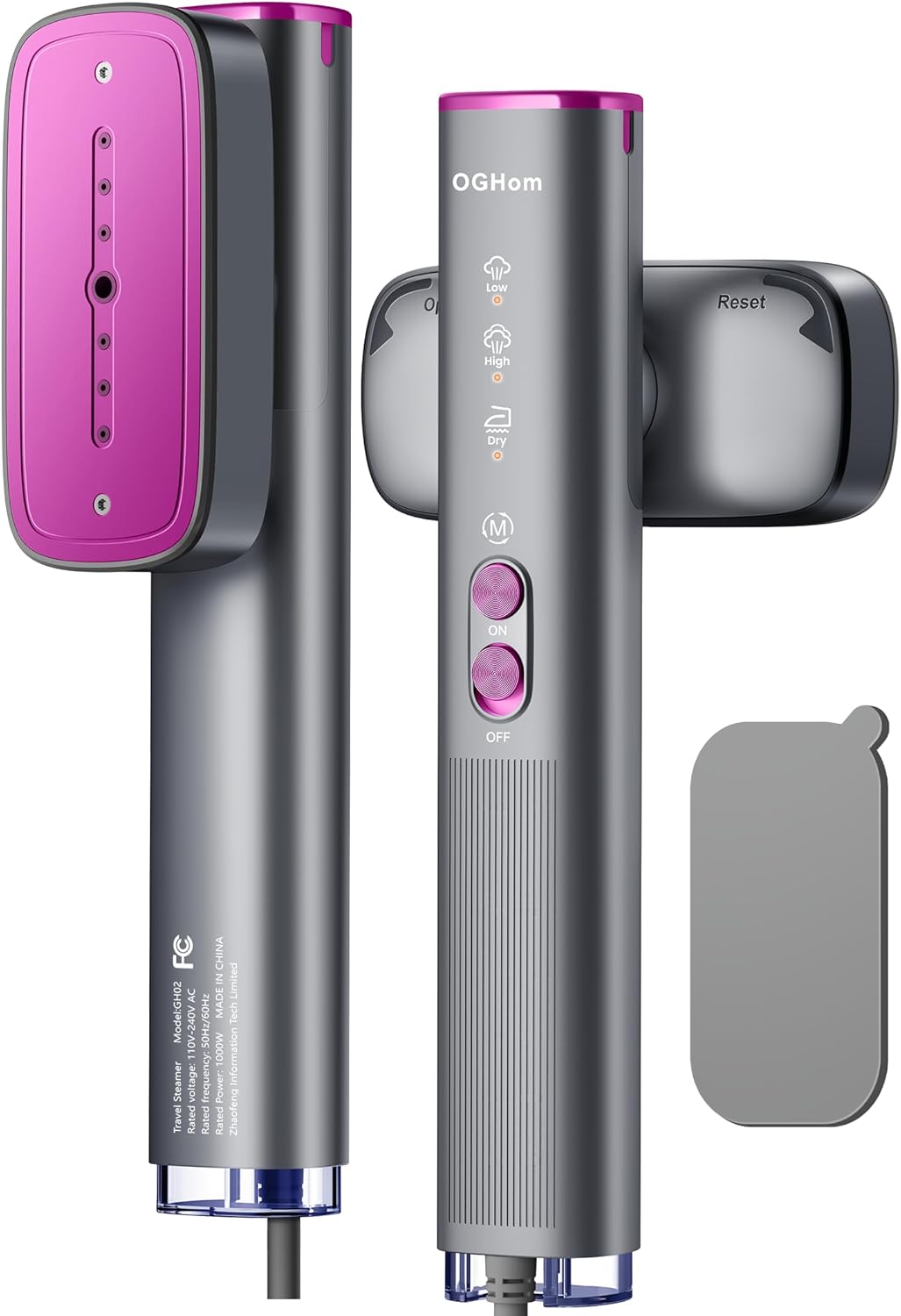
The OGHom GH02 uses 1000W and heats in about 30 seconds for portable wrinkle removal. It offers dry, low-steam, and high-steam modes with a 90-degree rotating head and a 120 ml tank. Its 110-240V input range and included user manual make the exact operating instructions especially relevant when checking garment and appliance compatibility.
Check On AmazonIf you click this link and buy, we earn a commission at no additional cost to you.
Recently cleaned clothing is different from actually dirty clothing
A recently cleaned suit jacket that has been worn for a short evening may still be structurally and visibly clean even though it no longer feels fresh. That is the situation where a between-wear cycle makes the most sense: the garment has not crossed back into a real soil problem. The cabinet can work on presentation and freshness while the professional cleaning interval is still governed by actual need. This is the sensible meaning of reducing cleaner visits rather than replacing the cleaner.
The opposite case is a coat that has been worn repeatedly through rain, transit, food environments, and daily handling until the collar and cuffs show buildup. Running that garment through repeated refresh cycles may make it smell better for a while, but the condition that calls for cleaning has not disappeared. A household that learns to separate “worn but still clean” from “dirty enough to clean” will get a more realistic result from this appliance category. That distinction also prevents the purchase from being justified by savings that only exist if necessary cleaning is incorrectly counted as optional.

This foldable 1000W garment steamer heats in about 30 seconds and is designed for 120V outlets. Its electronic pump supports steaming at multiple angles, and the compact body includes a storage bag for travel. The white YPZ-146 model is intended for wrinkle removal on garments and other suitable fabrics.
Check On AmazonIf you click this link and buy, we earn a commission at no additional cost to you.
Suits, coats, and occasion wear are useful examples, not universal permissions
Suits are an obvious use case because they can develop light wrinkles and environmental odors long before they look stained. Coats create a similar pattern, especially when they are worn briefly and then stored again. Occasion wear may spend long periods hanging between uses and can benefit from gentle dewrinkling or freshening when the label and cycle allow it. These examples explain why the category exists, but none of them proves that every suit, coat, dress, or delicate belongs in every steam closet.
Construction details can change the answer even within one garment type. A simple jacket and a structured jacket with special interfacing, adhesive components, decorative trim, or a sensitive finish may react differently to heat and moisture. The same caution applies to sequins, glued embellishments, leather details, coated fabrics, and mixed-material pieces. Treat garment names as a starting point for checking compatibility, never as blanket permission to select a cycle.

The Jack & Rose K1 combines a travel steamer and dry iron with 1000W of power and about a 15-second warm-up. It supports 100-220V operation and includes a 5-ounce water tank for portable garment care. The rotating head, ceramic heating panel, LED display, and travel pouch make it suited to touch-ups at home or on trips.
Check On AmazonIf you click this link and buy, we earn a commission at no additional cost to you.
Odor reduction and wrinkle release are performance questions, not proof of cleaning
Even inside the refresh job, results can vary by fabric, cycle, load size, how deeply an odor has penetrated, and how firmly a wrinkle has set. Light food odor on a jacket is a different challenge from smoke that has been absorbed over many wears. Fresh travel creases are also different from sharp folds that have been stored under pressure for weeks. A cabinet can be useful without producing the same result on every item, and the manufacturer cycle guidance should be read as a set of operating boundaries rather than a promise of identical outcomes.
| Garment condition | Likely job | Reasonable next step |
|---|---|---|
| Clean, lightly worn, mild odor or soft wrinkles | Refresh | Use a permitted refresh cycle if the care label and manual agree. |
| Washable garment with ordinary soil | Launder | Use the label-approved washing method instead of substituting refresh care. |
| Visible stain, oily soil, heavy buildup, or professional-care requirement | Clean | Use the appropriate cleaning route, including professional dry cleaning when directed. |
| Unclear label, prohibited steam, fragile construction, or uncertain cycle compatibility | Verify or stop | Check the garment and appliance instructions before proceeding. |
The matrix keeps appearance changes from being mistaken for soil removal. If an item comes out less wrinkled or less odorous, that is evidence that the refresh job helped, not evidence that a stain, body oil, or embedded dirt has been removed. The same logic applies to sanitizing cycles: they have specific claims and operating conditions, but they do not erase the separate question of whether the garment is physically clean. Judge each cycle by the task it is documented to perform.

The HiLIFE HL7 uses 700W of power and a 240 ml water tank for handheld garment steaming. Amazon lists up to 15 minutes of continuous steam and includes a fabric brush with this blue model. It is designed only for 110-120V use, so the voltage requirement should be checked before use.
Check On AmazonIf you click this link and buy, we earn a commission at no additional cost to you.
Use four outcomes instead of one replace-or-not verdict
A simple yes-or-no answer is too crude for real wardrobes. The better decision is to sort each garment into one of four outcomes: refresh now, launder, send for professional dry cleaning, or stop and verify before doing anything. That forces the garment’s actual condition to lead the choice instead of letting the appliance lead it. It also gives households a repeatable rule that still works after the novelty of a new machine wears off.
- If the garment has visible stains, oily residue, heavy soil, or obvious buildup: do not treat it as a refresh job. Follow the care label and use the appropriate laundering or professional cleaning route.
- If the garment is not visibly dirty but has ordinary washable soil: launder it when the label permits washing rather than substituting a cabinet cycle.
- If the garment is clean enough to wear and the problem is mild odor, light wrinkles, or gentle between-wear care: check the care label and the exact appliance cycle. If both permit the treatment, refresh is the reasonable branch.
- If the label, fabric, trim, construction, or cycle permission is unclear: stop and verify instead of guessing. Expensive, delicate, coated, embellished, or unusually constructed garments deserve the more cautious branch.
This branching check makes soil state the first decision instead of the appliance itself. Refresh now fits a clean-enough garment with a permitted cycle and a light presentation problem, while laundering fits washable items that have crossed into normal soil. Professional dry cleaning remains appropriate when the label or garment condition calls for it, and stop-and-verify covers uncertainty before a garment is exposed to steam, heat, moisture, or motion. The point is not to create more steps, but to prevent a convenience cycle from being mistaken for a cleaning method.

The Nirrom N02 is a 1200W travel steamer with about a 15-second heat time and a 140 ml water tank. Amazon lists five fabric settings and identifies fabric refreshing and wrinkle removal among its product benefits. Its compact 1.8-pound body, rotating head, and dual-voltage design are useful for garment touch-ups when a full-size steam cabinet is unnecessary.
Check On AmazonIf you click this link and buy, we earn a commission at no additional cost to you.
Count avoided cleaner visits only after the job boundary is clear
Ownership economics can matter, but the calculation should begin with legitimate avoided trips rather than every garment that enters the cabinet. If a jacket would have gone to the cleaner only because it smelled stale after one short wear, a successful refresh may delay that trip. If the jacket has an oil stain and still needs professional cleaning, running a cabinet cycle first has not created a real saving. The same logic keeps a household from inventing an attractive payback period by counting cleaning work the appliance never replaced.
Then add the costs that come with ownership: purchase price, permanent floor space, electricity, water handling where applicable, filter or tank care, cleaning, and the time spent loading and maintaining the unit. The value side should include convenience, lower active hand time, fewer unnecessary cleaner trips, and the ability to refresh several garments within the machine’s real capacity. There is no universal break-even point because wardrobes, local service costs, wear frequency, and household routines differ. The relevant question is how often your clothing creates a refresh job that you would otherwise solve with a separate trip or more manual work.

The green Nexdoo G6 is a 900W two-in-one travel steamer and iron weighing about 0.7 pounds. Amazon lists up to 10 minutes of continuous steam in this compact model. Its light format makes it a useful lower-footprint comparison for readers weighing the space and ownership commitment of a full steam closet.
Check On AmazonIf you click this link and buy, we earn a commission at no additional cost to you.
Once the capability is clear, decide whether the cabinet is worth owning
The purchase case gets stronger when a household has a meaningful rotation of suits, coats, dresses, uniforms, delicate items, or other clothing that is often worn briefly and cleaned less frequently. It also gets stronger when the household values lower-touch batch refreshing and has a practical place to keep a tall appliance ready to use. By contrast, a wardrobe dominated by machine-washable everyday clothing may not create enough between-cleaning work to justify the footprint. A handheld steamer, normal laundry equipment, and occasional professional cleaning can be the simpler answer.
This is where the broader question of whether a steam closet is worth it becomes more useful than asking whether it replaces a professional service. The appliance should earn its place through repeated, documented garment-care jobs, not through a fantasy that cleaning disappears. Households with frequent refresh needs may value the convenience even if professional dry cleaning remains part of the routine. Households with few such garments should be comfortable skipping the purchase altogether.

This Reewit handheld uses 1200W and heats in about 20 seconds. It combines steam and dry-ironing functions, supports 100-240V input, and uses a 110 ml water tank. At about 1.85 pounds with a travel bag and heat-resistant base, it offers a compact alternative for readers deciding whether a tall cabinet appliance is worth the permanent floor space.
Check On AmazonIf you click this link and buy, we earn a commission at no additional cost to you.
Final thoughts: use the cabinet between cleanings, not instead of cleaning
A steam closet is most convincing when it solves the problem it was actually built to solve. Clean-enough garments with mild odor, light wrinkles, or a need for gentle between-wear care can be good candidates when both the care label and appliance instructions permit the cycle. Stains, oily soil, heavy buildup, prohibited steam, and professional-care requirements move the garment out of refresh territory. Keep that boundary intact, and reduced cleaner visits can be a real convenience rather than a misleading promise of replacement.
Before buying, look at your own wardrobe and count how often you encounter refresh problems compared with actual cleaning problems. Then compare that frequency with the space, cost, loading routine, and maintenance the cabinet adds to the home. If refresh jobs happen often, the appliance may reduce friction while professional cleaning remains available for the garments that truly need it. If most garments are either washable or already need full cleaning when they come out of rotation, the smarter decision may be not to buy one.

This HiLIFE HL9 handheld steamer uses 1100W and a 300 ml water tank. Amazon states the tank can provide up to 20 minutes of continuous steam, reducing refills during multi-garment sessions. The white model is compact for home or travel use and is designed for 120V power.
Check On AmazonIf you click this link and buy, we earn a commission at no additional cost to you.
FAQs
🧥 Can I put a dry-clean-only jacket in a steam closet?
Only when the garment care label does not prohibit the relevant treatment and the exact appliance instructions permit that fabric and construction. “Dry clean only” is not blanket permission for steam, so check both sources before choosing a cycle.
🧼 Does a steam closet remove stains?
Do not treat it as a stain-removal appliance. Visible stains, oily soil, and heavy buildup call for the garment’s appropriate cleaning method rather than another refresh cycle.
👃 Can a steam closet remove clothing odors?
Odor reduction is a normal refresh target, but results depend on the fabric, odor source, how deeply it has penetrated, load, and cycle. Reduced odor does not prove that soil has been removed.
👔 Will a steam closet reduce dry-cleaner visits for suits?
It can reduce unnecessary visits when a suit is still clean enough to wear and only needs refreshing or wrinkle reduction. It should not delay professional cleaning when the suit is visibly soiled, stained, or due for care under its label instructions.
🧵 What if the care label says no steam?
Do not use a steam cycle on that garment. Follow the care label and any applicable professional-care instruction instead of assuming a gentler appliance setting will be safe.
References and sources
- LG Styler overview: Supports the distinction between refreshing garments between professional cleanings and fully replacing dry cleaning.
- Samsung AirDresser cycle guidance: Supports care-tag checking and the use of fabric-specific refresh cycles for wrinkles and light odors.
- GE Steam Closet troubleshooting: Supports washing oily or strongly odorous garments first when appropriate and shows that wrinkle results vary by garment condition.
- FTC care labeling guidance: Supports treating garment care labels and warnings as the controlling care instructions, including cases where steam may be restricted.