A portable dehumidifier can be a sensible answer for one damp room or defined zone, but a large coverage claim does not turn a room appliance into a whole-house air-distribution system. A whole-home dehumidifier is a ducted approach that can serve multiple locations, yet it also turns a simple appliance purchase into an installed equipment decision involving drainage, duct context, service access, and professional work. The right choice starts with where the humidity problem actually appears, how air moves between those spaces, and how much recurring ownership work the household is willing to accept. If the pattern is still unclear, measure the problem before choosing either path.
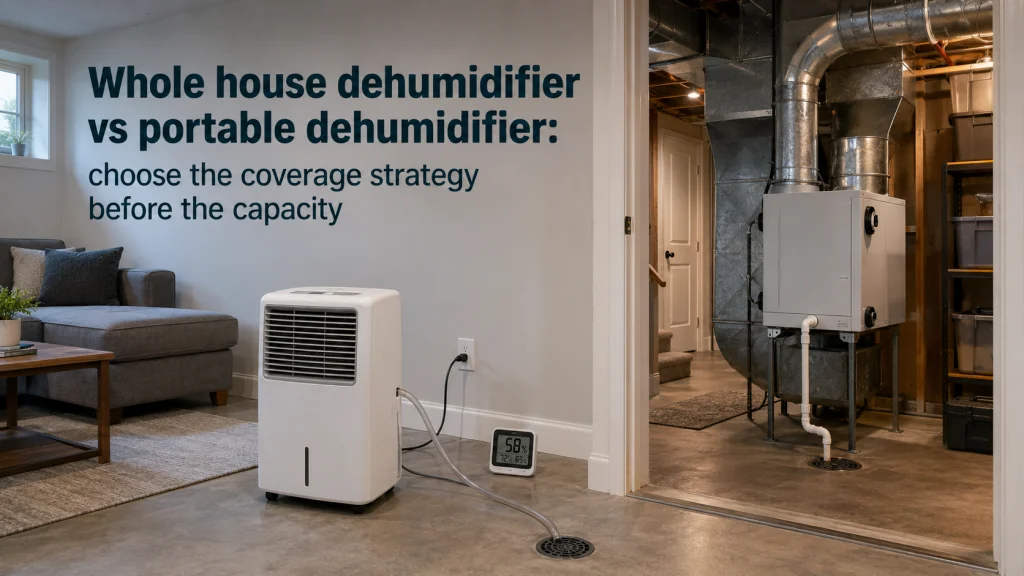
A large coverage claim does not make one portable unit a whole-house system
The whole house dehumidifier vs portable dehumidifier decision gets distorted when a shopper starts with the biggest square-foot number on a box. A portable unit treats air that reaches its intake, so a machine in an open basement has a different job from one expected to influence bedrooms behind closed doors. Open doors, stairwells, fans, and household airflow can let one unit affect nearby spaces, but that is not controlled ducted distribution. The first question is therefore not how much water a machine can remove in a test, but where the humid air is and whether it can reliably reach the equipment.
That distinction matters because the wrong architecture creates work even when the machine itself is capable. A household may end up moving one unit, running several units, emptying buckets, routing hoses, or tolerating noise where people spend time. A ducted system reduces some of that room-level equipment burden, but it introduces installation, service, drainage, and HVAC coordination that a plug-in product does not. Before comparing capacity, price, or efficiency labels, decide whether the moisture problem is local, repeated across several separate spaces, or genuinely broad throughout the conditioned home. Both approaches sit within air quality appliances, but portable and whole-house dehumidification create very different placement, drainage, and service routines.

This 22-pint portable dehumidifier is ENERGY STAR certified and intended for spaces such as basements, bathrooms, and medium to large rooms. Its reusable air filter supports routine owner maintenance without a disposable-filter schedule. The freestanding room-unit design makes it a practical example of localized dehumidification rather than a ducted whole-home system.
Check On AmazonIf you click this link and buy, we earn a commission at no additional cost to you.
What portable and whole-home dehumidifiers actually mean
ENERGY STAR currently defines a portable dehumidifier as a unit that operates within the space being dehumidified without requiring additional ducting, even though some models may allow optional duct attachment. That definition is more useful than treating “portable” as a synonym for small, because the important point is where the appliance operates and how air reaches it. A portable machine normally sits in the room or zone it is expected to dry, collects or drains condensate, and returns drier air to that space. Its mobility can be useful, but moving it also means the household is changing which space gets direct treatment.
ENERGY STAR defines a whole-home dehumidifier by ducted air delivery: return process air reaches the unit through ducting, and dehumidified air is supplied through ducting to one or more locations. That makes “whole-home” an air-distribution strategy rather than merely a higher-capacity appliance. Some systems integrate with central HVAC, while other ducted configurations may be possible, so the exact path depends on manufacturer requirements and professional assessment. This article stays at the owner-decision level and does not provide duct design, electrical design, condensate-plumbing instructions, equipment commissioning, or DIY installation steps.
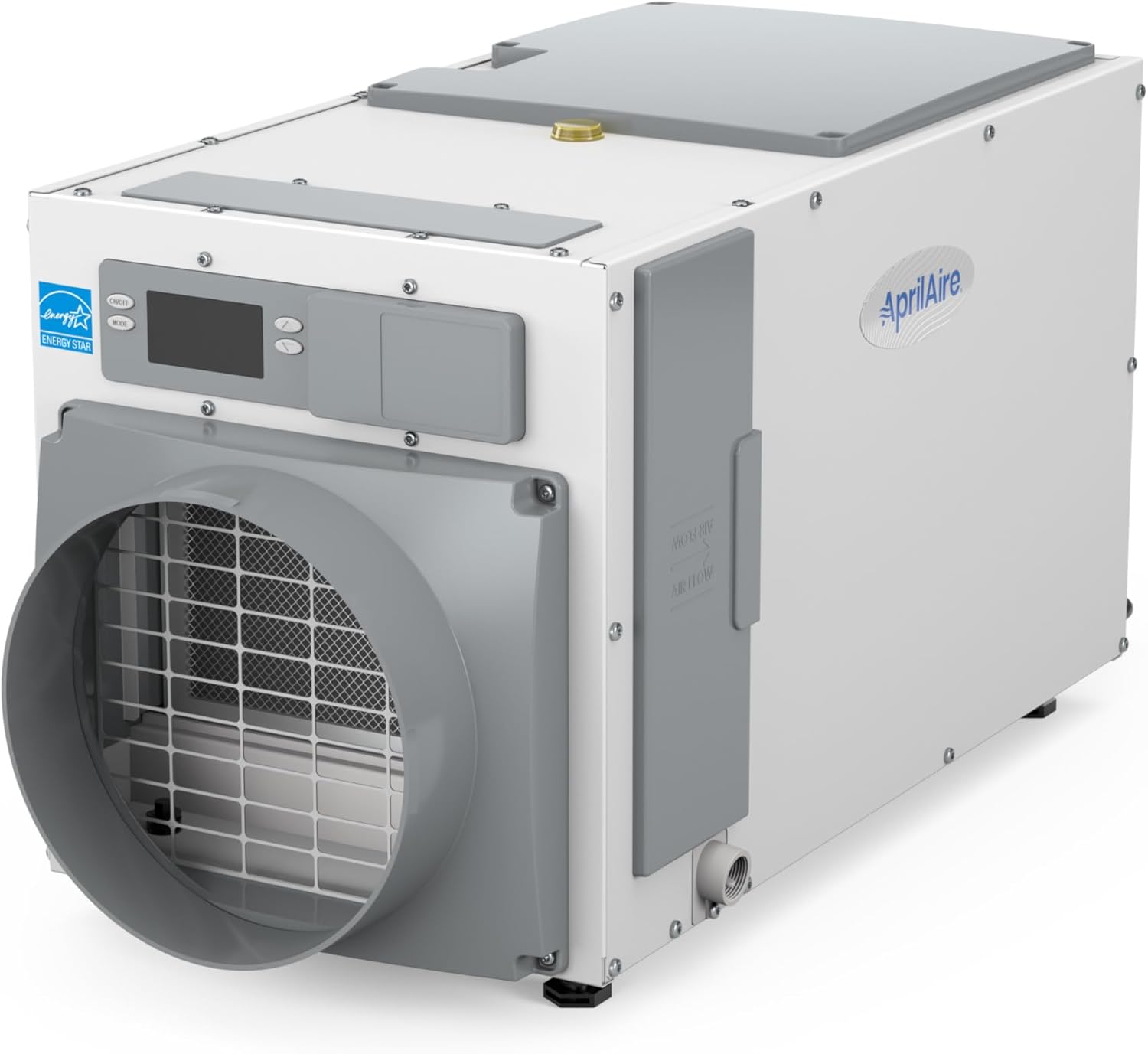
The AprilAire E100 is a whole-house dehumidifier designed for centralized humidity control. It removes up to 100 pints of moisture per day and is rated ENERGY STAR Most Efficient in the Amazon listing. Its configuration supports whole-home, basement, and crawl-space applications with continuous drainage rather than a collection bucket.
Check On AmazonIf you click this link and buy, we earn a commission at no additional cost to you.
Map the moisture problem before comparing hardware
A useful moisture map is not a house sketch with one capacity number across it. It is a set of repeated humidity observations showing whether the problem stays in one room, follows one level, appears in several closed rooms, or remains broad under comparable conditions. If a basement is persistently damp while the main living levels stay comfortable, that points toward a local or zone problem rather than automatic justification for whole-home equipment. If several separated areas repeat the same pattern, centralized assessment becomes more reasonable because the household is no longer solving one room.
Measure before changing equipment so the comparison is based on the house rather than on a marketing coverage claim. The goal is not a perfect sensor reading, but a clear pattern of distribution and recurrence. A room that spikes after a moisture event is different from several occupied rooms that stay humid through normal operation. If you have not yet established that dehumidification is the right response at all, start with whether the home actually needs a dehumidifier before choosing the equipment strategy.
- Check the problem room and at least one nearby comparison area under similar household conditions.
- Note whether doors are normally open or closed, because that changes how easily air can reach a portable unit.
- Separate a persistent humidity pattern from a temporary event such as a leak, wet materials, or unusual ventilation.
- Look for a practical drain location and usable equipment location before assuming either strategy will be convenient.
| Observed moisture pattern | What it suggests | Best next comparison |
|---|---|---|
| One room stays humid; nearby areas stay stable | Likely local or zone-specific | Check portable placement, drainage, and capacity |
| One open level shows similar readings | May behave as one treatment zone | Test whether one portable location serves it acceptably |
| Several closed rooms stay humid | Distribution becomes the key issue | Compare multiple portables with whole-home assessment |
| Readings are inconsistent or source-linked | The source may matter more than equipment size | Investigate before buying more capacity |
Use this table as a routing check, not as a sizing formula. It separates a local problem from a repeated multi-room pattern before capacity or equipment class enters the decision. The result may still be a portable unit, a professional whole-home assessment, or no equipment purchase until the moisture source is understood. That is more useful than asking one square-foot claim to answer every part of the problem.

The TP50 displays indoor temperature and relative humidity in one compact room monitor. It is designed for household spaces such as offices, cellars, greenhouses, and RVs, making repeated humidity spot checks easy to place where they matter. Its compact freestanding format makes it easy to position in different indoor areas while you collect repeated readings.
Check On AmazonIf you click this link and buy, we earn a commission at no additional cost to you.
How each strategy gets humid air to the dehumidifier
A portable dehumidifier removes moisture from air that reaches it, so placement and room connection matter. In a large open basement, air can circulate through one shared volume and a properly selected portable unit may have a straightforward job. With closed bedroom doors, separate floors, or weak air exchange, the same machine may mostly treat air nearest its intake. One portable can still influence adjacent spaces when air moves freely, but the effect depends on the layout and airflow rather than on a printed whole-area claim.
The distinction between a whole-home system and a portable unit becomes more meaningful when several spaces need treatment without relying on doors being left open or a machine being relocated. Ducted equipment is designed to move process air to and from one or more locations, which gives the system a deliberate distribution path. That does not mean every ducted system automatically produces identical humidity in every room, because duct layout, controls, air leakage, equipment sizing, and the home itself still matter. It means distribution is addressed by the installed system instead of mainly by room-to-room air movement.
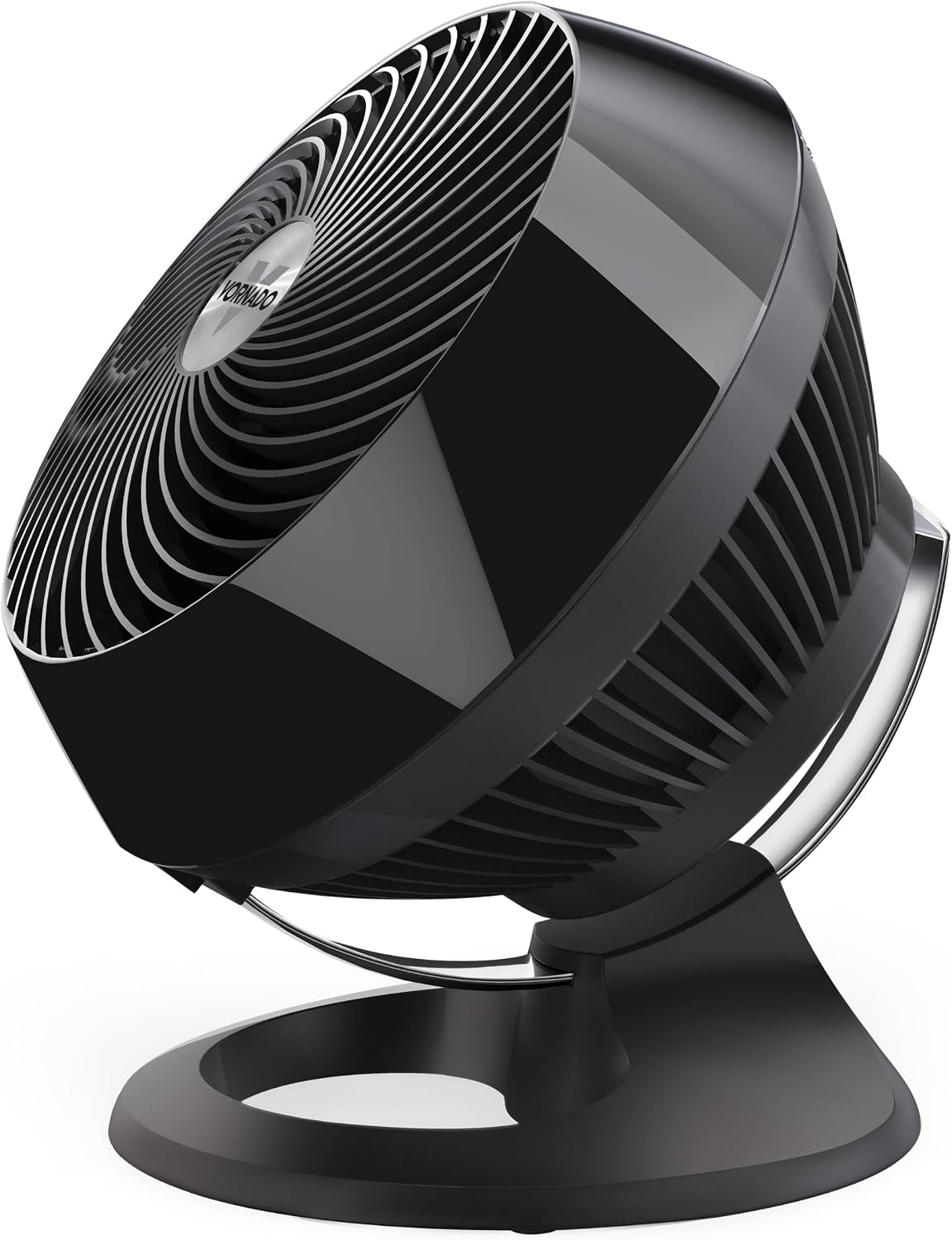
The Vornado 660 uses four speed settings and a 90-degree tilt range to direct room airflow. Its deep-pitched blades, inlet guide cone, and spiral grille are designed to move air up to 100 feet. The black indoor unit is intended for whole-room circulation in spaces such as bedrooms, offices, and dorm rooms.
Check On AmazonIf you click this link and buy, we earn a commission at no additional cost to you.
Compare the commitment, not just the purchase price
A portable dehumidifier is usually a product purchase: choose the right class and capacity, confirm operating conditions, place it where air can reach it, and decide how condensate will be handled. The household can relocate, store, or replace it without redesigning part of the home. That flexibility matters when the problem is limited, the pattern is still uncertain, or permanent equipment is hard to justify. The lower commitment is often more important than simply saying the appliance is “cheaper.”
A whole-home path is an installed project, so the meaningful upfront comparison includes far more than the equipment itself. Access, duct configuration, controls, drainage, electrical requirements, labor, commissioning, and service access can all affect the project, so one local quote is not a national norm. Comparing a portable room unit with a whole-home system should therefore never assume the centralized option is an automatic upgrade. It is a different ownership commitment that makes the most sense when the distribution problem and long-term use justify professional installation.
| Decision factor | Portable strategy | Whole-home strategy |
|---|---|---|
| Best starting fit | One room, open zone, or uncertain pattern | Repeated humidity across connected spaces |
| Air distribution | Depends on placement and room airflow | Uses ducted return and supply air |
| Upfront commitment | Appliance purchase | Installed project with professional assessment |
| Condensate handling | Bucket or supported continuous drain | Drainage planned with installation |
| Living-space burden | Visible unit, floor space, cord, noise, warm exhaust | Less room equipment; centralized service access |
| Flexibility | Easy to relocate or store | Permanent installed location |
The table and decision card are most useful after the moisture pattern is known. Without that first step, a household can pay for permanence when it only needed local control, or keep adding portable machines when the real problem is broad distribution. Treat the portable path as a product decision and the ducted path as a home-system project with different evidence requirements. That distinction keeps price from becoming a misleading shorthand for how large the commitment really is.

This Midea Cube is the 20-pint portable variant for spaces up to 1,500 square feet. Its removable water tank and drain-hose option support either bucket collection or continuous drainage when the setup allows it. Smart control and the nestable Cube form add flexibility when the appliance needs to be relocated or stored.
Check On AmazonIf you click this link and buy, we earn a commission at no additional cost to you.
Drainage changes the daily burden more than many buyers expect
Condensate disposal is where a capable portable unit can become annoying in actual household use. A bucket is simple, but the machine stops being low-attention equipment if someone must repeatedly notice that it is full, carry water, and reset the routine. Continuous gravity drainage can remove much of that burden when the exact model permits it and a suitable lower drain is available. A supported pump can add flexibility on some units, but hose routing, maintenance, and manufacturer instructions still must be checked for the exact model.
Whole-home systems are normally planned around continuous condensate disposal rather than buckets. ENERGY STAR notes that most whole-home units are equipped with a drain and that routing to a floor drain or condensate pump is part of professional installation. That reduces daily bucket attention, but it does not make drainage disappear as an ownership issue because the drain path and system still require correct installation and maintenance. Water near electrical equipment, persistent leakage, or any drainage condition outside the manufacturer’s owner-level instructions is a stop point for qualified service rather than a DIY troubleshooting project.

This 50-pint Midea Cube includes a built-in pump for vertical or horizontal condensate drainage. Amazon lists a 16-foot drain tube plus a separate continuous-drain option for routing water without relying only on the bucket. The 4.2-gallon removable tank, smart control, and included drain hardware give the owner multiple condensate-handling choices.
Check On AmazonIf you click this link and buy, we earn a commission at no additional cost to you.
Room-level noise, floor space, and warm exhaust are part of the decision
A portable dehumidifier occupies the room it treats, so its burden includes more than electricity and filter cleaning. It takes floor space, needs airflow clearance, brings a cord or hose into the room, and produces noise where people may sleep, work, or relax. Refrigerant dehumidifiers also return air that is typically warmer than the air entering the unit because the refrigeration cycle and fan release heat into the space. In a utility room that may barely matter, while in a small bedroom or finished living area it may change when and where the household is willing to run the machine.
A ducted system can move the main equipment away from occupied rooms, which often improves the visible and audible experience at the room level. That benefit still needs limits: whole-home equipment is not silent, and location, duct transmission, airflow, and isolation affect what occupants hear. The important contrast is that the machine itself does not need to sit in each problem room. If noise or floor-space friction is the reason the household keeps turning off otherwise adequate portable units, that recurring behavior belongs in the comparison, not just the rated capacity.
This 50-pint Midea Cube measures about 14.45 by 14.76 by 14.96 inches and uses a 4.2-gallon removable tank. It has three fan speeds, continuous-drain capability, and smart control. The Lift-and-Twist Cube design can operate extended or nested, which is useful when floor space and seasonal storage burden are part of the decision.
Check On AmazonIf you click this link and buy, we earn a commission at no additional cost to you.
Maintenance shifts from repeated room tasks to installed-system access
One portable unit has a manageable maintenance list: keep the air path clear, clean the filter, maintain bucket or drain parts, inspect hoses, and follow the manual for storage. The burden grows when the household needs two or three units to cover separate areas. Then the same tasks multiply across filters, tanks, hoses, cords, storage, and reminders, making multi-unit ownership more demanding than expected. The machines may still be the right choice, but the recurring-work ledger should be honest.
Whole-home equipment reduces the number of room appliances, yet maintenance does not vanish; it moves to a central installed system. Filters, drain components, controls, and service access still matter, and exact tasks vary by model and installation. A poorly placed installed unit can also make routine service harder. The practical comparison is whether the household prefers several simple owner-level tasks or a smaller number of centralized tasks that may involve professional service.
| Recurring work | One portable unit | Several portable units | Whole-home system |
|---|---|---|---|
| Filter attention | One filter schedule | Repeated across each unit | Centralized; system-specific |
| Condensate checks | Bucket or one drain path | Multiple drains or buckets | Installed drainage path |
| Moving and storage | Possible seasonal handling | More units to store | No room storage task |
| Service access | Direct appliance access | Access for each unit | Serviceable installed access |
This is not an argument that centralized equipment is maintenance-free. It is a way to compare where the work lives and how often the household will notice it. Several portable units spread simple tasks across more rooms, while an installed system concentrates maintenance in one service location. Choose the burden the household can realistically keep up with rather than assuming fewer visible machines means less maintenance overall.
Use current efficiency data without assuming one class always costs less to run
ENERGY STAR and DOE use integrated energy factor, or IEF, as the main dehumidifier efficiency metric. IEF is expressed in liters of water removed per kilowatt-hour, and a higher value means more moisture is removed per unit of energy under the specified test conditions. That gives shoppers a useful way to compare efficiency within an appropriate product class, but it does not tell the entire operating-cost story. Actual energy use still depends on moisture load, runtime, home conditions, air leakage, settings, and whether several portable units are running.
There is another reason to avoid simplistic “whole-home is always more efficient” claims. Current ENERGY STAR certification criteria group portable units by removal capacity, while whole-home criteria are grouped by product case volume, so the threshold tables are not a direct household operating-cost comparison between the two strategies. A portable unit with a strong IEF may suit one basement, while several spaces can create a very different usage pattern. Use product efficiency information after deciding how many spaces need treatment, not as a shortcut around the distribution question.
Check the home’s duct and central-air context before choosing the whole-home path
Whole-home dehumidification is not simply a larger portable appliance hidden in a mechanical room. ENERGY STAR defines the class around ducted return and supply process air and points households with central air and broadly persistent humidity toward professional assessment. Not every ducted installation uses the existing HVAC system in the same way. The house still needs workable ducting, drainage, controls, equipment space, and service access that a square-foot claim cannot prove.
This is where owner-level comparison should stop and professional design should begin. Do not cut ducts, improvise condensate routing, alter electrical circuits, or treat an online sizing rule as a commissioning plan. A contractor should verify equipment integration, airflow, condensate disposal, and service access. If the home lacks useful duct context or the humidity is concentrated in a space outside the central system, a portable or separate-zone approach may remain the more logical first move.
Stop condition: If the decision requires duct modifications, electrical work, condensate design, commissioning, or HVAC diagnosis, move to qualified professional assessment. Those tasks affect safety, drainage, airflow, and serviceability. Do not turn a buying decision into improvised installation work because equipment appears physically compatible. The exact instructions and conditions in the home set the owner-level boundary.
The same boundary applies when a moisture source may be driving the problem. Dehumidification manages moisture in the air, but it does not repair active leaks, water intrusion, wet building materials, or another source that needs its own corrective path. If humidity changes sharply with one source condition, investigate that condition before assuming more dehumidification capacity is the answer. A larger machine can remove more moisture without proving why the moisture keeps entering the space.
Choose a portable-only, whole-home-assessment, or investigation path
A portable-only outcome makes sense when the problem is one room or open zone, air can reach the machine, drainage is manageable, and room-level burden is acceptable. It also works as a lower-commitment step when the household has not established a broad humidity problem. If one portable unit controls the actual problem area without creating a burdensome emptying, hose, noise, or storage routine, there is little reason to turn that success into an HVAC project. The simpler solution earns its place by doing the needed job with less commitment.
A whole-home assessment becomes more reasonable when several connected conditioned spaces stay humid and the household wants centralized treatment instead of several room appliances. A mixed or investigation path is better when the pattern is inconsistent, the problem appears tied to a basement or crawl-space source, the home is frequently open to humid outdoor air, or the HVAC system itself may be contributing to the conditions. In those cases, buying larger equipment before understanding the source can hide the real decision. The strategy should follow the moisture pattern, not the other way around.

The MMD4E is a pin-type moisture meter for checking moisture in wood and common building materials. It uses stainless-steel pins, a backlit LCD, and audible and visual moisture-level alerts. Its measurement ranges cover 5 to 50 percent for wood and 1.5 to 33 percent for building materials, helping investigate a suspected wet-material source before buying more dehumidification capacity.
Check On AmazonIf you click this link and buy, we earn a commission at no additional cost to you.
After choosing the strategy, size and shop within that path
Once the household has decided that a portable unit is the right architecture, capacity becomes the next question rather than the first one. Use the served area, dampness level, operating temperature, drainage plan, and layout to narrow the size instead of relying on the largest coverage claim. The detailed process is covered in how to choose dehumidifier capacity for the space you will actually treat. That keeps a room-level sizing decision from being confused with the separate question of whether one room appliance should be asked to serve the entire home.
If you are still comparing dehumidifier types, controls, drainage features, placement needs, and ownership trade-offs, use the dehumidifier buying guide for the broader purchase decision. Readers who have settled on a portable strategy can then move to current dehumidifier selection criteria and models. That keeps product comparison inside the strategy already chosen. It also prevents buying a machine before discovering that the household needed a different coverage strategy.
Final Thoughts: choose the moisture-distribution strategy before the machine
The useful dividing line is local air treatment versus ducted distribution, not a simple cheap-versus-better ranking. A portable unit earns its place when one room or open zone can be treated without an awkward drain, noise, or maintenance routine. A whole-home assessment earns its place when repeated humidity across several conditioned spaces makes room-by-room equipment the larger burden. Neither path is proven by a coverage number alone.
Start with the pattern, then check airflow, drainage, and the level of ownership commitment the household will accept. If the evidence points to one defined area, keep the solution local and size for that job. If it points to a broad multi-room problem and the home supports ducted equipment, move to professional assessment. If the pattern is still uncertain, investigate first instead of buying more capacity.

The Govee H5075 combines a room temperature and humidity display with Bluetooth app monitoring. Its listing supports notification alerts, a 164-foot Bluetooth range, and up to two years of stored data for export. The 1-pack black H5075 makes it practical to track whether a humidity pattern is broad, recurring, or limited to one location over time.
Check On AmazonIf you click this link and buy, we earn a commission at no additional cost to you.
FAQs
Most questions here come back to distribution, drainage, and ownership burden. Capacity alone cannot prove that air from several closed rooms will reach one portable machine. Ducted coverage also depends on correct equipment selection and installation. Use these answers as decision boundaries, not substitutes for the exact manual or professional assessment.
If the situation falls between the categories, gather more evidence before buying. Compare the problem areas, note how rooms connect, and identify a realistic condensate path. Those checks usually separate a room-appliance decision from an installed-system decision. They also reduce the risk of overbuying from a square-foot claim that ignores doors, ducting, and maintenance.
🏠 Can one portable dehumidifier dehumidify an entire house?
It can affect adjacent areas when air moves freely, but a large coverage claim does not prove control across separated rooms. Judge the result from readings in the rooms that matter.
🚪 Does leaving doors open help a portable dehumidifier reach other rooms?
Yes, open doors can improve air exchange, but the effect still depends on layout and airflow. If doors are normally closed, judge the unit under that normal condition.
💧 Do whole-home dehumidifiers need a drain?
Whole-home systems normally use continuous drainage rather than a collection bucket. The drain path should follow the exact equipment requirements and installation plan.
🔊 Is a whole-home dehumidifier always quieter than a portable unit?
Not always. Sound still depends on equipment location, duct transmission, airflow, and installation.
⚡ Is a whole-home dehumidifier always more energy efficient?
No. Compare IEF within the appropriate product class, then consider runtime, moisture load, and how many units must operate.
🧰 Do I need central air to use a whole-home dehumidifier?
Whole-home dehumidifiers are ducted systems, and many installations work with central HVAC. A professional assessment should confirm the workable duct and control strategy.
References and Sources
- ENERGY STAR dehumidifier guidance: Supports guidance on whole-home systems, drainage, and IEF.
- ENERGY STAR efficiency criteria: Verifies portable and whole-home definitions and criteria.
- ENERGY STAR testing and capacity: Explains capacity and integrated energy factor under DOE testing.