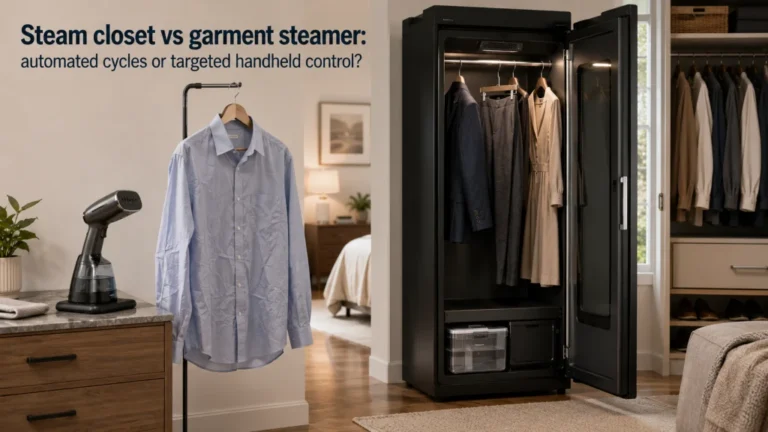
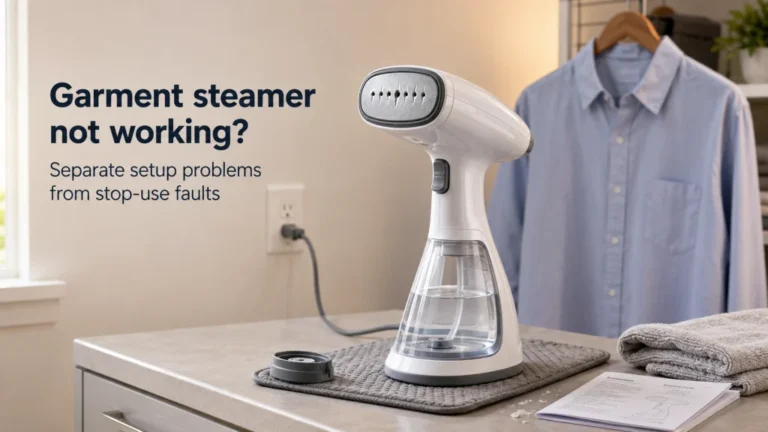
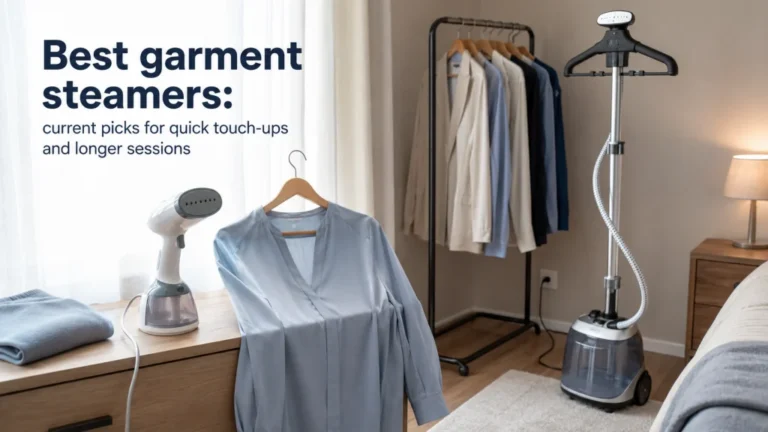
A handheld steamer saves space and keeps setup simple, while a standing steamer moves the water tank off your arm and usually makes longer sessions easier to sustain. The useful comparison is not small versus large, but how many garments you steam at once, how much water you are willing to carry, how often you will refill, and where the steamer will live between uses. A larger base does not automatically mean better wrinkle removal, and a smaller unit does not automatically mean faster readiness. Choose the architecture that removes the most repeated friction from your actual garment-care routine.
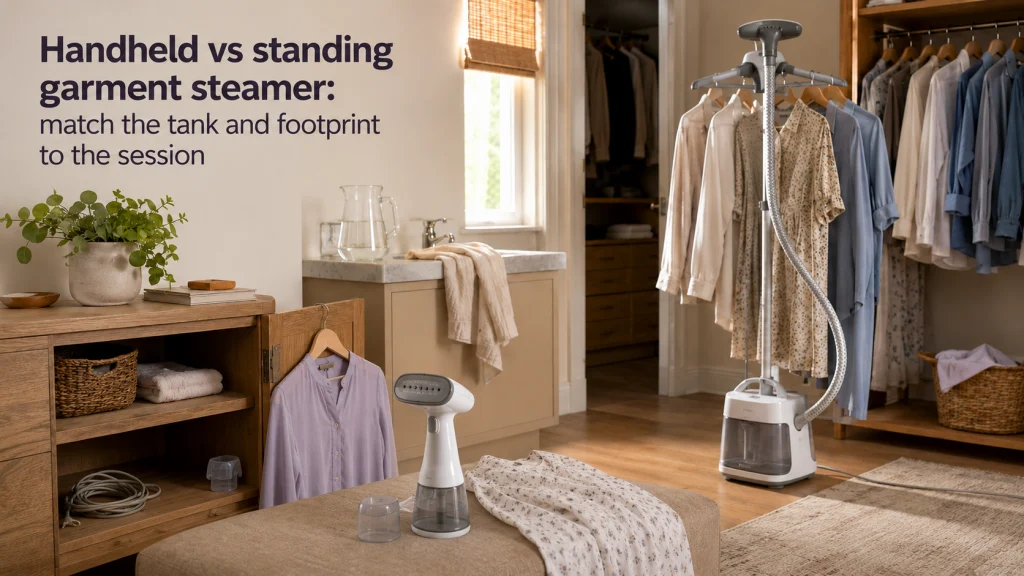
Let the third refill and the unused floor footprint decide
A comparison between handheld and standing garment steamers becomes much clearer when you picture the session instead of the appliance. A handheld can feel ideal for one blouse, then become annoying when a larger load forces repeated refills and keeps the full tank in your hand. A standing unit can run through more garments with less carried water, yet still be the wrong purchase if the pole, base, hose, and hanger have nowhere sensible to stay. The better architecture is the one that fits the work you repeat without creating a storage problem you deal with every day.
That is why this comparison starts with garment count, refill tolerance, filled weight, and storage before steam-output claims. If you are still deciding whether steaming belongs in your routine at all, the separate garment steamer ownership decision is the better place to settle that question first. Here, the assumption is that you want a garment steamer and need to choose between two physical layouts. The answer may still be neither if both layouts add more handling, storage, or cleanup than they remove. Within garment care products, handheld and standing steamers solve the same wrinkle-care job with very different carrying, refill, and storage demands.

This handheld steamer uses 1875 watts and has a 7.3-ounce water tank. Amazon lists a 40-second heat-up and up to 20 minutes of continuous steam. It includes a built-in creaser plus silicone, delicate-fabric, and bristle-brush attachments.
Check On AmazonIf you click this link and buy, we earn a commission at no additional cost to you.
Understand the two architectures without assuming which performs better
A handheld steamer combines the water tank, heater, controls, and steam head into a unit that stays in your hand during use. That design reduces setup and makes cabinet or drawer storage realistic for many households, but the water you add becomes part of the weight you move around the garment. A standing or upright steamer separates the main water supply into a floor base and sends steam through a hose to a lighter head. The pole or hanger system may also give the garment a dedicated place to hang while you work.
Those physical differences matter, but they do not prove wrinkle-removal performance by themselves. A larger tank can reduce refill frequency without guaranteeing stronger or drier steam, and a compact body can heat quickly without being comfortable through a long session. Independent testing of current steamers shows meaningful variation within both formats, including differences in tank size, comfort, heat-up behavior, and refill needs. Treat architecture as the workflow decision, then treat performance as a model-level question after you have chosen the format.
Match the steamer to one garment, several garments, or a full batch
A one-garment touch-up favors low setup friction. You pull the unit out, fill it if needed, wait until it is ready, smooth the garment, let the appliance cool, and put it away. In that routine, a large standing system can spend more space solving a problem that only lasts a few minutes. The advantage shifts when steaming becomes a repeated batch task rather than an occasional rescue.
Several shirts, dresses, or work outfits create a different cost. Refilling interrupts the rhythm, and a handheld tank that felt light at the start may feel less pleasant after repeated passes at shoulder height. A standing unit asks for more room, but it can keep the main water mass on the floor while you move only the head and hose. Think in session patterns rather than a universal garment count, because fabric size, wrinkle depth, steam setting, and your pace can all change how long a tank lasts.
| Typical session | Handheld fit | Standing fit | Main question to verify |
|---|---|---|---|
| One quick garment | Usually strong | Often more setup than needed | Can it be stored and filled quickly? |
| Several garments | Depends on tank and filled weight | Often more comfortable for longer use | Will refills or hose handling interrupt the session? |
| Repeated batch steaming | Can become refill-heavy | Often better aligned with the workload | Is there permanent or near-permanent floor space? |
The table is a starting filter, not a promise about any exact model. Before buying, check the stated tank capacity, how the tank is removed and refilled, whether steam is continuous or trigger-controlled, and what the manufacturer says about normal operating behavior. Those details tell you whether the architecture actually supports the session you have in mind. They also prevent a common first-time mistake: choosing by tank size alone and discovering that the handling around that tank is the real annoyance.

This 1000-watt handheld steamer heats in about 15 seconds and combines vertical steaming with a dry-ironing panel. Its 5-ounce tank is rated for a maximum runtime of 10 minutes. The K1 supports 100-220V operation and includes a travel pouch for packing.
Check On AmazonIf you click this link and buy, we earn a commission at no additional cost to you.
Compare water carried in your hand with water stored in a base
Tank capacity changes more than refill frequency. In a handheld design, added water increases the weight of the appliance you lift, angle, and move around sleeves, shoulders, collars, and hems. A larger handheld tank can therefore solve one problem while making another more noticeable. The right question is not simply how much water fits, but whether the filled unit remains comfortable for the length and reach of your normal session.
A standing design moves most of that water mass to the floor, so the handpiece can stay lighter even when the system holds substantially more water overall. The trade-off is that the hose becomes part of the handling system, and the base must sit somewhere stable with a safe cord path. If your routine includes long garments or repeated shoulder-height work, separating the tank from the hand may matter more than the headline capacity. If you steam briefly and store everything immediately, the compact all-in-one form may still be easier overall.
| Where the water sits | What your hand manages | What changes during a longer session |
|---|---|---|
| Inside a handheld unit | Steam head, controls, heater body, and filled tank move together | More capacity can mean fewer refills, but the extra water stays in the hand |
| Inside a standing base | The hand mainly moves the steam head and hose | The carried load stays lower, but hose routing and base placement become part of the job |
Use this comparison to identify which burden you would rather manage repeatedly. A larger handheld tank is not automatically the better compromise if the filled unit becomes awkward, and a floor tank is not automatically easier if the hose constantly fights your reach. The useful check is where the water weight sits during the exact motions you repeat. That is a more dependable fit test than capacity alone.

The G6 weighs about 0.7 pounds, keeping the carried appliance load low during handheld use. Its 900-watt heater is listed with a 15-second warm-up and 12 minutes of continuous steam. The head can be used for vertical or horizontal steaming at different angles.
Check On AmazonIf you click this link and buy, we earn a commission at no additional cost to you.
Judge refill frequency by usable steam behavior, not tank size alone
A large tank sounds like a simple advantage, but usable session length depends on more than volume. Steam setting, pump behavior, whether the unit produces steam continuously, and how much time you spend repositioning garments can all affect how often you actually return to the sink. Some compact models are perfectly adequate for short touch-ups even with small tanks, while others become inconvenient as soon as the session grows. This is one reason the choice between handheld and standing designs should be answered around routine rather than capacity marketing.
Check how the exact tank comes out, whether it can stand securely while being filled, how clearly the water level can be seen, and whether the manual tells you to empty remaining water after use. These details determine how annoying each refill or shutdown becomes. A removable base tank may reduce interruptions but still be awkward if it is difficult to seat correctly, while an easy handheld reservoir can make a modest capacity less bothersome. The practical winner is the design whose refill cycle fits naturally into the session instead of repeatedly stopping it.
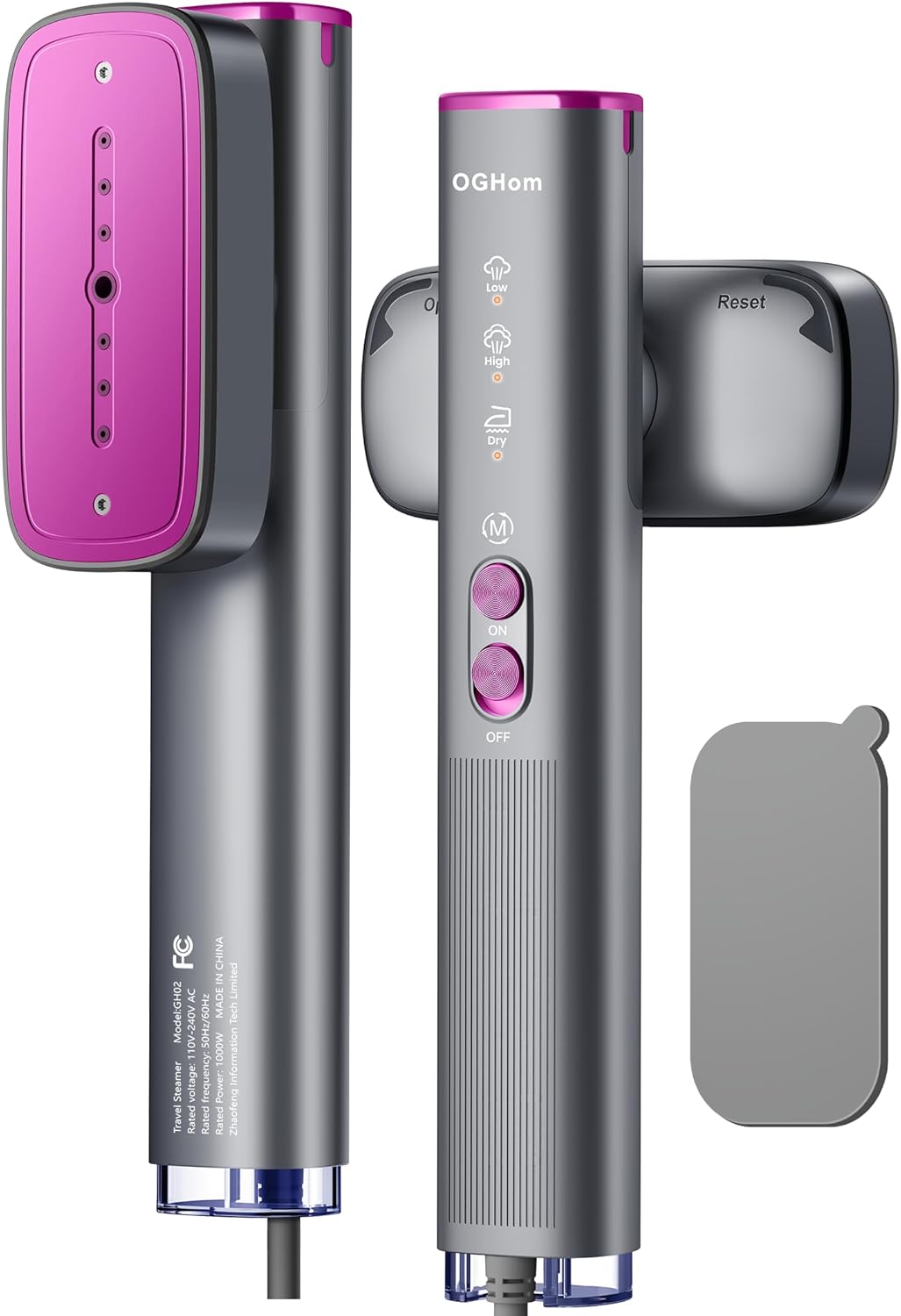
The GH02 uses a removable 120 ml tank with a one-button pop-out design for refilling. It offers dry, low-steam, and high-steam modes with a 90-degree rotating head. The listing specifies 110-240V operation and a leak-proof tank design for multi-angle use.
Check On AmazonIf you click this link and buy, we earn a commission at no additional cost to you.
Compare readiness without assuming the smaller steamer always starts faster
Compact size often gets associated with quick heat-up, but architecture alone does not establish readiness time. Heater design, water path, steam setting, standby behavior, and control logic vary by model. A standing unit can be ready quickly, while a handheld may still need additional time before it produces the steam quality you expect. Treat the manufacturer’s stated readiness information as a model-specific specification, not a rule for an entire format.
More importantly, readiness includes the steps before and after the heater comes on. A handheld may only need a hanger and an outlet, while a standing system may require extending a pole, arranging a hose, positioning a garment support, and placing the base where the cord is not in the way. If the standing system remains assembled, much of that setup disappears from later sessions. That is why a steamer that technically heats faster can still feel slower in a real household routine.

This 1200-watt handheld steamer is listed with a 15-second heat-up and a 140 ml tank. Its LED touch control provides five fabric settings, including dry and multiple steam levels. The design supports both flat ironing and vertical steaming for different garment-care routines.
Check On AmazonIf you click this link and buy, we earn a commission at no additional cost to you.
Compare arm weight, head control, hose drag, pole stability, and mobility
Handheld comfort depends heavily on filled weight and balance. The steamer may feel manageable in a store or when empty, yet the same body becomes more demanding once the tank is full and you are working across a long dress or several garments. Controls also matter because a trigger that is awkward to hold can become irritating during continuous use. Look for the exact operating posture the design requires rather than relying on the product’s empty weight or compact appearance.
Standing systems shift the burden to different points. The steam head may be lighter, but the hose can resist movement, the pole can flex if the garment is pulled against it, and the base may be awkward to relocate around furniture. Wheels only help when the loaded unit rolls well on your floor and the cord and hose do not create new obstacles. Comparing handheld and upright garment steamers is therefore a choice between different kinds of handling, not between effort and no effort.
Include hose condensation, tank seals, draining, and post-use water handling
Standing steamers add a hose, and hoses can collect condensation as steam travels through them. Manufacturer documentation for standing units specifically warns that condensed water in the hose can contribute to droplets and that hose position can matter. That does not mean every upright steamer will spit water, but it does mean hose routing is part of normal ownership rather than a detail to ignore. A bent or low loop can behave differently from a hose kept in the position described by the exact manual.
Tank installation matters as well. Official support information for full-size steamers ties some leaks to a tank that is not seated correctly or a valve that is not properly closed, and it links reduced steam to mineral buildup. That makes draining, tank access, and maintenance part of the architecture decision, especially if the unit will be stored with the hose and tank attached. Follow the exact manual for water type, emptying, descaling, and cooling because these instructions vary, and stop using a unit with a damaged cord, electrical-area leakage, smoke, burning odor, or uncontrolled operation.

This foldable handheld steamer uses a 1000-watt heater and is listed with a 30-second heat-up. An electronic pump supports leak-resistant steaming at multiple angles, including upside down. It is a 120V-only model and includes a storage bag for compact packing.
Check On AmazonIf you click this link and buy, we earn a commission at no additional cost to you.
Choose between cabinet storage and a permanent floor footprint
A handheld usually earns its place by disappearing when the job is done. If it fits in a drawer, cabinet, laundry shelf, or small basket near the clothes you steam, the routine can stay simple. Storage still needs enough room for the cord, attachments, and a tank that may need to dry before being enclosed. A compact appliance that gets buried behind other items can lose much of the convenience that justified buying it.
A standing unit works best when its footprint is accepted rather than fought. Measure the base, the pole height, the space needed for the hose to hang without a tight bend, and the clearance required to remove or refill the tank. Also decide whether it can remain assembled, because repeatedly collapsing and rebuilding a full-size steamer may erase the advantage of its longer-session design. If there is no realistic parking spot near an outlet and hanging area, floor-space friction can outweigh the larger tank.
| Storage check | Handheld | Standing or upright |
|---|---|---|
| Primary space | Drawer, cabinet, shelf, or basket | Floor area plus vertical pole clearance |
| Access during use | Room for the unit, cord, and nearby hanger | Room for the base, hose movement, garment support, and cord path |
| After-use burden | Cooling, emptying when required, drying, and cord storage | Cooling, tank handling, hose positioning, draining when required, and deciding whether to leave it assembled |
| Best fit | Storage is tight and sessions are short | A dedicated parking spot is realistic and longer sessions are common |
Measure the storage path as well as the resting footprint. A standing unit that technically fits in a closet can still be inconvenient if it must be carried around a door, detached from its hose, or rebuilt before every use. A handheld that fits neatly but lives behind heavier appliances can create the same kind of friction. Storage only counts as convenient when access is convenient too.

The Conair GSC24 uses 1200 watts and folds flat for more compact storage. Amazon lists dual-voltage operation, a 35-second heat-up, an easy-fill removable water tank, and an adjustable steam head. Its compact handheld design is intended for home, office, and travel use, making it well suited to a storage-focused routine.
Check On AmazonIf you click this link and buy, we earn a commission at no additional cost to you.
Separate everyday handheld convenience from actual travel requirements
A handheld steamer is portable around the house, but that does not automatically make it a good travel steamer. Packing size, leak-resistant storage, voltage compatibility, plug requirements, tank emptying, and the space available in luggage are separate questions. A model can be excellent for moving between a bedroom and laundry area while still being inconvenient or unsuitable for a trip. Treat portability as a physical convenience first, then verify travel requirements independently.
If travel is a major reason for buying, use the dedicated travel garment steamer requirements after deciding that a handheld format suits your home routine. That keeps voltage and luggage constraints from distorting the everyday architecture choice. A household that travels occasionally may prefer a home steamer chosen for regular use and handle trips separately. A frequent traveler may reasonably give packing size and travel compatibility much more weight.

This 1200-watt steamer uses automatic 100-240V voltage adaptation for international travel. It has a 110 ml tank, a 90-degree rotating head, and a listed weight of 1.85 pounds. The package includes a travel bag, heat-resistant base, and 6.56-foot power cord for packing and use away from home.
Check On AmazonIf you click this link and buy, we earn a commission at no additional cost to you.
Choose handheld, choose standing, or keep ironing
Choose a handheld when most sessions are short, storage space is tight, and you value pulling the steamer out with minimal setup. It is also the stronger fit when you would rather refill occasionally than give up permanent floor space. Choose a standing unit when sessions regularly stretch across several garments, carrying a full handheld becomes the larger annoyance, and you have a sensible place to keep the base, pole, and hose. Neither choice is automatically better for wrinkle removal until you compare exact models.
Keeping your current ironing routine is a valid outcome if steaming does not remove enough work. If you mainly need sharp creases, pressed collars, or a finish that depends on pressure against a flat surface, architecture alone will not solve that mismatch. If your routine combines quick wrinkle release with occasional crisp pressing, owning both tools may make more sense than forcing one to replace the other. Use the broader garment steamer buying framework when you need to connect architecture with fabric needs, controls, maintenance, and overall ownership fit.
- Start with session length and storage, not tank size or power claims.
- Then decide whether carried water weight or floor footprint is the bigger repeated burden.
- Use finish expectations as the final gate before choosing a steamer at all.
| If this is true | Move toward | Why |
|---|---|---|
| Most sessions are short and storage space is tight | Handheld | Compact storage and low setup friction matter more than carrying the tank |
| Sessions are regularly longer and carrying the filled unit becomes tiring | Standing or upright | The base carries most of the water while the hand manages the head and hose |
| There is no sensible floor location for a base and pole | Handheld | The standing format creates a daily space problem even if its tank is larger |
| You mainly need crisp creases or pressure-based pressing | Keep ironing | Changing steamer architecture does not solve a finish mismatch |
This sequence keeps the decision anchored to repeated household work. Once the physical layout fits, steam settings, tank design, controls, attachments, and current test performance become useful model-level differentiators. If the layout itself conflicts with your space or session, extra features rarely rescue the purchase. Choose the format first, then compare the exact machine.
After choosing the architecture, compare current home models separately
Once the format fits your routine, compare the details that can still change ownership. Two handheld steamers can differ in filled weight, tank access, control placement, and steam behavior, while two standing units can differ in pole stability, hose management, tank seating, drainage, and mobility. Those differences are where current testing and exact manufacturer documentation become important. They matter because the same architecture can still feel very different from one model to another.
Once you know which format fits your household, the current garment steamer comparison can help with the next shopping step without reopening the architecture decision from scratch. Verify the exact tank system, storage dimensions, operating instructions, and handling details before buying. Avoid assuming that a larger tank, higher power figure, or more premium positioning automatically means a better match. The strongest candidate is the one that performs well within the architecture your routine can actually support.
Final thoughts: match the architecture to the session you actually repeat
The practical split is simple once the marketing language is removed. A handheld keeps setup and storage small but makes you carry the water, while a standing steamer moves the water to a base and asks for more room and hose management. Short sessions usually reward compactness, while longer sessions make refill frequency and carried weight more important. Match those trade-offs to the routine you expect to repeat.
Before buying, picture the full cycle from storage to fill, steaming, refill, draining, cooling, and putting the unit away. Measure where a standing base would live or where a handheld would actually be stored, then verify exact model instructions for tank handling, water, maintenance, and safety. If the routine still looks easier after those checks, you have a useful architecture choice. If it looks like more equipment to manage for the same result, keeping the simpler garment-care method is the better decision.
FAQs
👕 Is a handheld steamer enough for several garments?
It can be, but check the exact tank capacity, filled weight, and refill process rather than assuming all handhelds behave alike. Several lightweight garments may be easy, while a longer session can make refills and arm fatigue more noticeable.
💧 Does a standing garment steamer always run longer?
Standing units commonly use larger base tanks, but usable session length still depends on the exact model, steam setting, and operating behavior. Verify the manufacturer’s tank and runtime information instead of using architecture alone as proof.
🪑 Do I need permanent floor space for an upright steamer?
Not always, but frequent folding and rebuilding can add enough setup friction to cancel some of the format’s convenience. Measure the base, pole, hose, tank access, and storage route before deciding that a closet corner is sufficient.
🧳 Is every handheld garment steamer suitable for travel?
No. Household portability does not prove luggage fit, voltage compatibility, plug compatibility, or leak-resistant packing. Verify those travel-specific requirements for the exact model.
🔥 Is a standing steamer automatically more powerful?
No. Tank size and physical format do not establish wrinkle-removal performance by themselves. Compare current independent testing and exact model specifications after you choose the architecture that fits your routine.
References and Sources
- Good Housekeeping garment steamer testing: supports model-level differences in tank size, refill frequency, ergonomics, and performance across handheld and upright formats.
- Rowenta full-size steamer support: supports tank installation, leak, limescale, water-use, and damaged-cord guidance for a standing steamer system.
- Xiaomi standing steamer manual: supports hose-condensation, hose-position, tank-seal, and owner-level safety guidance for an upright steamer.