The best garment steamers are not simply the machines that score highest in wrinkle-removal testing. A household steaming one shirt has different tank, handling, and storage needs from one working through a weekly batch. Current independent testing points to strong performers, but runtime, filled handling, water care, electrical requirements, and storage still decide the household fit. The picks below are matched to those routines rather than forced into one universal winner.
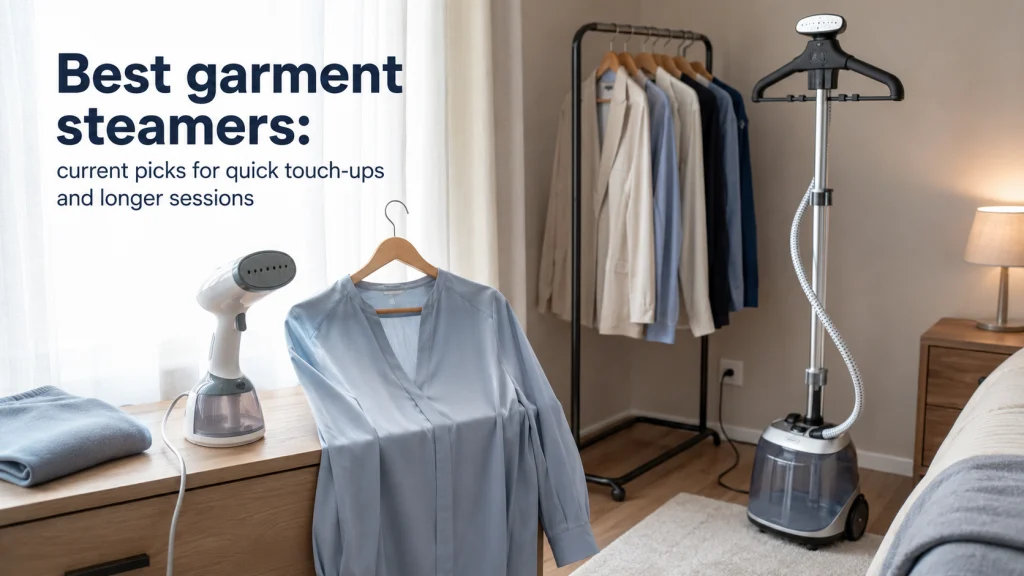
Make every test winner pass the household-fit check
A lab can show that a steamer removes wrinkles well, yet that does not prove it belongs among the best garment steamers for your routine. Current independent testing across multiple fabrics records wrinkle removal, heat-up, runtime, handling, tank use, and spitting, which gives a stronger starting point than wattage alone. A high scorer still has to pass three household checks: normal session size, filled handling, and storage. A machine that clears the performance test but fails those checks is a strong performer in the wrong home.
Handheld and standing machines also create different work. A small handheld can be quick to grab and easy to store, but a short session can turn several garments into repeated refills. A standing unit can reduce refill interruption, yet it needs floor space and becomes much heavier once its large reservoir is filled. If you are still deciding which features matter, start with the garment steamer buying criteria that affect daily use, then return with your normal session already defined. That household-fit filter is what turns a tested steamer into the right choice among garment care products rather than simply the highest-scoring machine.

This handheld steamer is rated at 1150 watts and lists a 15-second heat-up time. Its 2.3-ounce tank and 1.5-pound listed weight suit short touch-up sessions better than long batches. The compact DR2024/DR2024U1 format aligns with readers prioritizing quick setup and storage.
Check On AmazonIf you click this link and buy, we earn a commission at no additional cost to you.
What current independent garment-steamer tests actually measure
Wrinkle removal should be the entry ticket, not the entire ranking. Independent garment-steamer testing evaluates models vertically on fabrics such as linen, silk, cotton, wool, and synthetics, while also checking heat-up, maneuverability, tank behavior, runtime, and steam consistency. The testers record spits and sputters because wet steam can leave fabric damp or spotted even when wrinkles relax. That makes the evidence more useful than a single wattage or steam-output number.
| Evidence field | What it tells you | What it cannot prove alone |
|---|---|---|
| Wrinkle-removal testing | Performance on identified fabrics | Household fit |
| Runtime and refill testing | Tested session length | Garments per fill in your routine |
| Spitting and steam consistency | Moisture control under test conditions | Behavior with every water or maintenance condition |
| Manufacturer specifications | Exact tank, voltage, dimensions, and warranty | Independent wrinkle removal |
Independent textile-lab work reinforces the same principle by assessing steam performance alongside usability, ergonomics, and safety. A high listed steam rate may be useful information, but it does not show how evenly steam reaches fabric or how the machine feels through a session. The best clothes steamers therefore need performance evidence and ownership evidence at the same time. Independent testing narrows the field, while exact-model documentation decides whether a finalist is practical for the household routine you repeat most often.

This 1875-watt handheld model uses a 7.3-ounce water tank and five steam settings. Amazon lists a 40-second heat-up time and up to 20 minutes of runtime. Three included attachments add flexibility for garment and upholstery tasks.
Check On AmazonIf you click this link and buy, we earn a commission at no additional cost to you.
Match the shortlist to finish, session size, handling, and maintenance
Define a normal steaming session before looking at model names. One blouse or work shirt favors fast setup and low carrying weight, while several garments make runtime, refill access, cord reach, and hand fatigue more important. Fabric mix matters because consistent steam can be more useful than maximum output on delicate or structured garments. If compatibility is uncertain, check which fabrics can be steamed and what needs extra caution before buying around a feature you may not use.
| Typical routine | Profile to prioritize | Main ownership check | Likely reason to skip |
|---|---|---|---|
| One or two items | Compact handheld | Filled weight and tank access | Too many refills when sessions grow |
| Several garments | Longer-running handheld | Runtime without excessive wrist load | Awkward full-tank balance |
| Regular batch work | Standing or floor-based unit | Floor space, hose, and refill path | Too bulky for occasional touch-ups |
| Crisp creases and pressed seams | Reconsider the tool type | Required finish | An iron may fit better |
Storage and maintenance complete the profile. A handheld needs shelf space and a safe cooling spot, while an upright needs floor area plus room for its pole, hose, cord, and hanger. Larger tanks reduce refill frequency but leave more water to manage under the exact manual. Once the architecture fits, compare models inside that lane instead of making a compact touch-up tool compete with a batch machine on capacity alone.

This handheld steamer uses a 260 ml detachable water tank and 1200-watt heating system. Amazon lists a 30-second heat-up time and about 15 minutes of continuous steaming per fill. That capacity and handheld format make it a practical fit for several-item sessions without moving to a floor-standing unit.
Check On AmazonIf you click this link and buy, we earn a commission at no additional cost to you.
Use recommendation profiles that match the household routine
A recommendation should describe the household before it names the machine. That keeps a broad “best” label from erasing the difference between a one-garment touch-up and a longer session. The profiles below use current independent performance evidence without turning unlike steamers into one ranking. Pick the routine that happens most often before comparing model names.
- Normal number of garments per session
- Whether the steamer is carried while full
- Available shelf, drawer, or floor storage
- Need for quick use versus uninterrupted batch work
- Fabric instructions and desired finish
- Water, cooling, emptying, and scale care
Decide what would make you reject a model before looking at price or attachments. A small tank is acceptable when storage and light handling matter more than long runtime, while a floor unit is reasonable when batch use is frequent and it can stay assembled. The aim is to remove the interruption you notice most often without creating a larger storage or handling problem. That makes each profile a gate rather than another feature checklist.
Quick one-to-two-item handheld profile
This profile favors low carried weight, fast setup, and a body that stores easily after one garment. A modest tank is fine because the session usually ends before refilling becomes the main annoyance. The best fit is a proven performer that finishes the short job without making capacity the priority.
Longer-session handheld profile
This profile needs enough tested runtime for several garments while keeping the machine practical to hold. More water extends the session but also stays in the same hand that guides the steamer. Continuous steam, cord reach, tank removal, and balance therefore matter more than simply choosing the biggest handheld reservoir.
Standing batch profile
Batch use changes the equation because most water weight stays on the floor instead of in the working hand. A standing unit earns its space when longer sessions make fewer refills and an integrated pole or hanger genuinely useful. If it must be lifted from storage for every shirt, much of that advantage disappears.
Value profile only when performance evidence supports it
Value starts with adequate wrinkle removal, not a low price. Repeated passes, awkward handling, or constant refilling can erase a small purchase-price advantage. Let price break a tie between models that already fit the session instead of using it to excuse weak performance or the wrong architecture.

This handheld steamer is rated at 1100 watts and has a 300 ml tank. Amazon lists a 30-second heat-up time and a no-leak design. It is specified for 120-volt use only, making the electrical limitation important when matching a recommendation profile to the household.
Check On AmazonIf you click this link and buy, we earn a commission at no additional cost to you.
Compare the strongest current garment-steamer candidates
The five models below have enough current evidence to compare handheld and standing trade-offs without turning the page into a long leaderboard. Wrinkle-removal results show performance, while exact specifications show whether the same model fits the session, storage space, and electrical setup at home. Those are different questions, and a strong answer needs both. Availability can change, so verify the exact model number before purchase.
| Current candidate | What the evidence shows | Session fit | Main friction | Who should skip |
|---|---|---|---|---|
| Rowenta Pure Pop DR2024U1 | Independent testing supports quick touch-ups; manufacturer specifications list a 2.4 oz tank and 1.57 lb weight | One or two items | Short session | Regular batch users |
| Conair ExtremeSteam GS14 | Independent testing gave it the top wrinkle-removal result in that test set; current U.S. specifications identify a 6.76 oz tank | Longer handheld sessions | No included attachments in the tested configuration | Buyers needing confirmed dual voltage |
| Electrolux LX15002 handheld steamer | Independent testing found fast wrinkle removal; current U.S. specifications list a 10 oz tank and 12 ft cord | Several-item handheld sessions | Heavier body; some test condensation | Buyers prioritizing minimum hand weight |
| Reliable Vivio 500GC | Independent testing found long upright runtime; manufacturer specifications list a 1 gal tank, wheels, and 13 lb dry weight | Regular batch work | Large footprint and filled weight | Occasional users without floor storage |
| SALAV GS18-DJ standing steamer | Independent testing found effective wrinkle removal; current U.S. specifications identify a 1.8 L tank, hanger, and wheels | Longer standing sessions | Stiff hose and occasional test sputtering | Buyers wanting minimal floor gear |
This remains a filtered shortlist rather than a catalog of every tested steamer. Keep runtime and steam-behavior findings attached to the test that produced them because settings and stop criteria can differ. A model appearing in a strong test still does not erase a mismatch such as wrist weight, floor storage, or refill frequency. Use performance evidence to keep a candidate, then use exact documentation to decide whether it belongs in the home.

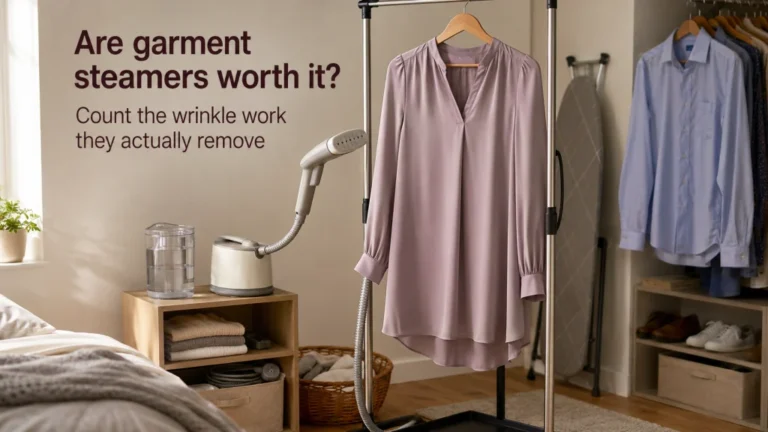
This standing garment steamer uses a 1500-watt heating system and offers four steam settings. Amazon lists a 1.5-liter water tank and wheels, supporting longer stationary sessions with easier movement. Two descaler packets are included for maintenance support.
Check On AmazonIf you click this link and buy, we earn a commission at no additional cost to you.
Put each model through both performance and ownership filters
A current pick deserves its place only when the benefit is stronger than the ownership friction for the intended routine. This pass names what can disqualify each finalist after performance is proven. The same winner can fit one household and fail another. Performance gets a model considered; the friction below decides whether it survives.
Rowenta Pure Pop DR2024U1
- Reason to consider: compact handling and a removable tank suit quick touch-ups.
- Main friction: the small reservoir brings refill breaks quickly as the session grows.
- Who should skip: regular batch users should not choose compactness when refilling is already the problem.
Conair ExtremeSteam GS14
- Reason to consider: strong wrinkle-removal evidence and longer tested runtime make it a capable handheld.
- Filled handling: the 6.76-ounce reservoir extends runtime but stays in the working hand.
- Who should skip: travelers should not assume dual voltage because current U.S. documentation identifies 110 to 120 volt input and says the GS14 is not dual voltage.
Electrolux LX15002 handheld steamer
- Reason to consider: Independent testing found fast wrinkle removal, and the 10-ounce tank plus long cord suit several items.
- Filled handling: ten ounces of water adds over half a pound before steaming begins.
- Who should skip: short-session users or buyers with low weight tolerance may prefer a smaller handheld.
Reliable Vivio 500GC
- Reason to consider: the one-gallon reservoir, wheeled base, hanger, and long tested session suit batch work.
- Filled handling: a gallon of water adds over eight pounds to the listed 13-pound dry machine, so rolling matters.
- Who should skip: one-item users or households without ready floor storage will keep capacity they rarely use.
SALAV GS18-DJ standing steamer
- Reason to consider: Independent testing found effective wrinkle removal, while the folding hanger and pole help with storage.
- Main friction: the test noted a stiff hose and occasional sputtering.
- Who should skip: buyers who want minimal equipment around the garment may prefer a proven handheld.
Performance evidence and exact specifications should stay separate because they answer different parts of the buying decision. Wrinkle removal and runtime tell you what happened under test conditions, while tank size, voltage, weight, and storage dimensions tell you what ownership will demand. Water weight is separated from dry weight because it changes handheld fatigue and floor-unit mobility differently. If the skip description fits your home, remove that model before comparing price.

This full-size upright steamer uses a 1500-watt heating system and a removable 1.8-liter water tank. Amazon lists more than 60 minutes of continuous steam, rolling wheels, a telescopic support pole, and foot-pedal controls. The floor-based setup fits regular batch work where longer sessions justify dedicated storage space.
Check On AmazonIf you click this link and buy, we earn a commission at no additional cost to you.
Compare steam consistency and water spotting before wattage
Wattage is an electrical input specification, not a wrinkle-removal score. Independent testing is stronger evidence because it can show whether a model smooths identified fabrics, maintains useful steam, and avoids excessive wetting under defined conditions. Independent tests record spitting and sputtering while also separating steam performance from usability and safety. That is a better comparison than assuming the largest wattage number must produce the best finish.
| Performance evidence | Ownership translation | Wrong shortcut |
|---|---|---|
| Strong wrinkle removal | Keep the model on the shortlist | Assume it fits every session |
| Controlled steam | Less observed wetting under test conditions | Ignore water choice and maintenance |
| High wattage or steam output | Verify as a specification | Rank by the largest number |
| Long measured runtime | Potentially fewer refills | Ignore filled weight and storage |
Water behavior still has an ownership side because orientation, heat state, mineral buildup, and maintenance can change what happens after purchase. A clean lab result is not a lifetime guarantee, so follow the exact manual for water and cleaning instead of applying one universal rule. If a steamer leaks into electrical areas, has a damaged cord, produces a burning odor, or behaves abnormally, stop using it and follow the manufacturer’s service path. Electrical or heat-related faults are service questions, not cleaning experiments.

This VALET model is a handheld garment steamer with a removable tank. Amazon describes it as quick-heating and travel-friendly, with steam-based care that does not require added chemicals. Its compact handheld format gives readers another way to compare steam delivery and water handling without using wattage alone.
Check On AmazonIf you click this link and buy, we earn a commission at no additional cost to you.
Treat tank access, continuous steam, attachments, and storage as workflow fields
Convenience features matter only when they remove work from a routine you repeat. A removable tank can simplify filling, continuous steam can reduce finger fatigue, and an integrated hanger can help batch work, but none is automatically an upgrade. A small handheld tank favors quick handling, a larger handheld stretches the session, and a floor reservoir moves water weight out of the working hand. Electrolux and SALAV make that contrast clearer without turning capacity into a quality ranking.
| Workflow field | Useful when | Hidden cost to check |
|---|---|---|
| Removable tank | Sink filling matters | Small reservoirs can still mean repeated trips |
| Continuous steam | Trigger fatigue matters | Steam must be deliberately controlled |
| Attachments | You repeatedly use the matching fabric task | Storage and exact-fabric compatibility |
| Hanger and wheels | Batch work happens in one area | Permanent floor footprint |
Attachments and storage deserve the same skepticism as performance features. A brush or lint pad matters only if it matches garments you actually steam, while a standing unit needs room for the hose, pole, cord, hanger, and cooling path rather than only its base. Measure the real storage path before purchase instead of planning to solve it later. If architecture is still unsettled, the handheld versus standing garment steamer comparison handles that decision in more depth.

This metal garment rack uses two hanging rods and rolls on wheels. The open rack format gives steamed garments a place to hang during a multi-item session instead of crowding a small work surface. It is contextually useful for readers evaluating hanger access, workflow, and the floor space required around batch steaming.
Check On AmazonIf you click this link and buy, we earn a commission at no additional cost to you.
Verify water guidance, electrical requirements, warranty, and U.S. availability last
After performance and routine fit narrow the shortlist, verify the exact variant. The Rowenta Pure Pop DR2024U1 manual specifies 120-volt use and untreated tap water, rejects pure distilled or pure demineralized water, and gives a mixed-water instruction for very hard water. Rowenta’s U.S. warranty terms list a one-year warranty for electrical appliances. The Reliable Vivio 500GC manual permits regular tap or distilled water, while its U.S. specifications list 110 volts, 12 amps, a one-gallon tank, and a three-year limited warranty. These are model-level ownership requirements, not generic steamer rules.
| Model | Water guidance status | Electrical check | Warranty source |
|---|---|---|---|
| Rowenta Pure Pop DR2024U1 | Exact manual gives tap-water guidance | 120 V | Rowenta U.S. warranty terms |
| Conair ExtremeSteam GS14 | Retail Q&A is inconsistent; verify the exact booklet | 110 to 120 V; not dual voltage per brand Q&A | Current GS14 listing |
| Reliable Vivio 500GC | Manual permits regular tap or distilled water | 110 V, 12 A | Reliable support documents |
The Conair GS14 needs more caution because current U.S. documentation verifies the model, voltage, tank, and warranty but shows conflicting water answers in visible Q&A. For Electrolux and SALAV, current U.S. listings verify the product trail and core hardware, but the exact packaged manual should still control water and electrical instructions. Do not borrow guidance from a similar model because the tank or brand looks familiar. All five candidates have current U.S. product or retailer trails, but model numbers, package contents, and availability can change.

The P4400 is an electricity usage monitor for plug-in devices. Amazon lists a 115-volt rating and 15-amp capacity for this model. It can support an electrical-use check alongside the appliance manual without replacing the manufacturer’s voltage, water, or warranty requirements.
Check On AmazonIf you click this link and buy, we earn a commission at no additional cost to you.
Keep home-first steamers separate from travel-first electrical needs
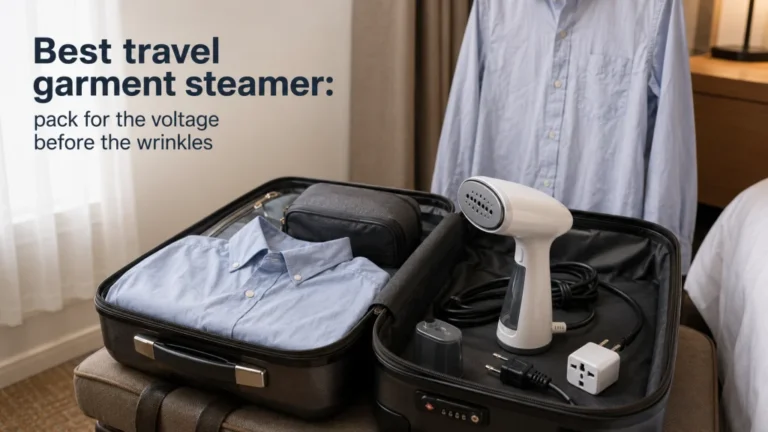
Compact does not automatically mean internationally travel-ready. A handheld may fit easily in luggage and still be designed only for North American household voltage, so packing size and electrical compatibility need separate checks. The Conair GS14 illustrates the problem: its body is compact, but current U.S. documentation identifies 110 to 120 volt input and says it is not dual voltage. Buying it for home use and later assuming it will work anywhere can turn a storage advantage into an electrical mismatch.
Travel-first selection adds voltage design, plug adaptation, hotel-room setup, and luggage limits that do not belong in this home shortlist. Those questions are handled separately in the current travel garment steamer comparison, where electrical fit can carry more weight than home storage convenience. For home use, prioritize the machine that fits the repeated session rather than rewarding a travel label you may never need. For travel use, verify the exact electrical specification because a plug adapter changes plug shape and does not automatically change voltage.

The Conair GSC24 is a 1200-watt handheld garment steamer with dual-voltage support for worldwide use. Amazon lists a 35-second heat time, 80 ml capacity, and 1.7-pound item weight. That combination makes it useful for showing why compact travel intent and electrical compatibility must be checked separately.
Check On AmazonIf you click this link and buy, we earn a commission at no additional cost to you.
Settle handheld versus standing and steamer versus iron before choosing
Model comparison is the wrong final step if the product type itself is unsettled. A handheld is usually easier to store and deploy, while a standing steamer trades floor space for a larger reservoir, stable base, and batch-friendly setup. Neither architecture is automatically better, so normal session size and storage should decide before features do. If your routine still sits between them, use the handheld and standing steamer decision instead of letting a current feature list choose the architecture.
The iron question matters because steamers and irons create different finishes. Steamers are convenient for relaxing wrinkles on hanging garments, soft fabrics, knits, dresses, and awkward shapes, while an iron is better suited to crisp collars, sharp trouser creases, and pressed seams. If you are unsure whether a steamer earns space at all, the practical test in when a garment steamer is worth owning is more useful than choosing a model first. The best clothes steamer is still the wrong purchase if the household actually needs pressing rather than steaming.

This steam iron uses a stainless steel soleplate with a precision tip. Amazon lists vertical steam and automatic shutoff among its features. It gives readers a direct alternative when the desired finish calls for pressing and crisp creases rather than wrinkle relaxation from a steamer.
Check On AmazonIf you click this link and buy, we earn a commission at no additional cost to you.
Final thoughts: choose the tested steamer whose session fits the household
Start with independent wrinkle-removal evidence, then make each finalist earn its place through session size, filled handling, storage, fabric compatibility, and maintenance. The expanded shortlist covers compact and longer-running handhelds plus two standing approaches, enough to show the real architecture trade-offs without copying a long leaderboard. Rowenta, Conair, and Electrolux represent different handheld compromises. Reliable and SALAV make more sense when batch use justifies floor equipment.
The final choice should remove the interruption you notice most often. If refilling is the problem, accept more tank only after checking added hand weight or floor space. If setup and storage are the problem, a shorter session may be the better compromise. Keep water, voltage, fabric, and maintenance instructions tied to the exact model because those rules are not universal.

This handheld garment steamer uses a 1200-watt heating system and an aluminum heating plate. Amazon lists a fast heat-up design and a large detachable water tank. It is specified for 120-volt use only, making it a home-oriented option for readers prioritizing compact storage and routine touch-ups.
Check On AmazonIf you click this link and buy, we earn a commission at no additional cost to you.

This compact 2-in-1 steamer and iron supports 100-220V input and automatically adapts across that range. Amazon lists a 15-second heat-up time and a large ceramic heat panel for vertical steaming or flat ironing. The wide-voltage design makes it a better fit for the article’s travel-electrical profile than a compact 120V-only home steamer.
Check On AmazonIf you click this link and buy, we earn a commission at no additional cost to you.
FAQs
👕 Which garment steamer is better for one or two items at a time?
A compact handheld usually fits because setup, filled weight, and storage matter more than maximum tank size. Choose verified wrinkle removal and enough runtime for the normal short session.
🧺 Is a standing garment steamer worth it for a weekly batch?
It can be if the larger reservoir reduces refills and you have convenient floor space. For one-item sessions, the storage burden may outweigh the capacity advantage.
💧 Should I use distilled water in a garment steamer?
Do not use one universal rule. Water instructions differ by model, so follow the exact manual rather than another steamer’s guidance.
⚡ Does higher wattage mean a garment steamer removes wrinkles better?
No. Wattage is an input specification; independent testing is better evidence for wrinkle removal, steam consistency, runtime, and spitting.
🧳 Can I take a compact home steamer overseas?
Only if the exact electrical specification supports the destination. Compact size does not prove dual voltage, and a plug adapter does not convert voltage.
👔 Is a garment steamer better than an iron for crisp clothes?
Not usually for sharp creases, pressed seams, or crisp collars because an iron adds pressure. A steamer is usually better for softer finishes and hanging garments.
References and Sources
- Good Housekeeping garment-steamer testing: Supports wrinkle-removal, runtime, handling, and spitting observations.
- Testfakta independent testing: Supports independent textile-lab performance and usability testing.
- Rowenta Pure Pop DR2024U1: Verifies U.S. model specifications and manual access.
- Conair ExtremeSteam GS14 listing: Verifies GS14 model, tank, weight, voltage, and warranty details.
- Reliable Vivio 500GC specifications: Verifies tank, weight, electrical requirements, and warranty.
- Reliable fabric-care support: Provides Vivio manual and warranty documents.
- HGTV garment-steamer testing: Supports Electrolux and SALAV performance and handling observations.
- Electrolux LX15002 listing: Verifies the U.S. model trail, tank, cord, and safety features.
- SALAV GS18-DJ listing: Verifies the U.S. model trail, tank, pole, hanger, and wheels.