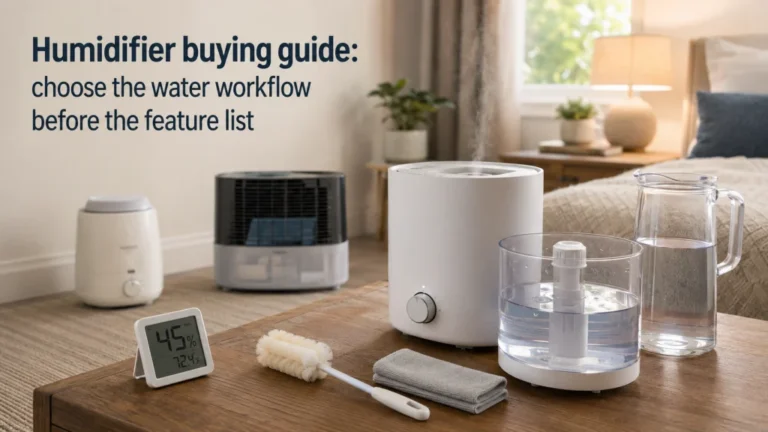
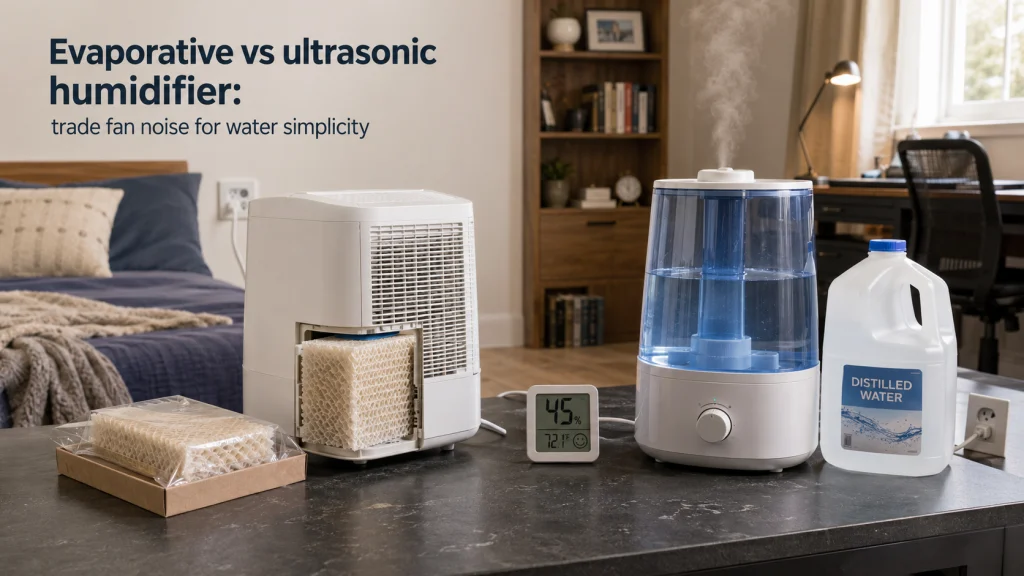
Evaporative and ultrasonic humidifiers both add cool moisture, but they shift ownership work in different directions. Ultrasonic designs can avoid a replaceable wick, yet mineral-rich water can create a distilled-water habit; evaporative designs keep more mineral residue in wet media that eventually needs attention. Noise, cleaning, room demand, controls, and exact water instructions still matter. The better choice is the routine you can maintain consistently, not the cleaner feature label.
Start with the recurring burden, not the feature label
An evaporative vs ultrasonic humidifier decision can look like a choice between a filter drawer and a filter-free box, but that hides the recurring work. An ultrasonic unit can create a distilled-water habit when mineral-rich water leaves residue, while an evaporative unit can shift the burden into replacement media. Neither system is automatically cheaper or easier once water, cleaning, noise, and supplies are counted over a full ownership routine. The useful question is which recurring burden your household will actually maintain without cutting corners.
This comparison assumes you have already chosen cool mist and are deciding between its two common architectures. If heat is still part of the decision, start with the cool mist vs warm mist humidifier comparison. For capacity, room fit, controls, and broader ownership checks, use the humidifier buying guide. Here, the focus is what changes when moisture comes from a wet wick and fan rather than ultrasonic atomization.

One gallon of distilled water gives ultrasonic owners a straightforward low-mineral refill option when the humidifier manual permits distilled water. The gallon format makes weekly water use and storage burden easy to estimate. It fits this section because the article asks readers to judge recurring water handling before choosing a technology.
Check On AmazonIf you click this link and buy, we earn a commission at no additional cost to you.
How evaporative and ultrasonic cool-mist systems work
An evaporative humidifier moves air across wet absorbent media, commonly a wick or filter, so water enters the room as vapor without a visible plume. The fan is part of the mechanism because airflow across the wet surface increases evaporation. Dissolved minerals tend to remain in the reservoir or wick rather than traveling with that vapor. The wick therefore becomes a maintenance and replacement item even when room surfaces avoid the powdery residue associated with some ultrasonic use.
An ultrasonic humidifier uses a rapidly vibrating element to break tank water into very small droplets and send that mist into the room. It can work without the same wick-and-fan arrangement, which helps explain why many ultrasonic units are compact and quiet. Those droplets can also carry dissolved minerals that were present in the tank water. The mechanism matters because it predicts what you will refill, clean, hear, replace, and possibly wipe from nearby surfaces.

DREO's 3-liter top-fill model uses cool-mist ultrasonic humidification and is rated for up to 30 hours of runtime. The listing specifies 250 mL per hour mist output and coverage up to 300 square feet. Its ultrasonic architecture makes it a concrete example of the mist-producing mechanism described in this section.
Check On AmazonIf you click this link and buy, we earn a commission at no additional cost to you.
What each system actually sends into the room
The visual difference is obvious, but the physical distinction matters more for ownership. Evaporative systems transfer moisture from a wet surface into moving air, leaving much of the dissolved mineral load in the media or reservoir. Ultrasonic systems create mist from the tank water itself, so emitted droplets can contain dissolved material already in that water. EPA guidance specifically distinguishes ultrasonic mineral dispersion from the generally lower mineral dispersion expected from evaporative humidifiers.
Visible mist is not a performance meter, even though it is easy to treat it as one. An ultrasonic plume can look dramatic while an evaporative unit appears inactive, yet invisible vapor does not prove low output. Compare the humidity the unit can maintain under the room’s actual conditions, not how the outlet looks. From there, water quality becomes the first buying fork because it changes what ultrasonic mist may carry and what an evaporative wick must retain.

Amazon's Smart Air Quality Monitor tracks PM2.5, humidity, temperature, VOCs, and carbon monoxide through the Alexa app. A color-coded LED provides an at-a-glance air-quality indication, while the app provides more detail. It gives readers an independent way to observe room conditions instead of judging humidifier performance by visible mist alone.
Check On AmazonIf you click this link and buy, we earn a commission at no additional cost to you.
Make water quality the first buying fork
Water that is perfectly acceptable for household use can still contain enough dissolved minerals to change humidifier ownership. Independent testing has shown that harder water can increase particle output from ultrasonic humidifiers, while EPA guidance recommends low-mineral water to reduce mineral dispersal and scale. That makes the household’s normal fill water more important than a “filter-free” label. Before comparing app controls or tank shape, decide what water you are realistically willing to use for routine refills.
Model instructions still control because cartridges, mineral-control parts, unusual media, or approved water types can change the routine. Softened, filtered, or visually clear water is not automatically equivalent to distilled water for an ultrasonic system because those treatments remove different things. An evaporative design also should not be treated as universal permission to use any tap-water condition. Before buying, identify the fill water, verify the allowed water and media, and price the routine those requirements create.
- Identify whether you plan to fill from tap, distilled water, or another water source allowed by the exact manual.
- Check whether your local water leaves obvious scale on faucets, kettles, or fixtures, which is a useful household clue that mineral loading may matter.
- For ultrasonic use, account for the effort of obtaining and storing low-mineral water if the manual or residue problem makes that necessary.
- For evaporative use, confirm the exact wick or filter type, replacement availability, and cleaning instructions before buying.
That list does not replace a water test or product manual. It exposes the ownership choice before purchase. If one path demands storage or upkeep you will avoid, that friction matters now. The routine you can maintain is the stronger candidate.
Ultrasonic: account for mineral dispersion and white dust
With ultrasonic humidification, minerals in the fill water can leave with the mist and settle as pale residue on nearby surfaces. The amount varies with water, output, runtime, room conditions, and the unit, so not every ultrasonic setup creates the same white dust. Suitably low-mineral water can reduce that load, but it adds supply and storage work to the purchase decision. If residue is already appearing, use the humidifier white dust troubleshooting article instead of turning this comparison into a cleanup manual.
Evaporative: account for wick loading and replacement
Evaporative media keeps much of the mineral load in the wet path rather than atomizing it into the room. Those minerals can stiffen or discolor the wick and reduce how well water and air move through it. Replacement timing therefore depends on water quality, use, media, and manufacturer instructions rather than a universal calendar. This trade works only if inspecting and replacing the correct wick feels easier than managing the alternative water routine.

HM Digital's TDS-3 measures total dissolved solids from 0 to 9,990 ppm and provides 1 ppm resolution in the lower range. It includes a hold function, built-in temperature readout, and carrying case. It is useful for comparing fill-water readings, but it does not replace the humidifier manual or a hardness-specific water test.
Check On AmazonIf you click this link and buy, we earn a commission at no additional cost to you.
Compare distilled-water cost with wick cost, not purchase price alone
The recurring-cost comparison is easy to skip. Ultrasonic ownership may shift spending toward water handling, while evaporative ownership may shift it toward wicks or filters. Neither cost follows from the technology name because use, local prices, media life, and runtime vary. Start with expected water throughput and the replacement schedule for the exact unit.
Occasional bedroom use can cost very differently from long daily operation in a larger space. Storage still matters because both water supplies and replacement media need a place to live. Count carrying, restocking, ordering, and keeping the right supplies available. A cheaper routine on paper can be the worse fit if it repeatedly interrupts use.
| Cost input to record | Ultrasonic routine | Evaporative routine |
|---|---|---|
| Water used in a normal week | Multiply by the cost of the water type you will actually use | Record normal fill volume and any manual-approved water requirement |
| Recurring media | Record any cartridge or mineral-control part required by the exact unit | Record exact wick or filter price and realistic replacement frequency |
| Storage burden | Space for water containers or treatment supplies | Space for clean replacement wicks or filters |
| Routine friction | Buying, carrying, filling, and disposing of containers when applicable | Inspecting, cleaning, ordering, and changing wet media |
Use this worksheet with your own prices, not a national average. Local water and replacement costs are what matter. The goal is not to crown one technology cheaper. It is to expose which recurring input will matter more in your household.

Pure Life Water Distilled comes in a 128-fluid-ounce container, giving a clear gallon-size unit for tracking refill consumption. That fixed container size makes it easy to estimate how many jugs a normal week of ultrasonic use would consume. It supports the section's recurring-cost worksheet without assuming that every ultrasonic model requires distilled water.
Check On AmazonIf you click this link and buy, we earn a commission at no additional cost to you.
Treat fan noise and ultrasonic quiet as model-level questions
Evaporative humidifiers have an unavoidable noise source because a fan moves air through wet media. Lower settings may fade into a living area, while higher settings can become noticeable near a bed or desk. That does not make every evaporative unit loud, since fan design, speed, cabinet resonance, and distance vary. Evaluate noise at the output setting you expect to use, not only at the quietest advertised mode.
Ultrasonic atomization avoids that same wick-driving airflow path in many designs, so low mechanical noise is a common reason to choose it. Still, “silent” is too strong because water movement, pumps, vibration, or auxiliary airflow can be audible. For sleep or focused work, look for measured sound at more than one operating level and compare it with output at those levels. A quiet setting that cannot keep up with the room may not solve the actual problem.
| Ownership issue | Evaporative tendency | Ultrasonic tendency |
|---|---|---|
| White mineral residue | More mineral load usually remains in the wet media | Mineral-rich water can increase residue and airborne particle output |
| Noise | Fan sound is part of normal operation | Atomization can be very quiet, but exact unit noise still varies |
| Cleaning focus | Reservoir, wet media area, fan path, and mineral buildup | Reservoir, atomizing area, scale, seams, and mist path |
| Recurring supply | Often wick or filter replacement | Potential low-mineral water habit plus any model-specific cartridge |
The matrix describes tendencies rather than promises. Exact noise and residue control can change with product architecture. Maintenance and supplied parts can change too. Make the final check on the product page and in the manual for the exact unit you are considering.

TopTes TS-501B measures sound from 30 to 130 dB and supports both A and C weighting. Its 2.25-inch backlit display includes MAX, MIN, and data-hold functions for comparing operating levels. It gives readers a practical way to compare humidifier noise at the settings and distances they actually expect to use.
Check On AmazonIf you click this link and buy, we earn a commission at no additional cost to you.
Compare cleaning geometry and standing-water maintenance
Both technologies still hold water, so neither escapes routine cleaning simply by using a different moisture mechanism. EPA guidance emphasizes regular emptying, drying, refilling, and cleaning of portable humidifiers, with the exact manufacturer’s directions taking priority. The practical difference is where residue and wet surfaces accumulate and how easy those areas are to reach. A wide tank opening, removable tray, simple corners, and accessible moisture path can matter more to weekly ownership than a long feature list.
Ultrasonic cleaning often centers on the tank, base, atomizing area, mineral scale, and any narrow channels that remain wet. Evaporative cleaning adds the wick compartment and the condition of the wet media, while the fan and air path can also collect ordinary household dust over time. Do not add household chemicals, bacteriostatic treatments, or improvised descaling methods unless the exact manual allows them, because compatible cleaning methods vary. When choosing between two otherwise suitable designs, inspect the fill opening and removable parts as carefully as the control panel because the harder unit to clean is the one most likely to have maintenance deferred.

OXO's two-piece Deep Clean Brush Set pairs a larger scrub brush with a smaller detail brush for tight spaces. The small brush includes a wiper blade for crevices, while both use nylon scrubbing bristles. For humidifier maintenance, use the brushes only on surfaces and parts the exact appliance manual permits you to brush.
Check On AmazonIf you click this link and buy, we earn a commission at no additional cost to you.
Size output and controls to the room without using visible mist as proof
Room size labels are a starting point, not proof that a humidifier will maintain the humidity you want. Air exchange, ceiling height, heating, starting humidity, and open doors can all change required output. An ultrasonic plume may look stronger because it is visible, while evaporative moisture may not be visible at all. Compare documented output, room role, refill burden, and control behavior instead of judging performance by appearance.
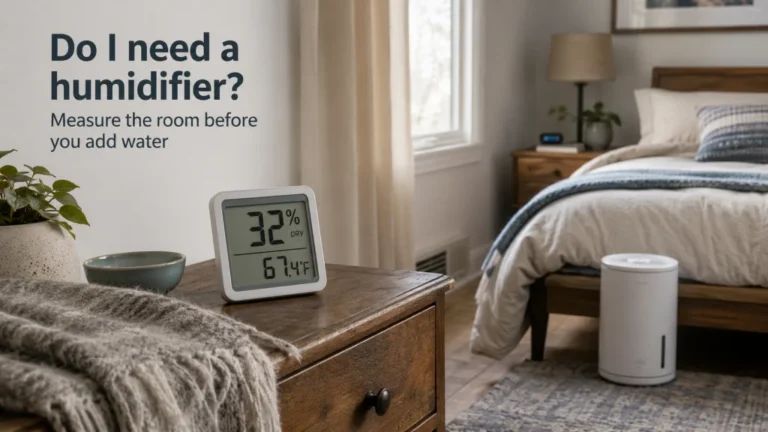
Controls matter because maximum output is not always what you want running continuously. A humidistat or automatic mode can reduce intervention, but sensor location and control logic vary by product. A separate hygrometer can check the room instead of assuming the machine display represents the whole space. For broader sizing and placement choices, the site’s heating, cooling, and air quality equipment coverage keeps the decision tied to room conditions rather than mist appearance.

TempPro's TP50 displays current indoor humidity and temperature along with recorded high and low values. It updates readings every 10 seconds and includes a tabletop stand plus magnetic back for flexible placement. As a separate room hygrometer, it helps check actual room conditions instead of relying only on the humidifier's built-in display.
Check On AmazonIf you click this link and buy, we earn a commission at no additional cost to you.
Do not confuse evaporative self-limiting behavior with humidity control
Evaporation tends to slow as surrounding air becomes more humid, giving evaporative systems a self-limiting characteristic. That tendency is sometimes marketed as “self-regulating,” but it is not the same as a humidistat measuring the room and holding a chosen level. Fan speed, wet surface area, airflow, and local conditions still affect moisture output. Treat the behavior as a useful mechanism trait, not permission to stop measuring humidity.
Ultrasonic output does not depend on evaporation from a wick, so automatic control matters when a unit can add moisture faster than the room loses it. EPA guidance warns against excessive indoor humidity and recommends responding to condensation or dampness. Either technology therefore needs a plan for monitoring the room, adjusting output, and noticing wet surfaces. A built-in humidistat can reduce manual work, but it does not replace checking actual room conditions.

Govee's H5075 monitors indoor temperature and humidity and connects to a phone over Bluetooth at up to 164 feet under listed conditions. The app supports alerts plus up to two years of data storage and export. That combination is useful for watching how humidity changes over time instead of treating evaporative self-limiting behavior as closed-loop control.
Check On AmazonIf you click this link and buy, we earn a commission at no additional cost to you.
Compare energy with actual wattage and runtime, not technology slogans
It is tempting to call ultrasonic units more efficient because they can create mist without a large fan, but useful cost comparisons need the exact model. Fan size, motor speed, electronics, pumps, controls, and runtime all affect electricity use. Two appliances using the same technology can therefore draw different power and run for different lengths of time. Use listed wattage or traceable measured consumption, then combine it with realistic runtime.
Energy can be a smaller ownership cost than the supplies and handling that dominate day-to-day use, so do not optimize the least important line item first. A modest power advantage matters less if the chosen unit creates a refill or replacement routine that keeps interrupting normal use. Compare electricity after room capacity, noise tolerance, maintenance access, and recurring supplies are settled. If energy use is materially different between the exact candidates, it becomes a legitimate tiebreaker rather than a generic technology claim.

MECHEER's PMP-N-1 plug-in watt meter displays power, energy use, voltage, current, frequency, power factor, unit price, and total cost across eight modes. Its backlit LCD lets a reader compare both instantaneous wattage and accumulated electricity use from a standard US outlet. That makes it a direct tool for comparing actual model consumption and runtime instead of relying on technology-wide efficiency slogans.
Check On AmazonIf you click this link and buy, we earn a commission at no additional cost to you.
Separate an existing residue problem from a new buying decision
If you already own an ultrasonic humidifier and see powdery residue, the immediate problem is not choosing between two technologies from scratch. Confirm the water instructions, check whether mineral-rich fill water is contributing, and clean the unit as directed. The white dust troubleshooting path is the more useful next step for that situation. Switching technologies may make sense later, but it should follow the ownership diagnosis rather than a quick reaction to a dusty surface.
If you are still shopping, use this comparison to define requirements before looking at current options. Set limits for water handling, replacement media, fan noise, cleaning access, room role, tank handling, and humidity controls. Only then should current product availability enter the conversation, and the current humidifier comparisons can be filtered by needs that actually matter. That sequence keeps a quiet or filter-free label from making the decision before the ownership routine is clear.

Amazon Basics Microfiber Cleaning Cloths are 16 by 12 inches and come in a 24-pack. The listing describes them as lint-free, non-abrasive, reusable, washable, and suitable for dry or liquid-assisted cleaning. They fit this section as a simple wipe-down tool for residue on permitted external surfaces while the humidifier itself is cleaned according to its manual.
Check On AmazonIf you click this link and buy, we earn a commission at no additional cost to you.
Choose the technology that matches your household profile
Start with the constraint most likely to disqualify one technology. If mineral residue on nearby surfaces is unacceptable, evaporative deserves the first look, but only if fan sound and wick care are acceptable. If low noise is the stronger priority, ultrasonic deserves the first look, but only if the water and cleaning routine is realistic. The point is to eliminate a bad ownership fit before feature count or styling pulls the decision off course.
The branches below turn those trade-offs into a simple purchase screen rather than a list of personality types. Each branch starts with the burden that matters most, then checks the condition most likely to make that choice fail. A pause is a valid result when room demand, cleaning access, or supply logistics are still undefined. If heat is still part of the decision, return to the cool mist and warm mist decision instead of forcing a choice between two cool-mist systems.
- If mineral residue is the deal-breaker: start with evaporative, then reject it if fan sound or wick replacement would be more troublesome than managing the fill-water routine.
- If low noise is the deal-breaker: start with ultrasonic, then reject it if your normal water source makes residue control or ongoing water handling impractical.
- If neither routine is clearly workable: pause before buying until room demand, cleaning access, water source, and supply storage are defined.
- If heat is still part of the choice: leave this comparison and settle the cool-mist versus warm-mist decision before selecting an architecture.
This decision screen does not override product instructions or the room’s measured behavior. Once one branch survives, verify output, controls, placement, cleaning access, and required supplies on the specific appliance. A technology can suit the household while a particular model still fails on capacity, handling, or maintenance. That final check separates a sound architecture choice from a poor product fit.

LEVOIT's Dual 200S is a 3-liter smart cool-mist humidifier with a built-in humidistat and automatic humidity mode. The VeSync app supports humidity adjustment, scheduling, and timers, with voice control also listed. It gives readers a concrete model-level example of how water routine, controls, tank size, and noise priorities can come together in one purchase decision.
Check On AmazonIf you click this link and buy, we earn a commission at no additional cost to you.
Final Thoughts: choose the burden you can maintain
The evaporative humidifier vs ultrasonic choice becomes clearer when the recurring routine comes before the feature list. Evaporative designs concentrate more of the burden in fan sound and wet media, while ultrasonic designs put more emphasis on fill water, residue control, and tank hygiene. Neither is maintenance-free, and visible mist or filter-free wording should not decide the purchase. The better fit is the system whose normal upkeep still looks reasonable after the novelty is gone.
Before buying, write down the water source, space to serve, acceptable sound, replacement parts, and surfaces you can reach for cleaning. Verify those requirements against product documentation rather than assuming every design behaves alike. If one branch of the decision screen clearly survives those checks, you have a useful answer without pretending there is a universal winner. If neither does, choose a different type or delay the purchase instead of buying around an unresolved ownership problem.

LEVOIT's Classic 300S is a 6-liter smart cool-mist humidifier with top-fill access plus app and voice control. The listing includes automatic humidity control and a quiet sleep mode. It fits the final section as a larger-capacity example that still requires the reader to verify water, space, sound, cleaning access, and controls against household needs.
Check On AmazonIf you click this link and buy, we earn a commission at no additional cost to you.
FAQs
💧 Is evaporative or ultrasonic better with hard water?
Evaporative designs usually keep more dissolved minerals in the wick or reservoir instead of sending them into the room as atomized droplets. Hard water can still shorten wick life or increase cleaning, so check the exact manual and price the replacement media before deciding.
🫙 Do ultrasonic humidifiers always need distilled water?
Do not apply one water rule to every model. EPA guidance supports using low-mineral water to reduce mineral dispersal, and the exact product manual should tell you which water types and mineral-control parts are approved.
🔊 Are evaporative humidifiers always loud?
No. They use a fan, so there is a mechanical noise source, but sound varies with fan design, speed, output, distance, and cabinet construction. Compare measured noise at the operating level you expect to use.
🧽 Which type is easier to clean?
Neither technology wins automatically. Ultrasonic units can require attention to scale and the atomizing area, while evaporative units add wet media and its compartment; tank shape and access can matter more than the technology label.
🌫️ Does visible mist mean an ultrasonic humidifier works better?
No. Visible mist shows how the unit releases moisture, not how well it can maintain the target humidity in your room. Compare documented output, room conditions, runtime, and humidity measurements instead.
🎛️ Does an evaporative humidifier need a humidistat?
Its evaporation rate can naturally slow as humidity rises, but that is not the same as closed-loop humidity control. A humidistat or separate hygrometer is still useful for checking and managing actual room humidity.
References and Sources
- EPA home humidifier guidance: Supports the mechanism, mineral-dispersion, low-mineral-water, humidity, and cleaning guidance used in this comparison.
- RTINGS white dust testing: Supports the relationship between water mineral content and measured particle output from ultrasonic humidifiers.