The best dehumidifiers for basements are not simply the units with the biggest capacity badge. A strong pick has to match the moisture load, drainage route, cooler room conditions, and whether the space is a utility area or living area. Current independent testing supports the Frigidaire FFAP5034W1 for high-capacity overall use, Black+Decker BDT30WTB for moderate-load value, Midea MAD50PS1AWT-C when an elevated drain needs a pump, and Midea MAD35S1QWT for many finished basements. Rule out active water intrusion first, then compare model-level removal, drainage, temperature, noise, heat, and handling.
A basement changes what “best” actually means
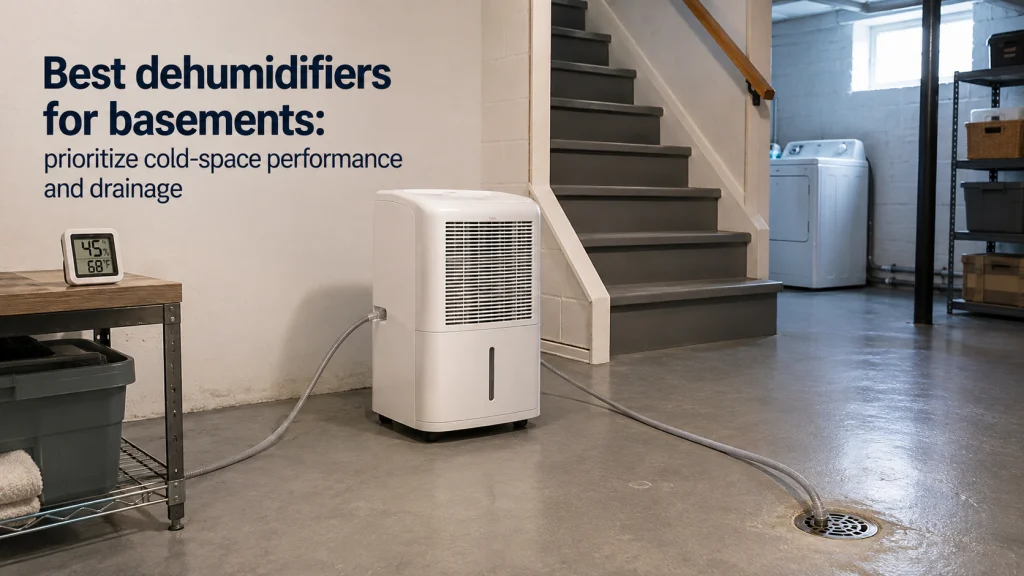
The best dehumidifiers for basements have to remove airborne moisture and dispose of the collected water without creating a daily chore. Picture the machine at the bottom of the stairs in cool air with no convenient sink beside it. A large capacity label does not tell you how the unit behaves in cooler conditions or whether you will carry a heavy bucket upstairs. Basement fit starts with the room and water path, not the biggest number on the box.
That is why the shortlist below does not copy one testing outlet’s ranking. Independent tests establish removal, temperature stability, and noise, while manufacturer documentation establishes drainage and model-specific features. I weigh those facts against gravity drain access, elevated sinks, stairs, warm exhaust, and finished-room comfort. The result is a set of conditional winners rather than one model for every basement. Basement dehumidifiers are one part of the broader air quality appliances decision, but cool conditions, drainage, and stair access make this use case unusually specific.

TP50 displays indoor temperature and relative humidity on a standalone digital screen. The unit can sit on a surface, attach magnetically, or hang from its rear hole. It gives a simple spot check of basement conditions before capacity and drainage decisions are made.
Check On AmazonIf you click this link and buy, we earn a commission at no additional cost to you.
First separate airborne humidity from active water intrusion
A portable dehumidifier is appropriate for moisture suspended in the air, not as a substitute for fixing water that is entering the basement. Damp-feeling air, condensation, and elevated relative humidity can support a dehumidifier decision, but standing water, active seepage, a plumbing leak, or water entering through the foundation changes the problem. Removing moisture from the air may reduce some dampness without addressing that source. The appliance can then look undersized when the real problem is outside its job.
Use an independent hygrometer to confirm that the room has an airborne humidity problem, and inspect the space for an obvious source before shopping. If you are still deciding whether humidity control is needed at all, the separate dehumidifier need check is the better starting point. This shortlist begins only after the basement is reasonably dry from leaks or other active water entry. That boundary keeps a product ranking from becoming accidental waterproofing advice.
Stop condition: Do not place or operate a portable dehumidifier in standing water, around wet electrical equipment, or where water is reaching electrical connections. Active leaks, flooding, repeated seepage, and structural water entry need the appropriate source-control response before appliance selection.

The ET140 checks relative moisture in drywall, wood, and masonry without driving pins into the surface. Its sensor detects moisture up to 3/4 inch below the surface. A 9-volt battery is included, making it useful for investigating damp materials before treating the problem as airborne humidity.
Check On AmazonIf you click this link and buy, we earn a commission at no additional cost to you.
Apply the sizing framework before comparing models
Capacity should match both basement size and moisture severity because square footage alone does not describe the workload. ENERGY STAR guidance treats room condition as a separate sizing input, so two basements with the same floor area can need different capacity. Rated pints per day classify products under standardized conditions, not the exact removal you will get downstairs. Temperature, starting humidity, airflow, and room openness still change real use.
If you have not worked through room size and dampness yet, use the dehumidifier sizing framework before narrowing the field. Do not assume every basement needs a 50-pint unit. A 30- or 35-pint model can suit a smaller, moderately damp room where noise matters, while 50-pint capacity makes more sense for a larger or persistently damp space. Buy enough removal capacity for the workload, not extra size for reassurance.
- Measure the basement area that will actually share air with the unit.
- Judge whether dampness is occasional, persistent, or severe without dehumidification.
- Record the typical basement temperature during the season when the unit runs.
- Decide whether doors between basement rooms normally stay open or closed.
- Identify the drainage route before deciding that a pump or large bucket is necessary.
This check prevents buying from a coverage claim and discovering later that drainage or comfort is the real constraint. A finished room that becomes mildly clammy is not the same workload as a large utility basement that stays damp for long stretches. Size the moisture job first, then compare only models that can serve it. That makes the shortlist more useful than a universal capacity recommendation.

A 165-foot green-beam laser distance measure designed for fast indoor and jobsite measurements. The bright green laser improves visibility compared with standard red beams, while the color display keeps readings easy to check. It supports straightforward distance measuring in a compact handheld format and provides a longer working range than the Bosch GLM100-23 it replaces.
Check On AmazonIf you click this link and buy, we earn a commission at no additional cost to you.
Use basement-specific evidence instead of one generic score
Every finalist should be judged with the same evidence categories. Start with independently measured removal, then check temperature stability, drainage, noise, warm exhaust, efficiency, and bucket handling. Independent tests and manufacturer specifications answer different questions, so they should not be blended into one invented score. The strongest model is the one whose evidence fits the basement you actually have.
RTINGS reports tested dehumidification capacity, temperature stability, and noise across the same group of current machines. Good Housekeeping adds controlled removal testing and usability observations for its basement picks. Manufacturer and ENERGY STAR records verify exact model features, rated capacity, and efficiency fields. When those sources disagree, the disagreement should stay visible.
Separate rated capacity from independently measured removal
RTINGS measured 31.0 pints per day for the Frigidaire FFAP5034W1 and 31.7 for the Midea MAD50PS1AWT-C under its protocol. The Midea MAD35S1QWT measured 21.0, while the smaller Waykar PD160B measured 6.0. Those figures make the workload difference between these finalists clear. They are comparative test results, not promises for a specific basement.
Treat temperature stability as a basement requirement
Cooler air can reduce useful removal when frost forms and the unit enters defrost behavior. Independent temperature-stability testing helps show which models handle those conditions more steadily. RTINGS scores the Waykar PD160B and Midea MAD35S1QWT better here than the two larger 50-pint picks. That advantage matters only when their lower removal capacity still covers the room.
Choose gravity drainage or a pump from the drain elevation
A gravity hose needs a continuous downward route, so a nearby floor drain can make a pump unnecessary. An elevated sink changes the decision because the water needs lift. The Midea MAD50PS1AWT-C is the clearest pump-first choice here because RTINGS identifies a built-in pump and ENERGY STAR lists the exact model. If neither route works, bucket handling becomes part of the purchase decision.
Judge bucket handling by the full carrying route
A larger reservoir reduces emptying frequency but becomes heavier when full. That matters when water must be carried upstairs or through a finished room. The Midea MAD35S1QWT reduces trips with a large bucket, but RTINGS notes that the full bucket can be awkward to handle. If manual emptying is permanent, carrying effort can outweigh tank capacity.
Give finished basements a stricter noise and heat limit
RTINGS rates the Waykar PD160B much better for noise than the two 50-pint models and describes it as producing very little heat. The Midea MAD35S1QWT also runs quieter and cooler than the high-capacity options. That makes both easier to share with occupied space. Lower removal remains the trade-off.
| Model | Independent evidence | Basement implication |
|---|---|---|
| Frigidaire FFAP5034W1 | 31.0 PPD tested removal; RTINGS basement score 8.6 | Strong high-capacity fit, but drainage documentation needs extra verification |
| Midea MAD50PS1AWT-C | 31.7 PPD tested removal; RTINGS basement score 8.5 | Strong high-load option with a built-in pump, but noisy and warm |
| Midea MAD35S1QWT | 21.0 PPD tested removal; better noise and temperature stability than the 50-pint picks | Better fit for many small or medium finished basements |
| Waykar PD160B | 6.0 PPD tested removal; strong noise and temperature-stability results | Quiet small-space option, not a heavy-moisture basement machine |
The matrix exposes the trade-off before price or smart features enter the discussion. High-capacity models remove more moisture but bring more noise, heat, bulk, or drainage complexity. Smaller units can be easier to live with but should not be stretched beyond their measured workload. The next step is to assign each model a basement role.

The H5075 tracks room temperature and humidity through a Bluetooth-connected app. It supports remote monitoring, smart alerts, and up to two years of data storage and export. That history can show whether a basement stays persistently damp or only spikes under specific conditions before a dehumidifier is selected.
Check On AmazonIf you click this link and buy, we earn a commission at no additional cost to you.
The current basement shortlist
Frigidaire FFAP5034W1 is the strongest overall high-capacity pick because RTINGS gives it the highest basement score in its current group and measured 31.0 pints per day. Black+Decker BDT30WTB is the value choice for moderate loads because Good Housekeeping names the 30-pint Black+Decker its basement value winner and the manufacturer confirms auto defrost plus gravity drainage. Midea MAD50PS1AWT-C is the pump-first pick for an elevated drain. Midea MAD35S1QWT is the better finished-basement balance when lower noise and heat matter.
Waykar PD160B remains a useful alternate for a small finished room where quiet operation matters more than speed. RTINGS measured only 6.0 pints per day from it, so it is not the default answer for a large or persistently damp basement. Keeping the list short makes the reasons to buy and skip each model clearer. These picks solve different basement constraints rather than competing on one universal score.
| Basement role | Current pick | Buy it for | Skip it when |
|---|---|---|---|
| Best overall high-capacity fit | Frigidaire FFAP5034W1 | Strong measured removal and a large basement workload | Noise is a major concern or pump drainage is essential without verification |
| Best value | Black+Decker BDT30WTB | Moderate dampness, lower upfront cost, auto defrost, gravity drain | The basement is large, persistently damp, or needs an elevated drain |
| Best pump-first fit | Midea MAD50PS1AWT-C | High removal plus built-in pump for an elevated discharge point | The basement is a quiet living space or gravity drainage already solves the water path |
| Best finished-basement balance | Midea MAD35S1QWT | Moderate load with lower noise and heat than larger units | The room is large, very damp, or has no lower drain and needs a pump |
A large utility basement with a floor drain pushes the decision toward high removal, while an elevated sink makes the Midea pump more valuable. A finished room can justify stepping down in capacity if the measured removal still covers the load. That is why the models should not be ranked by capacity alone. The room decides what matters most.
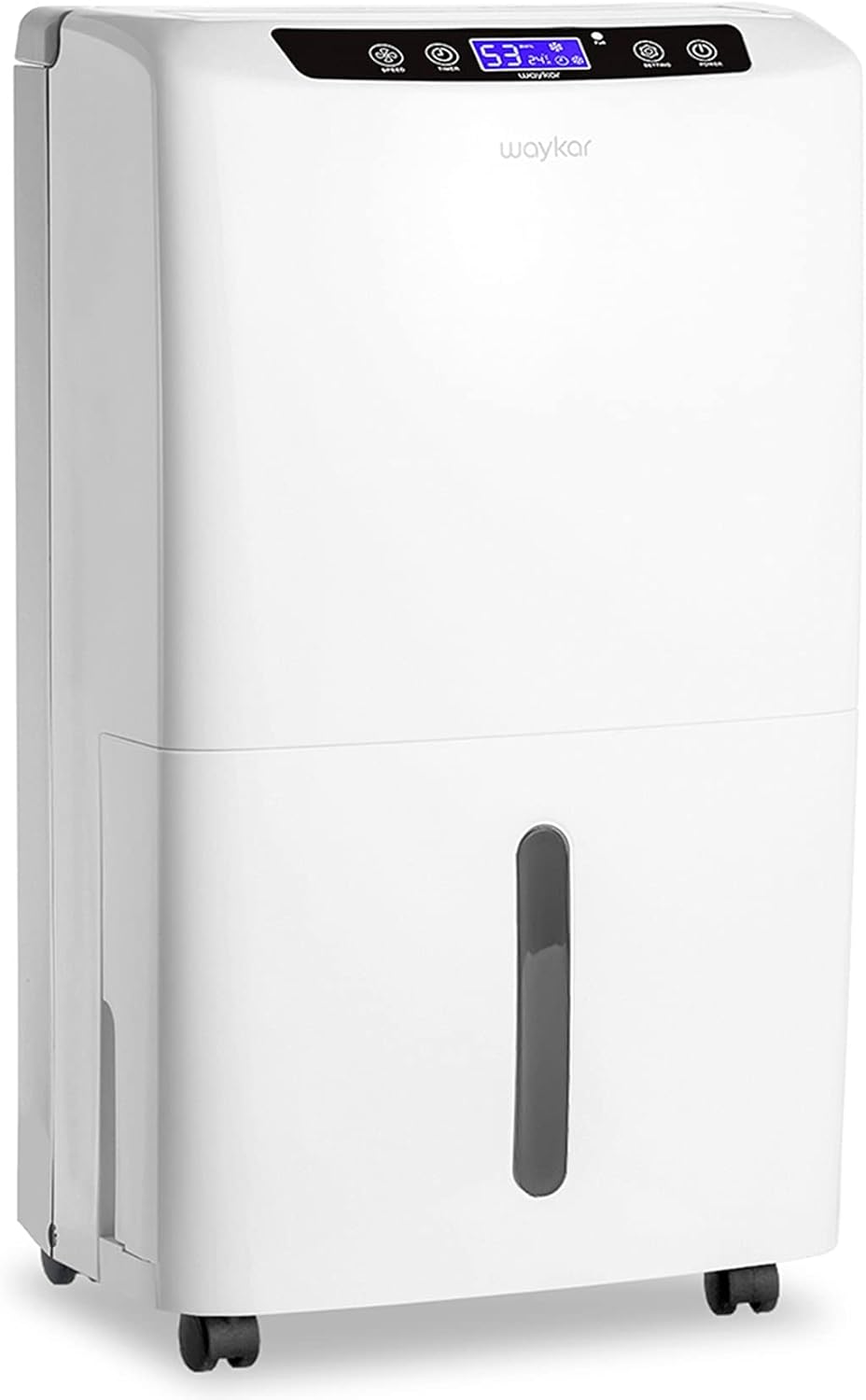
The PD160B is the selected 34-pint version rated for spaces up to 2,000 square feet on the current Amazon listing. It provides 30% to 80% humidity control, automatic defrost, and an included drain hose. Its 0.66-gallon tank gives the shortlist a current lighter-capacity portable option.
Check On AmazonIf you click this link and buy, we earn a commission at no additional cost to you.
Best overall high-capacity fit: Frigidaire FFAP5034W1
Frigidaire FFAP5034W1 is my first pick for a medium to large basement where fast moisture removal matters more than living-room comfort. RTINGS measured 31.0 pints per day and gives it the highest basement score among its current picks, which supports the recommendation with more than a nominal 50-pint label. Its large tank and continuous-drain capability also suit longer basement runtimes. The trade-off is noticeable fan noise and warm exhaust, so this is a better utility, storage, or laundry-basement choice than a quiet den.
There is one documentation issue I would not ignore. Current Frigidaire and retailer material identifies FFAP5034W1 as pump-equipped, while the current RTINGS basement page says the tested unit does not include a built-in drain pump. Because that disagreement changes whether the model can send water to an elevated sink, I would verify the exact unit listing and manual before buying it for pump drainage. If you have a lower floor drain, the conflict matters much less because the model’s high removal performance remains the main reason to choose it.

This current Frigidaire 50-pint dehumidifier includes a built-in pump for flexible condensate removal. The selected Amazon child is the 50-pint version marked with the 2026 ENERGY STAR designation. The listing positions it for basement use and combines 50-pint capacity with pumped drainage in one portable unit.
Check On AmazonIf you click this link and buy, we earn a commission at no additional cost to you.
Best value for moderate dampness: Black+Decker BDT30WTB
Black+Decker BDT30WTB is the value pick when the basement is smaller or moderately damp rather than a heavy, persistent moisture load. Good Housekeeping selected the 30-pint Black+Decker as its basement value winner after observing effective moisture removal and relatively quiet operation in testing. The current manufacturer page identifies BDT30WTB as a 30-pint ENERGY STAR portable model with auto defrost, an adjustable humidistat, an 8-pint bucket, and an included hose for continuous gravity drainage. That is a useful feature set without paying for a pump you may not need.
The reason to skip it is equally important. Good Housekeeping explicitly warns that this capacity class is not intended for a large, very damp basement, and the model cannot pump water uphill. A lower floor drain makes the gravity hose practical, but an elevated utility sink does not. This is a value winner only when the workload is moderate enough that buying less machine does not create longer runtime, constant bucket emptying, or poor humidity control.

The BD30MWSA is a 30-pint portable dehumidifier listed for spaces up to 3,000 square feet. The selected variant is the no-pump configuration and includes a removable bucket plus a drain hose. It fits moderate-load basement use when gravity drainage is available and an integrated pump is unnecessary.
Check On AmazonIf you click this link and buy, we earn a commission at no additional cost to you.
Best when the drain is uphill: Midea MAD50PS1AWT-C
Midea MAD50PS1AWT-C is the most convincing pump-first choice in the current evidence. RTINGS measured 31.7 pints per day and identifies a built-in pump for an elevated discharge point. ENERGY STAR lists the exact model with rated removal just under 50 pints per day and an integrated energy factor of 1.8 L/kWh. That makes it a strong fit for a large or persistently damp basement where gravity drainage is impractical.
Do not pay for the pump automatically. RTINGS describes this Midea as noisy, warm, and bulky enough that it suits an unfinished basement better than a den or playroom. If a floor drain already sits below the outlet, gravity drainage solves the same water-handling problem with less complexity. Choose this model when the drain needs lift and the room also needs high removal.
| Drain location | Better choice | What to verify |
|---|---|---|
| Floor drain below the unit | Gravity hose | Continuous downward slope and secure termination |
| Elevated utility sink | Midea MAD50PS1AWT-C pump | Exact hose route and pump instructions |
| No practical drain | Bucket collection | Full-bucket weight and carrying route |
The water path should be decided before smart controls or tank size. A pump removes a real basement chore when elevation is the problem. It adds little when gravity already works. The Midea earns this role because its pump is paired with strong measured removal.
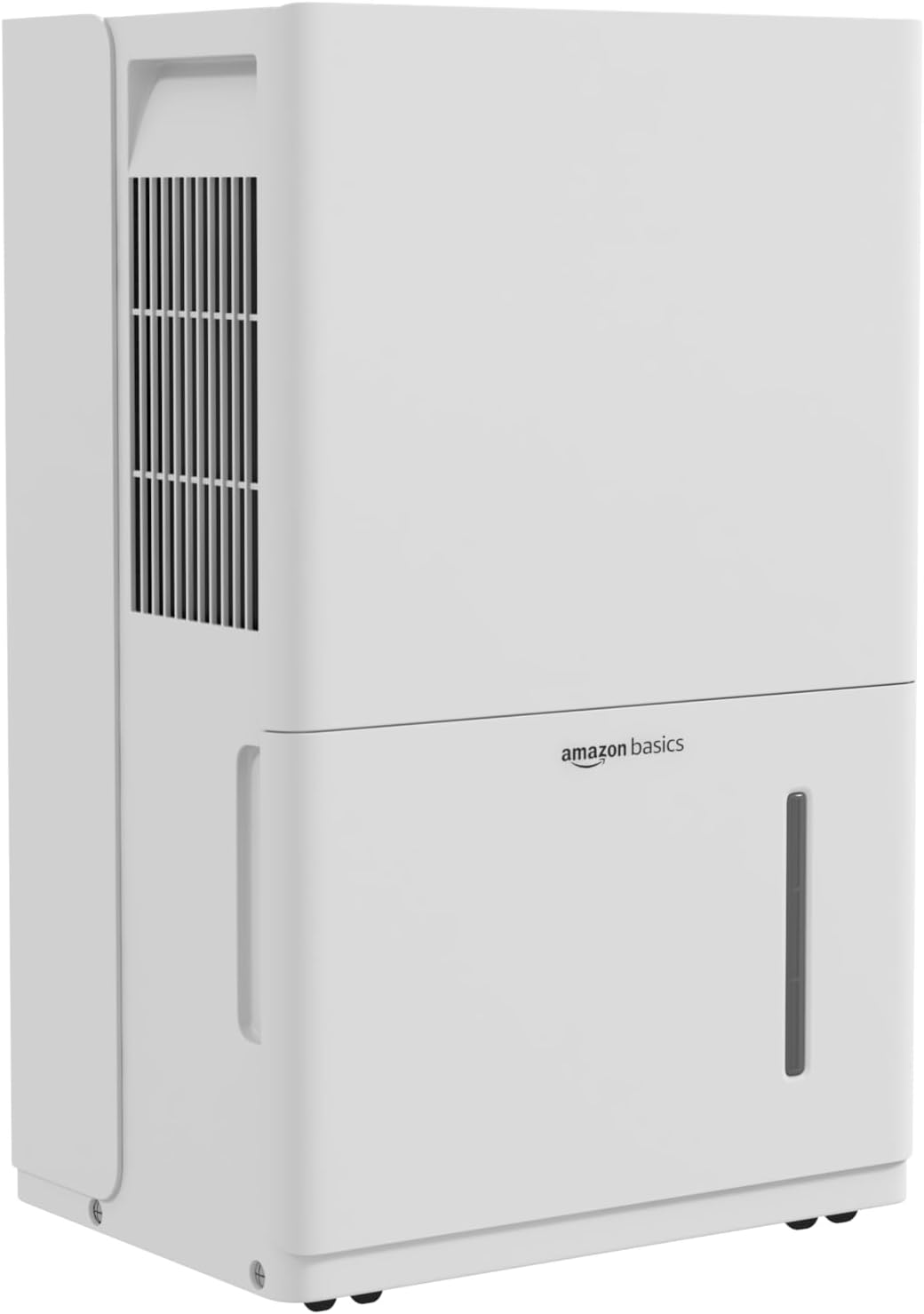
This 50-pint Amazon Basics dehumidifier includes a pump and is listed for rooms up to 4,000 square feet. The listing also identifies humidity control, automatic defrost, a timer, and overflow protection. Its pump-equipped configuration directly supports basements that need condensate moved to an elevated discharge point.
Check On AmazonIf you click this link and buy, we earn a commission at no additional cost to you.
Best finished-basement balance: Midea MAD35S1QWT
Midea MAD35S1QWT fits a small or medium finished basement that needs meaningful removal without the noise and heat burden of a larger 50-pint machine. RTINGS measured 21.0 pints per day and found it quieter, cooler-running, and more temperature-stable than the larger picks. Midea confirms the exact model is a 35-pint Cube with smart control and no built-in pump. For a family room, office, or guest area with a lower drain, that balance can matter more than maximum extraction speed.
The weak point is manual water handling. The Cube’s large bucket reduces trips but becomes heavy when full, and the design requires lifting the dehumidifier section away from the bucket. For a small, mildly damp room, Waykar PD160B is quieter still but has much lower tested removal. I would choose the Waykar only when the workload is genuinely light.
| Finished-basement profile | Better fit | Main compromise |
|---|---|---|
| Small to medium, moderately damp | Midea MAD35S1QWT | Large bucket is heavy; no built-in pump |
| Small, mildly damp, noise-sensitive | Waykar PD160B | Only 6.0 PPD in RTINGS testing |
| Large or persistently damp | Move back to a 50-pint finalist | More noise and warm exhaust |
A finished basement should not trade away necessary capacity just to gain quiet operation. If a smaller unit must run constantly, its comfort advantage disappears. Match the load first, then choose the least intrusive model that still covers it. That keeps comfort and performance in the right order.
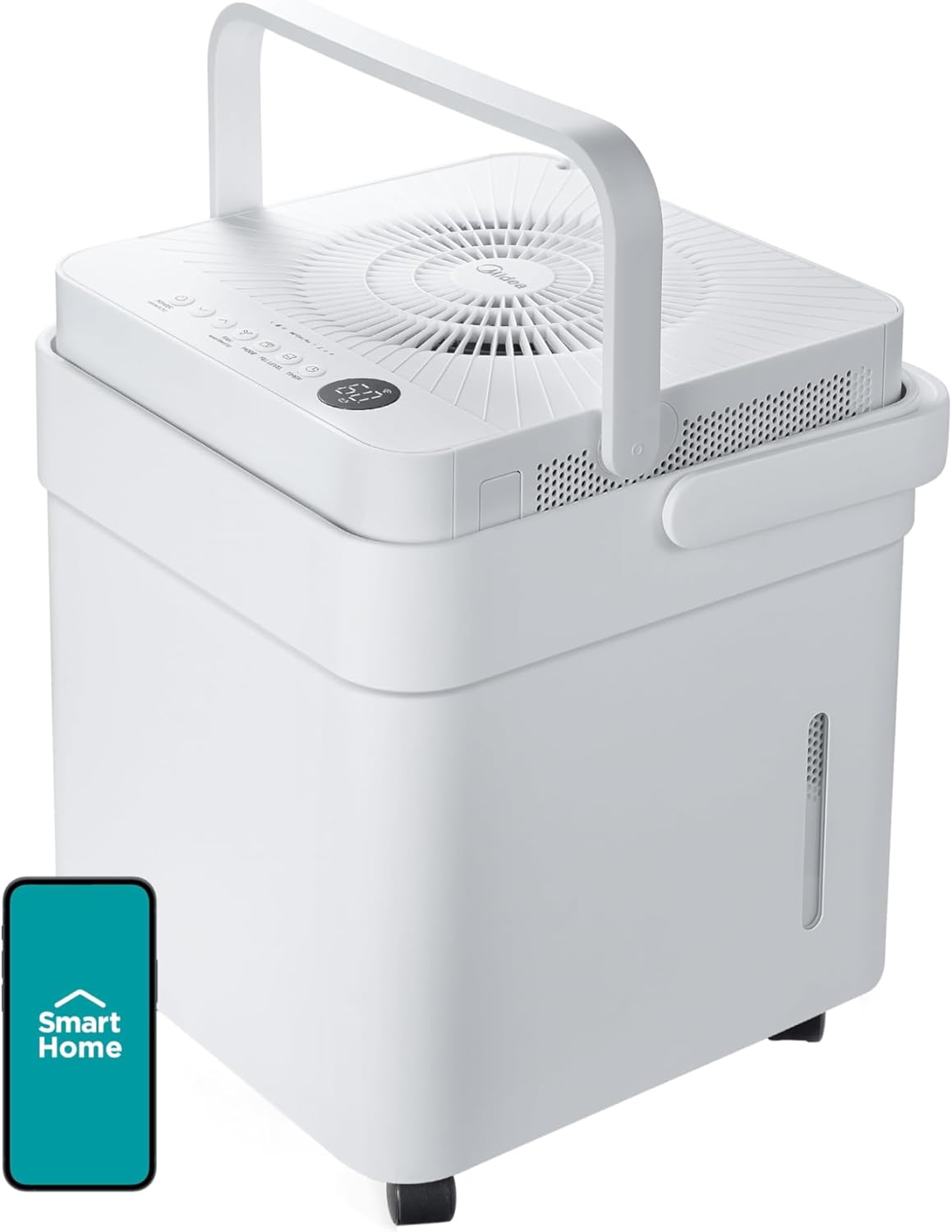
The Midea Cube 35-pint model is listed for rooms up to 3,500 square feet and includes smart control. It works with Alexa and includes a drain hose for continuous drainage where gravity routing is practical. The selected listing is the white 3,500-square-foot variant, distinct from the separate 4,500-square-foot pump variant.
Check On AmazonIf you click this link and buy, we earn a commission at no additional cost to you.
Know when to skip every portable basement pick
A portable unit is a room-level moisture-control tool, so it becomes the wrong starting point when the problem extends well beyond one basement zone. If elevated humidity is persistent across multiple floors or many separated rooms, it may be more useful to compare a central strategy rather than placing several portable machines around the house. The whole-home versus portable dehumidifier comparison handles that broader decision. The same boundary applies when the basement has active leakage or another moisture source that needs correction before appliance sizing.
You should also skip a new purchase when an existing unit already holds the basement at the desired humidity with reasonable runtime and manageable drainage. More capacity is not automatically an upgrade if it only adds weight, noise, heat, and storage burden. Likewise, Wi-Fi or a larger tank is not a reason to replace a functioning machine unless it removes work the household actually cares about. A no-purchase outcome belongs in the same decision process as choosing a winner.

The E070 Pro is a 70-pint dehumidifier intended for crawl spaces, basements, and whole-home applications up to 2,200 square feet. A drain hose is included for continuous water removal. Its whole-home positioning makes it relevant when humidity control extends beyond a single portable-unit zone.
Check On AmazonIf you click this link and buy, we earn a commission at no additional cost to you.
Compare the finalists by the constraint that can disqualify them
Frigidaire FFAP5034W1 leads the current RTINGS basement score, but its pump documentation deserves verification if elevated drainage is essential. Midea MAD50PS1AWT-C has slightly higher tested removal and a clearer pump case, but it is noisy and warm. Black+Decker BDT30WTB saves money for moderate loads. Midea MAD35S1QWT gives a finished room a better comfort balance.
Each model therefore has a clear disqualifier. A large, constantly damp basement can eliminate the 30- and 35-pint choices before smart features matter. A quiet den can eliminate the louder 50-pint machines when a smaller model still covers the load. An elevated sink can make the pump-equipped Midea the obvious choice.
| Model | Strongest reason to buy | Strongest reason to skip |
|---|---|---|
| Frigidaire FFAP5034W1 | Strong high-capacity independent performance | Noise, heat, and conflicting pump documentation |
| Black+Decker BDT30WTB | Good value for moderate basement humidity | Not enough machine for large persistent loads; no pump |
| Midea MAD50PS1AWT-C | High measured removal plus built-in pump | Noisy and warm for finished living space |
| Midea MAD35S1QWT | Better comfort balance with useful mid-size capacity | No pump and a heavy full bucket |
Before buying, confirm the exact model number, current manual, drainage instructions, warranty, and CPSC recall status. Similar-looking variants can differ in pumps, controls, or capacity. That matters most when one feature is the reason you chose the machine. The shortlist narrows the decision; exact documentation closes it.

The P4400 plugs between an appliance and a wall outlet to display electrical use. It can show kilowatt-hour consumption so operating energy can be observed directly rather than inferred from a label alone. This makes it useful when comparing the real ownership burden of dehumidifier finalists.
Check On AmazonIf you click this link and buy, we earn a commission at no additional cost to you.
Use broader buying pages only when basement constraints stop deciding the winner
This page owns the basement decision: Frigidaire FFAP5034W1 for high-capacity overall use, Black+Decker BDT30WTB for moderate-load value, Midea MAD50PS1AWT-C when drainage needs lift, and Midea MAD35S1QWT for many finished basements. You do not need another page to discover which current model fits those roles. The broader best dehumidifiers comparison is useful when you are also shopping for bedrooms or living spaces. Those rooms change the weighting enough to justify a broader comparison.
If the remaining question is general feature selection, use the dehumidifier buying guide. If capacity is still uncertain, return to sizing instead of guessing from square-foot marketing. The basement page should finish the basement purchase whenever the room conditions are known. The broader pages answer different next questions rather than replacing this shortlist.

The Midea Cube 20-pint model is listed for basements and rooms up to 1,500 square feet. It includes a drain hose, Wi-Fi control, and Alexa compatibility. The smaller capacity class provides a current option for lighter moisture loads when broader buying needs extend beyond a large basement.
Check On AmazonIf you click this link and buy, we earn a commission at no additional cost to you.
Final thoughts: choose the model that solves the basement you actually have
Frigidaire FFAP5034W1 has the strongest overall case for a medium to large utility basement, provided you verify drainage if a pump matters. Black+Decker BDT30WTB is the better value choice for moderate loads, while Midea MAD50PS1AWT-C is the clearest answer when a high-capacity machine must pump uphill. Midea MAD35S1QWT is easier to share with a finished basement when its lower capacity is enough. These are different jobs, so they should not collapse into one universal winner.
Rule out active water intrusion, size the moisture load, map the drain, and decide how much noise and warm exhaust the room can tolerate. Then verify the exact model’s operating limits, drainage instructions, warranty, and recall status. If the machine clears those checks without creating unnecessary carrying or comfort problems, it is a credible fit. If it fails the drainage, capacity, or room-use test, more features will not rescue it.
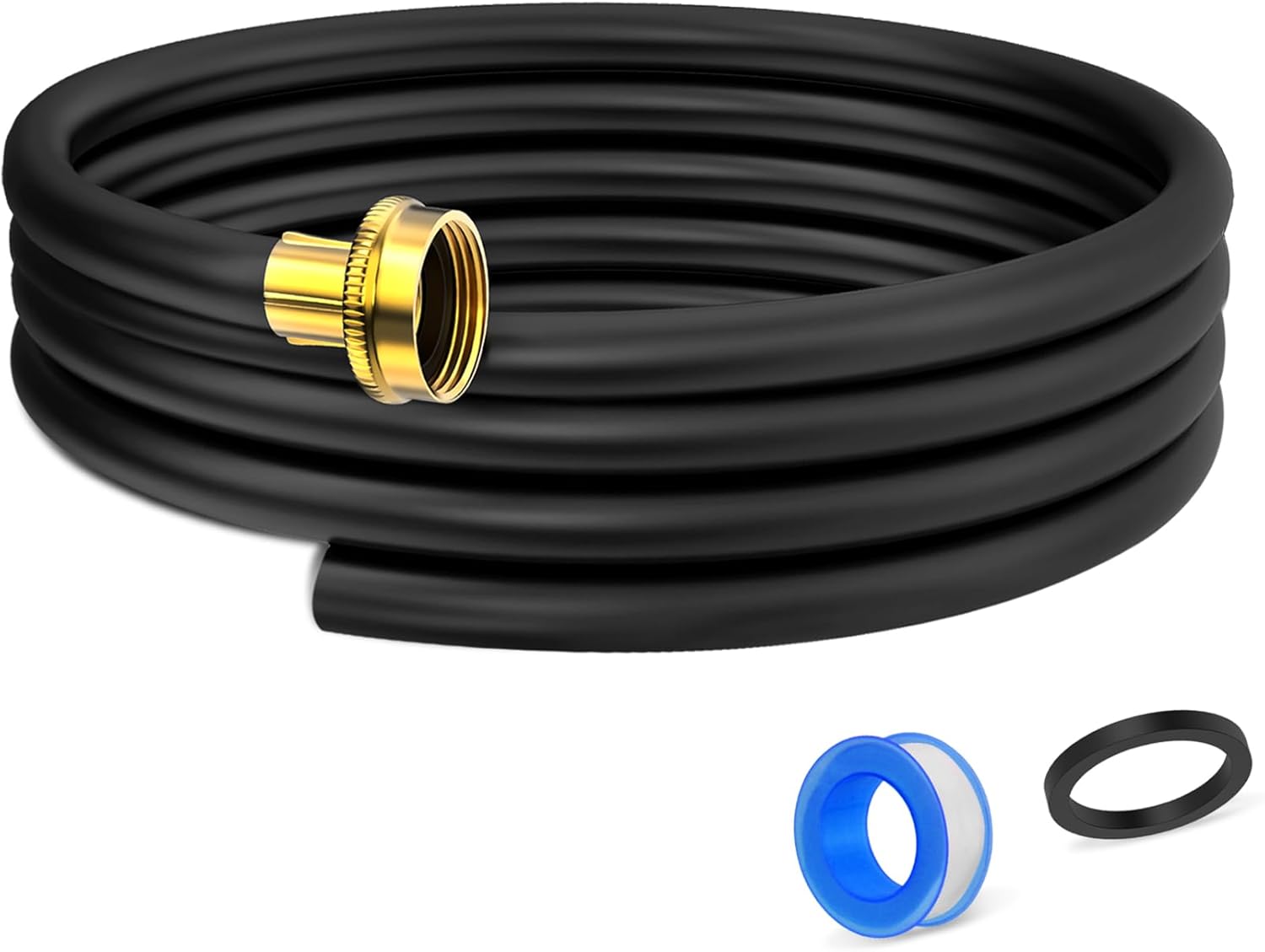
This 12-foot dehumidifier drain hose uses a 3/4-inch FHT connector and brass fittings. The selected Amazon child is the black 12-foot variant among several available lengths. It is appropriate only when the dehumidifier drain port accepts the same 3/4-inch FHT connection and gravity routing can maintain a continuous downward slope.
Check On AmazonIf you click this link and buy, we earn a commission at no additional cost to you.
FAQs
💧 Does a basement dehumidifier need a drain hose?
No. It can collect water in a bucket, but a hose removes the routine emptying job when a suitable lower drain is available. Check the exact manual for hose size, slope, and routing requirements.
🪜 Which basement dehumidifier is better when the drain is uphill?
Midea MAD50PS1AWT-C is the clearest pump-first pick in this shortlist because it combines a built-in pump with strong independent moisture-removal results. Verify the exact hose route and pump instructions before installation.
🌡️ Do basements need a dehumidifier that works well in cooler conditions?
They can if the basement regularly runs cool. Check the manufacturer operating range and frost-control behavior, then use independent temperature-stability evidence when available rather than assuming every refrigerant model behaves the same way.
📐 Is a 50-pint unit always the best dehumidifier for a basement?
No. A 30- or 35-pint model can be a better fit for a smaller or moderately damp basement, especially when noise and heat matter. The capacity class should follow the moisture load, not a basement label.
🔊 Which pick is better for a finished basement?
Midea MAD35S1QWT offers a useful balance of measured removal, lower noise, and lower heat for many small or medium finished basements. Waykar PD160B is quieter still, but its much lower tested removal limits it to light workloads.
⚠️ Can a dehumidifier fix water leaking into a basement?
No. A portable dehumidifier removes airborne moisture; it does not repair active seepage, plumbing leaks, flooding, or foundation water entry. Address the source and keep electrical equipment away from standing water.
References and Sources
- RTINGS basement dehumidifier testing: supports measured removal, temperature stability, noise, and basement comparisons.
- Good Housekeeping basement testing: supports the Black+Decker value recommendation and usability trade-offs.
- Black+Decker BDT30WTB specifications: verifies rated capacity, auto defrost, bucket size, and gravity drainage.
- ENERGY STAR Midea MAD50PS1AWT-C record: verifies the exact model’s certified water-removal and efficiency fields.
- Midea MAD35S1QWT specifications: verifies the Cube model, rated capacity, weight, smart control, and no built-in pump.
- Waykar PD160B specifications: verifies current model details, gravity drainage, auto defrost, and tank size.
- Frigidaire FFAP5034W1 product specifications: supports the U.S. listing and the pump specification that conflicts with RTINGS.