A tilt-head and a bowl-lift stand mixer solve the same mixing job with different physical movements, and that movement can matter more than the silhouette suggests. Tilt-head designs open by raising the mixer head, while bowl-lift designs keep the head fixed and move the bowl, so cabinet clearance, ingredient access, scraping, bowl removal, and storage can change which one feels easier. Capacity, dough ability, and stability often follow recognizable patterns within a brand, but the architecture alone does not prove power or safe workload. Choose by the workflow your kitchen can support, then verify the exact model for capacity, performance, and compatibility.
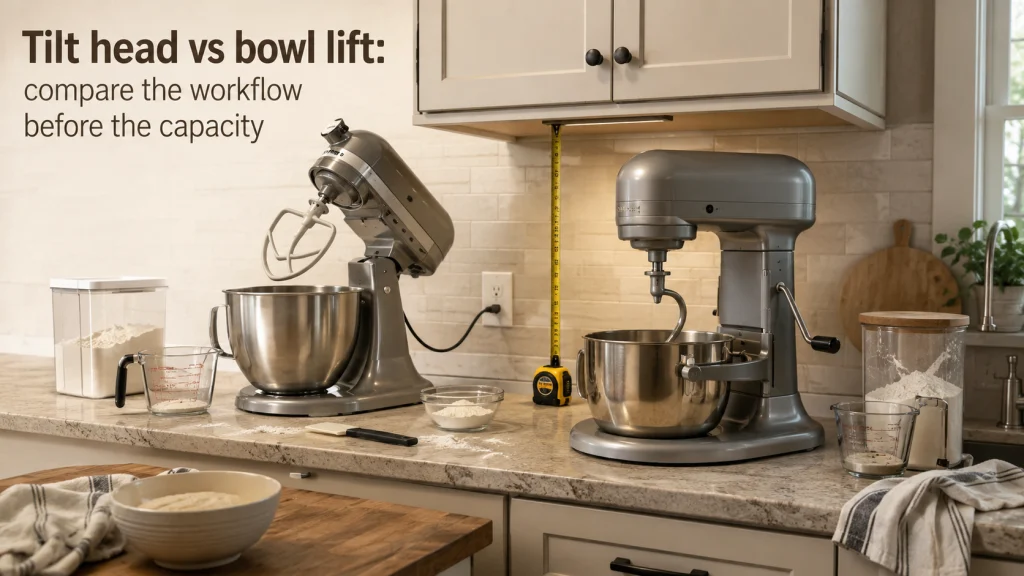
Start with what moves, not what looks more serious
A bowl-lift mixer can look like the more serious machine, while a tilt-head can look like the easier one, but that visual shortcut can point you toward the wrong kitchen fit. In a tilt head vs bowl lift comparison, the first useful question is not which frame looks heavier-duty, but which movement works with your cabinets, ingredient access, scraping routine, and bowl removal. A tilt-head opens by hinging the motor head upward, while a bowl-lift keeps the head fixed and raises or lowers the bowl on support arms. That difference changes the physical workflow before it proves anything about power, durability, or safe batch limits.
The expectation can reverse as soon as the mixer is placed in a real workspace. A tilt-head may feel wonderfully open until an upper cabinet blocks the head, while a bowl-lift may avoid that upward swing but create a bowl-removal motion you like less. If you are still sorting out the broader types of mixers, architecture is only one field within that larger choice. Here, the useful comparison is deliberately narrower: which moving part makes adding, scraping, removing, storing, and repeatedly using the mixer easier in the kitchen you actually have. Both designs belong to the same small kitchen appliances category, so the deciding difference here is the movement and access each mixer requires.

This 4.5-quart tilt-head mixer uses a stainless steel bowl and offers 10 speeds for mixing, kneading, and whipping. The tilt-head design opens the bowl area for easier ingredient access and tool changes. It includes a coated flat beater, coated dough hook, and 6-wire whip, making the moving-head workflow easy to evaluate in a real kitchen.
Check On AmazonIf you click this link and buy, we earn a commission at no additional cost to you.
Ingredient access depends on when you need the opening
Tilt-head designs can create a wide opening when the head is raised, which is useful when you want unobstructed access before mixing starts or after you stop. During mixing, however, the head must be locked down, so the practical opening is the space around the installed beater and bowl rim. A bowl-lift design keeps the head fixed, but lowering the bowl can create additional space beneath the beater for adding ingredients or changing tools. Neither system gives perfect access in every stage of a recipe, which is why the timing of your additions matters.
Think about a cookie dough that receives flour in several additions, then chips or nuts near the end. A baker who frequently stops, raises the head, scrapes, and checks the mixture may prefer the open access of a tilt-head once the machine is stopped. Another baker may prefer leaving a fixed head in place and lowering the bowl rather than moving the whole head assembly. The right choice is the one that makes repeated additions controlled and comfortable in your actual counter position, not the one described as easier in a generic comparison.
| Access check | Tilt-head | Bowl-lift |
|---|---|---|
| Adding ingredients with the tool installed | Work around the bowl rim while the head is locked down | Lowering the bowl may create more space beneath the fixed tool |
| Opening the bowl after stopping | Raise the head for direct top access if clearance allows | Lower the bowl while the head stays in place |
| Frequent scraping | Useful if raising the head is quick and unobstructed | Useful if lowering the bowl feels easier than moving the head |
| Low cabinet above the mixer | Check full raised-head clearance | No head swing, but verify total height and hand space |
Use this as a counter-level check rather than a brand rule. The better layout is the one that gives your hands enough room during the steps you repeat most, especially additions and scraping. If both feel workable, bowl removal and cabinet clearance become the next useful tie-breakers. That keeps the decision focused on movements you will actually perform rather than a label attached to the machine.

This pouring shield is made for KitchenAid 4.5- and 5-quart tilt-head mixers using stainless steel bowls. It surrounds the bowl opening to help control splatter while ingredients are added. Its fit is limited to the stated mixer and bowl format, so it is a useful accessory when ingredient access matters but compatibility still needs to stay model-specific.
Check On AmazonIf you click this link and buy, we earn a commission at no additional cost to you.
Bowl removal and scraping can change the daily preference
Removing the bowl is not a small detail if you routinely scrape the sides, portion dough from the bowl, or carry a finished mixture to another work surface. Tilt-head bowls commonly twist onto the mixer base, and lifting the head can clear the beater from the bowl area before removal. Bowl-lift bowls attach to support arms, so removal involves lowering the bowl and disengaging it from that support system. Both can be straightforward after the motion becomes familiar, but they are not the same motion and they do not create the same hand space.
Scraping is where personal workflow becomes especially visible. That scraping difference becomes more important when the recipe requires several stops instead of one final cleanup. If you stop several times per batch to scrape the bowl or beater, test that sequence mentally before buying: stop, open or lower, scrape, re-engage, and continue. Some kitchens make the raised head easier to reach, while others make the fixed-head layout less awkward because nothing swings upward. A design that saves one awkward reach every few minutes can matter more in daily use than a capacity difference you rarely use.

This six-piece silicone utensil set is designed for scraping, baking, cooking, and mixing. The tools are listed as heat resistant up to 600°F, BPA-free, and dishwasher safe. Flexible spatulas are useful for clearing mixer-bowl sides and transferring mixtures when repeated scrape-and-mix cycles are part of the routine.
Check On AmazonIf you click this link and buy, we earn a commission at no additional cost to you.
Measure stored height and working height separately
A tilt-head mixer can fit neatly below an upper cabinet when closed and still fail to open in that exact position. The stored height tells you whether the mixer can sit there, while the working height tells you whether the head can complete its full upward movement without striking cabinetry, trim, or a low shelf. Consumer Reports specifically advises checking clearance for mixers whose heads tilt up because the operating position needs more vertical room than the parked position. If the mixer must be pulled forward every time it opens, that extra movement becomes part of the ownership routine.
A bowl-lift design avoids that particular upward head swing because its head remains stationary, but it can still be taller or wider overall depending on the model. KitchenAid, for example, lists its full-size tilt-head line at a lower profile than its bowl-lift line, but that lineup pattern should not be generalized to every manufacturer. Measure the exact counter-to-cabinet opening, the mixer height, the space needed to operate controls, and the room required to remove the bowl. A machine that technically fits but cannot be used comfortably in place does not really fit the workspace.
| Measurement | What to check | Why it matters |
|---|---|---|
| Stored height | Mixer in its normal parked position | Confirms whether it can remain under the cabinet or on the intended shelf |
| Working height | Highest point reached during normal operation or access | Shows whether a tilt head can fully open without pulling the mixer forward |
| Front clearance | Room for hands, controls, and any forward movement | Prevents a nominal fit from becoming awkward during every use |
| Bowl-removal space | Room needed to disengage and lift the bowl out | Matters when the mixer stays under cabinetry or beside another appliance |
Measure the mixer where it will be used, not only where it will be stored. A few inches of workable hand space can matter more than a compact-looking footprint when every batch requires opening the head, lowering the bowl, or lifting a full bowl away from the machine. If the unit must be repositioned for normal access, include that movement in the ownership decision. The practical fit is the operating envelope, not the closed silhouette.

This 25-foot tape measure provides up to 14 feet of reach and uses large markings for easier reading. Its high-impact case has a non-slip rubber exterior, and the blade uses protective coatings for repeated use. It is a practical tool for checking stored mixer height, raised-head clearance, counter depth, and the full operating envelope before choosing a permanent location.
Check On AmazonIf you click this link and buy, we earn a commission at no additional cost to you.
Treat capacity as a model fact, not an architecture rule
Bowl-lift mixers are often sold in larger capacities, while tilt-head mixers are often concentrated in smaller and mid-size capacities. That is a market pattern, not a mechanical law. KitchenAid’s US comparison, for example, places its tilt-head bowls in a smaller range than its bowl-lift bowls, which helps explain why shoppers often connect bowl-lift construction with larger batches. Another brand can organize its lineup differently, so read the bowl specification instead of inferring size from the lifting mechanism.
Capacity also needs to mean more than the number printed beside the bowl. A larger bowl can reduce overflow risk and make room for bigger batches, but very small mixtures can behave differently depending on bowl shape, tool geometry, and minimum effective contact. If capacity is still unresolved, the what size stand mixer do I need comparison belongs before the architecture decision is finalized. Architecture should decide how you want to work with the bowl, while the exact model should decide whether the bowl is actually the right size.
| Question | What architecture can tell you | What needs model-level evidence |
|---|---|---|
| How do I open the bowl area? | Whether the head tilts or the bowl lowers | Exact clearance and control layout |
| How large is the batch? | Only a common lineup pattern | Actual bowl capacity and usable load |
| Will it stay planted? | Heavier construction may influence feel | Exact weight and tested behavior under load |
| Can it handle dense dough? | No reliable answer by architecture alone | Manual limits and independent model testing |
The table is a useful guardrail against a common first-time buying mistake: treating a visible design feature as proof of several unrelated capabilities. Use architecture to understand movement and access, then verify the separate claims that actually determine workload. This keeps a familiar pattern from turning into an unsupported universal rule. It also makes comparisons across brands much cleaner.

This digital kitchen scale weighs up to 11 pounds and measures in 1-gram increments. It supports five units and includes a tare function for weighing ingredients in a separate container. Tracking the actual ingredient weight of normal and heavy batches helps separate real workload from assumptions based only on mixer architecture or bowl size.
Check On AmazonIf you click this link and buy, we earn a commission at no additional cost to you.
More planted can also mean more annoying to move
Heavier construction can help a stand mixer feel more planted, especially when a demanding load pushes against the machine, but weight creates its own household cost. Consumer Reports notes that a stand mixer should not be so heavy that lifting it from storage becomes a problem, which matters whenever the appliance does not have a permanent counter position. A machine that feels reassuring during mixing can become the wrong choice if it must be lifted from a low cabinet before every use. Stability and portability are therefore competing benefits rather than one simple quality scale.
This trade-off often favors different designs because many bowl-lift models are built larger and heavier than common tilt-head models, but the exact weights still belong to the individual products. If the mixer stays on the counter, added weight may create little daily penalty beyond cleaning around it. If it lives in a pantry, appliance garage, or lower cabinet, every session begins and ends with handling that weight. Before paying for a more substantial frame, decide whether you are buying steadiness you will use or mass you will repeatedly carry.

This clear slider mat is sized for KitchenAid 4.5-quart tilt-head stand mixers. It creates a sliding surface that helps reposition the appliance across a countertop instead of lifting it for every use. That makes it directly relevant when mixer weight is acceptable during operation but repeated moving between storage and the work position is the household friction point.
Check On AmazonIf you click this link and buy, we earn a commission at no additional cost to you.
Heavy dough performance has to be proven by the exact mixer
Bowl-lift designs are commonly associated with bread dough and other dense mixtures because many manufacturers place larger, heavier-duty models in that format. That association can be useful for narrowing a shortlist, but it is not enough to prove torque, durability, thermal behavior, or a safe dough quantity. Independent mixer testing finds meaningful performance differences between individual models, and Consumer Reports also warns that wattage alone does not translate directly into better performance. The model, motor system, gearing, bowl geometry, speed guidance, and stated load limits all matter.
The same caution applies in the other direction: a tilt-head architecture does not automatically make a mixer unsuitable for dough. Good Housekeeping has tested tilt-head mixers that handled bread dough successfully, while also recording head movement on one tested model with a stiff dough. Those findings belong to the tested machines and conditions, not every tilt-head product. If bread is a major reason for buying the mixer, use the stand mixer for bread dough framework and follow the exact manual rather than inferring safe workload from head style.

This stainless steel spiral dough hook is listed for KitchenAid 4.5- and 5-quart tilt-head stand mixers. It is intended for kneading bread, pizza, pasta, cookie, and similar doughs and is described as rust resistant and easy to clean. Because fit is limited to stated mixer formats, it reinforces the need to verify the exact machine before treating any dough accessory as universal.
Check On AmazonIf you click this link and buy, we earn a commission at no additional cost to you.
Verify bowls and attachments as separate compatibility questions
Architecture can narrow compatibility, but it does not finish the check. KitchenAid states that its bowls are generally designed around tilt-head, bowl-lift, or mini tilt-head systems and are not interchangeable across those types, while specific bowl listings still identify the exact mixer models they fit. That means a bowl that looks physically similar is not enough evidence. The bowl interface, capacity, accessory geometry, and model list should agree before you treat the part as compatible.
Powered attachments that connect at the front drive port can follow a different rule from bowls and in-bowl tools. KitchenAid describes those drive-port attachments as broadly compatible across its stand mixers, while also noting that some bowls require matching or special in-bowl tools, which shows why the word attachment is too broad for a compatibility decision. Before buying any bowl, beater, dough hook, splash guard, or powered attachment, check the manufacturer’s exact fit information for that item and mixer. Architecture is a useful filter, not permission to assume that every accessory for the same head style will fit.

This KitchenAid flex edge beater is made for compatible 4.5- and 5-quart tilt-head mixers. Its flexible silicone edge scrapes the bowl while mixing, and the beater is listed as dishwasher safe. The model-specific fit makes it a useful example of why bowls and in-bowl tools should be checked against the exact mixer rather than assumed compatible by appearance.
Check On AmazonIf you click this link and buy, we earn a commission at no additional cost to you.
A tilt-head design fits households that value direct top access
A tilt-head design is often a strong fit when the mixer handles moderate batches, the head can open freely, and the baker values direct access to the bowl. The raised head can make tool changes and bowl access visually obvious, which can be convenient for recipes that involve frequent scraping or checking texture. Many tilt-head models also occupy a smaller overall footprint than larger bowl-lift counterparts within the same brand family. Those advantages matter most when they match the kitchen rather than when they are treated as universal benefits.
Choose this architecture when the opening movement has a clear place to go and the mixer is likely to be moved or stored often enough that a smaller, lighter body helps. It can also make sense for households that rarely need the largest batches offered by a brand’s bowl-lift line. Before deciding, run a simple fit check in the intended workspace. The goal is to confirm that convenience survives contact with your actual cabinet clearance, bowl routine, and storage plan.
- Check that the head can fully open where the mixer will actually be used.
- Confirm that normal batch size fits the exact bowl without buying unused capacity.
- Picture the full scrape, tool-change, bowl-removal, and cleanup sequence.
- Verify the exact bowl and in-bowl attachment compatibility before adding extras.
If those checks work cleanly, the tilt motion is doing useful household work rather than simply giving the mixer a familiar shape. If the mixer has to be dragged out from under a cabinet every time you need access, some of that convenience disappears. The architecture is successful when its main movement fits the room you already have. That is a better reason to choose it than assuming it is automatically the easier style.
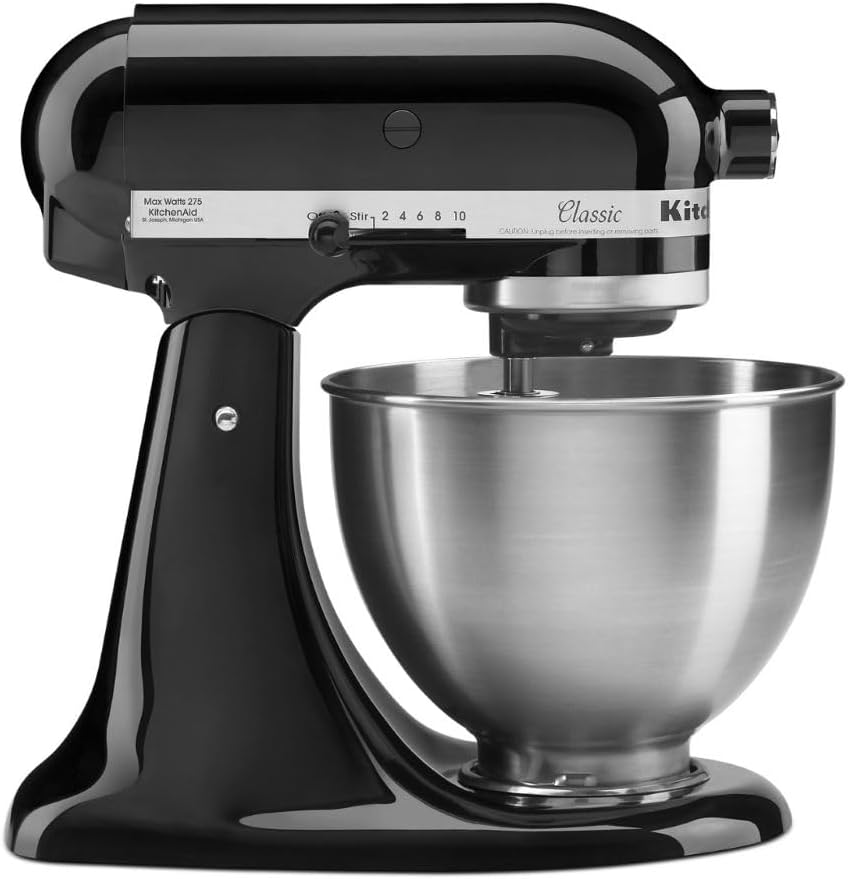
This Onyx Black K45SS uses a 4.5-quart stainless steel bowl, 10 speeds, and a tilt-head design that opens the bowl area for ingredient access. The mixer measures 14.1 inches deep, 8.7 inches wide, and 13.9 inches high, with a listed weight of 22 pounds. Those dimensions make it a concrete tilt-head example for checking counter fit, opening clearance, and storage handling.
Check On AmazonIf you click this link and buy, we earn a commission at no additional cost to you.
A bowl-lift design fits when the fixed head solves a real problem
A bowl-lift design becomes compelling when a fixed head works better in the available vertical space and the exact model provides the capacity or tested stability the household needs. Lowering the bowl instead of swinging the head upward can be especially useful under cabinetry where a tilt mechanism would collide with the space above. Many bowl-lift models are also heavier and offered with larger bowls, which can suit repeated large batches when those specific characteristics are genuinely needed. That combination is common in the market, but it is not automatic.
This format makes the most sense for a mixer that can stay in a workable position rather than being carried in and out of storage. It also suits a baker who is comfortable attaching and removing the bowl from support arms and who does not mind the access geometry around a fixed head. For frequent large or dense batches, compare the manual limits and credible performance evidence for the mixer you are considering instead of treating the heavier frame as proof. A bowl-lift mixer should earn its counter space through repeated workload and better fit, not through a more serious appearance.

This stainless steel flat beater is listed for selected KitchenAid 5- and 6-quart bowl-lift stand mixers, including Professional 5 Plus and Professional 600 families. It is described as heavy duty and dishwasher safe. The narrow compatibility list is useful when a bowl-lift format solves the workspace problem but the household still needs to verify the exact bowl and tool interface.
Check On AmazonIf you click this link and buy, we earn a commission at no additional cost to you.
Resolve size and workload questions before you let architecture decide
Architecture is only decisive after you know what the mixer must actually do. If you are still choosing between occasional cakes, frequent cookie batches, bread dough, and very large batches, start with the broader stand mixer guide and define the workload first. Then compare bowl capacity, usable workspace, storage, lifting, and cleanup against that routine. This keeps the head mechanism from standing in for a workload decision.
The same rule applies when two candidates use different architectures but solve the workload equally well. At that point, measure the counter, check cabinet clearance, confirm bowl and accessory fit, review the manual for workload limits, and decide which movement you would rather repeat. If one candidate feels better to operate but cannot handle the batches you need, it is still the wrong mixer. A useful bowl-lift vs. tilt-head comparison ends only when the physical workflow and the required workload both fit the same machine.

This Hamilton Beach stand mixer uses a 4-quart bowl and offers seven speeds. It comes with a dough hook, flat beater, whisk, splash guard, and an easy-carry top handle. Its defined bowl size and included core tools make it a useful reference point for resolving ordinary batch needs and handling requirements before letting mixer architecture become the deciding factor.
Check On AmazonIf you click this link and buy, we earn a commission at no additional cost to you.
Final thoughts: choose the movement your kitchen can support
Tilt-head versus bowl-lift is first a question of access, clearance, and bowl movement. A tilt-head can offer direct top access when there is room to raise the head, while a bowl-lift can avoid that upward swing by moving the bowl beneath a fixed head. Those are real differences you can evaluate before reading a motor claim or comparing a capacity badge. They are also the differences you will repeat every time you add, scrape, remove, and clean.
After that workflow choice, compare bowl capacity, weight, dough limits, performance evidence, and compatible accessories for the machines still on your list. Do not buy the bowl-lift because it looks more capable, and do not buy the tilt-head because it looks automatically easier. Either design can be the better household fit when its movement suits the kitchen and its workload matches what you actually make. That is the comparison worth carrying to the checkout page when the final two machines both appear capable on paper.

This fitted cover is designed for KitchenAid tilt-head stand mixers and measures about 14.4 by 18 by 10 inches. It uses quilted cotton construction and includes a storage pocket. A cover is most relevant after the mixer has earned a workable permanent counter position, reinforcing that the final choice should fit the kitchen's movement, access, and storage routine.
Check On AmazonIf you click this link and buy, we earn a commission at no additional cost to you.
FAQs
📏 Does a tilt-head mixer need more cabinet clearance?
It often needs more vertical room while the head is raised, even if the mixer fits under the cabinet when closed. Measure the exact model in its operating position rather than using stored height alone.
🥣 Is a bowl-lift mixer always larger than a tilt-head mixer?
No. Larger capacities are common in many bowl-lift lineups, but capacity belongs to the exact model. Compare the bowl specification and usable batch needs rather than assuming size from architecture.
🍞 Is a bowl-lift mixer always better for bread dough?
No. Many bowl-lift models are designed for demanding loads, but dough performance and safe limits still depend on the exact mixer. Check the manual and credible model-specific testing before deciding.
🧽 Which design is easier to scrape?
It depends on how you scrape and when you stop the machine. A raised tilt head can create open access, while a lowered bowl can work well for people who prefer a fixed head.
🔧 Do bowls and beaters fit both mixer styles?
Do not assume they do. Bowl and in-bowl tool compatibility can depend on architecture, bowl size, and exact model, so use the manufacturer’s fit list for the specific accessory.
🏠 Which style is better if I store the mixer after every use?
Compare exact weight, dimensions, grip points, and the path from storage to counter. A lighter model may reduce handling friction, but only if its capacity and workload fit are still sufficient.
References and Sources
- KitchenAid tilt-head vs. bowl-lift comparison: Supports the brand-specific architecture, profile, capacity, weight, and bowl-access examples used in the article.
- KitchenAid bowl compatibility: Supports the distinction between tilt-head, bowl-lift, and mini bowl fit rather than assuming interchangeability.
- Consumer Reports mixer buying guide: Supports cabinet-clearance, weight, wattage, and model-performance cautions.
- Good Housekeeping stand mixer tests: Supports the model-specific examples showing that tilt-head dough performance varies by the tested machine and load.