The strongest baker’s rack for appliance storage is the one whose usable work surface, shelf-specific load limits, depth, and stability features match the appliance you actually own. A current shortlist also has to pass an availability check, because a technically suitable rack is not a useful pick when the exact model is no longer readily purchasable. The finalists here come from several brands and separate exact-model hands-on evidence from current manufacturer or retailer specifications. You should finish with a small set of racks that can be compared on real support geometry instead of shelf count, styling, or a vague total-capacity number.
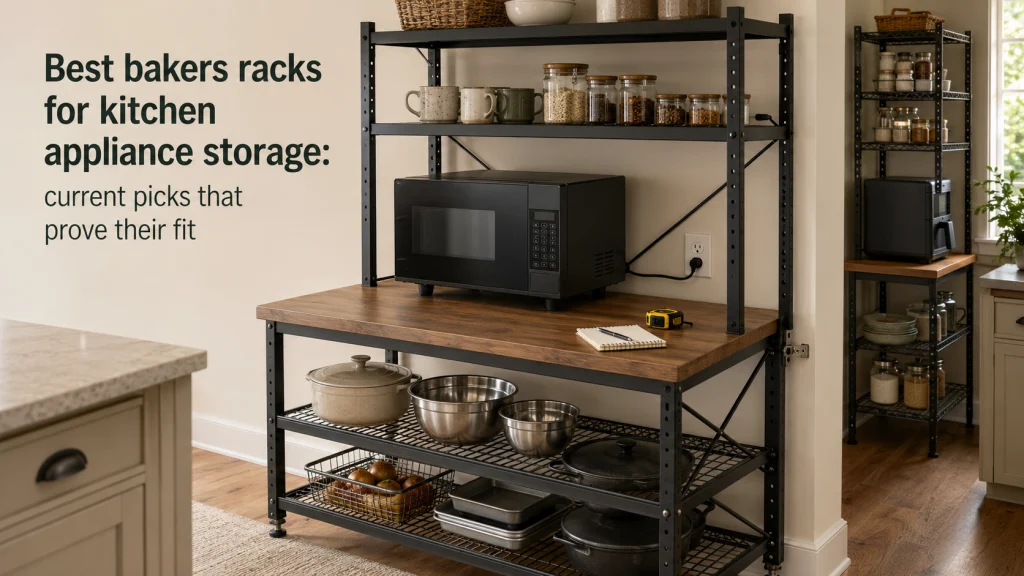
Start with the loaded work surface, not the shelf count
The best baker’s racks are not automatically the tallest racks or the ones with the most tiers. Put a tall, narrow rack beside a shorter unit with a deeper worktop, then imagine the actual microwave, air fryer, mixer, or coffee machine sitting on it. The shorter rack may offer less total storage yet give the appliance more usable depth, a better operating height, and a surface with a clearly stated load limit. That is the difference between storage that photographs well and storage that works once it is loaded.
Start with the appliance footprint, weight, and required clearances, then compare those needs with the exact shelf intended to support it. Total rack capacity does not prove that one worktop can carry the same load, and exterior width does not prove that the usable surface is equally wide. Upper shelves, baskets, hooks, and narrow lower tiers should be treated as separate storage zones unless their own dimensions and limits support the intended item. Once the working surface passes this check, the extra tiers become useful storage rather than compensation for a poor appliance fit. Capacity is only useful within home storage solutions when each compartment still matches the loads, route, and floor space available in the household.

The STANLEY FATMAX 25-foot tape measure provides up to 14 feet of reach for solo measurements. Large markings improve readability, while the high-impact case and coated blade are designed for repeated use. It is a practical tool for checking appliance footprint, rack depth, and available room before comparing shelf counts.
Check On AmazonIf you click this link and buy, we earn a commission at no additional cost to you.
Use an evidence hierarchy before calling any rack a winner
A current product page is the first stop for dimensions, shelf limits, leveling, anti-tip instructions, outlets, and package contents. Independent testing answers different questions, such as assembly effort and stability after setup. The two evidence types are strongest when they refer to the same identifiable model. If the model cannot be matched, the test can inform what to inspect without proving anything about the current rack.
Availability can fail before the specifications do. A sold-out rack should not keep a current winner label simply because its dimensions once looked good. Refresh price at publication and recheck availability whenever the article is updated. That keeps the shortlist tied to products a U.S. reader can realistically buy rather than to archived specifications.
Separate independent observations from current specifications
TechGearLab bought and assembled multiple baker’s racks, including an Amazon Basics model linked directly to the current B073P1V6HR listing. Its test found notably fast no-tool assembly, adjustable shelves, and strong suitability for larger items. Amazon separately lists a 70 lb full shelf with wood top and 160 lb total across the full wire shelves. That exact-model pairing is stronger than borrowing an old observation for a similar-looking SKU.
Require exact model identity, usable worktop size, and shelf-specific loads
A rack should not enter the shortlist just because a retailer calls it a microwave stand. The intended surface needs usable width and depth, and its own load limit must make sense for the appliance placed there. When a source lists only total capacity, that is not enough to infer the limit of one worktop. Adjustable shelves deserve the same scrutiny because a strong shelf can still be unusable when the appliance will not fit within the available opening.
Verify assembly, leveling, anti-tip, and power instructions
- Confirm the exact model or SKU and the listing that is currently purchasable.
- Match appliance width, depth, weight, and required clearance to the intended surface.
- Separate independent assembly evidence from manufacturer claims about easy setup.
- Check adjustable feet, caster limits, wall anchoring, and anti-tip hardware for that model.
- Use the appliance manual, not the rack marketing, to approve outlet and cord arrangements.
Tall open racks create more leverage when weight is stored high, so leveling and anti-tip instructions deserve more attention than hooks or decorative trim. Wheels also change the load case, as the Seville rack demonstrates with different shelf limits on leveling feet and casters. Built-in power remains a convenience feature rather than blanket electrical approval for a microwave, toaster oven, air fryer, or other high-draw appliance. The exact appliance instructions still control placement, clearance, and power.

The ProSensor M210 uses 13 sensors and 21 LEDs to show stud position across the sensing area. Its deep-scan system reaches up to 1.7 inches and includes a live-wire meter plus a bubble level. Use it to support wall-stud and leveling checks when a rack's anti-tip instructions call for secure anchoring.
Check On AmazonIf you click this link and buy, we earn a commission at no additional cost to you.
Keep the current shortlist small and role based
The shortlist is deliberately broader than one brand. HOOBRO supplies the balanced solid-surface candidate, Amazon Basics has the strongest exact-model hands-on evidence, Costway provides the narrowest open-wire option, and Seville Classics brings the clearest heavy-storage data. Each still has a meaningful limitation, so the roles are conditional. A model leaves the shortlist when availability disappears or the appliance fails its surface and clearance checks.
Availability is evidence, not a permanent product trait. HOOBRO BF64UHB01 appears in a Walmart listing with an add-to-cart option, Amazon Basics B073P1V6HR shows in-stock inventory, and Costway and Seville show active purchase controls. Those signals can change, so specific prices are not frozen into the recommendation logic. Refresh price and listing status before publication, while keeping geometry and shelf loads as the durable comparison.
| Current candidate | Conditional role | Why it survives the evidence gate | Main limitation |
|---|---|---|---|
| HOOBRO BF64UHB01 | Best overall balance | 31.5 in. wide, 15.7 in. deep, 80 lb large-shelf limits, adjustable feet, current retailer listing | No independent exact-model assembly test found |
| Amazon Basics B073P1V6HR | Best value with the strongest hands-on evidence | 70 lb wood-top shelf, adjustable wire shelving, no-tool assembly, exact listing linked from TechGearLab test | Only 14 in. deep, so many appliances will fail the footprint check |
| Costway 4-tier iron rack | Best compact open-wire option | 23.5 in. wide, 13.5 in. deep, 55 lb per shelf, adjustable feet, active manufacturer listing | Shallow wire support narrows appliance compatibility |
| Seville Classics SHE15385B | Best heavy-storage wire option | 300 lb per shelf on leveling feet, adjustable shelves, no-tool assembly, active manufacturer listing | Capacity drops sharply on casters and depth is only 14 in. |
The table is a conditional-winner matrix, not a scorecard. HOOBRO takes the broad solid-surface role only when 15.7 inches of depth is enough, while Amazon Basics is stronger when exact-model assembly evidence matters. Costway earns the compact role by giving up depth and solid support, and Seville earns the heavy-storage role only when open wire is acceptable. That is more useful than ranking four similar racks from one brand by feature count.

This two-tier utility cart uses a steel frame with a top board and plastic drawer. It measures 12.75 inches deep, 17.75 inches wide, and 28.6 inches high. Locking casters support mobile storage when a lower cart format fits the room better than a tall rack.
Check On AmazonIf you click this link and buy, we earn a commission at no additional cost to you.
Best overall role: HOOBRO BF64UHB01 when 15.7 inches of depth is enough
The HOOBRO BF64UHB01 is the strongest all-around paper candidate because its proportions are more appliance-friendly than the shallower wire finalists. The manufacturer lists a 31.5-inch width, 15.7-inch depth, six storage levels, and an 80 lb maximum static load for each large shelf, with smaller shelves rated at 40 lb. Adjustable feet give the frame a defined leveling method, while a current Walmart listing for the exact SKU shows it as purchasable rather than merely archived. That combination makes it easier to evaluate as a working rack instead of a decorative storage piece.
The evidence boundary is equally important. I did not find an independent exact-model assembly or stability test that would justify repeating a hands-on verdict about this HOOBRO rack. Its four built-in outlets also do not make every appliance electrically compatible with the rack, so the appliance manual still controls the power decision. Choose it when the intended appliance fits within the usable large shelf, stays under the relevant limit, and the household actually needs the extra vertical storage.

The 935DAG functions as both a digital level and an angle gauge with 0-to-90-degree and 0-to-180-degree ranges. Its display auto-rotates for easier reading, and the magnetic base helps hold the tool against ferrous surfaces. It is useful for checking whether adjustable feet have left a rack level before it is loaded.
Check On AmazonIf you click this link and buy, we earn a commission at no additional cost to you.
Best value role: Amazon Basics B073P1V6HR when shallow depth still works
The Amazon Basics B073P1V6HR earns the value role because it combines current load documentation with the strongest independent exact-model evidence in this shortlist. Amazon lists a removable wood countertop, a 70 lb limit for the full shelf with wood top, 160 lb total across the full wire shelves, and a 30 lb half-shelf limit. TechGearLab’s link resolves to this same ASIN, and its testers found the no-tool assembly notably fast. That makes the ownership evidence more concrete than a generic manufacturer claim that assembly is easy.
The catch is the 14-inch depth, which is a hard filter rather than a small inconvenience. A rack can be structurally strong and still be a poor appliance stand when the feet, body, ventilation space, or cord routing do not fit that shallow surface. Wire shelves are also less friendly to small items, a drawback TechGearLab noted in its test. Value exists here only when the geometry already works, because a tested rack that does not fit the appliance is still the wrong purchase.
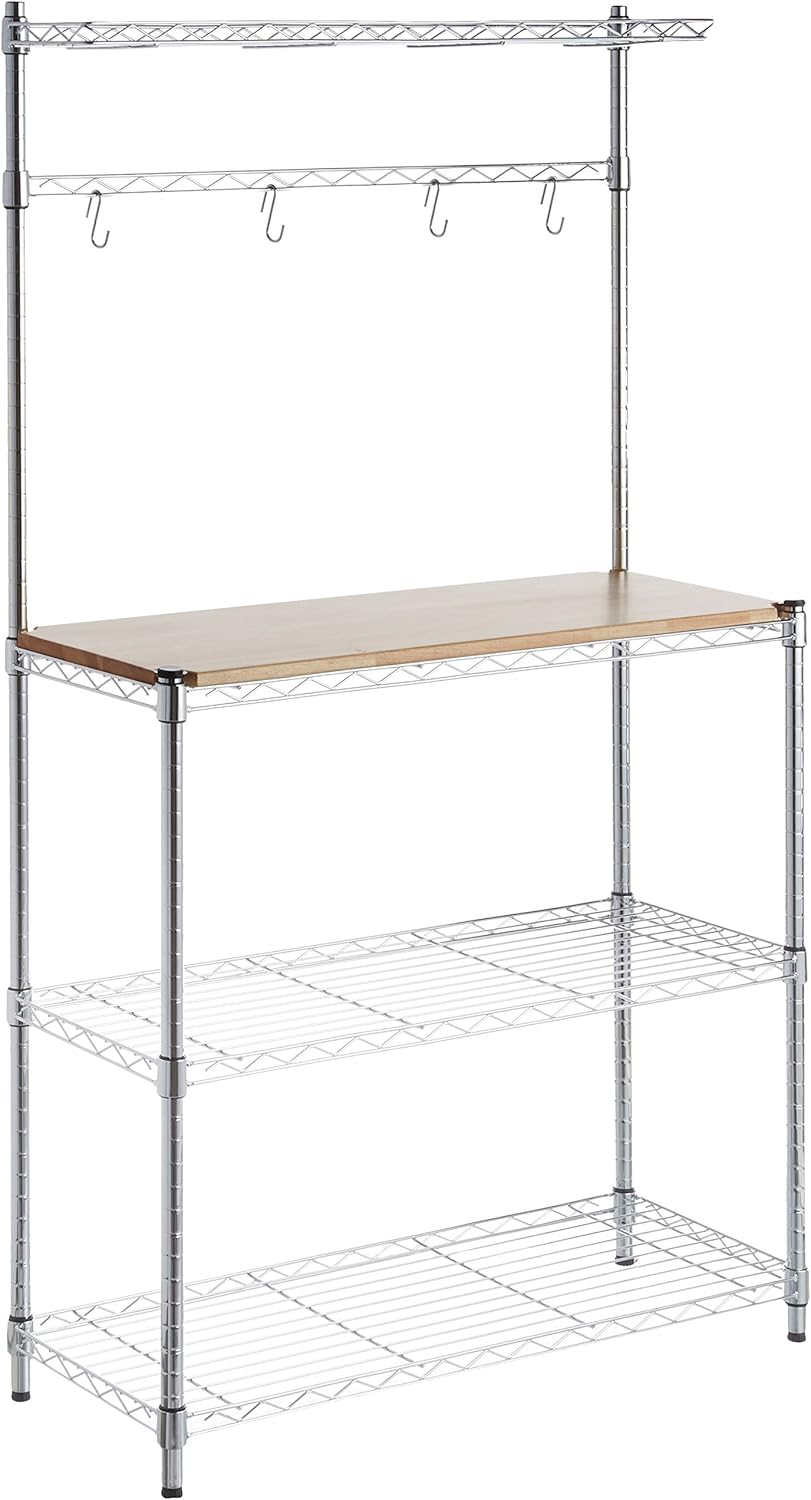
The Amazon Basics B073P1V6HR combines a removable wood worktop with adjustable wire storage. The wood-top full shelf is rated for 70 pounds, the half shelf for 30 pounds, and the full wire shelves for 160 pounds total. Its 36-by-14-by-63-inch frame assembles without tools, making its documented geometry and shelf limits easy to compare with the intended appliance.
Check On AmazonIf you click this link and buy, we earn a commission at no additional cost to you.
Best compact role: Costway’s 23.5-inch open-wire rack for smaller footprints
Costway’s four-tier iron rack is the compact finalist because its current manufacturer listing gives both a narrow 23.5-inch width and a specific 55 lb capacity for each shelf. At 13.5 inches deep, it consumes little floor space and uses adjustable feet rather than casters as its standard support. The open-wire construction also keeps the unit visually light and gives the shelves a clearly repeatable load rating. Those advantages matter most when the intended appliance is genuinely small enough for the surface.
The shallow depth is also the reason this is not a default microwave recommendation. Measure the appliance feet and required clearance before assuming that a 23.5-inch-wide rack solves a small-kitchen problem. Open wire can be awkward under narrow feet or small accessories even when the weight is within the stated limit. If the appliance needs more depth or a continuous support surface, choose a wider solid-surface finalist instead of treating compactness as the higher priority.

This three-shelf steel wire rack measures 23.2 by 13.4 by 30 inches. Each shelf is rated for up to 250 pounds with weight evenly distributed, and shelf height adjusts in 1-inch increments. Four leveling feet and no-tool assembly make it a compact open-wire option when the appliance actually fits the shallow 13.4-inch depth.
Check On AmazonIf you click this link and buy, we earn a commission at no additional cost to you.
Best heavy-storage role: Seville Classics SHE15385B on leveling feet
The Seville Classics SHE15385B has the clearest per-shelf heavy-load documentation in this group. Its manufacturer lists four adjustable steel wire shelves at 36 inches wide and 14 inches deep, with a 300 lb capacity per shelf when the rack stands on its leveling feet. Assembly requires no tools, and the shelf height can be changed in one-inch increments. The active manufacturer listing also makes the exact model easier to verify than an older marketplace rack whose current identity is uncertain.
The important qualifier is that the same rack has a much lower 82.5 lb per-shelf limit when used on its wheels. That difference shows why a headline total capacity is not enough and why mobility should never be treated as a free feature. The 14-inch wire depth also narrows the range of appliances that can sit comfortably on it. Choose this role for heavy storage only when the intended shelf, support mode, and appliance footprint all match the documented configuration.

This five-shelf wire rack measures 30 by 14 by 64.75 inches and includes both leveling feet and 4-inch casters. Amazon lists 300 pounds per shelf on leveling feet, 132 pounds per shelf on stationary casters, and 88 pounds per shelf while rolling. Shelf height adjusts in 1-inch increments, so its documented configuration changes show why mobility and load ratings must be checked together.
Check On AmazonIf you click this link and buy, we earn a commission at no additional cost to you.
Compare the finalists on the surface that will carry the appliance
The useful comparison is not four brand names in a row. Compare the work surface, its load, footprint, material, assembly evidence, leveling or mobility hardware, and listing status. Side by side, the roles separate quickly. HOOBRO offers more depth, Amazon Basics stronger independent assembly evidence, Costway less width, and Seville the highest documented shelf load on feet.
The table also exposes weaker evidence. Only Amazon Basics has a direct exact-model bridge between current listing data and the TechGearLab test used here. The other three rely on manufacturer or retailer specifications, so they cannot inherit hands-on conclusions from different models. That distinction is more useful than pretending every finalist was tested under identical conditions.
| Finalist | Usable support evidence | Overall footprint | Surface | Assembly evidence | Leveling, mobility, or anti-tip | Current listing status |
|---|---|---|---|---|---|---|
| HOOBRO BF64UHB01 | Large shelves: 80 lb each | 31.5 W x 15.7 D x 60.6 H in. | Particleboard plus metal shelving | Manufacturer instructions only | Six adjustable feet | Exact SKU offered through current Walmart listing |
| Amazon Basics B073P1V6HR | Wood-top full shelf: 70 lb; full wire shelves: 160 lb total | About 36 W x 14 D x 63 H in. | Removable wood top plus wire shelves | TechGearLab exact-model test: notably fast no-tool assembly | Adjustable shelf heights; no anti-tip claim carried into this comparison | Current Amazon listing shows in-stock inventory |
| Costway 4-tier iron rack | 55 lb per shelf | 23.5 W x 13.5 D x 53.5 H in. | Open iron wire | Manufacturer assembly instructions | Adjustable feet | Manufacturer page offers Add to Cart |
| Seville Classics SHE15385B | 300 lb per shelf on feet; 82.5 lb per shelf on wheels | 36 W x 14 D x 56.5 H in. | Open steel wire | Manufacturer states no-tool assembly | Adjustable leveling feet or locking casters | Manufacturer page offers Add to Cart |
Use the comparison as an elimination table, not a point system. A deeper solid surface can matter more than a higher load rating when geometry is tight, while observed fast assembly can matter more than extra shelves. Seville’s wheel-versus-foot limits show how configuration changes load without changing the product name. Once a finalist fails the intended surface, clearance, or support condition, its other features should stop influencing the decision.

This five-shelf chrome wire rack measures 36 by 14 by 72 inches. Each shelf is rated for up to 350 pounds with weight evenly distributed, for 1,750 pounds total, and shelf height adjusts in 1-inch increments. Four leveling feet and no-tool assembly provide clearly documented comparison points for surface dimensions, load, and setup.
Check On AmazonIf you click this link and buy, we earn a commission at no additional cost to you.
Open wire and solid surfaces solve different storage problems
Open wire is light, adjustable, and easy to inspect from below, but it does not give every appliance foot or small container continuous support. Solid worktops are usually easier for crumbs, drips, and small accessories, and they remove the question of whether a narrow foot lands between wires. Neither surface automatically handles heat or ventilation better in every setup. The appliance manual still determines the clearance and support conditions that matter.
A first-time buyer can easily focus on material and miss geometry. A solid shelf that is too shallow is still a bad appliance surface, just as a very strong wire shelf can be wrong for feet that do not sit securely. Avoid improvising with liners or boards unless the rack and appliance instructions permit that setup and the added layer does not create a heat, clearance, or stability problem. The better surface is the one that supports the exact appliance without creating a new workaround.
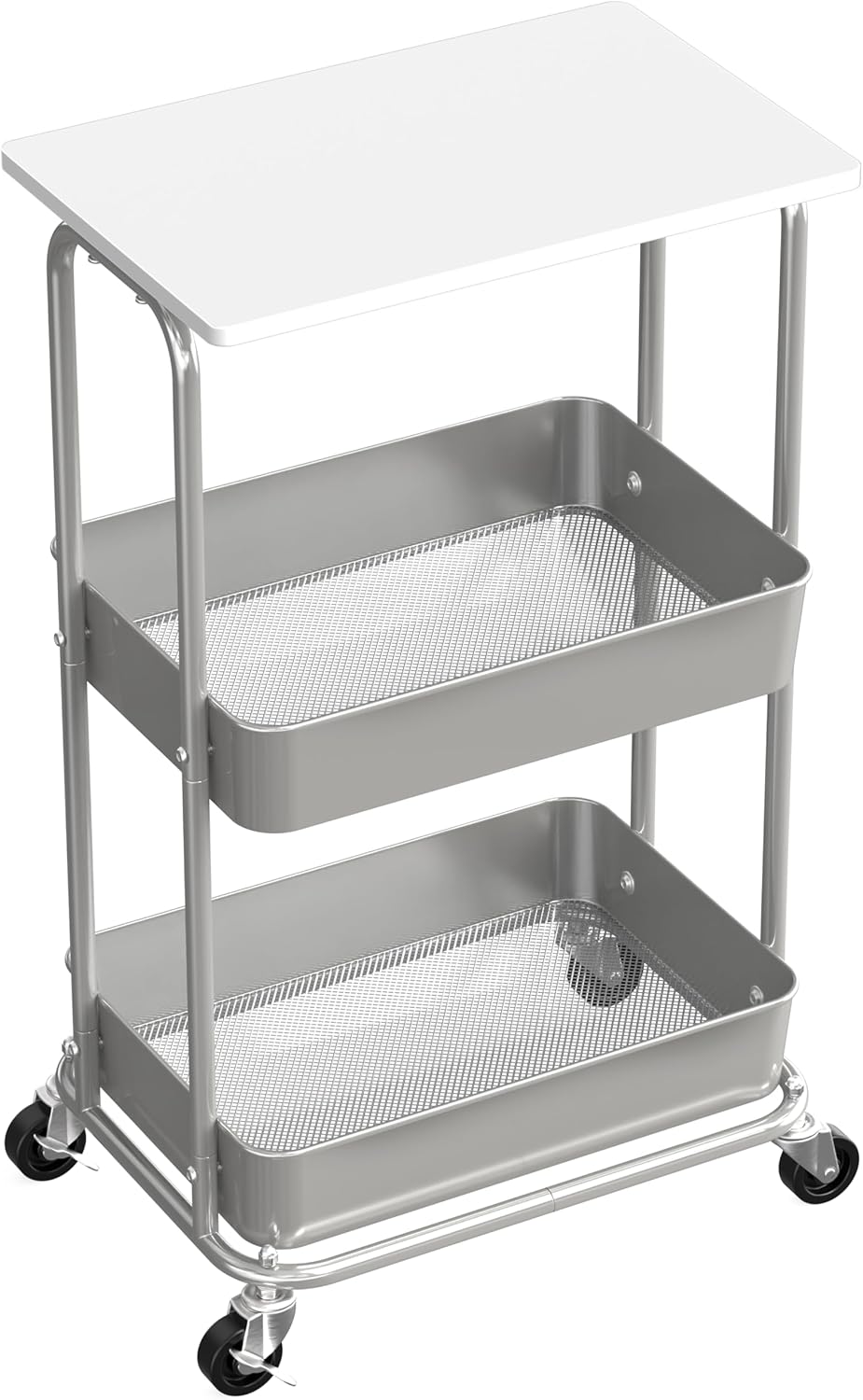
This two-tier cart pairs a steel frame with a particleboard top surface. It measures 12.5 inches deep, 17 inches wide, and 29.2 inches high. Locking casters make it a compact solid-top option when continuous surface support matters.
Check On AmazonIf you click this link and buy, we earn a commission at no additional cost to you.
Treat built-in outlets as conditional convenience
The HOOBRO finalist includes multiple outlets, but that feature does not move it ahead of a rack that fits the appliance better. An integrated strip can shorten cord routing and keep plugs accessible, yet it cannot change the electrical requirements printed in the appliance instructions. High-draw equipment may require a direct wall connection or another specific arrangement. Treat the rack outlet as usable only after the appliance documentation approves the setup.
Cord routing matters even when the electrical arrangement is allowed. Keep cords away from pinch points, hot surfaces, moving shelves, and walkways, and do not let the rack create a hidden tangle behind the appliance. Extra receptacles are not a reason to run several heat-producing appliances simultaneously unless the equipment instructions and household circuit support that use. If built-in power solves no real placement problem, a simpler rack near the correct wall receptacle is easier to own.

The Klein Tools RT250 checks standard three-wire 120V receptacles and displays voltage plus wiring conditions on its LCD. It can identify common wiring faults and measure GFCI trip time. Use it to evaluate the receptacle itself, while the appliance manual still determines whether a microwave or other high-draw appliance may use a rack-mounted outlet.
Check On AmazonIf you click this link and buy, we earn a commission at no additional cost to you.
Skip a baker’s rack when open vertical storage is the wrong architecture
A baker’s rack is a poor choice when the appliance is too deep for common open worktops, when the household wants clutter hidden, or when the rack would block a narrow walkway. It also becomes less appealing when heavy items must be lifted to uncomfortable heights or when wall anchoring is impractical in the intended location. In those cases, a broader fixed stand, a cabinet-style unit, or a purpose-built cart can solve the same storage problem with a different balance of access and enclosure. Choosing another format is not a downgrade if it better matches the room and appliance.
If mobility is the real requirement, review when a microwave cart makes more sense instead of assuming wheels belong on every rack. If the question is broader than open storage, compare current microwave stand choices across several formats. A fixed, lower stand can also be easier to load and reach for a frequently used appliance. The right format should reduce repeated friction, not merely free a rectangle of counter space.

This three-tier utility cart uses an all-metal storage layout on a steel frame. It measures 12 inches deep, 15.6 inches wide, and 24.2 inches high. Locking casters and the low under-desk design make it a concrete alternative when a tall baker's rack is the wrong format.
Check On AmazonIf you click this link and buy, we earn a commission at no additional cost to you.
Use the rack criteria first, then compare current models
This page assumes you have already chosen an open vertical rack and now need to compare current candidates. If that format is still uncertain, start with how baker’s racks work as an appliance-storage format and measure the room before returning to a shortlist. That broader decision includes worktop height, reach, cleanup, visibility, and how a tall frame changes the room. Settle those issues before model features pull the decision in different directions.
For a microwave specifically, microwave stand options cover the broader support problem before it is narrowed to one furniture style. That distinction matters because a rack can be perfectly good furniture and still be a poor microwave support surface for one exact machine. Model comparison begins only after the format passes the household test. From there, exact geometry, shelf-specific load, stability hardware, assembly, and power instructions decide which finalist deserves the space.

This three-tier utility cart uses plastic baskets on a steel frame. It measures 11.2 inches deep, 17 inches wide, and 31.38 inches high. Locking casters and the hanging-bucket design suit mobile, divided storage when the room calls for a different architecture than open shelving.
Check On AmazonIf you click this link and buy, we earn a commission at no additional cost to you.
Final thoughts: choose the rack whose current evidence matches the job
The strongest shortlist is not the one with the most products. It is the one that can explain why each finalist remains available, what exact surface carries the appliance, what that surface is rated to hold, and where the evidence stops. HOOBRO is the broad solid-surface pick here, Amazon Basics has the best exact-model hands-on bridge, Costway is the compact open-wire option, and Seville is the heavy-storage wire option. None should survive a mismatch with the appliance footprint, clearance, support, or power instructions.
Refresh availability and price before publication, then measure the appliance and the intended location one more time. Once those checks pass, compare assembly burden, reach, cleaning, surface type, and storage layout rather than returning to shelf count or decorative features. A smaller or simpler rack is often the better purchase when it completes the same job with less space and setup. The final winner should be the rack that removes household friction without asking you to invent a workaround for fit or support.

This four-tier utility cart uses plastic baskets on a steel frame. It measures 12.25 inches deep, 17 inches wide, and 37 inches high. Locking casters provide mobility while the tiered basket layout offers a compact storage alternative when simpler organization fits the job.
Check On AmazonIf you click this link and buy, we earn a commission at no additional cost to you.
FAQs
📏 How deep should a baker’s rack be for a microwave?
Use the microwave’s exact footprint and required clearances rather than a generic depth target. The rack must support the feet or base as required by the microwave manufacturer without forcing the appliance against the frame or wall.
⚖️ Can I use the total rack weight capacity for the microwave shelf?
No. Use the documented load limit for the exact shelf or worktop holding the microwave, because total capacity may combine several surfaces with different limits.
🔌 Is a baker’s rack with outlets safe for a microwave?
The rack outlet alone does not prove compatibility. Follow the exact microwave manual for outlet, circuit, cord, and extension or power-strip restrictions.
🧱 Do tall baker’s racks need to be anchored to the wall?
If the rack includes an anti-tip kit or its instructions require anchoring, install it as directed. Tall loaded furniture becomes more sensitive to uneven floors, high storage, pulling forces, and accidental bumps.
🧹 Are wire shelves better than solid shelves for appliances?
Neither is universally better. Solid surfaces usually support appliance feet and small items more continuously, while wire shelves can be lighter and better ventilated, so the appliance and rack instructions should decide the fit.
📦 What should I measure before buying a baker’s rack?
Measure the appliance, intended work surface, rack footprint, vertical opening, nearby doors and walkways, and the cord path. Then verify the exact surface load and any leveling or anchoring requirements.
🛒 Should a sold-out rack stay on a current best list?
Not as a primary current pick unless a reliable purchasable listing for the exact model remains available. Keep its specifications only as reference evidence and refresh availability before publication or update.
References and sources
- TechGearLab baker’s rack testing: Independent assembly and stability observations for the exact Amazon Basics model linked from the test.
- Amazon Basics B073P1V6HR listing: Current dimensions, shelf load limits, assembly details, and availability.
- HOOBRO BF64UHB01 specifications: Exact dimensions, shelf load limits, outlets, and adjustable feet.
- HOOBRO BF64UHB01 retailer listing: Current U.S. purchase availability for the exact model.
- Costway four-tier rack specifications: Current dimensions, per-shelf load, adjustable feet, and availability.
- Seville Classics SHE15385B specifications: Current dimensions, foot-versus-wheel loads, leveling, and assembly details.