A wheeled support cart can free counter space, but mobility only matters when the loaded setup can move without creating a worse power, clearance, or stability problem. Verify the microwave’s footprint, weight, ventilation needs, outlet requirements, and access before comparing storage or caster features. A cart that stays parked can still be useful, but it should compete honestly with a fixed stand. Choose the setup that supports the appliance and the kitchen routine, not the one with the longest feature list.
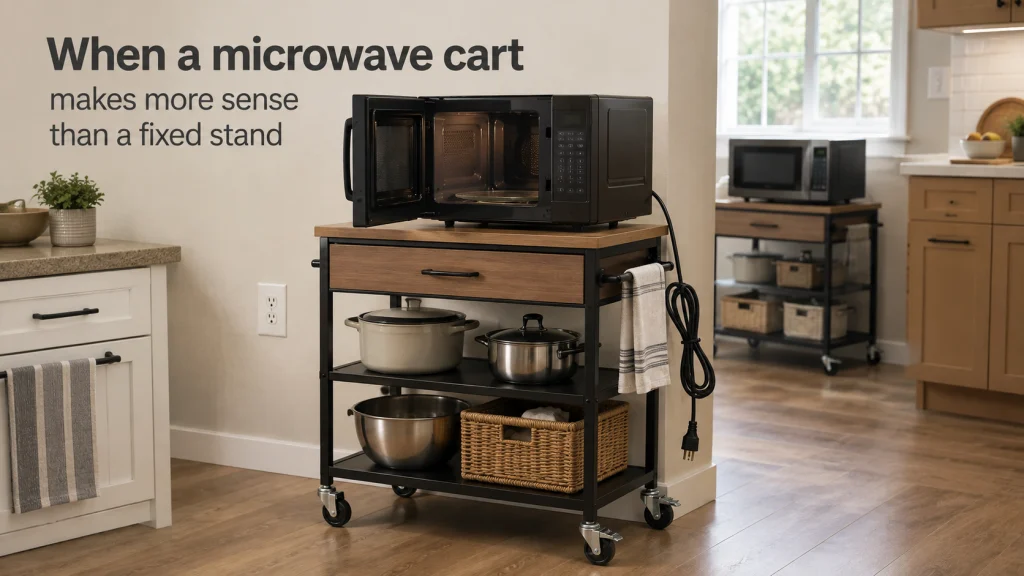
Will the loaded microwave cart ever actually move?
A microwave cart sounds mobile, but ask what happens after the microwave is loaded, plugged in, and surrounded by stored items. If you expect to reposition it often, the floor path, turning space, cord routine, and caster locks become part of normal use. If it will barely move, the cart behaves more like a fixed microwave stand with casters. That can still be useful, but the purchase should be judged by what the furniture actually does in the room.
A microwave cart with wheels can look more flexible online than it feels after the setup is complete. Appliance weight and filled shelves change handling, while the outlet location defines the normal operating position. An empty cart rolling across a showroom-style floor tells you little about that finished setup. Start by deciding how often movement will really happen, then let the later checks determine whether the room supports it. That same route-first logic applies across home storage solutions, because storage only works when the container fits how items actually move through the home.

This ThreeHio cart combines a three-tier microwave table stand with open storage. Lockable wheels let the cart roll for repositioning and park when movement is finished. Its compact shelf-rack format also supports coffee-station or utility storage use.
Check On AmazonIf you click this link and buy, we earn a commission at no additional cost to you.
Know what counts as the right cart before comparing features
For this decision, the cart is freestanding furniture intended to support a countertop microwave while adding wheels, shelves, drawers, or cabinets. A microwave cart with storage may use an open top, recessed opening, or hutch-style upper section around the appliance. Those layouts change usable width, depth, overhead clearance, door access, and storage access. The product label alone does not prove that the exact microwave fits safely in the intended position.
Generic utility carts and full kitchen islands belong outside this comparison unless their documentation supports the intended appliance use and the exact support surface is suitable. Strong shelves do not compensate for shallow support, blocked ventilation, awkward height, or a poor power path. A large island can provide plenty of surface area while solving a different job centered on preparation or seating. Judge every feature by whether it improves the microwave setup you actually need in the available kitchen space.

This BolDuck rolling microwave cart has three tiers, adjustable shelves, and a 450-pound listed capacity. Its overall size is 23.6 inches long, 15.7 inches wide, and 37 inches high. The wood-and-chrome design provides a defined appliance surface plus additional storage levels.
Check On AmazonIf you click this link and buy, we earn a commission at no additional cost to you.
Verify the microwave before you compare the cart
The cart cannot be judged until you know what the microwave requires. Pull the exact dimensions, weight, ventilation instructions, door behavior, and electrical guidance from its manual or manufacturer support material. If you are still choosing the appliance, settle the broader countertop microwave decision before furniture dimensions drive the purchase. Otherwise the furniture can quietly force the wrong appliance size or placement.
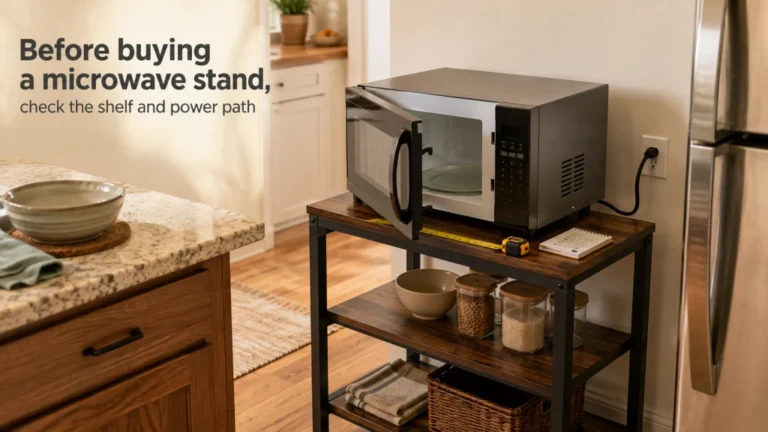
Write down the controlling requirements before shopping: usable support surface, load rating for that surface, ventilation space, outlet location, plug reach, and access height. These are not interchangeable with outside dimensions or one total-capacity headline. The furniture can be wide overall while the usable top is narrower, or have a high total rating while the microwave surface carries less. The exact support point is what must pass.
Match the appliance footprint to the usable surface
Compare the microwave’s full footprint with the actual flat support area, not the furniture’s widest exterior measurement. Rails, raised edges, posts, hutches, handles, or trim can reduce usable space. For recessed layouts, check opening height and depth rather than assuming the cavity matches the outside dimensions. The appliance should sit as its manufacturer permits, without relying on unverified overhang.
Match microwave weight to the correct rating
Use the rating for the top, shelf, or platform that will actually carry the microwave. Total capacity can include several load points, so it does not prove what one surface can support. If a hypothetical cart lists 180 pounds total but only 40 pounds on top, a 45-pound microwave fails that check. Compare appliance weight with the documented rating of the exact support surface.
Apply the microwave’s exact ventilation and power requirements
Countertop microwave manufacturers commonly require a stable surface, ventilation space, and appropriate grounding, but exact instructions vary by model. Do not borrow a clearance number from another microwave because the cabinets look similar. Follow the exact documentation for cords, adapters, extension cords, and power strips instead of improvising for furniture mobility. If the intended position conflicts with the microwave manual, reject the position.

The Proto PRO33-425 is a 1-inch-wide, 25-foot classic tape measure. Its length supports checking a microwave footprint, cart support surface, and surrounding room dimensions. The compact hand tool is also useful for repeat measurements when planning outlet reach and a movement path.
Check On AmazonIf you click this link and buy, we earn a commission at no additional cost to you.
Decide whether you need regular, occasional, or parked mobility
A rolling microwave cart makes sense when movement removes recurring work. Regular mobility might clear a narrow path, improve cleaning access, or free floor space used for another task. Occasional mobility means the cart normally stays in one operating position but can be repositioned when needed. Parked mobility means the casters help with placement and then rarely matter.
Those patterns justify different priorities. Regular movement puts more pressure on caster behavior, turning clearance, floor transitions, and how securely stored items remain in place. Occasional movement may only require enough access to reposition the furniture for cleaning or room changes. Parked use shifts attention toward stability, storage access, and the quality of the support surface. Classifying the routine first keeps later feature comparisons from treating every set of casters as equally important.
| Mobility pattern | What the cart must do well | What to question |
|---|---|---|
| Regular movement | Roll predictably on the actual floor, turn within the available space, park securely, and support a workable unplugged movement routine | Thresholds, rugs, caster locks, stored-item movement, cord reach, and whether the manual allows the intended loaded movement |
| Occasional movement | Reposition without becoming difficult to control or awkward to clear | Whether access behind the cart is valuable enough to justify wheels |
| Mostly parked | Stay stable and provide useful appliance support and storage | Whether a fixed stand would provide the same benefit with fewer compromises |
Use the row that describes ordinary ownership, not the rare day when you might rearrange the room. A feature that matters once or twice a year should not outweigh a layout that works better every day. This is especially important when storage, access, or floor space changes depending on where the cart is parked. The normal routine is the better test.

This ThreeHio rolling microwave cart combines a three-tier table stand with storage and an integrated power outlet. The wheeled layout is built for movable kitchen or utility use. Its compact shelf-rack format can also serve as a coffee cart or small-appliance station.
Check On AmazonIf you click this link and buy, we earn a commission at no additional cost to you.
Check the casters as a complete stability and movement system
Four wheels do not tell you how a loaded cart behaves. Check how many casters lock, what the instructions say about locking or moving the unit, how the wheels attach, and whether the frame stays square. Two locking casters may be normal for a design, but documentation should explain their intended use. Do not turn “easy mobility” into a claim that every loaded movement is acceptable.
Floor conditions matter because grout lines, thresholds, rugs, soft flooring, and tight turns change wheel behavior. Smooth hard flooring is different from a raised transition with a heavy appliance on the frame. Consider steering position and whether doors, drawers, or stored items can shift. A cart that needs constant correction is not meaningfully convenient just because it rolls.
Verify which wheels lock and what the instructions require
Use a caster diagram, parts list, assembly manual, or manufacturer statement instead of assuming every wheel locks. Check whether the instructions require locks for stationary use or limit loaded movement. If that information is missing, do not invent a rule from product photos. Resolve the unknown before relying on mobility as a purchase benefit.
Walk the floor path before assuming the cart will be easy to move
Trace the route with the cart’s full footprint in mind, including handles, hooks, and turning space. Note every rug edge, threshold, narrow passage, or pivot point. Ask whether the loaded furniture can follow that path without lifting, snagging, or repeated unloading. If the route is poor, occasional or parked use may be more realistic.
- Identify which casters lock and how the manufacturer says to use them.
- Check the route for thresholds, rugs, tight turns, and narrow passages.
- Confirm the microwave will be unplugged before any movement that requires it.
- Keep the cord clear of wheels and the walking path during repositioning.
- Recheck doors, drawers, hooks, and loose stored items before rolling.
Run this check with the cart normally loaded, not only while empty. A good result means movement is predictable from start to finish. Any unresolved cord or floor-path problem weakens the case for regular mobility. That can change which furniture type makes sense.

This set includes four 3-inch locking swivel casters with rubber wheels and 360-degree rotation. Each caster uses a 3/8-16 threaded stem that is 1 inch long. It is appropriate only when the cart or furniture specifies that exact threaded-stem interface.
Check On AmazonIf you click this link and buy, we earn a commission at no additional cost to you.
Plan the power path before you count mobility as a benefit
The microwave cord can turn mobile furniture into a fixed setup as soon as the appliance is plugged in. Start with the operating position and make sure the cord reaches the appropriate grounded outlet as the exact instructions allow. If the cart needs to move, decide when the appliance will be unplugged and where the cord will stay so it cannot catch under a wheel. That routine is part of the furniture decision.
Do not add an extension cord or power strip merely to gain rolling distance. Microwave electrical guidance is model-specific, and instructions can differ on whether an extension cord is permitted. If the intended operating spot requires a workaround that the appliance documentation does not support, change the placement rather than building the furniture decision around that workaround. The outlet position is therefore a practical room constraint, not just an electrical detail.
Let the microwave manual control grounding and outlet use
Use the exact microwave instructions for the outlet, grounding, cord arrangement, and any extension-cord language. Do not substitute a generic rule for model-specific requirements. If the outlet forces the cord into traffic or prevents correct ventilation, the room layout may be the real constraint. Solve that placement problem before buying furniture around it.
Do not buy extra rolling range by adding electrical complexity
For many households, the useful routine may be simple: operate the microwave in one verified position, then unplug it before occasional repositioning if the furniture and appliance instructions allow that use. This separates appliance operation from furniture movement instead of trying to make both happen at once. It also makes cord storage, wheel clearance, and the destination position easier to evaluate. If that routine feels cumbersome for the task you are trying to solve, the cart may not need to move as often as the product page suggests.

These VELCRO ONE-WRAP ties are pre-cut cable-management straps sized 8 inches by 1/2 inch. The black 100-pack is designed for organizing cords and wires. They can keep an unplugged microwave cord bundled away from wheels while a cart is being repositioned.
Check On AmazonIf you click this link and buy, we earn a commission at no additional cost to you.
Check appliance height and the path for removing hot dishes
A cart can fit the microwave and still place it at an awkward working height. Picture opening the door, reaching the controls, seeing into the cavity, and removing a hot container without lifting around a shelf or cabinet edge. Useful height depends on the users and the appliance design, so one furniture height cannot suit every household. What matters is a stable, comfortable transfer path to the next safe surface.
Check what sits beside and below the microwave as well, including the nearest safe landing area for a hot dish. A narrow top may leave nowhere to set a hot dish, while a hutch or rail can crowd the hand path without blocking the appliance footprint. Different users may need different access heights, but the appliance instructions and household safety needs still control placement. The cart should make normal use easier without awkward reaching or hurried carrying around nearby furniture.

This KitchenAid set includes two ribbed soft silicone pot holders in matte black. Each pot holder measures 7 by 9 inches. The pair provides a dedicated handling accessory for moving hot cookware between the microwave and a nearby landing surface.
Check On AmazonIf you click this link and buy, we earn a commission at no additional cost to you.
Compare open-top, recessed, and hutch-style cart layouts by usable space
An open top leaves less furniture around the microwave, which can simplify measuring and vent checks from several sides. A recessed alcove may look tidier, but its opening must match the appliance’s width, depth, height, door movement, and ventilation needs. A hutch adds upper storage, yet posts or shelves can become clearance constraints around the appliance. None of these layouts is automatically better because each changes what must be verified before normal use in that exact location.
Measure the area the microwave occupies and the space that remains for hand access, door movement, cord routing, and ventilation. Do not assume a recessed opening is appliance-ready because a retailer labels the furniture for microwaves. An open top also fails if the appliance cannot sit on the support surface as required or leaves important vents crowded. Choose the layout that gives the exact appliance verified room without sacrificing stability or everyday access.

A 165-foot green-beam laser distance measure designed for fast indoor and jobsite measurements. The bright green laser improves visibility compared with standard red beams, while the color display keeps readings easy to check. It supports straightforward distance measuring in a compact handheld format and provides a longer working range than the Bosch GLM100-23 it replaces.
Check On AmazonIf you click this link and buy, we earn a commission at no additional cost to you.
Choose shelves, drawers, and cabinets by access rather than storage volume
Extra storage helps only when it keeps the microwave setup easier to use. Open shelves make frequently used items visible and easy to reach, but they also leave everything exposed to dust and visual clutter. Drawers contain smaller items well, while lower cabinets hide bulkier pieces and can keep the cart looking calmer. The trade-off is that doors and drawers need their own opening space, which matters in a narrow kitchen or beside another cabinet.
Store items according to how the cart moves and how the microwave is used. Heavy objects placed low can be easier to manage than putting them high, but every shelf or drawer still needs to stay within its documented load rating. Loose glassware, tall bottles, or items that slide easily deserve extra thought if the cart will ever roll. The best storage layout is the one that stays useful during normal appliance use instead of maximizing the number of compartments on the product page.
- Check whether the appliance door can open fully without colliding with a rail, post, or nearby wall.
- Open every drawer and cabinet door in the intended parking spot before assuming the footprint works.
- Keep frequently moved items where they do not require reaching around a hot appliance.
- Verify the rating of each loaded shelf or drawer rather than relying on total cart capacity.
- For a movable setup, avoid treating loose storage as if it will remain perfectly still while rolling.
This is where a smaller cart can sometimes outperform a larger one. More storage is only better when extra doors, shelves, and stored weight do not interfere with the appliance or floor path. Empty compartments are not a benefit by themselves. Useful access matters more than maximum volume.

Duck Brand Select Grip EasyLiner is a non-adhesive shelf and drawer liner measuring 12 inches by 10 feet. The white liner is washable and can be cut to fit storage surfaces. Its non-adhesive format makes it useful for lining shelves or drawers without permanently bonding to the furniture.
Check On AmazonIf you click this link and buy, we earn a commission at no additional cost to you.
Treat assembly and load distribution as part of appliance support
A cart is not ready for a microwave merely because all parts are attached. Confirm the frame sits square, fasteners are tightened as specified, shelves are seated, casters are correctly installed, and the unit does not rock on the actual kitchen floor. Follow any documented shelf-position, load-distribution, restraint, or caster instructions before loading the appliance. Do not use the microwave’s weight to settle poor assembly or hide an uneven frame.
Load each surface within its documented limit instead of filling every space until the total seems acceptable. The microwave already concentrates weight on one level, so additional stored items can change handling, balance, and wheel behavior even below the overall capacity. Recheck the cart after loading because drawers, doors, and wheels may behave differently once the furniture carries its normal household load. If the frame twists, rocks, rolls unexpectedly, or has damaged hardware, correct the furniture issue before appliance use.

The Empire EM81.9G is a 9-inch magnetic torpedo level with an overhead viewing slot. Its compact length fits easily on cart tops, shelves, and frame members during assembly checks. The magnetic body also supports hands-free positioning on compatible metal surfaces.
Check On AmazonIf you click this link and buy, we earn a commission at no additional cost to you.
Compare a parked cart with a fixed stand before paying for wheels
If the cart will live beside one outlet and rarely move, compare it directly with fixed furniture. A fixed stand may offer a simpler base, fewer moving parts, and storage designed around one location. The wheeled option has to earn the extra hardware through a specific household task such as easier access behind the furniture or more flexible room use. Otherwise the comparison should come down to support quality, storage layout, footprint, and day-to-day access.
Compare both options using the same requirements: usable surface, load rating, ventilation, outlet path, appliance height, storage access, and footprint. Then compare the ownership difference created by the casters themselves, including cleaning access, floor behavior, and any extra movement routine. A fixed stand can be the better answer even when a cart technically fits. A cart can be the better answer when those wheels make a recurring task materially easier.
| Decision point | Parked cart | Fixed stand |
|---|---|---|
| Appliance fit | Must match exact usable surface and clearance | Must match exact usable surface and clearance |
| Load support | Check the exact top or shelf rating | Check the exact top or shelf rating |
| Power path | Must work in the normal parked position without improvised rolling range | Must work in the permanent position |
| Movement value | Worth paying for only when repositioning solves a real task | No caster benefit, but no caster system to manage |
| Storage | Judge access while parked and, if relevant, while moving | Judge access in one permanent location |
If the first three rows decide the winner before you reach movement value, that is useful information. It means the choice is being controlled by appliance support and room fit rather than furniture marketing. If both options pass those checks, the final comparison becomes much cleaner. At that point, the casters either solve a real recurring task or they do not.

This SUPERJARE kitchen baker's rack uses a four-tier layout with a dedicated microwave-stand format and storage shelves. It includes a power outlet and six S-shaped hooks for small kitchen items. The rack provides a fixed shelving alternative for comparing support and storage when wheels are not solving a recurring task.
Check On AmazonIf you click this link and buy, we earn a commission at no additional cost to you.
Know when another storage architecture fits the job better
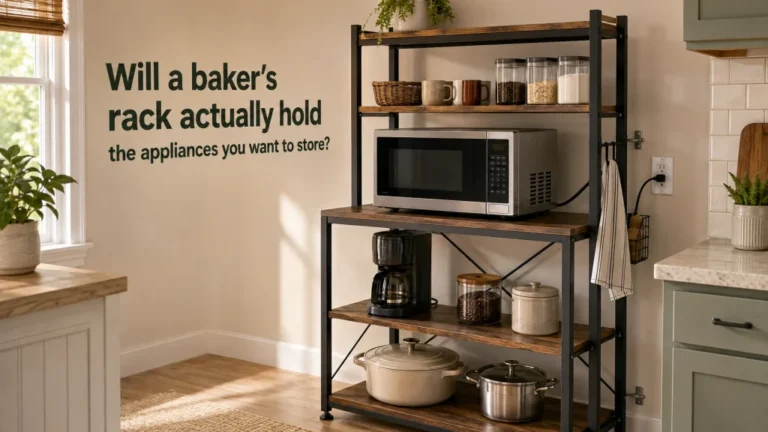
A cart is only one way to move a microwave off the main counter. If you need more vertical shelving and the furniture will stay stationary, a baker’s rack for appliance storage may use wall-side space better and keep the floor plan simpler. An enclosed system may look calmer, but it makes ventilation, door clearance, and access checks even more important. Choose the furniture type that supports the appliance without creating new placement problems.
Skip the cart when the wheels solve nothing, the route is poor, the power arrangement only works in one spot, or the microwave cannot meet its support and ventilation requirements there. Also skip it when you really need a large prep surface or full kitchen island, which is a different furniture job. Clear boundaries keep a small counter-space problem from becoming oversized furniture with unused features. Choose the cart only when support, storage, and movement all fit the room.

This Furologee baker's rack combines a four-tier microwave-stand layout with storage and a power outlet. Six S-hooks add hanging space for smaller kitchen items. The vertical rack format offers an alternative to a wheeled cart when the furniture will stay in one location.
Check On AmazonIf you click this link and buy, we earn a commission at no additional cost to you.
Use current listings only after your requirement profile is complete
Current listings reveal real combinations of open tops, shelves, cabinets, drawers, casters, and published load ratings, but they should come late in the process. Use the requirement profile you have already built as a filter rather than restarting the decision from each retailer’s feature list. Eliminate candidates that fail a controlling requirement before comparing finish, decorative details, or extra storage. That makes the shopping stage faster because most unsuitable options can be rejected on evidence instead of appearance.
To compare more than one support type, use the broader microwave stand comparison only after defining nonnegotiable requirements. Retailer descriptions can emphasize convenience before the limits that matter to your room, especially usable support dimensions and model-specific restrictions. Verify dimensions, the microwave-surface load rating, caster details, assembly instructions, and movement limits before purchase. A listing that survives those checks is a better candidate than one that merely offers more features.

This Homleke cart uses a three-tier rolling layout with lockable wheels and black small-appliance storage shelves. Six hooks provide extra hanging space beside the main surfaces. The cart format supports comparing a current microwave-storage configuration after size, load, clearance, and outlet requirements are already defined.
Check On AmazonIf you click this link and buy, we earn a commission at no additional cost to you.
Final Thoughts: buy wheels for a movement problem
A good cart choice starts with appliance support, not the caster count. Confirm the usable surface, correct load rating, ventilation, power position, working height, and storage access before the furniture enters normal use. Once those basics pass, the remaining question is whether the wheeled design makes the room easier to live with. That is the point where the cart either justifies its complexity or loses to a simpler stand.
Choose the cart when its movement and storage solve tasks you expect to repeat, not because mobility sounds useful in theory. Choose fixed furniture when one permanent position already works and the extra hardware brings little benefit. Both are sensible outcomes when they follow the same fit and safety checks. Buy wheels for a movement problem, not for decoration.
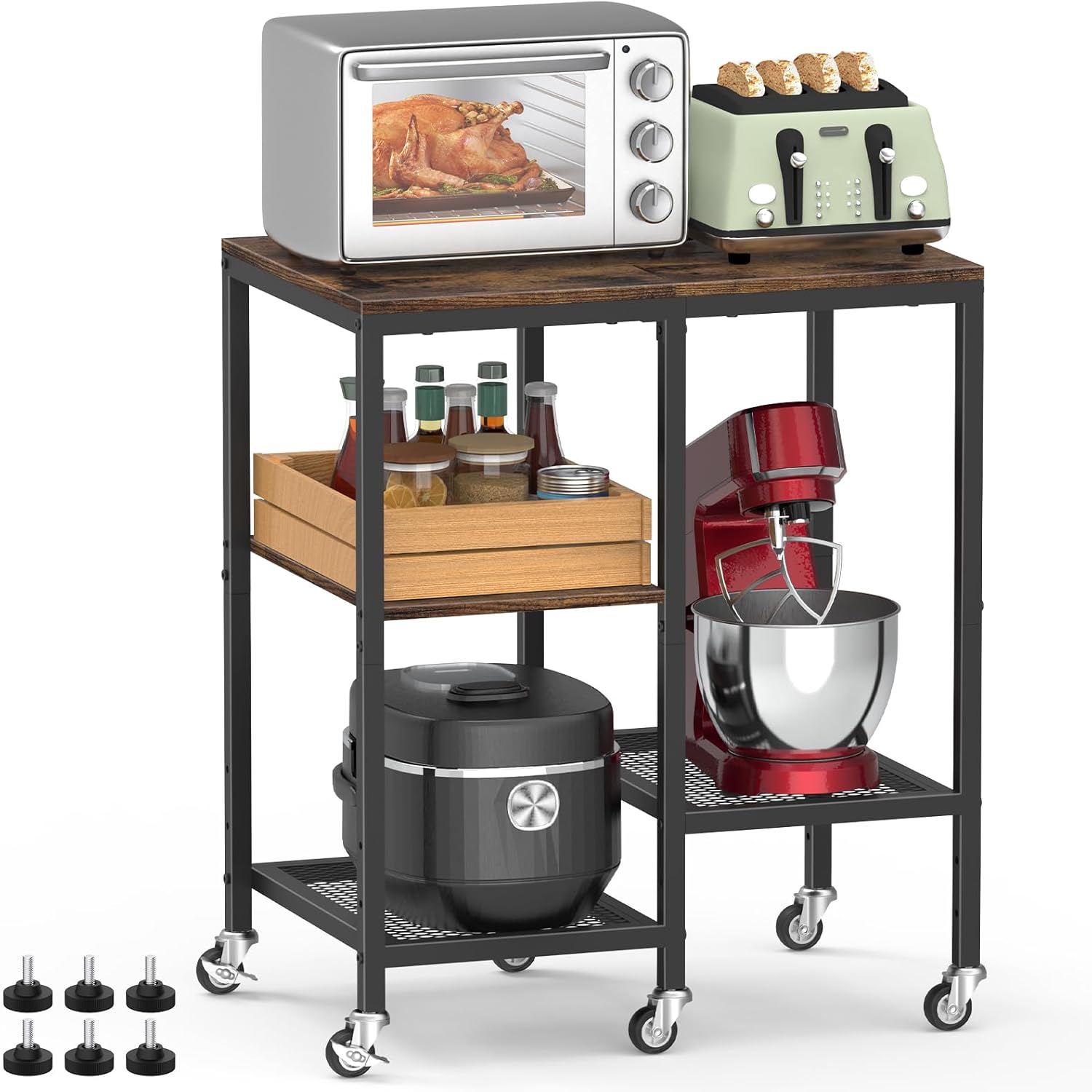
This OGEMXU rolling microwave cart uses a four-tier brown stand with open storage. Lockable wheels support repositioning while the multiple levels hold kitchen or coffee-station items. Its microwave-stand format gives a direct example of wheels paired with useful storage rather than mobility as a decorative feature.
Check On AmazonIf you click this link and buy, we earn a commission at no additional cost to you.
FAQs
📏 Can any countertop microwave go on a cart?
No. The microwave must fit the cart’s actual usable support surface, stay within the rating for that exact surface, and meet its own ventilation and placement instructions. Check the exact microwave and cart documentation rather than relying on the furniture label.
🛞 Should the wheels stay locked while I use the microwave?
Follow the cart manufacturer’s instructions for the exact caster system. If the documentation requires the casters to be locked for stationary use, lock them before operating the appliance. Do not infer a movement rule from photos or marketing copy alone.
🔌 Can I use an extension cord so the cart can move farther?
Do not add an extension cord simply to create more rolling range. Microwave electrical instructions vary, so the exact model manual must control whether an extension cord is permitted and what requirements apply. If mobility depends on an improvised power setup, treat the cart as a parked setup instead.
🧱 Is a cart better than a fixed stand?
Only when the wheels solve a real recurring need such as repositioning for access or cleaning. If the furniture stays beside one outlet, compare fit, stability, storage, and footprint first, then decide whether casters add anything useful.
🌬️ How much space should I leave around a microwave on a cart?
Use the exact microwave manual or manufacturer support instructions because required clearance depends on the model and vent layout. Do not copy a generic clearance number from another microwave or from the cart listing.
References and Sources
- LG countertop microwave installation support: Supports the need for a firm, level surface and model-aware ventilation clearance.
- Panasonic microwave placement support: Supports checking ventilation, stable placement, access, and the exact model instructions.
- Panasonic microwave electrical requirements: Supports grounding, outlet, cord, and model-specific electrical checks.
- Seville Classics kitchen cart specifications: Shows why total cart capacity and the rating for the appliance-support surface must be treated as separate values.