A dehumidifier and an air purifier solve different household problems even though both are sold under the broad idea of better indoor air. A dehumidifier removes water vapor from room air, while a portable air purifier moves air through a system designed to capture specific airborne pollutants, most commonly particles. The useful buying question is therefore not which machine is stronger, but whether the room needs moisture removal, particle filtration, or two separate functions. This comparison shows how to identify that job, read the right metrics, and account for the maintenance and floor-space burden before buying.
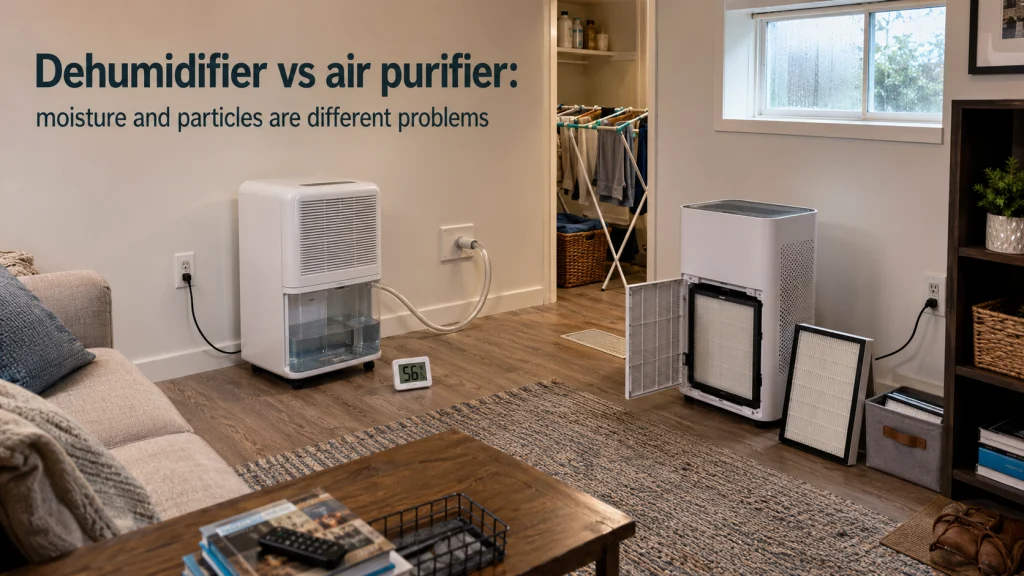
One machine collects water; the other captures particles
Put a dehumidifier and an air purifier next to each other, and the most important difference appears in what each machine leaves behind. For a dehumidifier vs air purifier comparison, that physical split matters more than the shared “air quality” label: one machine removes water and the other is designed to capture specific airborne pollutants. Those are different jobs, so a larger coverage claim on one machine cannot prove that it can replace the other. Before comparing price, noise, or room size, identify what actually needs to leave the room air.
This matters because common room complaints often arrive together. A basement can be damp and dusty, a bedroom can have condensation and outdoor smoke entering through an open window, and a living area can have normal humidity while airborne particles remain the main concern. Choosing one appliance because both sit in the same retail aisle turns a two-problem room into a one-metric shopping exercise. This article stays at the equipment level: it compares moisture removal with air cleaning and does not use symptoms to diagnose a health condition or prescribe a device. That job distinction matters across air quality appliances, where moisture control and particle removal should not be treated as interchangeable outcomes.

The Midea Cube is a 20-pint dehumidifier rated for spaces up to 1,500 square feet. Its removable bucket holds 3.2 gallons of collected water. The design also supports continuous drainage with a drain hose when a no-bucket setup is more practical.
Check On AmazonIf you click this link and buy, we earn a commission at no additional cost to you.
A dehumidifier removes water vapor from room air
A portable dehumidifier draws in humid room air, removes moisture from that air, and returns drier air to the room. The removed water has to go somewhere, which is why ownership revolves around a bucket, a gravity drain, or another drainage arrangement supported by the exact model. ENERGY STAR describes dehumidifier capacity in terms of how much moisture the unit can remove under specified test conditions, not how much dust or smoke it can capture. If the household problem is elevated relative humidity, recurring condensation, or a persistently damp space, moisture removal is the relevant equipment job.
The important boundary is that lowering humidity does not make the dehumidifier a substitute for a particle filter. Many units have an intake filter or screen, but that component can exist primarily to protect airflow through the appliance rather than to provide the same particle-removal function as a dedicated air cleaner. Moisture control also does not replace fixing leaks, seepage, wet materials, or another continuing water source. If you are still deciding whether the room needs active moisture removal at all, start with whether a dehumidifier is actually needed before comparing capacities.

This Frigidaire model is a portable 50-pint dehumidifier built for household moisture removal. The listing includes WiFi connectivity for connected control. Its larger-capacity format is intended for spaces such as bedrooms, living rooms, garages, attics, and crawl spaces.
Check On AmazonIf you click this link and buy, we earn a commission at no additional cost to you.
A portable air purifier moves air through an air-cleaning system
A portable air purifier is built around repeated air movement through a cleaning technology, commonly a mechanical particle filter. For particle-focused machines, the useful question is how much appropriately filtered air the unit can deliver in the room where it will operate. EPA guidance treats portable air cleaners as a supplement to source control and clean-air ventilation rather than as a machine that removes every indoor pollutant. That framing is important because the label “air purifier” covers products with different filters and technologies, and not every configuration has the same capability.
Particle filtration also needs to stay separate from gas and odor claims. EPA notes that filters are commonly designed for particles or gases, and gas removal depends on media specifically intended for that job rather than on a particle rating alone. That means a high particle-cleaning metric does not prove universal VOC or odor removal, just as a HEPA label does not establish a humidity-control function. When filtration is the actual household need, the next step is to compare room fit, airflow performance, filter access, and replacement burden in the air purifier buying guide.

The Coway Airmega AP-1512HH uses a True HEPA filtration system for particle-focused air cleaning. It includes air-quality monitoring, Auto mode, a timer, a filter indicator, and Eco mode. Its 16.8 by 18.3 by 9.7 inch cabinet gives buyers a concrete footprint to plan around for airflow and filter access.
Check On AmazonIf you click this link and buy, we earn a commission at no additional cost to you.
Separate water vapor from airborne particles before comparing coverage
Coverage numbers are easy to compare visually because both appliance boxes may name a room size, but those numbers are attached to different mechanisms. A dehumidifier room-size claim is tied to moisture load, capacity, room conditions, and the way the unit is expected to remove water. An air purifier room-size claim is tied to airflow and air-cleaning performance, with particle-focused sizing commonly connected to clean air delivery rate. The numbers may both use square feet somewhere on the package, yet they do not rank the same task.
A simple household example makes the distinction clearer. If a room has high measured humidity and condensation but little reason to target airborne particles, buying a larger purifier does not address the moisture load. If humidity is already in a reasonable range but the room receives a recurring particle source, buying a larger dehumidifier does not create more filtered air. If both conditions exist independently, the room may need two functions rather than a winner in an air purifier vs dehumidifier contest.
| What you are trying to remove | Equipment job | What to verify |
|---|---|---|
| Excess water vapor | Dehumidification | Measured relative humidity, moisture source, capacity, drainage, room conditions |
| Airborne particles | Particle filtration or air cleaning | Particle-cleaning metric, room size, airflow path, filter type, replacement access |
| Both, for separate reasons | Two independent functions | Whether each problem is actually present and whether the room can support both ownership routines |
| Leak, wet material, or active source problem | Source correction first | Water entry, ventilation, source control, cleanup, and the appropriate owner or professional next step |
The table is not a diagnosis tool; it is a way to keep appliance jobs separate. Start with what can be observed or measured in the room, then match the machine to that physical problem. Once the correct equipment class is clear, coverage becomes useful inside that class instead of across two unrelated rating systems. That avoids paying for a larger machine that is simply better at doing the wrong job.

The Airthings View Plus monitors PM2.5, carbon dioxide, VOCs, humidity, temperature, air pressure, and radon. Its separate particle and humidity readings help keep moisture conditions distinct from airborne-particle measurements. The unit is battery powered and connects over WiFi for ongoing indoor-air monitoring.
Check On AmazonIf you click this link and buy, we earn a commission at no additional cost to you.
Use measured humidity for moisture and source context for filtration
Humidity is one of the easier parts of this comparison to measure directly. A reliable humidity reading shows whether the room is staying unusually damp instead of making the decision by feel alone. EPA moisture guidance also treats condensation and recurring surface moisture as reasons to investigate the water or humidity source, not as proof that an air cleaner is the answer. A musty odor deserves the same caution because it does not identify whether the main issue is humidity, wet material, gases, particles, or a combination.
Particle decisions need different context because no single household number represents every possible source. Identify what is entering or being generated in the room, whether it is actually a particle problem, and whether source control or ventilation can reduce it first. Visible dust also does not map perfectly to airborne particle performance because some material settles before a purifier can capture it. The goal is simply to avoid using humidity, odor, or surface dust as a stand-in for a different filtration question.
- For moisture, check relative humidity, condensation patterns, drainage options, and any continuing water source.
- For particles, identify the likely source, room boundaries, purifier placement, airflow needs, and the filter or technology intended for that pollutant class.
- For odors or gases, verify the exact air-cleaning technology rather than assuming a particle filter handles every gas.
- For active leaks, wet building materials, or extensive contamination, do not treat either portable appliance as a substitute for correcting the source.
This is where the “dehumidifier or air purifier” question usually becomes simpler. Excess moisture keeps the decision in the dehumidifier path, while an identified particle problem with reasonable humidity keeps it in the purifier path. Evidence for both means two ownership decisions, including space and maintenance. One shared retail label should not erase two separate physical loads.

The TempPro TP50 displays indoor temperature and relative humidity with a dry, comfort, or wet indicator. It records high and low temperature and humidity values and refreshes readings every 10 seconds. A tabletop stand, magnetic back, Fahrenheit or Celsius selector, and included AAA battery support simple room placement.
Check On AmazonIf you click this link and buy, we earn a commission at no additional cost to you.
Pints per day and clean-air metrics cannot be cross-ranked
Dehumidifiers are commonly described by moisture-removal capacity, while ENERGY STAR also uses integrated energy factor to express dehumidification efficiency under defined test conditions. Air cleaners use a different performance language, including clean air delivery rate for particle removal and efficiency measures tied to air-cleaning output and power. Neither set of numbers is a translation of the other because liters of moisture removed and filtered airflow are not the same physical output. A shopper should never treat a higher numerical value on one appliance class as evidence that it is stronger than the other class.
The same warning applies to room-size marketing. A purifier that is appropriately sized for a large room can still leave excess water vapor untouched, and a high-capacity dehumidifier can still leave airborne particles circulating because moisture removal is its primary job. Compare pints per day and dehumidifier efficiency only against other dehumidifiers that fit the same moisture problem. Compare particle-cleaning metrics, room fit, filter system, and operating conditions only against air purifiers intended for the same filtration job.
Key point: Pints per day, integrated energy factor, clean air delivery rate, and particle filter ratings answer different questions. None of them converts cleanly into another appliance class’s performance score. Use each metric only within the class and test context it was designed to describe. If two boxes show impressive numbers with different units, compare the jobs before comparing the numbers.
This separation also protects against overbuying. A household that needs modest moisture removal should not jump to a larger dehumidifier because a purifier advertisement uses a larger room number, and the reverse is equally unhelpful. Once the problem class is correct, sizing can become a practical question about actual room conditions, runtime, noise, and maintenance. Until then, cross-ranking the headline numbers only creates false precision.

The Levoit Vital 200S-P is AHAM Verified and listed for large rooms up to 1,875 square feet. It includes an air-quality monitor and a HEPA Sleep Mode for particle-focused air cleaning. The listing also specifies a 27 dB quiet-bedroom operating claim, giving another purifier-specific performance point to compare within the air-cleaner class.
Check On AmazonIf you click this link and buy, we earn a commission at no additional cost to you.
Ownership differs as much as the mechanism
A dehumidifier creates a water-management routine. Depending on the exact model, that can mean emptying a bucket, keeping a drain path clear, cleaning an intake filter, and preserving airflow around the cabinet. The burden may be minor in a utility area but awkward when the bucket route crosses furniture or stairs. More moisture removal can also mean more water to handle when continuous drainage is not practical.
A portable air purifier creates a filter and airflow routine instead. It needs open intake and outlet space plus reliable access to the replacement filters or media required by the exact design. Replacement cost and availability belong in the buying decision because the machine depends on continued airflow through serviceable media. Neither ownership system is automatically easier; the better fit is the one attached to the problem you actually need to manage.
| Ownership task | Dehumidifier | Portable air purifier |
|---|---|---|
| Recurring output | Collected water or drain flow | Loaded filters or other serviceable air-cleaning media |
| Routine access | Bucket, drain connection, intake area | Filter compartment, intake, clean-air outlet |
| Consumable burden | Usually lower for basic filtration, model dependent | Replacement filters or media, model dependent |
| Placement friction | Airflow plus practical water handling | Airflow plus room circulation and filter access |
The maintenance table is where two otherwise suitable purchases can separate. Frequent bucket trips can make a capable dehumidifier inconvenient, while costly or hard-to-find filters can make a capable purifier frustrating to keep running. Check the exact manual and replacement system because drainage, filter schedules, and clearances vary by model. Ownership is part of performance when the machine must run repeatedly.
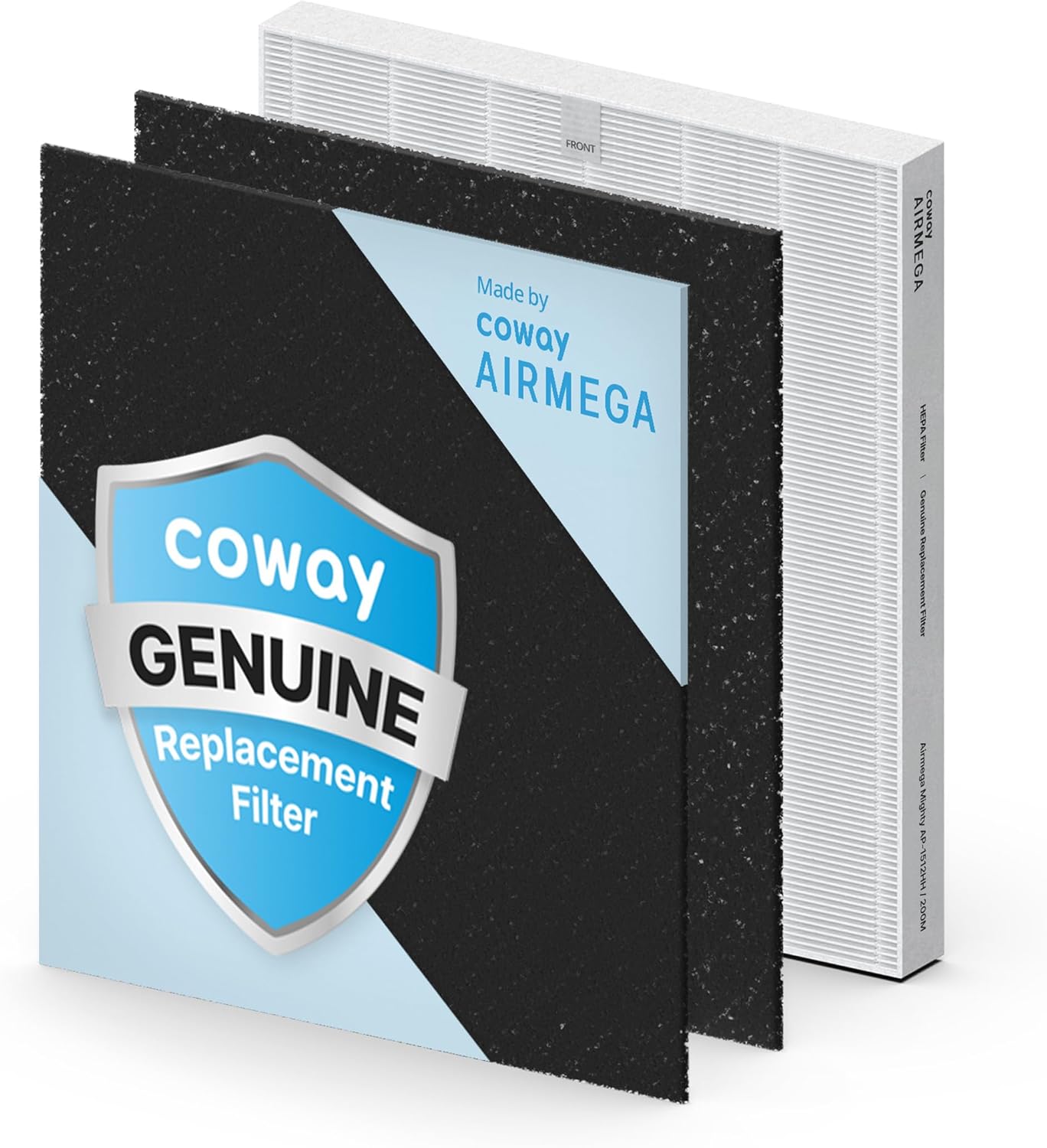
This Coway replacement pack is made for Airmega AP-1512HH and 200M models. It includes one HEPA filter and two carbon pre-filters, making the recurring filter-maintenance burden visible before purchase. Coway describes it as a one-year replacement filter pack, with the carbon pre-filters carrying a shorter average service interval.
Check On AmazonIf you click this link and buy, we earn a commission at no additional cost to you.
Noise, floor space, and runtime matter after the job is correct
Both machines move air, so both can become noticeable in a quiet room. A dehumidifier also runs a moisture-removal system, while a portable purifier relies heavily on fan speed to move room air through its cleaning system. Higher operating settings can increase the amount of work done over a given period, but they can also raise noise and electricity use. The practical choice is not simply the quietest rating or the lowest power figure; it is the setting and runtime the household can tolerate long enough for the machine to do useful work.
Electricity cost is therefore an ownership question, not a single spec-sheet contest between the two classes. A dehumidifier may run more or less often as room humidity and moisture load change, while a purifier’s ongoing draw depends heavily on fan setting and how continuously the household chooses to run it. Within dehumidifiers, an efficiency measure such as integrated energy factor can help compare how efficiently models perform the same moisture-removal job, but it should not be cross-ranked against purifier airflow or clean-air metrics. For either class, compare rated power, realistic runtime, and local electricity cost instead of assuming a smaller headline number always means lower operating cost.
Floor space becomes more important when both functions are independently justified. Two separate units need two airflow envelopes, two power-cord routes, service access, and enough room to avoid blocking furniture or door paths. A combination product may look attractive because it compresses that footprint, but the exact specifications still need to prove both moisture-removal and air-cleaning performance rather than letting one function borrow credibility from the other. If a household cannot place, power, and maintain both jobs properly, solving the dominant source problem first can be more useful than crowding the room with equipment.

The TopTes TS-501B measures sound levels from 30 to 130 dB with A and C frequency weighting. It provides maximum and minimum readings plus a data-hold function for comparing operating noise. The meter has a 2.25-inch backlit LCD and includes three AAA batteries and a carry case.
Check On AmazonIf you click this link and buy, we earn a commission at no additional cost to you.
Neither machine substitutes for the other
The easiest way to waste money here is to buy more capacity in the wrong appliance class. A high-output purifier placed in a basement with persistently high measured humidity can move and filter plenty of air while the bucket-sized moisture problem remains untouched. The reverse mistake is buying a larger dehumidifier for a room whose humidity is already reasonable but where the actual concern is a recurring airborne particle source. In both cases, the purchase can look powerful on paper while failing the household job that triggered the shopping decision.
A second failure pattern is expecting either portable machine to compensate for a source problem that should be addressed directly. An active leak, wet material, or continuing water entry can keep adding moisture no matter how capable the dehumidifier is, while a continuing particle source can keep loading a purifier faster than expected. Source control does not make portable equipment useless, but it changes what the equipment can reasonably be expected to accomplish and how long it may need to run. That is why the purchase decision should begin with the source and the thing being removed, not with whichever machine has the larger room number or longer feature list.
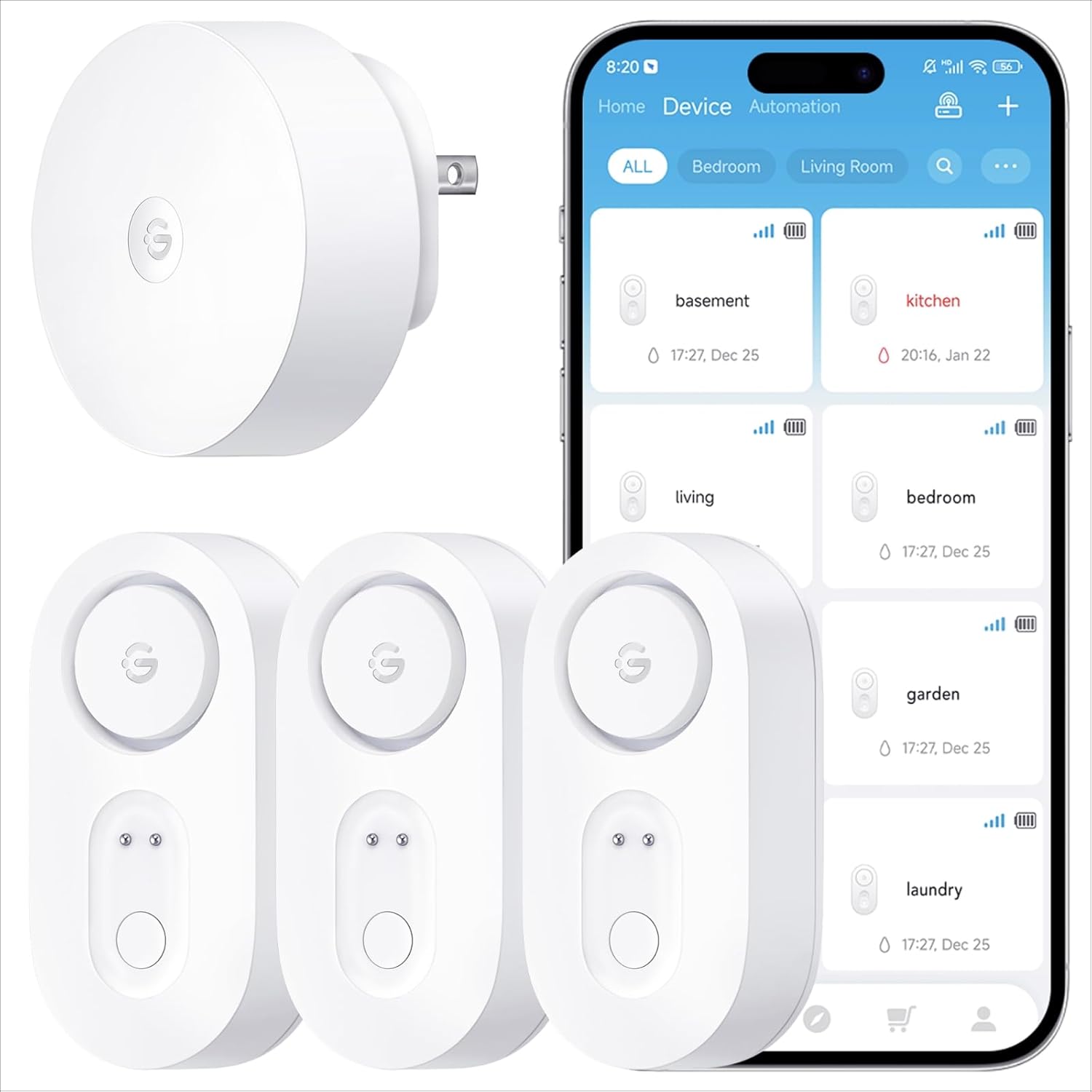
This GoveeLife kit pairs a gateway with three water-leak sensors for direct source detection. It can send app, email, and SMS alerts and also sounds an adjustable alarm up to 105 dB. The sensors are IP67 rated and use a long-range Sub-1G connection advertised to reach up to 1,804 feet.
Check On AmazonIf you click this link and buy, we earn a commission at no additional cost to you.
Both can make sense when two separate problems are present
Using both appliances is reasonable when the room has a demonstrated moisture problem and a separate particle-filtration need. For example, a damp lower-level room may need humidity control while also receiving airborne particles from outdoor air, household activity, or another identified source. The dehumidifier handles water vapor, while the purifier handles the pollutant class its filter or technology is designed to address. That is not duplication; it is two machines doing two different jobs in the same space.
“Both” should still earn its floor space and operating cost. Measure humidity, identify the particle problem, check source-control options, and then confirm that each appliance has a practical location, electrical path, maintenance routine, and service access. If only one problem is supported by the evidence, buying two machines adds complexity without solving a second demonstrated need. If neither problem is present and the real issue is a leak, ventilation fault, or another source condition, buying neither appliance may be the more logical first move.
| What the room evidence shows | First equipment decision | What to avoid |
|---|---|---|
| Humidity is persistently high, with no separate particle need established | Evaluate a dehumidifier | Buying a purifier because its coverage number looks larger |
| Humidity is reasonable, but a recurring airborne particle source is the real concern | Evaluate a particle-focused air purifier | Buying a dehumidifier for filtration it is not designed to provide |
| High humidity and a separate particle problem are both supported | Evaluate both functions independently | Assuming one machine’s rating proves the other function |
| The dominant problem is an active leak, wet material, or another correctable source | Address the source first | Buying either machine as a substitute for source correction |
A second machine should solve a second verified problem. If both functions are justified, count the combined electricity, filter replacement, drainage or bucket work, noise, and clearance burden as part of the purchase. If one function is not justified, leaving that appliance out is a valid decision. The goal is to match each recurring problem to the correct control method, not to maximize equipment in the room.

The GoveeLife H5106 measures PM2.5, temperature, and relative humidity on one indoor display. It refreshes measurements every two seconds and supports Bluetooth and 2.4 GHz WiFi monitoring. The app can show 13-day graphs and export up to two years of stored data for comparing particle and humidity patterns over time.
Check On AmazonIf you click this link and buy, we earn a commission at no additional cost to you.
Choose the equipment class first, then choose the size and features
Once you know the room needs moisture removal, the comparison should stay within dehumidifiers. Capacity, room conditions, drainage, operating temperature, placement, noise, and efficiency then become useful buying criteria instead of distractions from the original problem. The dehumidifier buying guide continues that decision from equipment class into sizing and ownership fit. This keeps a moisture problem from being rerouted into filtration simply because purifier features are easier to compare on a retail page.
If the room instead needs particle filtration, stay within portable air cleaners and evaluate the technology intended for that pollutant class. Room size, clean-air performance, filter replacement, noise at realistic fan speeds, placement, and ongoing operating burden are the relevant next checks. A gas or odor concern needs its own technology-specific evidence rather than a generic assumption that every purifier handles it. The useful sequence is problem first, equipment class second, and only then size, features, price, and convenience.

A 165-foot green-beam laser distance measure designed for fast indoor and jobsite measurements. The bright green laser improves visibility compared with standard red beams, while the color display keeps readings easy to check. It supports straightforward distance measuring in a compact handheld format and provides a longer working range than the Bosch GLM100-23 it replaces.
Check On AmazonIf you click this link and buy, we earn a commission at no additional cost to you.
Final Thoughts: identify what needs to be removed from the air before buying
The cleanest way to choose between these appliance classes is to name the physical problem before looking at a product page. Excess water vapor points toward dehumidification, while airborne particles point toward a purifier with verified particle-cleaning capability. If both problems are independently present, both functions can be justified, but the room then inherits two placement and maintenance routines. If the real problem is an active source such as water intrusion or wet material, source correction comes before expecting a portable appliance to carry the whole job.
That framework also keeps marketing metrics in their proper lanes. Pints per day and dehumidifier efficiency belong to moisture removal, while clean-air metrics and filter specifications belong to air cleaning. Neither machine is the universal “air quality” winner because the household job changes the answer. Buy the machine that removes the thing you have actually identified, then size and maintain it for the room where it must work.

The Govee H5075 measures indoor temperature and relative humidity and refreshes readings in about two seconds. Bluetooth monitoring works at up to 164 feet and can send app alerts when preset temperature or humidity limits are crossed. The app stores trend graphs and can export up to two years of historical data.
Check On AmazonIf you click this link and buy, we earn a commission at no additional cost to you.
FAQs
💧 Should I get a dehumidifier or air purifier for a damp room?
If measured humidity is high or condensation keeps returning, a dehumidifier addresses the moisture load directly. A purifier only makes sense for a separate filtration need, and neither appliance should substitute for correcting a continuing leak or wet material.
🧹 Does a dehumidifier remove dust from the air?
Do not assume that it does. A dehumidifier’s main job is moisture removal, so an intake screen should not be treated as verified room-particle filtration unless the exact model documents that function. For a particle problem, evaluate a dedicated air-cleaning system instead.
🌫️ Will an air purifier lower room humidity?
No. A standard portable air purifier circulates and cleans air but does not remove water vapor as a dehumidifier does. If humidity is the problem, measure it and evaluate moisture control separately.
🏠 Can I run an air purifier and dehumidifier in the same room?
Yes, when the room independently needs both moisture removal and air cleaning. Give each unit the airflow, power, drainage, and service access required by its exact manual. Also count the combined noise, floor space, electricity, and recurring maintenance before buying both.
📏 Which coverage number matters more?
Neither coverage number outranks the other across appliance classes. For moisture, compare dehumidifier capacity and room conditions; for particle filtration, compare the relevant clean-air performance, room fit, and filter system. Choose the equipment class before using coverage to size it.
🪟 What if the room has condensation and visible dust?
Treat them as separate clues. Check measured humidity and the moisture source for the condensation, then decide whether a separate airborne-particle problem justifies filtration. If water is entering the room or materials remain wet, source correction comes first.
References and Sources
- US EPA guide to air cleaners: Supports the distinction between particle filtration, gas-specific media, source control, room sizing, and clean air delivery rate.
- ENERGY STAR dehumidifiers: Supports dehumidifier moisture-removal function, relative-humidity framing, bucket and drainage ownership, and capacity context.
- ENERGY STAR dehumidifier efficiency criteria: Supports the use of product capacity and integrated energy factor as dehumidifier-specific performance measures.
- US Department of Energy air cleaners: Supports the federal equipment distinction between air cleaners and dehumidifiers.
- US EPA mold and moisture guide: Supports moisture-source control, humidity measurement, and the boundary between portable equipment and correcting water problems.