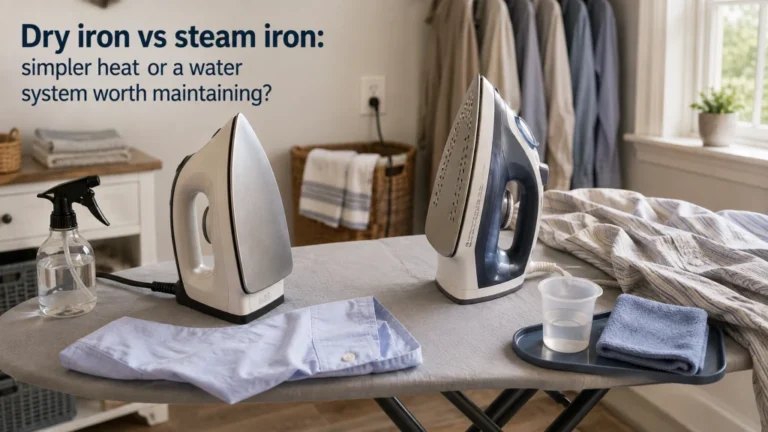
A corded iron gives you continuous electrical power while you work, but the cord can interfere with board movement and fabric repositioning. A cordless iron removes that moving cord from the iron itself, yet it trades that freedom for repeated returns to a powered base so the soleplate can recover heat. The better choice depends less on which design sounds more convenient and more on session length, outlet position, board layout, steam demand, docking rhythm, and how often you stop to reposition a garment. By the end, you should know which interruption is easier to live with in your own ironing routine.
How each iron receives power
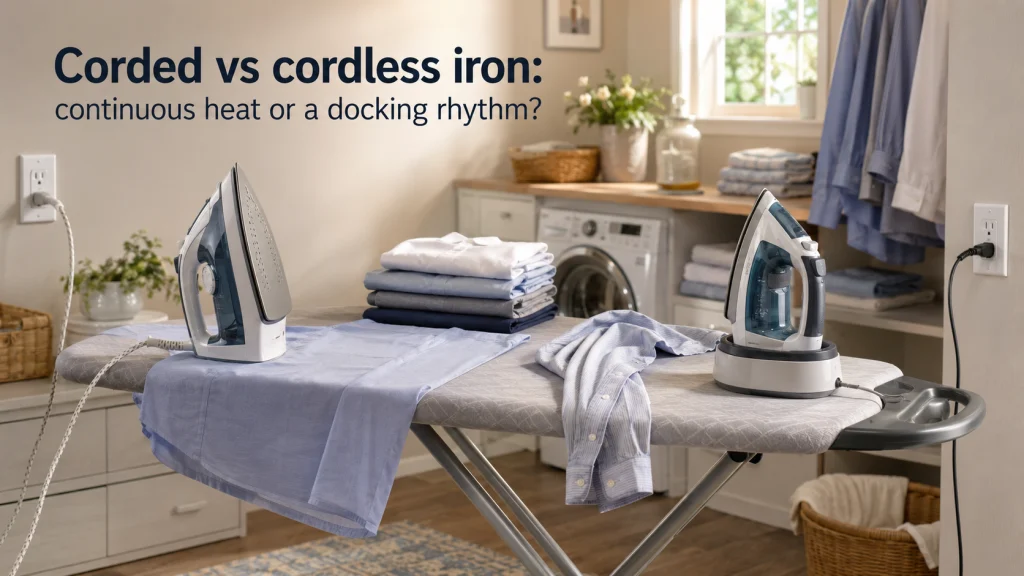
The corded vs cordless iron decision starts with where electrical power reaches the system while you work. A standard corded iron stays connected through its cord, so it can keep cycling the heating system during the session. A cordless iron moves that connection to a powered base, which frees the iron from a moving cord but makes returning to the base part of normal use. The practical trade is continuous access to power versus a cleaner movement path across the board.
That difference matters because ironing is not one continuous forward pass. You turn sleeves, rotate shirts, flatten seams, move a trouser leg, shift a quilt block, and stop to inspect what the last pass actually did. If those pauses already happen near the same corner of the board, docking can fit into the routine with little drama. If you tend to make long uninterrupted passes across larger pieces, repeated docking may feel like a more obvious break than managing a cord.
| What interrupts you | Corded iron | Cordless iron | What to check at home |
|---|---|---|---|
| Power flow | Continuous while plugged in | Heat is restored on the powered base | How long your normal passes run before you naturally pause |
| Movement | Cord can trail, pull, or cross the board edge | No moving cord attached to the iron | Which directions you press and where the outlet sits |
| Board space | No separate docking footprint | Base needs a stable parking area | Whether the base crowds the garment or board end |
| Long sessions | Fewer deliberate heat-recovery pauses | Repeated redocking becomes part of the workflow | Whether your sessions are touchups or full baskets |
Most household cordless irons use a different path: the cord is attached to a powered base, not to the moving iron. The iron heats while it is seated on that base, then you lift it away and work on stored heat until it needs to be returned. The base therefore becomes part of the active ironing cycle rather than just a storage accessory. A cordless vs corded iron comparison that ignores the base is missing the part of the system that creates the trade-off.
This also explains why the outlet still matters with cordless designs. You are not removing electricity from the setup; you are moving the cord away from the iron and concentrating it at the docking point. That can be a major improvement if the cord normally snags on a board corner or brushes freshly pressed fabric. It can be less useful if the only stable place for the base forces an awkward reach every time the iron needs heat.
The broader process in how to choose a steam iron still applies, but power delivery changes how the rest of the feature list fits your routine. Choose the power path first, then compare soleplate shape, tank size, controls, storage, and other model-level details. That keeps the buying sequence practical instead of feature-first.

This 1725-watt corded steam iron uses a retractable power cord, so it represents the continuous-power side of the comparison while keeping storage tidier. Its stainless steel soleplate uses more than 350 microholes to distribute steam across fabric. Auto-off and anti-drip features add practical safeguards for everyday ironing.
Check On AmazonIf you click this link and buy, we earn a commission at no additional cost to you.
Why cordless usually means a powered base, not a battery
The word cordless is easy to read as battery powered, but that is not the usual household cordless steam iron design. Panasonic’s support material, for example, explicitly explains that its cordless irons are not rechargeable devices and must return to the power base to reheat the soleplate. That is the practical model to keep in mind when comparing common cordless irons: the iron moves without an attached cord, while the base remains plugged in. A true onboard-battery design would be a different architecture and should be judged from its own documentation.
This distinction matters at the store because a cordless iron vs regular iron comparison can otherwise create the wrong expectation. If you imagine a device that charges once and then works through an entire basket, a base-heated iron will feel unusually needy. If you understand the dock as the iron’s heat source, the repeated return becomes a predictable part of use rather than a surprise. The honest question is whether that return naturally fits the moments when you already move the garment.
Do not rely on the word charging alone to decide how the appliance behaves. Product pages often use charging-base language even when the base is restoring heat rather than filling a battery for long independent operation. Check the exact manual or manufacturer support page for the model you are considering. If the documentation says the iron must be placed back on the base to reheat, treat redocking cadence as a core buying requirement.

This 1500-watt cordless steam and dry iron heats through a separate power base rather than an onboard rechargeable battery. Its double-tipped stainless steel soleplate is designed for multidirectional movement, and the water tank holds 4 ounces. A heat-resistant carrying case fits over the iron and base for compact storage and transport.
Check On AmazonIf you click this link and buy, we earn a commission at no additional cost to you.
Heat and steam continuity change with session length
For a quick collar, one shirt front, or a small sewing piece, the difference between continuous power and stored heat may barely register. You make a pass, reposition the item, and the cordless iron can return to its base during a pause that already exists. In that kind of short session, movement freedom can matter more than the extra docking step. The board feels less cluttered by a moving cord, and there is less chance of the cord dragging across an area you just smoothed.
Longer sessions expose the other side of the trade. A full basket, several large table linens, or repeated work on heavier fabrics can demand more sustained heat and steam, so a cordless model’s recovery rhythm becomes more visible. Strong steam use can also pull heat from the soleplate faster on some models, which is why the exact reheat behavior cannot be assumed from the word cordless. Corded power does not guarantee better wrinkle removal by itself, but it removes the need to interrupt the session for access to power.
Key point: Short, stop-and-reposition sessions are the easiest place for cordless docking to disappear into the workflow. Dock while repositioning and the pause can do two jobs at once. Long, continuous sessions expose the recovery cycle more often. That is where a corded design’s uninterrupted power path becomes easier to appreciate.
Your fabric mix still matters. A household that mostly touches up lightweight shirts is asking less from heat continuity than one that regularly presses cotton bedding, linen, or sewing yardage. That is why session length and steam demand should be considered together. The power path does not choose the iron for you, but it tells you which type of interruption will show up most often.

This 1850-watt steam iron uses a stainless steel soleplate and an on-demand steam boost for demanding wrinkle removal. A smart screen provides five fabric presets with electronic heat and steam adjustment. Anti-drip and anti-calc features support regular steam use across longer ironing sessions.
Check On AmazonIf you click this link and buy, we earn a commission at no additional cost to you.
Reheat cadence matters more than a best-case marketing number
Independent testing of current cordless irons makes the cadence easier to see. Good Housekeeping reports that many cordless models can typically be used for roughly 20 to 45 seconds before they need to return to the base, while recovery itself often takes only a few seconds. That range is useful as a reality check, not as a promise for every iron. Heat setting, steam use, fabric, soleplate mass, and the model’s control logic can all change how quickly useful heat falls away.
The more important question is what happens inside that off-base window. If you normally press for twenty seconds and then spend another ten seconds rotating the garment, the return to base may line up neatly with work you were going to do anyway. If you expect a long steam-heavy pass before you stop, the same cadence can feel intrusive. A single quoted reheat time is therefore less informative than the relationship between usable off-base time and your natural repositioning cycle.
When comparing models, look for test evidence that measures wrinkle removal and steam behavior along with reheat timing. A fast recovery number does not help much if the iron loses effective steam too quickly for the fabrics you press. Likewise, a longer off-base period is not automatically better if the iron is heavy or the base is awkward to hit accurately. The useful measurement is the whole cycle: lift, press, reposition, dock, recover, and lift again.
Board movement is where cordless earns its case
The strongest argument for cordless is not that it removes work. It removes one specific piece of work: managing a live cord while the iron changes direction across the board. That can be valuable when the cord tends to catch the board edge, bump the garment, or pull against your wrist at the far end of a pass. It can also help when you frequently rotate a shirt or sewing piece and do not want to lift the cord clear each time.
Board geometry decides how large that benefit is. An outlet directly behind the board with a cord that feeds cleanly from the heel may create very little interference, especially if most movement is forward and back. An outlet off to one side can create a diagonal pull that crosses the working area and becomes annoying on wide pieces. Before assuming cordless is the fix, set up your current board and trace where the cord actually travels during the motions you repeat most.
- Check whether the cord touches fabric you have already pressed.
- Notice whether it catches the board edge during direction changes.
- See whether you regularly lift or flick the cord out of the way.
- Check whether moving to a different outlet would solve most of the problem.
- Compare that friction with how often a cordless iron would need to return to its base.
If the cord is only mildly inconvenient, a cordless design can exchange a small annoyance for a larger docking habit. If the cord genuinely controls how you position the board or how freely you can move around a large item, cordless has a clearer job to do. The point is not freedom in the abstract. It is whether removing the moving cord fixes a repeated problem in your own route across the board.

A 1700-watt steam iron with a titanium-infused ceramic soleplate designed for smooth, consistent pressing across common garment fabrics. More than 400 steam holes distribute steam across the soleplate, while the retractable 8-foot cord keeps storage more organized between uses. Three-way automatic shutoff, adjustable temperature control, and variable steam settings add practical control for routine household ironing.
Check On AmazonIf you click this link and buy, we earn a commission at no additional cost to you.
The dock needs its own board and outlet plan
A cordless iron still needs a stable powered base, and that base occupies real space. On a wide board with a solid end platform, the footprint may be easy to absorb. On a narrow board, a wall-mounted board, or a crowded utility surface, the station can take away exactly the parking space you thought cordless would free up. The base also needs to sit where returning the iron is easy enough to become automatic rather than a careful two-handed maneuver.
Outlet position now matters in a different way. With a corded iron, you care about cord length, routing, and pull while the iron moves. With cordless, the base can stay still, but its cord still has to reach a suitable outlet without placing the station where it crowds the working area. If the only outlet forces the dock onto the wrong end of the board for your dominant hand, every reheat stop can become an awkward cross-body reach.
Dock-placement concept: Think of the setup as a simple route: outlet → stable base at the board end → clear pressing zone → natural return point while you reposition the garment. A poor route runs outlet → cord across the working edge → base behind your working arm → garment forced around the dock. The first layout lets docking disappear into a pause you already make. The second solves cord drag at the iron only to create a new reach and space problem at the base.
Storage deserves the same attention because the base does not disappear when the session ends. Some systems store as a combined iron-and-base unit, while others create a wider package than a conventional iron on its own. Measure the shelf, cabinet, or utility cart that will hold the entire system, not just the handheld iron. If you are comparing other garment-care equipment choices, this is the same fit rule that applies elsewhere: count the parts you must actually store.
Weight and tank size are model-level trade-offs
It is tempting to treat cordless as lighter because there is no cord attached to the moving iron, but weight is not determined by architecture alone. Soleplate material, water capacity, handle design, body construction, and how the model balances in the hand can matter more than the missing cord. A larger tank may reduce refills but also increases carried weight when full. That trade can matter more during a long session than the difference between corded and cordless power delivery.
Compare the iron’s own working weight, not the shipping weight of a cordless set that includes the base or storage case. Also check where the water sits and whether the tank is easy to fill without wetting the controls or base area. Two models with similar listed weight can feel different if one carries more mass toward the nose. Exact dimensions and tank capacity are useful only when they explain handling, refill frequency, or storage in your setup.
This is also where broad class claims become unreliable. A cordless model can be compact or bulky, light or heavy, small-tanked or relatively generous. A corded model can have the same range of variation. Once you have chosen which power path suits your session, compare weight, balance, tank visibility, filling access, soleplate size, and control placement model by model rather than assuming the category decided them for you.

This 1200-watt folding garment steamer weighs about 1.5 pounds and uses a 180-milliliter removable water tank, making the weight-versus-capacity trade-off easy to compare. It supports horizontal and vertical steaming plus dry ironing. The unit heats in about 20 seconds and folds down for compact storage or travel.
Check On AmazonIf you click this link and buy, we earn a commission at no additional cost to you.
Auto shutoff and restart behavior must be checked model by model
Auto shutoff is a safety and convenience feature, but its behavior is not a class-wide rule. Corded irons may shut heating off after different idle conditions depending on whether the iron is on its heel, side, or soleplate. Cordless irons can tie shutoff behavior to time spent on the base or to their own control system. Do not copy one model’s timing or restart method onto another iron simply because both are described as steam irons.
Restart behavior matters because it can add another interruption to a session. Some irons resume heating when moved, while others may require a button press, a return to the base, or another model-specific action. That difference is easy to miss on a comparison chart but noticeable if you pause often to sort garments or answer another household task. Check the exact manual for the model’s shutoff positions, restart method, indicator lights, and any instructions about unplugging after use.
Warning: Treat the manual as the final authority for power-base use, auto shutoff, vertical steam, filling, cooling, and storage. Stop using the iron for a damaged cord or base, sparks, smoke, or burning odor. The same applies to overheating, exposed wiring, or leaking into electrical areas. Use qualified service for uncontrolled operation or work the manual reserves for service.
Safety features should support a good workflow, not excuse a poor setup. The base still needs a stable surface, the cord still needs a safe route, and the iron still needs an appropriate resting position. If a model’s restart behavior annoys you in theory, it will not become less annoying after purchase. Verify it before treating auto shutoff as just another checked box on a feature list.

This 1500-watt steam iron uses a ceramic-coated soleplate, an 11.84-ounce water tank, and adjustable temperature control. Its three-way auto shutoff activates after about 30 seconds when horizontal or tipped sideways and after 8 minutes when upright. Picking up and shaking the iron restores power, making restart behavior explicit rather than something to assume across models.
Check On AmazonIf you click this link and buy, we earn a commission at no additional cost to you.
Choose corded or cordless by the session you actually run
Choose corded when your normal session is long, steam-heavy, or built around extended passes where stopping for heat recovery would interrupt your pace. It is also the simpler fit when the cord routes cleanly from the outlet and does not cross the fabric or pull at the edge of the board. In that situation, continuous access to power solves a real need while the main downside of the cord is already controlled. You are not giving up much movement freedom because your board layout has already made the cord predictable.
Choose cordless when cord drag is a repeated problem and your ironing rhythm already contains frequent garment-repositioning pauses. The design is especially logical when you can place the base exactly where the iron naturally rests between sections of a garment. You still need to accept the heat-recovery cycle and the station footprint, but those costs may be small if docking overlaps with work you were doing anyway. The benefit is strongest when the moving cord, not heat continuity, is the thing slowing you down.
Session decision: Short touchups favor cordless when you press briefly, reposition often, and have an easy docking spot. Corded still makes sense when its cord already stays out of the working path. Long sessions favor corded when sustained heat and steam matter more than cord-free movement. Cordless can still fit, but only if the docking rhythm feels natural rather than tolerated.
There is also a valid no-upgrade outcome. If your existing iron performs well and the only complaint is occasional cord annoyance, try a better board orientation or outlet position before replacing it. Buying a different power architecture makes sense when it removes a repeated friction point, not when it merely sounds newer. The cheaper choice is the one that solves the problem you actually have without creating a more irritating one.

This 1200-watt two-in-one garment tool combines flat ironing with horizontal or vertical steaming for short touchups and travel-size sessions. It heats in about 10 seconds and uses a detachable tank for refilling. The 110-120-volt design and rotating head make it a compact example of how session type can matter as much as headline feature counts.
Check On AmazonIf you click this link and buy, we earn a commission at no additional cost to you.
Compare current models only after choosing the power path
Once you know whether continuous power or cord-free movement fits your routine, then current model comparisons become useful. For cordless, focus on tested wrinkle removal, steam consistency, usable off-base time, recovery behavior, base stability, indicator clarity, working weight, tank design, and storage footprint. For corded, focus on wrinkle and steam performance plus cord length, cord exit, swivel behavior, balance, tank access, soleplate size, and how the iron rests on your board. Those details answer different questions because the underlying workflows are different.
If cordless is the better architecture, use current cordless iron comparisons to judge models on tested performance instead of treating cordless freedom as proof of a good iron. If continuous power is the better fit, current steam iron testing is the more relevant next step. This keeps the decision sequence clean: choose the interruption you can live with, then compare the models that deliver that power path well. It also reduces the chance of paying for a feature set attached to the wrong basic design.
Keep the same evidence standard for either type. Exact weight, tank capacity, shutoff behavior, steam controls, included base or case, and storage dimensions should come from the current model documentation or a clearly identified test. Performance claims should come from tests that disclose what was measured and under what conditions. A feature list can tell you what an iron has, but it cannot tell you whether that feature improves the way you move through your own board.

A full-size 1500-watt steam iron designed for everyday garment care, with a ceramic-coated soleplate that glides smoothly across common fabrics. The precision thermostat dial provides adjustable heat control, while steam, anti-drip, anti-calcium, and self-cleaning functions help make routine ironing easier to manage. A 3-way automatic shutoff adds an extra safety feature for regular household use.
Check On AmazonIf you click this link and buy, we earn a commission at no additional cost to you.
Final thoughts: choose the interruption that fits your ironing rhythm
Corded and cordless irons do not divide neatly into old-fashioned and convenient. One keeps power attached to the moving iron. The other moves that cord to a base and asks you to return for heat. The better design is the one whose interruption fits the way you already press and reposition fabric.
For long continuous sessions, corded power usually creates fewer workflow breaks. If cord drag is the repeated problem and you reposition garments often, cordless can be easier to work around. Measure base space, trace the outlet route, and think through normal session length. Then verify the exact model’s reheat, shutoff, weight, and storage behavior before buying.

This 1775-watt corded steam iron pairs a stainless steel soleplate with 430 steam holes and a strong steam boost for full-size household ironing. Its 120-volt design and auto-off feature make it a conventional continuous-power alternative to base-heated cordless systems. Comparing its cord, weight, steam output, and safety behavior against cordless models keeps the final choice tied to real workflow trade-offs.
Check On AmazonIf you click this link and buy, we earn a commission at no additional cost to you.
FAQs
🔌 Is a cordless iron actually battery powered?
Usually not. Common household cordless irons heat on a plugged-in power base and must return to that base to restore heat, so check the exact manual rather than assuming the word cordless means onboard battery power.
⏱️ How long can a cordless iron stay off the base?
It varies by model, heat setting, steam use, and fabric. Current independent testing commonly finds short off-base windows measured in tens of seconds, so use model-specific test data instead of one universal number.
🧺 Is cordless better for a large basket of clothes?
Not automatically. Long sessions can make repeated docking more noticeable, while corded models avoid those deliberate heat-recovery stops as long as the cord itself is easy to manage.
📏 Where should the cordless base sit?
Place it on a stable part of the board or work surface where you can return the iron naturally during garment repositioning. Confirm that the base fits without crowding fabric and that its cord reaches the outlet safely.
🛑 Does auto shutoff work the same on every iron?
No. Shutoff timing, position sensing, indicator behavior, and restart steps can differ by exact model, so verify them in the manual rather than relying on the product type.
References and sources
- Panasonic cordless iron support: Confirms that Panasonic cordless irons use a powered base and return to it for reheating.
- Good Housekeeping cordless iron testing: Supports reheat cadence, off-base time, steam, wrinkle removal, and usability testing.
- Good Housekeeping iron testing: Supports steam performance, heat-up behavior, weight, wrinkle removal, and safety.