Humidifier white dust is often a mineral-residue problem, especially when an ultrasonic or impeller unit is filled with mineral-rich water. The practical fix is not just wiping the furniture more often, because the water source and the humidifier’s mist-making method determine whether those minerals can travel into the room. Distilled or other low-mineral water can reduce the problem when the model allows it, while approved mineral-control parts or a different humidifier technology may make more sense for some households. The goal is to trace the residue back to its source, change the condition causing it, and keep cleaning and health questions within the limits of the exact humidifier manual.
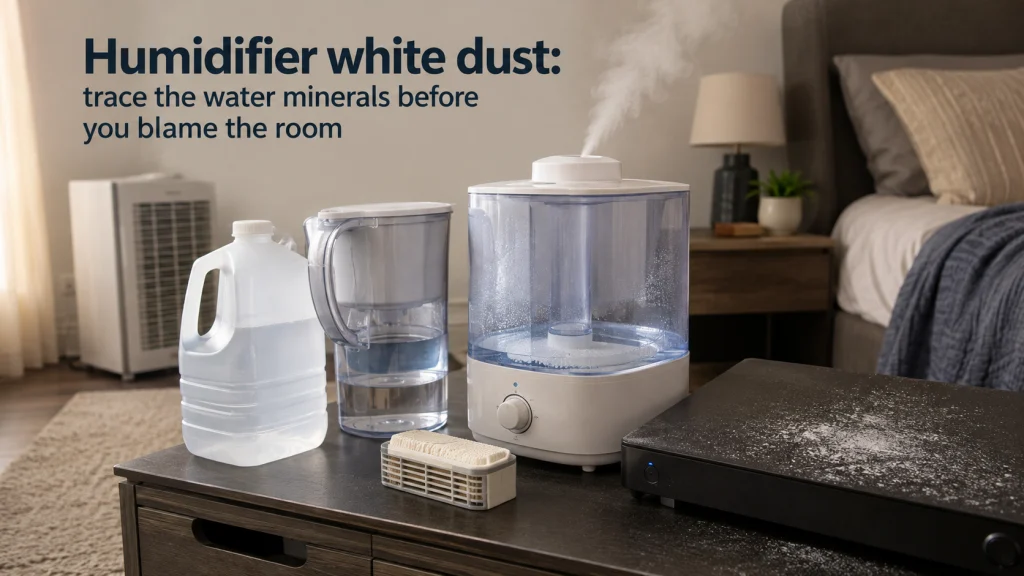
Why white dust points back to the water
Humidifier white dust can be surprisingly obvious on a black table, television stand, monitor, or other dark surface. If the residue appears while an ultrasonic or impeller humidifier is operating, the useful question is not how to dust the room faster, but what was dissolved in the water poured into the tank. The U.S. Environmental Protection Agency notes that these humidifier types can disperse minerals from tank water into indoor air, which is why water mineral content belongs near the top of the troubleshooting list. That does not prove that every pale deposit in a room came from a humidifier, so the first job is to connect the residue to the appliance, its water, and its operating pattern rather than assume.
The common household misunderstanding is treating visible mist as if it were pure water and treating any later powder as a separate cleaning problem. Water can evaporate while dissolved minerals remain behind, so a refill choice that looks harmless at the sink can create more surface cleanup after the humidifier runs. This is also why a humidifier causing white dust may seem perfectly functional: mineral dispersion can happen even when the unit is making mist normally. If the problem appeared after changing from distilled water to tap, well, spring, mineral, or another higher-mineral water source, that change is especially useful evidence to check.

The meter combines TDS, electrical conductivity, and temperature readings in one handheld tester. Its TDS scale runs from 0 to 9,990 ppm, and it includes automatic locking plus a manual hold function. The backlit pen format is designed for quick water checks across drinking water, RO or DI systems, and similar household uses.
Check On AmazonIf you click this link and buy, we earn a commission at no additional cost to you.
Why ultrasonic mist can carry minerals into the room
An ultrasonic humidifier creates fine droplets by vibrating water rather than heating it into vapor or moving air through a wet wick. That mechanism matters because the droplet can contain more than water; dissolved minerals in the tank can travel with the droplets and remain after the water portion evaporates. EPA guidance identifies ultrasonic and impeller humidifiers as the portable types most associated with mineral dispersion, while independent testing has also shown substantially more particulate output with mineral-containing water than with distilled water in an ultrasonic setup. The exact amount will vary with the water, the unit, output level, room conditions, and test method, so one laboratory result should not be treated as a universal household measurement.
This mechanism explains why ultrasonic humidifier white dust is often tied to water hardness, but hardness is not a simple yes-or-no label. Municipal tap water, private well water, bottled water, softened water, and filtered water can all have different remaining mineral content depending on how they are treated. A pitcher filter or refrigerator filter is not automatically a demineralizer, and a bottle labeled spring or mineral water is not the same thing as distilled water. Before buying anything to fix the problem, identify what water is actually going into the tank and what the manufacturer says that exact humidifier accepts.

The Classic 160 uses ultrasonic cool-mist humidification with a 2.5-liter top-fill tank. The Amazon listing specifies 28 dB operation, up to 25 hours of runtime, and automatic shutoff. Its top-fill design is intended to make refilling and cleaning easier during routine use.
Check On AmazonIf you click this link and buy, we earn a commission at no additional cost to you.
Visible mist is not the same thing as white dust
A visible plume from a cool-mist humidifier can look white simply because tiny water droplets scatter light. That plume is not automatically the powder later found on a shelf, and confusing the two can send troubleshooting in the wrong direction. White dust from humidifier use is better understood as residue that remains after the water in mineral-containing droplets is gone. The distinction matters because changing the mist direction or wiping the outlet may change where moisture travels, but it does not remove dissolved minerals from the refill water.
Use the surface residue as a clue rather than a diagnosis. A fine pale coating that repeatedly appears near an operating ultrasonic unit, becomes more noticeable on dark surfaces, and decreases after a model-approved switch to low-mineral water makes the water-mineral explanation more plausible. Residue that appears when the humidifier is off, has an oily or fibrous texture, or comes from construction dust, cleaners, candles, fireplaces, HVAC work, or another source needs a different investigation. The point is to confirm a reasonable appliance connection before replacing a working humidifier or assuming that every white deposit has the same cause.

The set includes 12 black microfiber cleaning cloths, each measuring 32 x 32 cm, or 12.6 x 12.6 inches. The cloths are reusable, absorbent, and designed for streak-free household cleaning. The listing describes them for countertops, tables, windows, kitchenware, and other household surfaces.
Check On AmazonIf you click this link and buy, we earn a commission at no additional cost to you.
Check the water source before changing the machine
The fastest useful check is to pair the humidifier type with the water source instead of starting with a shopping list. Read the model manual or support information to confirm whether the unit is ultrasonic, impeller, evaporative, or steam based, then check its approved water guidance. Next, look at what you have actually been pouring into it, because “filtered,” “purified,” “spring,” and “distilled” do not describe the same mineral-removal process. If the manual recommends distilled or low-mineral water and the residue drops after making that change, you have stronger evidence that minerals were driving the problem.
Keep the check simple enough that you can repeat it without turning the house into a laboratory. Wipe one nearby dark surface clean, use only a manufacturer-approved water choice, and watch whether the same powder returns during normal operation. At the same time, inspect the tank and water-contact areas for scale, because internal mineral buildup is another sign that the water carries a meaningful mineral load. For broader setup questions, the site’s article on how to use a humidifier correctly covers placement and owner-level operating checks without treating white dust as a separate room-cleaning problem.
- Confirm the humidifier technology from the manual or manufacturer support page.
- Identify the exact water source used in the tank.
- Check whether the manual recommends distilled, demineralized, or another low-mineral option.
- Look for scale inside the tank or other water-contact parts.
- Compare residue after a model-approved water change before replacing the humidifier.
This checklist is meant to narrow the cause, not certify the chemical makeup of a mystery powder. If the residue does not respond to a sensible water-source change, or if the appliance shows abnormal operation, leaks into electrical areas, overheating, smoke, sparks, or a burning odor, stop owner-level troubleshooting and follow the manual’s service guidance. The same restraint applies when the source of the residue remains uncertain after the obvious appliance checks. A clean surface and a changed refill routine can tell you a lot, but they are not environmental contamination testing.

The kit contains 150 water-hardness test strips for home water checks. The listing specifies use with tap, well, and softened water and includes an easy color chart for reading results. The selected strip style is designed for fast hardness checks when comparing household water sources.
Check On AmazonIf you click this link and buy, we earn a commission at no additional cost to you.
When distilled or low-mineral water is the practical fix
For an ultrasonic or impeller humidifier that allows it, distilled water is a direct way to reduce the mineral load entering the tank. EPA guidance specifically points to distilled water as a lower-mineral alternative when white dust is a problem, and it distinguishes distilled water from bottled water that may still contain substantial minerals. That makes the label on the water more important than the fact that it came from a sealed bottle. If the owner’s manual gives a narrower water requirement, the exact model instruction takes priority over a general rule.
The trade-off is recurring effort and cost. A small bedroom unit with modest refills may be easy to run on purchased distilled water, while a larger unit or several humidifiers can turn water hauling, storage, and jug disposal into part of the ownership routine. That does not make distilled water a bad solution; it means the solution should be judged by the amount of water the household actually uses. If the ongoing refill burden is already irritating enough that you are tempted to ignore the water guidance, comparing a different humidifier architecture may be more practical than repeatedly fighting the same mineral source.

This selected white distiller has a 6-liter, or 1.6-gallon, capacity and a 900-watt heating system. It uses a 304 stainless-steel interior and includes a plastic collection container. The countertop unit is designed to produce distilled water at home for a repeatable low-mineral refill-water source.
Check On AmazonIf you click this link and buy, we earn a commission at no additional cost to you.
Demineralization cartridges are model-specific tools
Some humidifiers are designed to use a demineralization cartridge, cassette, filter, or other mineral-control component. That can be useful when the part is specifically supplied or recommended for the exact model, but the generic label is not proof that a random cartridge will fit or perform correctly. EPA guidance also cautions that mineral-removal performance can vary, so a cartridge should be treated as a consumable tool rather than a guarantee that white dust can never return. If residue begins to reappear, that is a reason to check the part condition, replacement guidance, water source, and model instructions together.
Compatibility is the part many owners skip because two cartridges can look almost identical in a product photo. Verify the exact humidifier model, accepted part number or interface, installation direction, and replacement instructions before buying replacements. Do not add loose media, homemade mineral-control material, unapproved chemicals, or a cartridge designed for another unit just because it fits inside the tank. The right decision is either a documented compatible part, a documented low-mineral water strategy, or a technology change, not an improvised modification to the water path.

The UHE-HDC4 package contains four blue demineralization cartridges for HoMedics ultrasonic humidifiers. HoMedics specifies compatibility with its ultrasonic models that have a 0.5-gallon tank or larger. Each cartridge is rated for up to 30 to 40 full-tank uses depending on water hardness and is intended to help reduce mineral residue.
Check On AmazonIf you click this link and buy, we earn a commission at no additional cost to you.
Why evaporative and steam designs behave differently
White-dust risk changes when the humidifier changes how water becomes room moisture. Evaporative units pull air through a wet wick or similar medium, while steam units heat water and release vapor rather than mechanically atomizing tank water into droplets. EPA guidance says evaporative and steam vaporizer humidifiers are not expected to disperse substantial amounts of minerals, which is the important ownership distinction here. Independent testing of evaporative models using tap water also found no noticeable particulate increase under the test conditions, though that does not remove the need for tank cleaning or wick replacement.
The trade-offs move instead of disappearing. Evaporative units typically add a fan, which can mean more audible airflow and a recurring wick or filter cost, while steam designs add heat, energy use, scale management, and burn-related placement concerns. None of those differences makes one architecture universally better; the right choice depends on whether the household would rather manage low-mineral water, consumable wicks, fan noise, heat, or scale. The site’s comparison of evaporative versus ultrasonic humidifiers goes deeper into that pre-purchase trade-off when white dust is only one part of the decision.
| Humidifier method | How minerals are handled | Ownership trade-off to verify |
|---|---|---|
| Ultrasonic | Minerals in tank water can travel with atomized droplets and later remain as residue. | Water mineral content, approved low-mineral water, cleaning, and any compatible mineral-control part. |
| Impeller | Mineral-containing water can also be dispersed with the mechanically produced mist. | Water guidance, cleaning, output control, and exact model instructions. |
| Evaporative | Moisture moves through evaporation rather than carrying tank droplets into the room. | Wick or filter cost, fan noise, cleaning, and replacement availability. |
| Steam vaporizer | Water is heated into vapor, so substantial mineral dispersion is not expected. | Scale, energy use, hot surfaces or water, placement, and manual-specific care. |
Use the table as a routing tool, not as permission to ignore the manual. A technology that reduces mineral dispersion can still have standing-water maintenance, consumables, placement requirements, or other model-specific care. If you are choosing a replacement rather than solving a single residue episode, start with the humidifier buying guide and compare the work each type adds to your actual routine. White dust is one ownership cost among several, not the only reason to choose a humidifier.
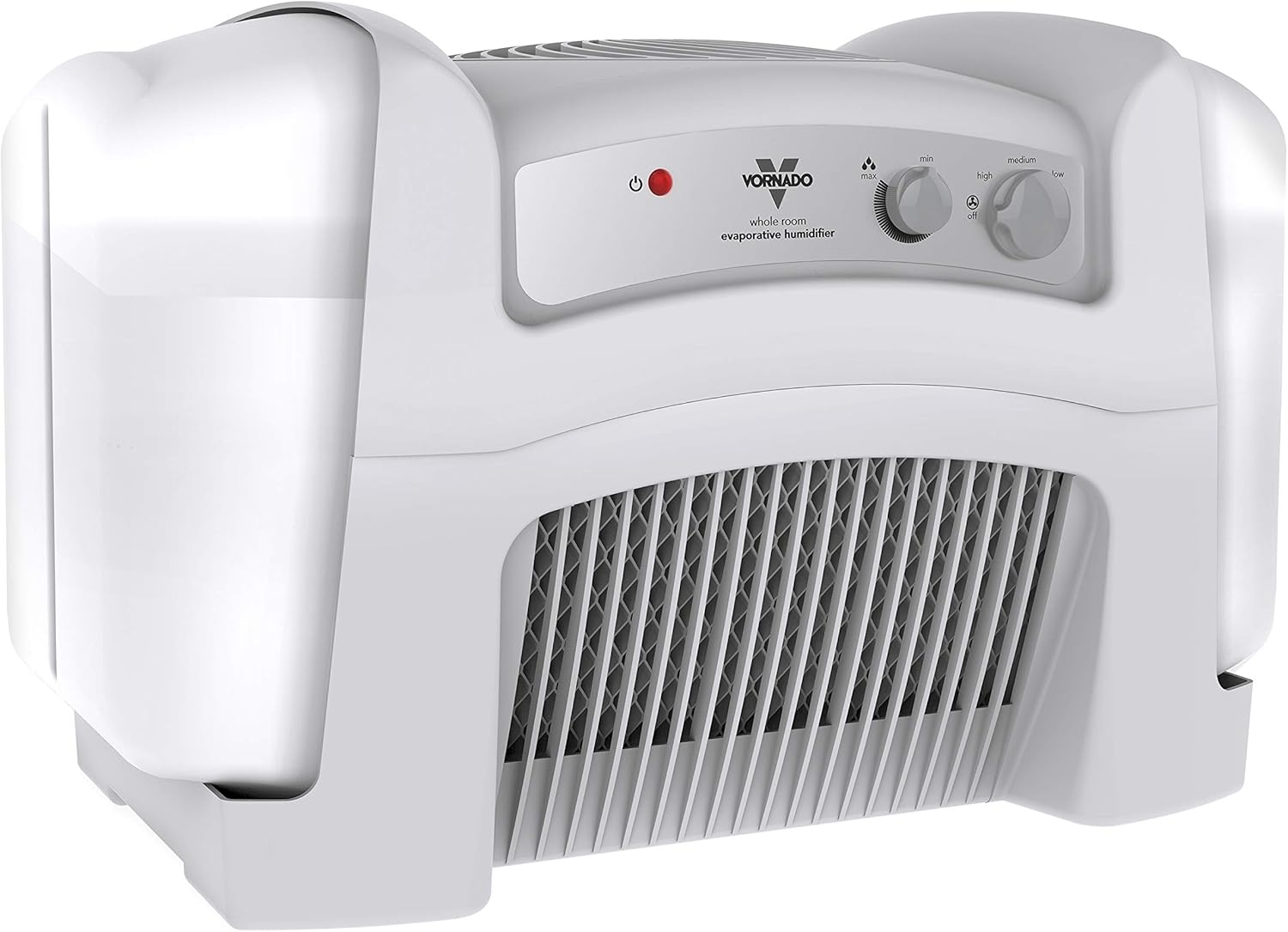
The EVAP40 is an evaporative humidifier with a 4-gallon capacity from two 2-gallon water tanks. The listing specifies coverage up to 1,000 square feet, an adjustable humidistat, and three fan-speed settings. Dual wicking filters pull dry air through the system for mist-free evaporative operation.
Check On AmazonIf you click this link and buy, we earn a commission at no additional cost to you.
Cleaning removes scale but does not remove minerals from tap water
Cleaning matters because mineral scale, film, and other buildup inside a humidifier should not be allowed to accumulate. The mistake is expecting cleaning to change the chemistry of the next tank of water. You can descale a water-contact surface perfectly and still create new residue if the same mineral-rich water goes back into an ultrasonic unit afterward. That is why cleaning and water choice solve different parts of the problem: one deals with what has already accumulated inside the appliance, while the other changes what enters the next refill.
Follow the exact manual for unplugging, disassembly, cleaning agents, rinsing, drying, and any parts that should not be submerged. Do not pour vinegar, disinfectant, essential oil, or another chemical into the tank as a homemade white-dust prevention method unless the manufacturer explicitly instructs that use for the exact model. If you need the owner-level maintenance sequence, use the site’s instructions for how to clean a humidifier and then return to the water-source decision here. A clean machine filled with high-mineral water can still recreate the same mineral-residue cycle.

The set includes a large cleaning brush and a smaller detail brush with a wiper blade. Both brushes use sturdy nylon bristles and non-slip grips for scrubbing tight household areas. The smaller brush is intended for fixtures and narrow spaces, while its wiper blade helps clear built-up dirt from crevices.
Check On AmazonIf you click this link and buy, we earn a commission at no additional cost to you.
Compare recurring water cost with switching technology
The cheapest-looking option at purchase can become annoying if its preferred water is expensive or inconvenient in your household. Instead of guessing, compare the recurring inputs you would actually buy: low-mineral water for an ultrasonic unit, compatible cartridges if the model uses them, replacement wicks for an evaporative unit, and the different energy and cleaning burden of a steam design. The useful number is not a national average price; it is your refill volume multiplied by your local cost and your actual use. Add storage space for water jugs or replacement parts, because a solution that does not fit the home is not really a low-friction solution.
Noise belongs in the same calculation even though it does not appear on a receipt. An evaporative model may reduce the white-dust problem without purchased distilled water, but its fan can be a poor fit for a quiet bedroom if the household is very noise sensitive. A steam design may avoid substantial mineral dispersion but create a different set of placement, heat, scale, and energy concerns. If switching makes sense after you total those trade-offs, the page on current humidifier options by household need can help narrow the type without treating one model as the answer for everyone.
| Cost or burden | Ultrasonic with low-mineral water | Evaporative alternative | Steam alternative |
|---|---|---|---|
| Recurring input | Distilled or other model-approved low-mineral water, plus any approved cartridge. | Wick or filter replacements when the model uses them. | Electricity and scale-removal supplies allowed by the manual. |
| Handling | Buying, carrying, storing, and pouring low-mineral water. | Keeping replacement wicks available and changing them as directed. | Managing a heated appliance and mineral scale inside the unit. |
| Noise or room fit | Often chosen when low operating noise matters. | Fan noise may be more noticeable. | Heat and safe placement can matter more than fan noise. |
| Your worksheet | Local water cost x refill volume x use, plus compatible consumables. | Replacement-part cost x actual replacement need, plus normal operation. | Energy and maintenance burden, plus the room’s safe placement constraints. |
The worksheet is intentionally based on your inputs rather than invented prices. A household using one compact unit occasionally can reach a very different answer from a household running several high-output units, even if both started with the same white-dust complaint. Choose the path whose recurring work you will realistically maintain, not the path that looks simplest in a product description. That is the difference between solving the mineral source and simply postponing the next round of powder.

The P4400 plugs between an AC appliance and the wall outlet to measure electricity use. Its display reports kilowatt-hour consumption and can show volts, amps, and wattage. The monitor can track usage over day, week, month, or year periods for comparing the recurring electrical burden of household equipment.
Check On AmazonIf you click this link and buy, we earn a commission at no additional cost to you.
Know where the equipment question ends
This page can help identify a plausible equipment and water explanation for residue, but it cannot diagnose what a person has inhaled or determine an individual’s health effect from a dust sample. EPA guidance says the possible health effects from humidifier-dispersed microorganisms and minerals are not fully understood, which is a good reason to avoid both panic and false reassurance. If you believe respiratory symptoms are associated with humidifier use, stop using the unit and seek appropriate medical advice rather than trying to diagnose the cause from furniture residue. The same boundary applies if you do not know what the deposit is or if another indoor source may be involved.
For the appliance itself, stay at owner level. Follow the model manual for water, cleaning, consumables, safe placement, and service boundaries, and stop using a unit with electrical damage, overheating, smoke, sparks, leaking into electrical areas, or uncontrolled operation. If the broader question is whether another piece of equipment belongs in the room, the site’s section on heating, cooling, and air quality equipment decisions keeps those choices separate from medical diagnosis. The useful outcome here is narrower: confirm the likely mineral pathway, reduce it using an approved method, and know when the issue no longer belongs to ordinary humidifier troubleshooting.

The TP49 displays indoor temperature and relative humidity on a compact LCD screen. Its face-icon comfort indicator labels conditions as dry, comfort, or wet, and the sensor refreshes every 10 seconds. The unit supports tabletop, magnetic-back, or hanging placement for flexible room monitoring.
Check On AmazonIf you click this link and buy, we earn a commission at no additional cost to you.
Final Thoughts: Fix the mineral source or change the technology
White powder on a dark table is a clue, not a reason to keep polishing the same surface. If an ultrasonic or impeller humidifier is dispersing minerals from the refill water, the durable choices are to reduce the mineral content entering the unit, use a compatible manufacturer-approved mineral-control part, or choose a humidifier architecture that handles minerals differently. Cleaning still matters, but it removes existing buildup rather than changing the mineral content of the next refill. That distinction keeps the solution focused on the cause instead of the cleanup.
Start with the exact model manual, the actual water source, and the recurring burden you are willing to accept. Distilled water can be simple for one household and tedious for another; an evaporative unit can reduce mineral dispersion but add wick cost and fan noise; steam can shift the trade-off toward heat, energy, and scale. The practical choice is the one that prevents the same problem from returning without creating an ownership routine you will ignore. When the residue source remains uncertain or the concern moves into health effects, stop treating it as a routine appliance decision and use the appropriate professional route.

This warm-steam vaporizer uses a 1.5-gallon tank and is designed for small to medium rooms. The unit includes a built-in night light and works with Vicks VapoPads and VapoSteam. It provides a heated-steam humidification option for readers comparing a different moisture-making method with ultrasonic or evaporative designs.
Check On AmazonIf you click this link and buy, we earn a commission at no additional cost to you.
Explore related humidifier decisions
White dust is only one part of choosing and owning a humidifier, so the next useful question depends on what is still unresolved. You may need to confirm whether the room needs added moisture at all, size the unit for the space, compare mist technologies, or decide whether a portable system creates more maintenance than it saves. Ownership questions such as cleaning, normal operation, and missing visible output also deserve their own checks because they are easy to confuse with a mineral-residue problem. The topics below keep those decisions separate so you can move to the issue that actually controls your next step.
| Humidifier topic | What it helps you decide |
|---|---|
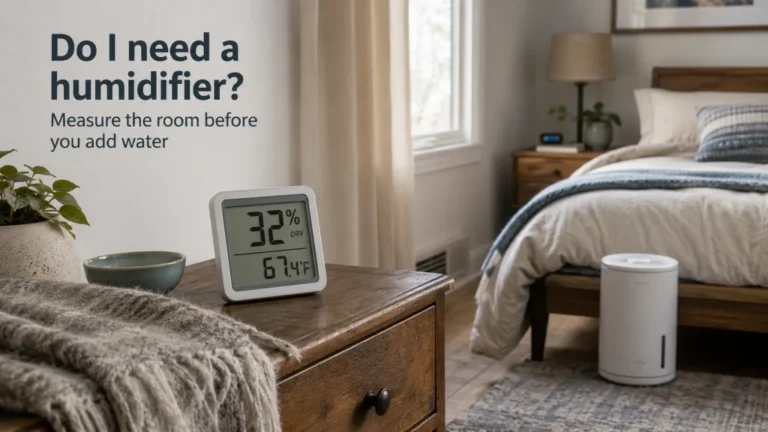
| Do I need a humidifier? | Check whether the room actually needs added moisture before accepting the refill, cleaning, and storage burden. |
| What size humidifier do I need? | Separate moisture-output needs from tank size and match the unit to the space instead of buying by capacity alone. |
| Cool mist vs warm mist humidifier | Compare heat, placement, safety, cleaning, and ownership differences before choosing a mist style. |
| Evaporative vs ultrasonic humidifier | Weigh fan noise, mineral handling, consumables, and water simplicity when choosing between the two common designs. |
| Whole house humidifier vs portable humidifier | Decide whether moisture control should stay room-by-room or move to a larger installed system with different service demands. |
| Humidifier vs air purifier | Separate adding moisture from removing airborne particles so the equipment matches the actual room problem. |
| Humidifier vs diffuser | Distinguish moisture control from fragrance use even when both devices create a visible plume. |
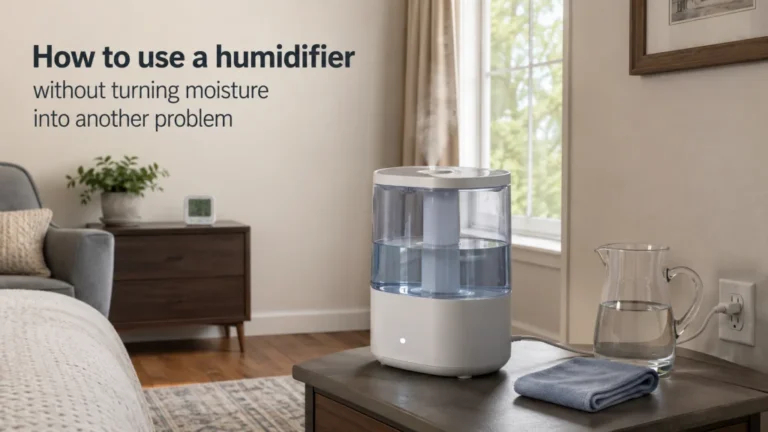
| How to use a humidifier | Check placement, water handling, output settings, and routine use without turning normal operation into another moisture problem. |
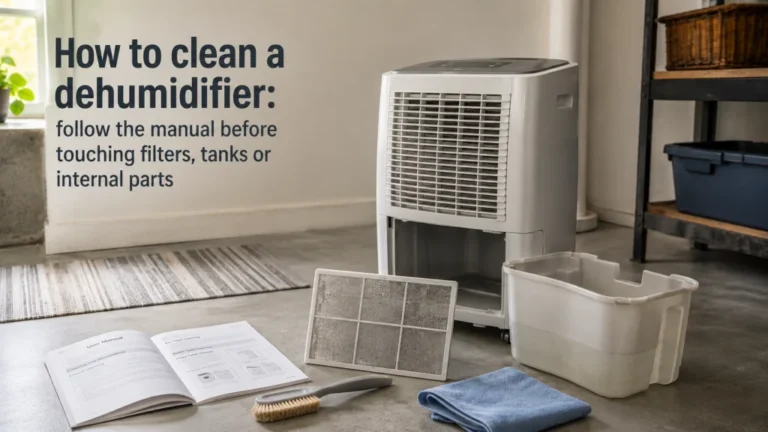
| How to clean a humidifier | Follow the exact water path and model instructions instead of assuming one cleaning chemical or method fits every design. |
| Humidifier not producing mist? | Determine whether the unit should make a visible plume before treating absent mist as a malfunction. |
| Best humidifiers | Move from ownership requirements to current options only after deciding which technology and maintenance pattern fit the household. |
If the white dust problem is already understood, use the table to move to the next unresolved ownership decision rather than reopening the same mineral question from another angle. A household replacing an ultrasonic unit may need the technology comparison first, while someone keeping the same machine may get more value from the operating or cleaning pages. If the basic need for humidification is still uncertain, start there before comparing size or features. Keeping each question in its own lane makes it easier to choose the next check without turning one residue problem into a full appliance-shopping reset.

The selected blue HM311 has a 4-liter tank and uses ultrasonic humidification. The Amazon listing specifies up to 36 hours of runtime and 28 dB operation, plus a built-in night light. Its refill-and-clean design provides a current portable-humidifier option for readers continuing into broader equipment comparisons.
Check On AmazonIf you click this link and buy, we earn a commission at no additional cost to you.
FAQs
💧 Why does my humidifier leave white dust on furniture?
An ultrasonic or impeller humidifier can disperse minerals that are dissolved in its tank water. After the water in the mist evaporates, those minerals can remain as a fine residue, especially when the refill water has a higher mineral content.
🧴 Does filtered water stop humidifier white dust?
Not automatically. A filter may improve taste or remove some contaminants without removing enough dissolved minerals to prevent residue, so check what the filtration method actually removes and follow the humidifier’s water guidance.
🪨 Is hard water the only cause of white dust near a humidifier?
No. Mineral-rich water makes the humidifier explanation more plausible, but pale residue can come from other household sources, so confirm the appliance connection before assuming the powder came from the tank.
🔄 Will switching to an evaporative humidifier stop mineral residue?
Evaporative humidifiers are not expected to disperse substantial amounts of minerals in the same way ultrasonic and impeller units can. You still need to manage the wick or filter, tank cleaning, noise, and exact model maintenance.
🧽 Can cleaning alone stop white dust from coming back?
Cleaning removes existing scale and buildup, but it does not remove minerals from the next tank of water. If mineral-rich refill water is the cause, the water choice or humidifier technology must also change.
🩺 Is humidifier white dust dangerous to breathe?
Do not diagnose personal risk from the appearance of residue alone. EPA guidance says the health effects of dispersed humidifier minerals and microorganisms are not fully understood, and anyone who believes respiratory symptoms are linked to humidifier use should stop using it and seek medical advice.
References and Sources
- U.S. EPA humidifier use and care: Supports the mineral-dispersion mechanism, low-mineral water guidance, technology differences, compatible demineralization options, and owner-level safety boundaries.
- RTINGS white-dust testing: Supports the independent comparison of ultrasonic particulate output with different water mineral levels and the evaporative-versus-ultrasonic ownership trade-off.