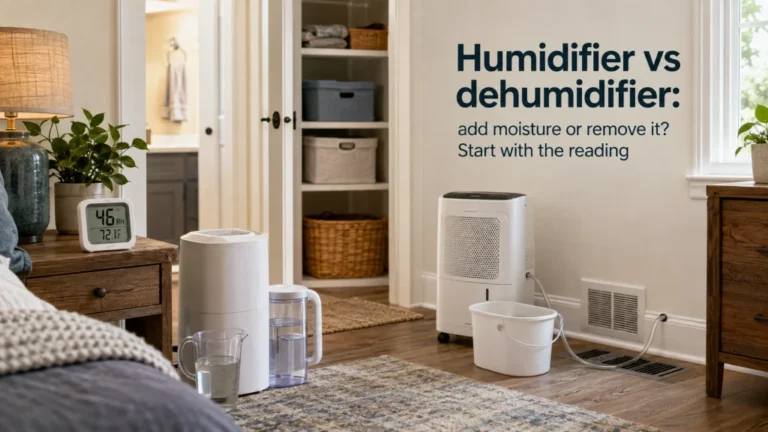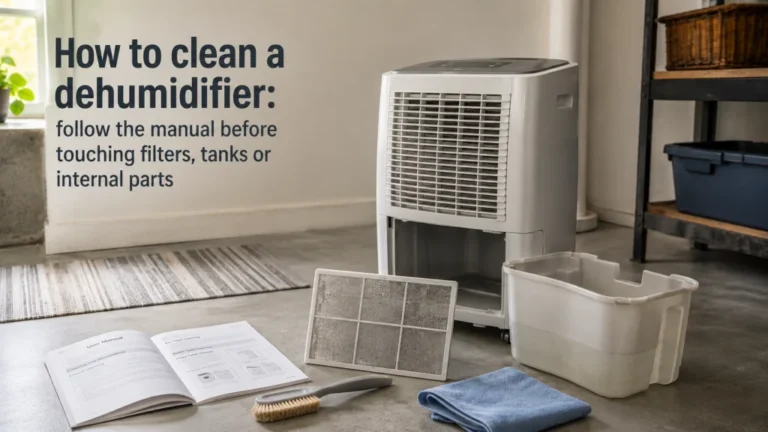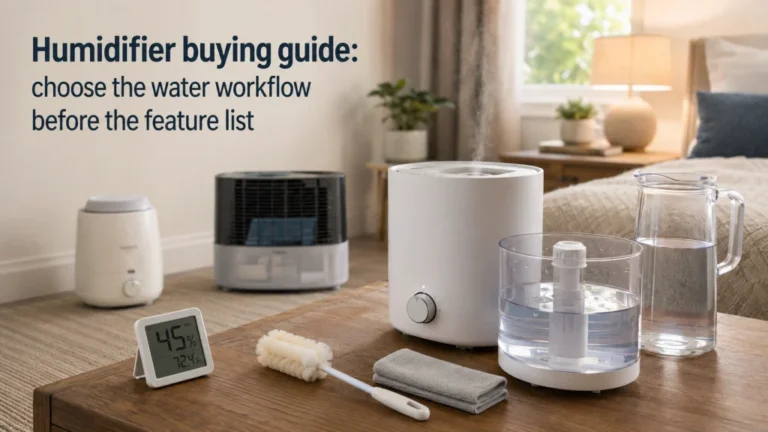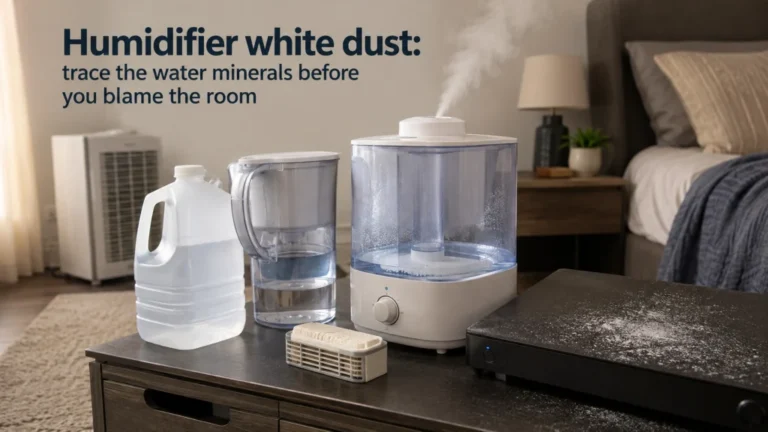
A humidifier changes moisture in the air, while an air purifier moves room air through a cleaning system to reduce the pollutants its filters are designed to capture. The right choice starts with the variable that is actually wrong in the room, not with a symptom list or a general promise to improve “air quality.” Measured relative humidity can tell you whether adding moisture is relevant, while a particle problem points toward filtration and room-size performance. Some homes need both jobs, and some need neither appliance until source control, ventilation, or a different moisture problem is addressed.
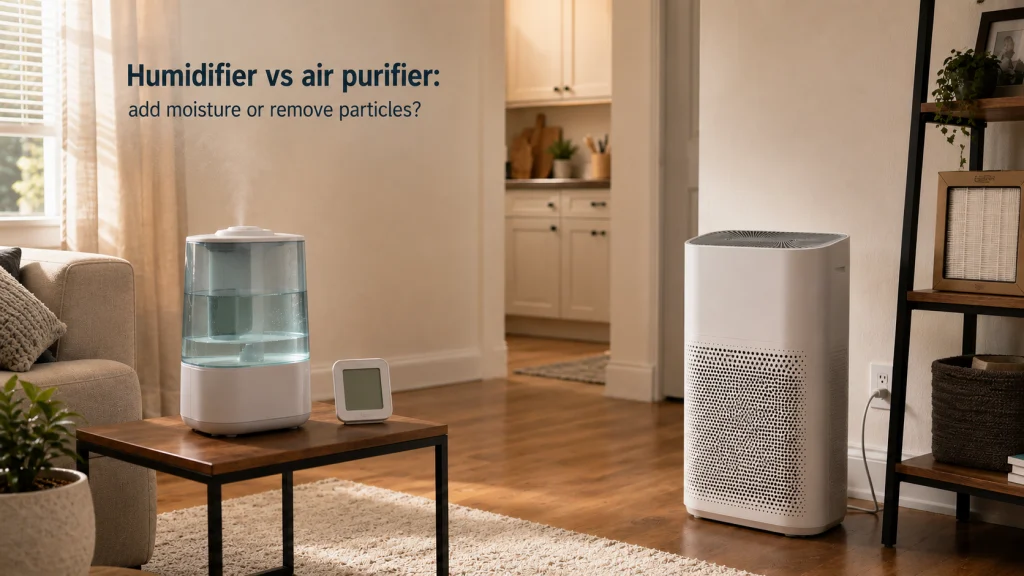
Two boxes, opposite jobs
The humidifier vs air purifier choice gets confusing because both devices can sit on the same retail shelf under broad indoor-air labels. Physically, though, they do opposite kinds of work: a humidifier adds water to room air, while an air purifier pulls air through a system intended to remove specific airborne pollutants. That difference should come before questions about features, brand names, or whether one device sounds more advanced. If the problem is not identified first, it is easy to buy a machine that changes the wrong variable.
A dry-feeling room, visible dust on furniture, cooking particles, pet dander, smoke, odors, and high or low humidity are not one single appliance problem. An air purifier cannot make dry air more humid, and a humidifier is not a particle filter simply because it changes how the room feels. That is why the useful starting point is mechanism: decide whether you need moisture added, airborne particles reduced, both jobs handled separately, or no additional machine at all. The broader heating, cooling, and air quality decisions around the home make more sense once that job is clear.
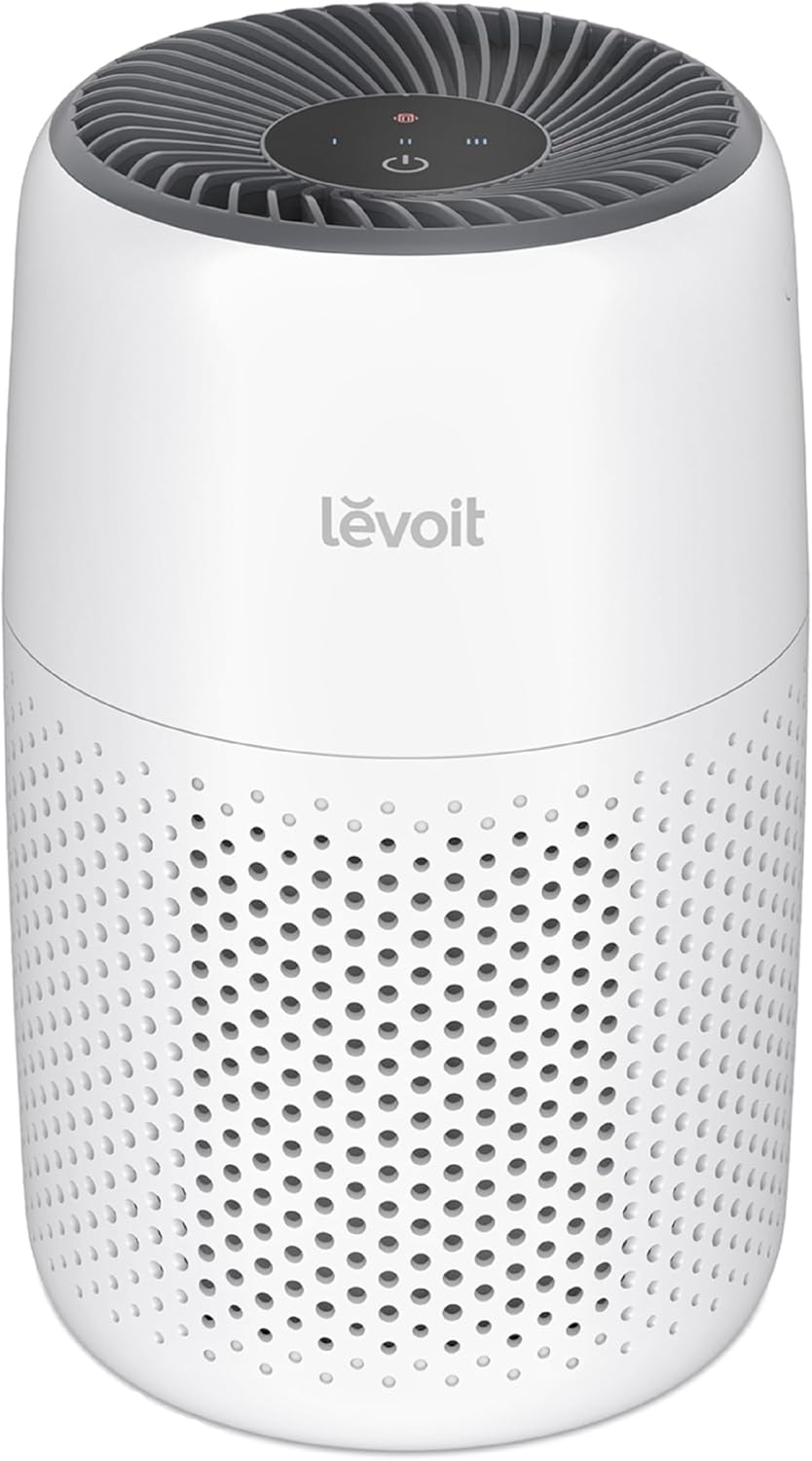
Core Mini-P is a compact air purifier intended for bedrooms, offices, and desktop use. Its listing describes filtration for smoke, allergens, pet dander, odor, and dust. A fragrance sponge is also built into the design for optional scent use.
Check On AmazonIf you click this link and buy, we earn a commission at no additional cost to you.
What a humidifier changes and what an air purifier changes
A humidifier deliberately increases moisture in the air by moving water from a tank or water supply into the room. The exact method varies by humidifier type, but the ownership question is the same: you are adding moisture and therefore taking responsibility for water quality, cleaning, wet surfaces, and humidity control. A portable air purifier has a different input and output path, drawing room air through one or more filters or air-cleaning stages and returning treated air to the room. Its performance therefore depends on airflow, the pollutants the filters are designed to address, and how well the unit is sized for the space.
| Household question | Humidifier | Air purifier |
|---|---|---|
| What does it intentionally change? | Moisture level in room air | Concentration of pollutants the cleaning system can capture or reduce |
| What does it consume or manage? | Water, tank cleaning, and sometimes water-treatment materials | Filter capacity, airflow, and replacement filters when used |
| What should prove the need? | Measured humidity plus room conditions | A real airborne-pollutant concern plus room-fit evidence |
| What does it not replace? | Particle filtration, dehumidification, source control, or ventilation | Humidity control, source control, ventilation, or moisture repair |
The difference between humidifier and air purifier operation also changes what “working” looks like. A humidifier should be judged by whether it can add the needed moisture without creating dampness, excessive humidity, or an unreasonable water-care routine. A purifier should be judged by whether it can move enough air through the appropriate filter system for the room and pollutant type, without becoming too noisy or costly to run as needed. The product label matters less than whether the machine actually controls the variable you set out to change.

The HM311 uses a 4-liter tank and is listed for up to 36 hours of runtime. DREO lists 28 dB operation plus a design intended to be easy to refill and clean. The blue model also includes a nightlight and is marketed for bedrooms, nurseries, and indoor plants.
Check On AmazonIf you click this link and buy, we earn a commission at no additional cost to you.
Measure humidity before deciding that moisture is missing
“The air feels dry” is useful context, but it is not a humidity measurement. A basic hygrometer gives you a room-level number that can be checked against what the home is doing, including condensation, damp surfaces, heating operation, and seasonal changes. The EPA advises against humidifying indoor relative humidity above 50 percent because higher moisture can encourage biological growth. That makes measured humidity a practical gate: if the room is already adequately humid or tending damp, adding more water is the wrong direction.
This is also where the air purifier vs humidifier decision can stop being a symptom-based guess. A room can feel uncomfortable for reasons that have nothing to do with low relative humidity, and a purifier cannot correct genuinely dry air. If your measurement shows a moisture problem in the opposite direction, the more relevant comparison is humidifier vs dehumidifier, because those two machines change the same variable in opposite directions. Once adding moisture is actually justified, the humidifier buying guide can take over the next decision about type, room fit, tank handling, and maintenance.

TempPro TempAir combines an indoor thermometer and hygrometer in one compact display. The black unit reports room temperature and relative humidity so you can check whether added moisture is actually needed. It uses a AAA battery and is sized for simple room-level monitoring.
Check On AmazonIf you click this link and buy, we earn a commission at no additional cost to you.
Identify a particle problem without turning appliance choice into a diagnosis
Air purifiers are most directly useful when the problem involves airborne pollutants that the selected cleaning system is designed to reduce. EPA guidance describes portable air cleaners as a supplement to source control and ventilation, not a replacement for removing or reducing the source of pollution. That distinction matters for ordinary household situations such as cooking particles, dust entering from outdoors, smoke residue in the air, or pet-related airborne material. You still need to identify what is being generated, where it comes from, and whether better exhaust or source control can reduce the load before the purifier has to handle it.
Health symptoms should not become the shortcut for choosing humidifier or air purifier equipment. Sneezing, congestion, coughing, irritation, or breathing difficulty can have many causes, and this page does not diagnose them or recommend an appliance as treatment. The equipment decision stays narrower: measured low humidity may justify moisture addition, while a known airborne-particle concern may justify filtration if the room and product are matched correctly. If symptoms are persistent, severe, or concerning, appliance shopping is not a substitute for appropriate medical advice.

The AC4825E is a 22-inch tower air purifier built around HEPA filtration. Its Amazon listing specifically targets pet dander, dust, pollen, smoke, and household scents. The tower format is intended for rooms such as bedrooms, offices, dorms, and other home spaces.
Check On AmazonIf you click this link and buy, we earn a commission at no additional cost to you.
Compare the recurring work: water care versus filter care
The easiest feature to overlook is the chore that arrives with the machine. A portable humidifier puts water handling into the routine, which can include refilling, emptying standing water, cleaning wet surfaces, removing mineral deposits, and following exact instructions for any cartridge or filter the model uses. EPA guidance specifically emphasizes keeping portable humidifiers clean and avoiding wet conditions around the unit. If that routine is ignored, the convenience of automatic moisture can be undercut by poor maintenance and an unnecessarily messy ownership cycle.
An air purifier usually shifts the recurring burden from water to airflow and filters. Filters load with captured material, airflow can fall as they become dirty, and replacement cost becomes part of ownership rather than a one-time purchase detail. Some machines add washable prefilters or gas-adsorbing media, which can create separate care schedules and replacement costs. A purifier that is cheap to buy but expensive or inconvenient to keep filtered is not automatically the better long-term choice.
| Ownership task | Humidifier burden | Air purifier burden |
|---|---|---|
| Routine input | Water | Electricity and usable filter life |
| Frequent hands-on task | Refill, empty, wipe, clean wet parts | Check intake, prefilter, and filter condition |
| Consumables | Model-dependent filters, cartridges, or water-treatment materials | Particle filters, carbon media, or other model-specific filters |
| Common hidden cost | Cleaning effort and water-management friction | Replacement-filter cost and availability |
Before buying, imagine the machine after extended use rather than only when it is new. If refilling and cleaning a tank will be skipped, a humidifier with perfect specifications on paper may still be a poor household fit. If replacement filters are difficult to source or too expensive to change when needed, a purifier can become an under-maintained fan with declining performance. Ownership burden is not a side issue here; it is part of whether the appliance will keep doing its intended job.

This package pairs the LEVOIT Core 300-P air purifier with a replacement filter. That makes filter replacement part of the product setup rather than an afterthought. The listing positions the system for household allergens and pet hair, which fits a section focused on the recurring work of keeping filtration in service.
Check On AmazonIf you click this link and buy, we earn a commission at no additional cost to you.
Noise and placement change whether either machine gets used properly
A room appliance only helps when it can operate where its work is needed. Air purifiers depend on moving air, so blocked intakes, blocked outlets, tucked-away placement, or a fan speed that is rarely tolerated can reduce useful filtration. EPA notes that higher fan speeds and longer run times generally increase the amount of air filtered, which means noise tolerance can become a performance constraint rather than a comfort detail. A purifier that is technically large enough but constantly turned down or off may not deliver the use pattern you expected.
Humidifier placement has a different set of risks because water is involved. The area around the unit should not become damp, and the exact model instructions should control spacing, surface protection, outlet use, cleaning, and safe operation. A bedside location may be convenient for refilling but wrong if nearby fabric, furniture, or walls become wet. For either device, choose a place where airflow is not obstructed, routine care is realistic, the cord does not create a bad route, and the manual permits the intended setup.
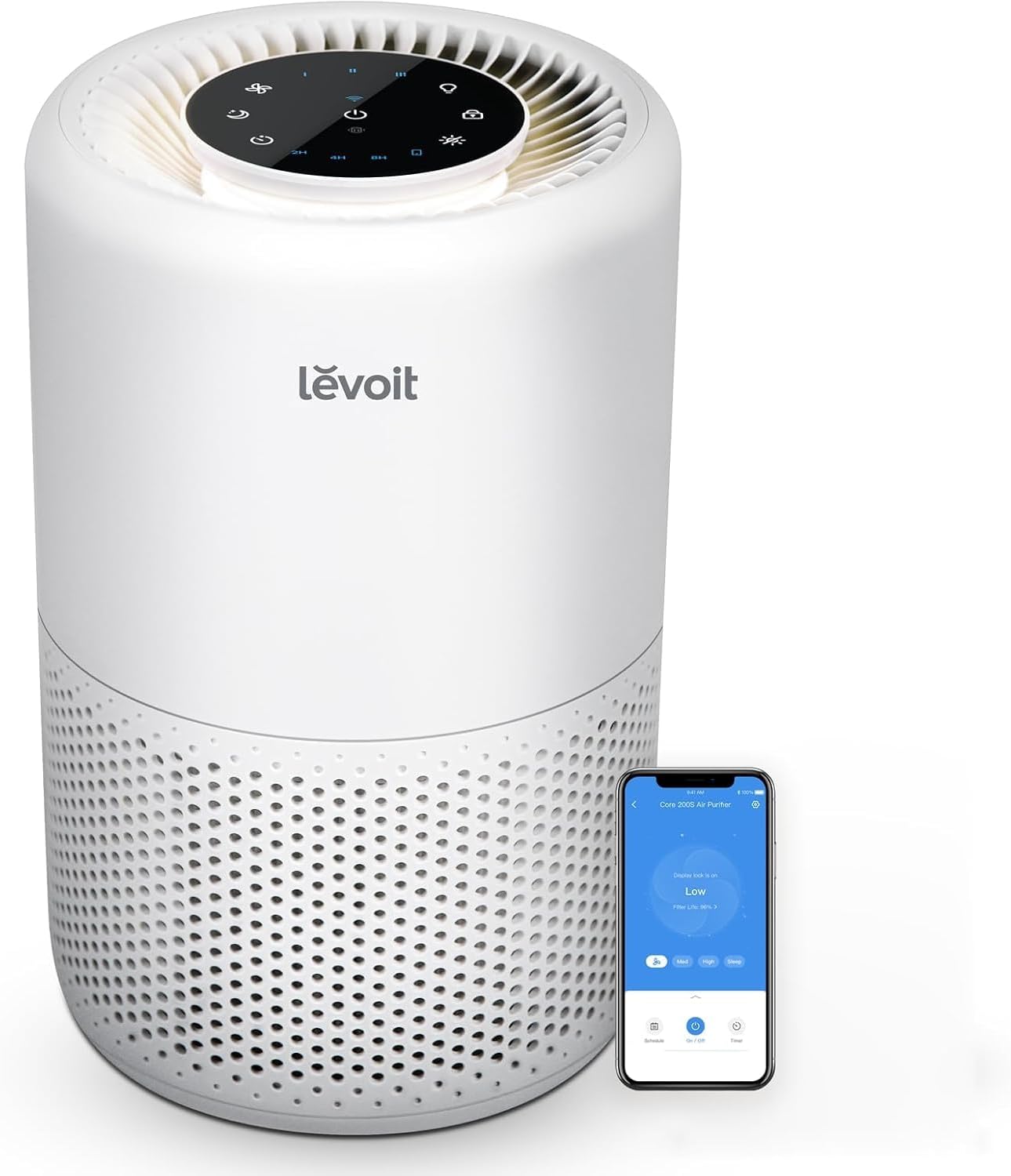
The Core 200S-P is a compact smart air purifier with a sleep mode listed as operating as low as 27 dB, making it relevant when fan noise affects whether the unit stays on. Its 8.1-inch square footprint and 12.6-inch height make placement easier in bedrooms, dorm rooms, and other smaller spaces. App and voice controls also let you adjust operation without repeatedly moving or reaching around the purifier after it has been placed.
Check On AmazonIf you click this link and buy, we earn a commission at no additional cost to you.
When both machines can make sense in the same home
Using both is reasonable only when the home has two separate problems that each machine actually addresses. For example, measured low humidity can justify moisture addition while an unrelated airborne-particle source justifies filtration. In that case, the devices are not duplicating each other; one manages moisture and the other manages particles. Buying both simply because both are sold under indoor-air labels is a much weaker reason.
Running both in the same room can also require more attention to placement and maintenance. Moisture should not be directed into another appliance, filter intake, electrical area, or surface that becomes damp, and exact spacing should come from the manuals for the equipment being used. The purifier still needs unobstructed airflow, while the humidifier still needs humidity control and water care. If the room cannot support both routines safely and conveniently, separating the jobs by location may be more practical than crowding two machines together.

This cool-mist humidifier uses a 2.5-liter top-fill tank and is listed for up to 25 hours of operation. LEVOIT describes the design as easy to fill and clean, with 28 dB operation. Automatic shutoff is included, giving the moisture side of a two-device setup its own water-handling and safety routine.
Check On AmazonIf you click this link and buy, we earn a commission at no additional cost to you.
Why a purifier does not lower humidity and a humidifier does not filter particles
An air purifier can move a large amount of room air through a filter and still leave relative humidity essentially unchanged because moisture control is not its job. A humidifier can add a meaningful amount of water vapor and still leave airborne particles in circulation because it is not a substitute for a correctly selected filtration system. Those limits are not minor feature differences; they are the reason these appliances should not be compared as interchangeable answers to a vague indoor-air complaint. The first purchase question is therefore what variable needs to change, not which machine has the longer feature list.
The same distinction prevents mismatched expectations after purchase. A purifier should be evaluated against the airborne pollutants its cleaning system is designed to reduce, the airflow it can deliver in the room, and the maintenance needed to preserve that airflow. A humidifier should be evaluated against measured humidity, moisture output, water care, and the risk of creating dampness when the room does not need more moisture. If the household needs both changes, two separate mechanisms may be justified, but neither device becomes capable of the other job simply because both are marketed for indoor air.

The H5106 monitors PM2.5 along with indoor temperature and humidity on an LED display. Its listing specifies a two-second refresh rate, two-year data storage, and 2.4 GHz Wi-Fi connectivity. Tracking particles and humidity separately reinforces that filtration and moisture control are different mechanisms.
Check On AmazonIf you click this link and buy, we earn a commission at no additional cost to you.
Keep mold, smoke events, and medical symptoms outside this appliance shortcut
Some indoor-air problems should not be collapsed into a humidifier-or-purifier shopping decision. A leak, persistent dampness, visible mold growth, or another building moisture defect calls for the moisture source to be addressed rather than covered up with a room appliance. Likewise, a purifier can be one part of ordinary particle control, but it does not replace source control or appropriate ventilation with clean outdoor air when those steps are available. The equipment decision remains useful only when the underlying problem is actually within the job the appliance can perform.
Smoke events and health symptoms need the same restraint. This comparison does not provide an emergency smoke-response plan, diagnose respiratory symptoms, or recommend either appliance as treatment for asthma, allergies, infection, or another medical condition. EPA guidance places portable air cleaning alongside source control and ventilation, while its humidifier guidance warns against excess moisture and damp surroundings. That evidence supports a narrow household decision about moisture addition and particle filtration, not a broader claim that one small room appliance solves every indoor-air problem.
Boundary: Do not use either appliance as a shortcut for mold remediation, emergency smoke response, medical diagnosis or treatment, or repair of a building moisture problem.
If the problem sits outside normal owner-level appliance use, stop the product comparison and address the actual source or seek the appropriate professional help. If the issue remains a routine room-level moisture or particle problem, then the appliance choice can continue on firmer ground. This boundary keeps a useful buying decision from drifting into claims the equipment cannot support. It also prevents spending more money on the wrong mechanism when the real next step is not another appliance.

The MMD4E is designed to check moisture in wood, walls, and areas where a water leak is suspected. It gives a household moisture problem a measurement step before a room appliance is blamed for the condition. This tool supports investigation of damp materials but does not replace repair or mold-remediation work.
Check On AmazonIf you click this link and buy, we earn a commission at no additional cost to you.
Four practical outcomes: humidifier, purifier, both, or neither
The most useful decision is not which machine wins in general, but which outcome matches the evidence in your room. Start with measured humidity, then identify whether there is a meaningful airborne-particle problem that filtration can address. After that, check whether source control or ventilation solves enough of the problem to make another appliance unnecessary. This order keeps you from buying two machines to solve one poorly defined complaint.
- If humidity is low:
- If there is no separate filtration need, the likely direction is a humidifier. Verify moisture output, room fit, tank routine, cleaning, and safe placement.
- If a separate airborne-particle problem also remains, both appliances may be justified. Verify the room fit, placement, maintenance, and operating burden of each device independently.
- If humidity is not low:
- If a real particle-filtration need remains, the likely direction is an air purifier. Verify pollutant type, room size, CADR or equivalent performance evidence, filter cost, and noise.
- If the main issue is source control, ventilation, excess moisture, a building problem, or something outside appliance scope, choose neither for now and address the variable that actually needs changing.
A first-time buyer mistake is to treat “dry, dusty room” as proof that a combination of devices is automatically needed. The dry part should be checked with a humidity measurement, while the dusty part should be traced to an airborne source and a filterable particle load rather than surface dust alone. Those checks can lead to two machines, one machine, or no purchase, and each is a valid outcome. The point is to buy only after the variables separate cleanly enough to justify the work each appliance adds.

The TP50 is a digital hygrometer and indoor thermometer for room-level temperature and humidity checks. Its display keeps the moisture measurement visible before you decide between a humidifier, purifier, both, or neither. The classic single-unit version is intended for indoor spaces such as homes, offices, cellars, kitchens, greenhouses, and RVs.
Check On AmazonIf you click this link and buy, we earn a commission at no additional cost to you.
Route the next decision to the correct equipment class
If adding moisture is the confirmed need, the next decision is which humidifier type and capacity fit the room, refill routine, cleaning tolerance, noise expectations, and available placement. That is where a dedicated humidifier selection process becomes useful because the mechanism has already been chosen. Room fit still depends on moisture output, starting humidity, air exchange, operating setting, tank burden, and the risk of making nearby materials damp. Bigger is not automatically better because excess moisture creates a different problem rather than solving the original one more completely.
If particle filtration is the confirmed need, move instead to the air purifier buying guide for filter architecture, room fit, CADR, noise, replacement filters, and ownership cost. EPA recommends choosing a portable air cleaner with a CADR large enough for the room, and AHAM Verifide lists certified room air cleaners with independently verified CADR ratings and suggested room sizes. AHAM’s simple sizing context is that tobacco-smoke CADR should be at least two-thirds of the room’s area, with more capacity considered for higher ceilings. That is a useful verification check after filtration has been selected, not a reason to compare a purifier’s airflow number with a humidifier’s tank size.
Before spending money, test the chosen equipment class against the room and the maintenance routine rather than against a generic “better” label. A machine can solve the correct problem on paper and still be a poor household fit if the tank will not be cleaned, replacement filters are too burdensome, the fan speed is intolerable, or the unit cannot be placed where it needs to work. The goal is to verify the right mechanism, enough room-level capacity, manageable recurring work, and safe placement before comparing extra features. A smaller or simpler machine may be enough when the need is local and well defined, while no purchase can still be the correct outcome when source control or another action removes the need.
- Measure relative humidity before choosing moisture addition.
- Name the airborne pollutant or particle concern before choosing filtration.
- Check source control and ventilation before asking a purifier to carry the whole load.
- Verify room size using evidence appropriate to the selected equipment class.
- Price the recurring work, including water care, cleaning, filters, cartridges, and other replacement supplies.
- Confirm safe placement, outlet access, clear airflow, and exact manual requirements.
If one of those checks fails, do not compensate by buying a more expensive version of the same wrong idea. Revisit the mechanism and room condition first, then decide whether a different size, a simpler configuration, or no appliance makes more sense. This keeps the purchase path tied to what the room actually needs rather than to a feature contest between two unrelated machines. Once that choice is settled, model-level comparison becomes much more useful because every candidate is finally being asked to do the same job.

The white AP-1512HH uses HEPA filtration and includes an air-quality monitor, automatic mode, and Eco mode. Its Amazon listing also includes a timer and filter indicator, both useful when comparing operating and ownership routines. The listing provides room-coverage information so the purifier can be evaluated against the space it is expected to serve.
Check On AmazonIf you click this link and buy, we earn a commission at no additional cost to you.
Final Thoughts: choose the variable you actually need to change
The humidifier or air purifier decision becomes straightforward once moisture and particles stop being treated as the same problem. Use a humidity measurement to decide whether adding water is even relevant, then identify whether a separate airborne-particle concern remains after source control and ventilation are considered. If those are two real problems, two different appliances can make sense. If only one problem is present, buying both adds cost and maintenance without a clear job for the extra machine.
From there, move into the correct equipment class and verify room fit, placement, noise, maintenance, and recurring cost. Keep medical symptoms, mold remediation, emergency smoke response, and building repair outside this appliance-choice shortcut. The right purchase is the one that changes the correct household variable with a routine you can realistically maintain. Sometimes that is a humidifier, sometimes a purifier, sometimes both, and sometimes the best answer is not to add another appliance.

The H5075 measures indoor temperature and humidity and sends readings to the Govee app over Bluetooth. Its listing specifies a 164-foot remote-monitoring range, smart alerts, and up to two years of data storage and export. That history can help confirm whether low humidity is persistent before another appliance is added.
Check On AmazonIf you click this link and buy, we earn a commission at no additional cost to you.
FAQs
💧 Does an air purifier help with dry air?
No. A standard air purifier filters air but does not intentionally add moisture. If dry air is the concern, measure relative humidity before deciding whether a humidifier is appropriate.
🧹 Does a humidifier remove dust from the air?
Do not treat a humidifier as a particle-removal device. Its primary job is adding moisture, while filtration requires an air-cleaning system designed and sized for airborne particles.
📏 How do I know if an air purifier is large enough for my room?
Check the room area against verified CADR or the manufacturer’s tested room-size claim. Higher ceilings and open layouts can increase the airflow requirement, so use the exact sizing evidence for the unit you are considering.
🏠 Can you use a humidifier and air purifier together?
Yes, when the room genuinely needs both moisture addition and particle filtration. Keep airflow clear, prevent moisture from wetting the purifier or nearby materials, and follow both manuals for placement and operation.
🧼 Which one needs more maintenance?
The burden is different rather than universally higher for one type. Humidifiers require water and wet-surface care, while purifiers depend on keeping airflow paths and filters in serviceable condition and replacing consumables as required.
🌫️ Should I buy a purifier just because I can see dust on furniture?
Not automatically. Identify where the dust comes from, improve source control or cleaning where practical, and decide whether a meaningful airborne-particle problem remains that a properly sized purifier can address.
References and Sources
- EPA home humidifier guidance: Supports humidity limits, water-care, cleaning, dampness, and model-instruction boundaries.
- EPA air cleaners and filters: Supports the role of source control, ventilation, and portable air cleaning in homes.
- EPA guide to air cleaners: Supports particle-filtration scope, room-area selection, CADR, fan-speed, and filter-maintenance guidance.
- AHAM Verifide air cleaner directory: Supports certified CADR, suggested room size, and the two-thirds room-area sizing context.