A rolling laundry cart only helps when it can complete the route you actually use and park without becoming another obstacle. Capacity matters, but frame width, turning space, floor transitions, caster behavior, load type, and parked footprint usually decide whether wheels are useful at home. This article stays with same-floor or otherwise accessible household routes, not stairs or commercial laundry work. By the end, you should know what to measure, which cart architecture fits the job, and when a simpler basket, hamper, or fixed work surface makes more sense.
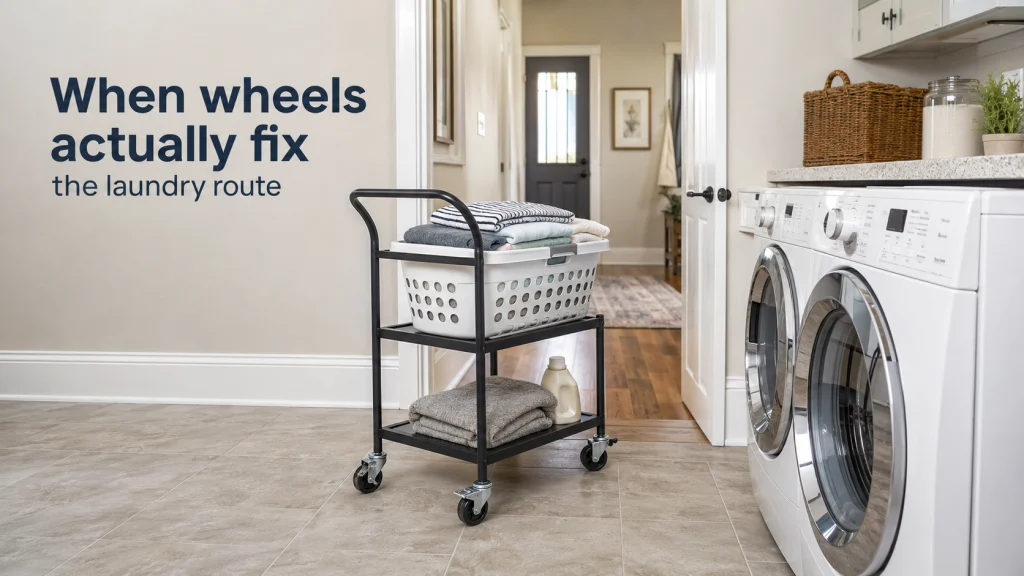
Wheels only help when the cart can finish the trip
A rolling laundry cart is worth considering when carrying laundry between stages is the recurring problem, not simply because a wheeled frame looks more convenient. The useful question is whether the cart can move a normal load from its starting point to its destination and then stay somewhere sensible when the trip is over. If the household already has an easy short carry and no need for mobile staging, wheels may add more furniture than function. Mobility should solve a repeated route problem before capacity, shelves, or extra features get any attention.
This keeps the choice grounded in the broader laundry station workflow without turning every laundry area into a cart project. The cart should support an accessible, same-floor route and remain stable when parked, while stairs stay outside this article because they require equipment specifically designed and documented for that use. Once mobility is clearly the missing function, the next step is to separate household carts from the much larger commercial equipment that appears in the same search results. Detailed clearance, turning, floor-transition, and parking measurements come after that boundary is clear.
Keep household carts separate from commercial laundry equipment
Search results often mix compact household frames with hotel, laundromat, warehouse, and institutional carts. The products can share terms such as wire basket, swivel caster, load capacity, and garment hanger while serving very different jobs. One current Uline laundry cart, for example, is documented with a 500-pound capacity and 5-inch swivel casters for hotel and laundromat use. That specification is useful as a boundary marker, not as a reason for a household to buy industrial capacity.
| Decision point | Household cart | Commercial or institutional cart |
|---|---|---|
| Primary job | Move normal household loads, folded stacks, baskets, or supplies | Move repeated high-volume loads in work settings |
| Fit priority | Doorways, turns, machine gaps, parking, and storage | Workplace aisles, bulk volume, and institutional load needs |
| Capacity question | Enough for the normal load without unnecessary frame size | Often designed around much higher documented ratings |
| What specs prove | Dimensions, wheel design, locks, layout, and stated limits | Workplace capability, not automatic residential fit |
For home use, oversized hardware can create greater frame mass, a larger parked footprint, and awkward residential maneuvering. A high load rating does not prove the frame will turn between a washer and wall or store without taking over the room. Judge the cart by the load you routinely move and the route it must complete. Buying far beyond those requirements can replace carrying friction with storage and steering friction.

This three-tier slim cart is 7.1 inches wide and uses caster wheels for movement through narrow spaces. Its ABS shelves have ventilation holes, and the cart includes a side cup and six hooks for small supplies. The compact household-scale layout suits laundry-room storage where aisle width matters more than industrial load capacity.
Check On AmazonIf you click this link and buy, we earn a commission at no additional cost to you.
Map the route before comparing capacity
A cart that travels straight across a wide laundry room has a different job from one that must leave a utility area, turn into a hallway, pass a doorway, and stop beside another surface. Distance matters because longer routes make repeated carrying more noticeable. Turns matter because a wider frame may need more floor area to pivot even when it fits through each opening. Measure the route as a sequence instead of collecting isolated room dimensions.
Write down the narrowest opening, tightest corner, floor transition, and clear floor area at both ends. Include things that move during laundry, such as a room door, washer door, cabinet door, or pull-out drawer. Measure with the room arranged the way it normally works rather than temporarily clearing the path. That produces a route profile you can compare directly with exact frame dimensions.
- Mark the starting point, destination, tightest opening, tightest turn, and final parking position.
- Measure usable clearance with doors, trim, machines, and stored items in their normal positions.
- Note thresholds, rugs, seams, or elevator lips the casters must cross.
- Check whether the parked cart blocks an appliance door, room door, cabinet, or walkway.
Distance and number of turns
Longer routes increase the value of rolling a load, while repeated turns increase the value of predictable steering. A narrow cart with swiveling casters may position more easily than a wider cart that carries more but needs extra pivot space. A short route is not automatically easy if it contains tight corners. Compare frame length and width with the floor area available during each turn.
Doorways, machine gaps, and floor transitions
Measure usable clearance, not the nominal width of a door or an empty gap. Trim, hinges, baseboards, hoses, appliance doors, and stored supplies can reduce the space available to the frame. Thresholds and rug edges deserve a separate check because caster behavior depends on the actual wheel and surface. Product documentation can verify wheel size or swivel design, but it cannot prove how every floor transition will behave in your home.
Parking location at each end
The cart needs a realistic home when it stops moving. Beside the washer, leave access to doors, controls, supplies, and the normal walking path. At the other end, make sure the basket or shelves do not protrude into a doorway or passage. A cart without a practical parking spot often becomes movable clutter rather than useful transport.

This 33-foot tape measure uses inch and metric scales with MID accuracy. A self-locking mechanism holds the blade until the push button releases it, and the case includes a belt clip and wrist strap. It is useful for recording door openings, turns, and parking clearances before comparing cart dimensions.
Check On AmazonIf you click this link and buy, we earn a commission at no additional cost to you.
Decide what the cart is actually transporting
The right frame depends on whether you move one basket, separated loads, clean folded stacks, supplies, or several of those jobs together. A low open basket can suit one washer-sized load, while multiple bins can help keep clean and dirty laundry apart. Shelves make more sense when the cart also acts as mobile staging. The recurring load shape should decide the architecture before feature count enters the comparison.
| What travels | Useful architecture | Main check |
|---|---|---|
| One normal load | Single basket or removable bin | Basket space, frame width, unloading access, and parking |
| Separated loads | Two or more bins or shelves | Whether the full frame still clears the route |
| Folded stacks | Flat shelves or stable top surface | Containment through turns and usable shelf depth |
| Supplies plus laundry | Mixed basket and shelf storage | Whether supplies consume the laundry space you actually need |
The phrase laundry cart with wheels covers very different forms. Yamazaki documents a slim wire basket about 9.84 inches wide with two standard and two locking swivel casters, while Giantex documents taller multi-tier forms with several shelves. Both roll, but they solve different staging problems. Choose the layout that matches your normal load instead of the one with the longest feature list.
Compare frame width and depth with usable capacity
Capacity is useful only when the frame that creates it can still complete the route. A larger basket can reduce trips, but added width can complicate turns and added depth can project farther into a hallway when parked. Tall carts preserve floor area by stacking storage vertically, yet shallow shelves may not accept a bulky basket or wide folded stack. Read nominal capacity and exterior dimensions together.
Use the maximum width and depth while the cart is loaded, including handles, bins, or anything that protrudes beyond the base.
Use the actual floor space the cart occupies in its normal waiting position, with appliance doors and walkways still usable.
Start from one normal load rather than the largest load you can imagine. If one removable basket already matches what you routinely move, extra tiers may add more frame than useful capacity. Multiple compartments earn their space when you actually use them to separate loads or stages during most laundry cycles. Collapsibility helps only when you are willing and able to empty and fold the cart between uses.
Evaluate casters by size, swivel behavior, and locks
Wheel count alone says little about how a cart will behave. Check caster diameter, which wheels swivel, which wheels lock, and what the manufacturer documents about intended use and load limits. Yamazaki specifies two standard swivel casters and two locking swivel casters on its slim wire basket, while Giantex specifies four universal casters with two lockable wheels on its multi-tier cart. Those details matter more than a generic claim that a frame is simply rolling.
Larger wheels may help around some floor irregularities, but there is no universal caster size that guarantees easy threshold crossing. The Uline commercial example uses 5-inch swivel casters because its intended scale and load are very different from a compact household frame. Locks are most useful when the cart must stay put while loading, unloading, or staging. Verify how the exact caster layout matches your floor and parking position rather than treating wheel diameter as a quality score.

This metal three-tier cart measures 16.40 by 11.25 by 31.0 inches and rolls on four casters. Two wheels lock, while three deep mesh baskets provide contained storage and airflow. Its documented wheel layout makes it a useful reference when comparing rolling behavior and parking stability.
Check On AmazonIf you click this link and buy, we earn a commission at no additional cost to you.
Check handle and frame height as a control point
Frame height changes how you steer, load, and park a cart, but it should not be turned into a universal ergonomic rule. A low basket may align well with a front-loading machine, while a taller handle can provide a clearer control point in a hallway. Measure against washer openings, counters, cabinets, and any surface the frame must pass under. The useful height is the one that works with the route and the way the cart is controlled.
Current product dimensions show how different rolling forms can be. Yamazaki documents its basket at about 14.76 inches high with the handle down and about 26.4 inches with the handle upright, while Whirlpool documents a narrow laundry supply cart at about 30.75 inches high. Those figures do not make one form better than another. They show why the handle, frame, and load need to be considered together before assuming that any rolling frame will feel equally manageable.
Separate a mobile cart from a hamper that happens to roll
Containment and transport can overlap, but they are not the same primary job. If the item spends most of its life collecting dirty laundry in one place and wheels simply make it easier to reposition, compare it as a laundry hamper or sorter. A cart becomes the better frame when movement between laundry stages is the reason it exists. That distinction prevents buying a larger mobile workstation when a simpler wheeled container would do the job.
Think about what happens after the load reaches the machine. A hamper-first product usually empties and returns to its collection spot, while a transport-first cart may continue through drying, folding, supply movement, or return trips. If the container is the essential feature and wheels are secondary, shop the container first. If the route is the essential problem, a rolling cart for laundry should be chosen around movement and staging first.

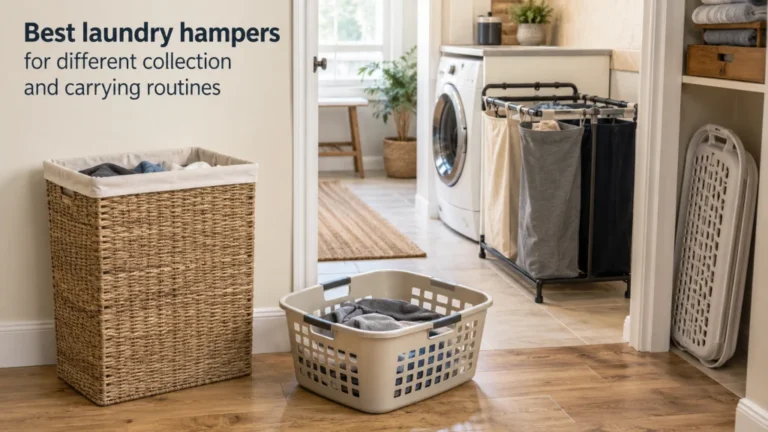
This wheeled plastic hamper has a lid, ventilated base, and integrated handle for moving laundry. Amazon lists it at 20.98 by 13.74 by 28.39 inches, with a 70.48-liter capacity. Its container-first design makes it a clear example of a hamper whose wheels support transport rather than turning it into a shelving cart.
Check On AmazonIf you click this link and buy, we earn a commission at no additional cost to you.
Decide whether shelves add useful staging or just more frame
Shelves can turn a cart into a mobile work companion, but only when they correspond to real laundry steps. A top surface may hold folded stacks, a lower shelf may keep supplies together, and a bin may carry the active load. That arrangement can work in a larger laundry area where the cart moves between machines and another work zone. In a narrow laundry closet, the same frame may consume the very maneuvering space the wheels were supposed to improve.
| Missing function | Wheels-only approach | Mobile workstation approach |
|---|---|---|
| Move one load | Prioritize basket fit, width, casters, and parking | Usually unnecessary unless another task also needs staging |
| Move supplies | Works if the load stays contained | Shelves can separate bottles and small items |
| Move folded stacks | Use a basket that keeps stacks stable | Flat shelves can add staging if the route allows the larger frame |
| Collect dirty laundry | Consider a wheeled hamper or sorter | Add workstation features only for another repeated job |
The Giantex multi-tier form illustrates the tradeoff because its taller versions stack several small shelves inside an 18 by 12-inch base. That is evidence of a vertical staging architecture, not proof that more shelves are better. If your normal load is one bulky basket, shallow tiers can organize small items without solving transport. Every shelf should earn its footprint by supporting a repeated step.

This three-tier metal utility cart measures 13.0 by 16.5 by 33.8 inches and supports up to 22 pounds per shelf. Four wheels provide mobility, including two locking wheels, while the deep open baskets help keep supplies contained. It fits the staging question because the shelves add vertical storage only when those levels support repeated laundry tasks.
Check On AmazonIf you click this link and buy, we earn a commission at no additional cost to you.
Include wheel debris, liners, and assembly in the ownership work
A cart is simple equipment, but it still creates maintenance that a basic basket may not. Hair, thread, lint, and floor debris can collect around caster axles and interfere with movement. Removable liners or bags should come out easily enough to clean according to their care instructions. Shelves and frame joints also add surfaces that may need wiping, inspection, or manufacturer-directed tightening.
Ownership burden rises as the frame gains shelves, hooks, bins, folding parts, and connections. Added components are worthwhile when they solve recurring work, not merely because they make the cart look more complete. Follow exact product instructions for cleaning, assembly, adjustment, and replacement parts instead of improvising repairs or lubricants. If a caster is damaged or the frame becomes unstable, stop using the cart under load until the problem is corrected within the manufacturer’s instructions.

This 16-piece cleaning set includes crevice brushes, long-handled brushes, track cleaners, straw brushes, and nylon, brass, and stainless-steel brushes. The set is designed for narrow gaps and other small spaces that larger cleaning tools may not reach. Its mix of brush shapes is contextually useful for routine debris cleaning around accessible cart hardware, while repair and lubrication should still follow the cart manufacturer instructions.
Check On AmazonIf you click this link and buy, we earn a commission at no additional cost to you.
Add a hanging bar only when vertical garment staging is the real need
A hanging bar changes the cart enough that it deserves a separate decision. It can help when shirts, pants, or other garments routinely leave the dryer on hangers before they reach a closet. The bar adds height and a larger moving envelope because garments may extend beyond the basket or frame. That extra space can affect doors and turns even when the base fits easily.
If vertical garment staging is the primary missing function, compare a laundry cart with a hanging bar instead of treating the bar as a minor accessory. Check bar height, usable hanging width, documented capacity, garment clearance, and the parked footprint. Those requirements are different from choosing a low cart for baskets and folded stacks. If hanging is only occasional, permanent vertical hardware may add more storage burden than value.
Choose a fixed folding surface when movement is not the missing step
Sometimes a cart looks attractive because the laundry room lacks a place to sort or fold, not because laundry needs to travel farther. If most loads move only a few feet from dryer to work surface, wheels may add little. A stable laundry folding table can answer the missing horizontal-workspace problem more directly. It also avoids making every folded stack depend on a frame that rolls and must be parked afterward.
Choose mobility when the recurring problem is carrying loads, supplies, or folded laundry across a meaningful accessible route. Choose a fixed surface when the recurring problem is having nowhere to fold, sort, or stage items near the machines. If both problems exist, measure carefully before combining them into one large movable frame. Broader home storage and organization should still serve the equipment workflow rather than add furniture for its own sake.
Use a route-clearance worksheet before you shop
A written fit check is faster than comparing carts that never had a chance of working in the space. Measure with doors and appliances in the positions they use during laundry. Record the cart’s maximum loaded envelope rather than only its base dimensions. If handles, bins, folded garments, or other parts protrude, include them in the width or depth you compare.
| Measure or check | Your household limit | What to verify on the cart |
|---|---|---|
| Narrowest usable opening | _____ in. | Maximum loaded width |
| Tightest turn | Describe available floor area | Frame length, depth, and caster layout |
| Floor transitions | List thresholds, rugs, or seams | Caster diameter and documented wheel design |
| Parking footprint | _____ in. wide by _____ in. deep | Full frame dimensions in normal parked use |
| Normal load | Basket, bins, folded stacks, or supplies | Usable layout and documented load limits |
| Parking stability | Where loading and unloading happen | Number and location of locking casters |
Compare the worksheet with exact manufacturer documentation instead of estimating dimensions from photos. If a cart fails a non-negotiable opening, turn, or parking measurement, move to a narrower architecture. Capacity cannot compensate for a frame that cannot finish the trip. Once the route fits, then compare basket space, shelves, locks, and other features.

This 25-foot tape measure has fractional markings on the blade for quick reading. Its self-locking blade stays extended until the release button is pressed, and a rubber overmold adds grip. It suits the route worksheet because the reader can record openings, parking footprint, and loaded-envelope dimensions with one compact measuring tool.
Check On AmazonIf you click this link and buy, we earn a commission at no additional cost to you.
Final Thoughts: buy wheels for a real route, not a feature checkbox
A useful laundry cart starts with the path, not the product page. Measure the tightest opening, turn, floor transition, and parking spot, then decide what the frame must transport. Compare only carts whose width, depth, caster layout, load architecture, and storage footprint fit that routine. If a basket, wheeled hamper, hanging-bar system, or fixed folding surface solves the bottleneck more directly, choose the simpler answer.
The strongest purchase removes a repeated step without creating a new obstacle. Wheels should let the load complete an accessible household route and stop in a stable place. Every shelf, bin, handle, lock, or added frame section should earn its space through repeated use. When product limits or assembly instructions differ, use the exact manufacturer documentation as the final check.
FAQs
📏 How wide should a laundry cart be?
There is no universal best width. Measure the narrowest usable opening and tightest turn, then choose a loaded cart width that clears the actual route.
🛞 Are bigger wheels always better on a laundry cart?
No. Wheel diameter can matter around floor transitions, but caster material, swivel design, locks, load, and the surface also affect behavior.
🧺 Is a rolling hamper the same as a laundry cart?
Not necessarily. If the main job is collecting laundry in one place, it is primarily a hamper even if wheels make repositioning easier.
🚪 What should I measure before buying a rolling laundry cart?
Measure the narrowest opening, tightest turn, floor transitions, and final parking footprint. Include handles, bins, or other parts that extend beyond the base.
🔒 Do I need locking casters?
Locks are useful when the cart must stay put while loading or unloading. Verify how many casters lock and whether the locks are reachable where the cart parks.
🏠 Can I use a household laundry cart on stairs?
Do not assume a standard cart is suitable for stairs. Use only equipment specifically designed and documented for that route.
References and Sources
- Yamazaki Home rolling wire basket: Verifies the compact basket dimensions and documented swivel and locking caster arrangement used as a household geometry example.
- Giantex rolling laundry cart: Verifies the multi-tier dimensions, shelf layout, and lockable caster configuration used to illustrate mobile staging.
- Whirlpool rolling laundry storage cart: Verifies a narrow three-shelf supply-cart form and its documented exterior dimensions.
- Uline little laundry cart: Verifies the hotel and laundromat positioning, 5-inch swivel casters, and 500-pound documented load rating used only to define the commercial boundary.