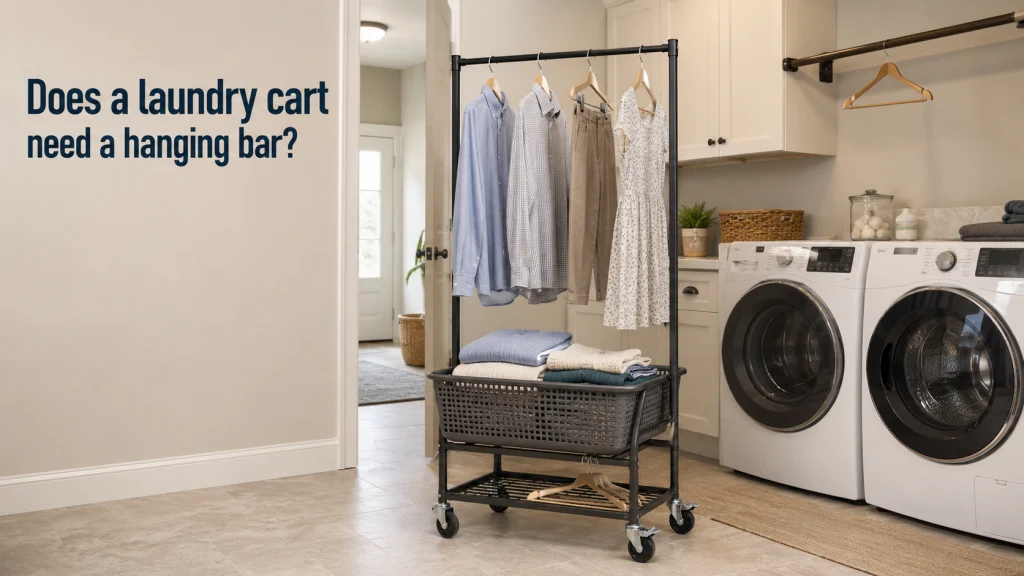
A hanging bar is useful only when clean garments regularly need a place to hang before they reach a closet, ironing area, or drying setup. If most loads are folded, a taller cart can add height, clearance problems, and unused hardware without removing meaningful work. The right choice comes from counting real hang-up garments, checking the full parked footprint, and verifying the exact rail dimensions and load limits. A simpler cart is often the better fit when an existing rod already handles the hanging step.
A hanging bar earns its space only when it removes a repeated step
A laundry cart with hanging bar makes sense when clean garments repeatedly need a temporary hanging point before they reach a closet, ironing area, or other finishing location. The rail should remove a real handoff, such as carrying a basket first and then finding somewhere else to hang several pieces. If the household mostly folds everything or already has a convenient rod beside the work area, the integrated rail may add height without changing the routine. That makes workflow, not the presence of the feature itself, the first buying test.
The trade-off becomes more noticeable in tight laundry rooms because the rail occupies vertical space even when it is empty. Cabinets, doors, shelves, lights, and the cart’s parking position can all matter more than a feature list suggests. A quick count of immediately hung garments is still useful, but the detailed count belongs in the worksheet below where it can be compared with the rest of the load. First decide whether a mobile hanging point solves a repeated transition at all, then measure how much hanging capacity that transition actually needs.

The Tajsoon rolling laundry cart combines mobile clothing storage with a hanging rail and a basket area, making it useful for sorting laundry or carrying garments between rooms. The wheeled frame can suit laundry rooms, small apartments, and spaces where a fixed closet organizer would be inconvenient. Its hanging section can hold recently washed clothing while the lower storage area helps contain everyday laundry items. Compare the frame measurements, caster design, basket capacity, and assembly requirements with your available space, because the layout differs between competing laundry carts.
Check On AmazonIf you click this link and buy, we earn a commission at no additional cost to you.
Treat it as a mobile laundry cart with a temporary garment-staging rail
This subtype still needs to work as a cart first. The basket, bags, shelf, wheels, and turning space determine whether laundry can move through the room without turning the rail into an obstacle. A rolling laundry cart with hanging bar should therefore be judged as a mobile laundry tool that happens to add vertical garment staging. If the hanging function becomes the main reason the unit exists, you are moving toward a garment rack or drying-rack decision instead.
That boundary matters because each product type solves a different bottleneck. A plain cart is mainly about transport, a sorter is mainly about separating loads, and a hanging-bar cart adds a temporary landing place for garments that should not be dropped into a clean basket. If you are still deciding how the whole room should work, the broader laundry station setup is the better place to map movement, parking, and work surfaces first. For the wider equipment-storage decision, the home storage guide helps identify the storage job before choosing the product type. The hanging rail should be added only after that larger workflow shows a clear need for it.

This metal rolling cart combines a hanging rack with a laundry basket, storage basket, and shelf. Its wheeled frame keeps garment staging and laundry transport on one mobile unit. The gold version provides the same integrated cart-and-rail format discussed in this section.
Check On AmazonIf you click this link and buy, we earn a commission at no additional cost to you.
Count how many garments per normal load are hung immediately
Use a normal load rather than a once-a-season laundry pile, because the cart will occupy floor and vertical space every day it is parked there. Count only garments that would go onto the cart immediately after drying, steaming, or ironing, not every item in the closet that could theoretically hang. Also note how many hangers need to be available at the cart, since a rail is less useful when the hangers live in another room. This small count turns a vague feature preference into a repeatable household requirement.
The worksheet below is intentionally simple because the decision does not need a fake precision score. What matters is whether the hanging step appears often enough to save a trip or stop clean garments from being piled into a basket. If most rows stay near zero, focus on basket capacity, mobility, and parking instead. If several rows are consistently meaningful, keep the rail on the shortlist.
| Garment group | Items hung right away | Where they go now | Would a cart rail remove a step? |
|---|---|---|---|
| Shirts and blouses | Count from a normal load | Closet, door, chair, or basket | Yes only if staging is repeated |
| Pants and skirts | Count from a normal load | Closet, folding surface, or basket | Check hanger type and clearance |
| Delicates | Count from a normal load | Drying setup or temporary rod | Separate drying needs from staging |
| Ironed or steamed pieces | Count from a normal session | Door, closet rod, or garment rack | Useful if the cart moves with the task |
After filling this in, look for repeated movement rather than the highest single count. A rail that saves a trip several times each week may be more valuable than one sized for an occasional large batch. That is the practical reason to count first and compare cart dimensions second. Consistency matters more.

This 50-pack gives a laundry cart a ready supply of hangers for garments staged immediately after washing, drying, steaming, or ironing. The slim velvet design is non-slip and space-saving, helping garments stay on the rail without bulky hanger profiles. The black hangers are intended for suits and everyday clothes.
Check On AmazonIf you click this link and buy, we earn a commission at no additional cost to you.
Decide whether the bar is for clean staging, limited air drying, or post-ironing hold
Clean staging is the clearest use case because it keeps freshly finished garments separate from loose laundry while they wait to be carried away. Post-ironing or post-steaming hold is similar: the rail becomes a short stop between garment care and the closet. Limited air drying can also happen on some carts when the exact product permits it, but that should remain a secondary use. A small rail over a basket does not automatically provide the spacing, total drying area, or room airflow that a real drying setup is chosen to provide.
Do not combine these jobs into one vague promise that the bar will handle everything. A household may need only six hangers of temporary clean staging, while another may need enough open space to dry a full group of delicates without garments touching the basket below. Those are different capacity questions, even if both involve hangers. Write down the primary job first, then judge rail width, garment clearance, and parking location against that job.
The rail is expected to hold a meaningful share of wet laundry until it dries. That points to a dedicated drying setup with enough usable drying area, spacing, and placement.
The rail holds a smaller group of clean, wrinkle-prone, steamed, or ironed garments while they move through the laundry routine. That remains a laundry-cart decision when transport and staging are still the main jobs.
This boundary keeps the feature from being credited with a job it may not be designed to carry. If the household would still need a separate drying rack after buying the cart, evaluate the cart for transport and staging rather than pretending the rail replaced that equipment. If the rail is only handling a few hanger-dry pieces as a secondary use, verify the exact product instructions and keep the main buying decision focused on mobility and garment staging. The clearer the primary job is, the easier it becomes to reject oversized or duplicate features.
Route primary air-drying capacity to clothes drying racks
If the main purpose is to dry a meaningful share of a load, compare clothes drying racks instead of assuming a cart rail is a substitute. Drying racks are selected around usable drying area, spacing, placement, and how the rack stores when not in use. A cart rail can still handle a few hanger-dry pieces when the exact model and space allow it. The distinction keeps a transport tool from being oversized for a drying job it was not chosen to perform.

This gullwing rack provides 46 feet of drying space and includes dedicated shoe bars. Its metal frame is rated for up to 50 pounds and folds flat for storage. That makes it a distinct primary air-drying tool when a cart rail would only provide limited hanger staging.
Check On AmazonIf you click this link and buy, we earn a commission at no additional cost to you.
Verify bar height, width, and exact hanging load on the product you are considering
Do not assume that two carts with similar photos provide the same usable hanging zone. Current household listings show meaningful differences in overall height and adjustability, including one design that adjusts through a broad vertical range and another that is listed at more than six feet tall overall. That difference can decide whether the cart clears a cabinet, whether longer garments hang cleanly, and whether the rail can be lowered when not needed. Measure the exact product, not the category name.
Load capacity needs the same model-specific treatment. A bar may look heavy-duty while the manufacturer or retailer gives a separate limit for the rail, the basket, the shelf, or the whole frame, and those numbers should not be combined or guessed. If a hanging-load rating is missing, treat the capacity as unknown rather than borrowing a number from a visually similar cart. The useful specification is the documented limit for the exact bar you will load, with the frame assembled and used as instructed.
- Check overall cart height at the setting you will actually use.
- Check usable bar width, not just total cart width.
- Check whether the bar is fixed, adjustable, removable, or telescoping.
- Check the documented hanging load separately from basket or shelf capacity.
- Check whether the manufacturer gives any specific instructions for wheel locks or stationary use.
These checks protect against choosing by feature count and discovering later that the rail cannot be used in the room. A hanging rail is valuable only inside the clear space where it will operate. Treat every unverified dimension or load claim as a reason to keep checking. Keep unknowns open.

This 25-foot tape measure gives enough reach to check cart height, usable rail width, and surrounding room clearances. Fraction markings make common household dimensions easier to read, while the self-locking blade holds its position during measurement. The blade retracts when the measurement is finished.
Check On AmazonIf you click this link and buy, we earn a commission at no additional cost to you.
Check garment length against the basket and shelf below
Usable hanging height is not the same as overall cart height. What matters is the clear drop from the hanger to the highest object below it, which may be a basket rim, sorter bag, shelf, pile of folded laundry, or detergent bottle. A shirt that hangs cleanly may fit while a dress, pair of pants on a clip hanger, or longer garment drapes into the load below. That defeats the point of creating a clean staging zone.
Measure one or two representative garments on the hangers you actually use, then compare that drop with the cart’s real clearance. Leave room for the basket to fill and for items on a lower shelf to remain usable, because an empty product photo can hide interference that appears only during a normal load. If clean garments would brush dirty laundry, touch the floor, or block access to the basket, the rail is not functionally tall enough for that use. In that case, either change the garment role, choose a different cart format, or keep hanging on an existing rod.

This 60-inch flexible tape can measure a representative garment while it is on its usual hanger. The fiberglass tape works across curved or flat surfaces and is marked in both inches and centimeters. It is a practical way to compare garment drop with the basket or shelf clearance below the rail.
Check On AmazonIf you click this link and buy, we earn a commission at no additional cost to you.
Check the full tall-cart footprint against doors, cabinets, lights, and parking space
A tall cart occupies more than the rectangle made by its wheels. The rail and hanging garments may extend into the swing path of a cabinet door, washer or dryer door, closet door, or overhead fixture even when the base fits neatly beside the machines. Some current household carts are roughly six feet tall or more, so a base measurement alone can give a false sense of fit. Measure the parked cart at full operating height and include the garments that will hang from it.
Then test the route from the parking spot to the place where laundry is unloaded or garments are finished. A rail that clears the ceiling can still catch a doorway, shelf edge, cabinet, or light when the cart turns. Keep stairs out of the route, and do not treat wheel locks as a substitute for a level floor. The cart should move and park without rearranging the room for every use.
- Measure base length and width at the widest fixed point.
- Measure maximum working height, including any adjustable rail.
- Open every nearby appliance, cabinet, and room door through its full swing.
- Check the turning path with garments hanging from both ends of the bar.
- Confirm a level parking spot where locked casters can be used if provided.
This parking check is more useful than asking whether a cart is marketed for a small laundry room. A compact base can still carry a tall or wide upper structure that conflicts with the room. Fit is proven by the actual route and clearances, not the label on the listing. Measure the real occupied envelope instead.

A 165-foot green-beam laser distance measure designed for fast indoor and jobsite measurements. The bright green laser improves visibility compared with standard red beams, while the color display keeps readings easy to check. It supports straightforward distance measuring in a compact handheld format and provides a longer working range than the Bosch GLM100-23 it replaces.
Check On AmazonIf you click this link and buy, we earn a commission at no additional cost to you.
Add wheel locks and frame stability to the stationary hanging check
A cart changes jobs when you stop rolling it and start pulling hangers on and off the rail. At that moment, the wheels, floor, frame joints, and weight distribution all matter because the cart is acting as a temporary stationary garment station. Some designs include lockable casters, but that feature still needs to be used on a level surface and according to the product instructions. A brake on one or two wheels does not make an overloaded or poorly assembled frame stable.
Load the rail evenly and keep the basket and shelf within their own documented limits. If the frame twists, rolls while locked, leans under a normal hanging load, or has loose joints after assembly, stop using the rail until the cause is resolved within the manufacturer instructions. Do not improvise added braces, altered casters, or other structural modifications unless the maker specifically supports them. The safer buying move is to choose a cart whose documented design already matches the stationary hanging work you expect it to do.

This 9-inch torpedo level has illuminated 0-, 45-, and 90-degree vials for checking orientation. A magnetic edge and V-groove are built into the tool, and the body is described as water- and impact-resistant. It gives the user a simple way to confirm that the cart's intended parking surface is level before relying on wheel locks.
Check On AmazonIf you click this link and buy, we earn a commission at no additional cost to you.
Decide whether built-in sorter bags belong on the same cart
Multiple bags can look efficient because they combine sorting, transport, and hanging in one frame. The trade-off is that dirty laundry now shares the same vertical zone used for clean garment staging. If the bags stay full while clean shirts hang above them, the design can create a clean-versus-dirty conflict. Extra compartments help only when they fit the load pattern without interfering with the hanging job.
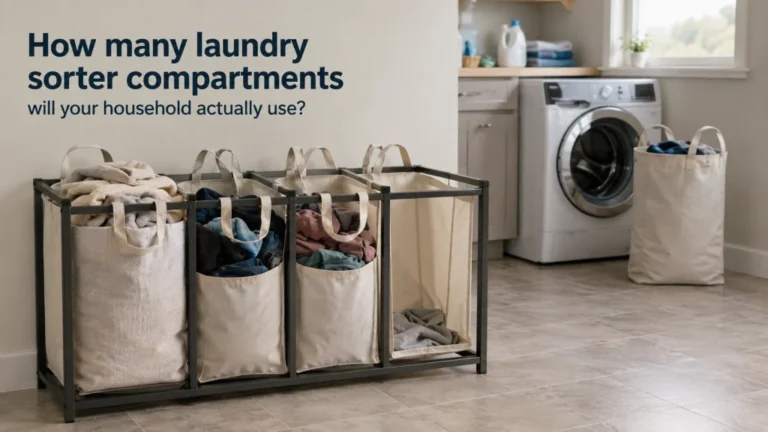
If sorting is already working well elsewhere, do not rebuy that function merely because it comes attached to a rail. The separate laundry sorter decision is better for choosing compartment count around recurring load categories and usable bag capacity. A hanging-bar cart can then stay focused on moving and staging clean laundry. Keeping those jobs separate can also make the cart smaller, lighter, and easier to park.

This rolling sorter uses three removable laundry bags to separate loads on one cart. The chrome cart also includes lockable wheels so the unit can be parked after it is moved. It fits the section's question of whether built-in sorting belongs on the same mobile laundry setup.
Check On AmazonIf you click this link and buy, we earn a commission at no additional cost to you.
Use shelves and hooks only for supplies that travel with the same step
A bottom shelf is useful when it carries items from the same post-wash workflow, such as hangers or folded pieces waiting to move. It is less useful when it becomes permanent storage for unrelated supplies that add weight or block garment clearance. The same rule applies to side hooks: they should solve a repeated task, not collect whatever fits. Every storage feature changes usable space and mobility.
If your real need is a stable place to fold or stage baskets, compare a dedicated laundry folding table rather than expecting a small cart shelf to replace a work surface. A shelf under a hanging rail is usually a storage zone, not proof that the unit can handle folding, ironing, or another load-bearing task. Keep the cart focused on the work that benefits from mobility. That keeps convenience features from turning into permanent clutter attached to wheels.
Compare the integrated rail with a plain cart plus an existing rod
The integrated rail is not automatically the more efficient setup. If a closet rod, wall-mounted rail, or stable garment rack already sits beside the dryer or folding area, a plain rolling laundry cart may handle transport while the existing rod handles clean staging. That avoids paying for a second rail and can lower the cart’s parked height. It can also make the cart easier to move through doorways when no garments are attached to it.
The integrated version is stronger when the hanging point must move with the basket. It also makes sense when there is no convenient temporary rod near the finishing step and adding one is impractical. Compare the setups by the repeated step they remove, not by feature count. If the same hanging job is already solved within arm’s reach, a simpler cart is usually enough.
| Decision point | Plain cart plus existing rod | Cart with integrated hanging bar |
|---|---|---|
| Hanging point already near laundry area | Usually sufficient | May duplicate existing hardware |
| Clean garments must move with the basket | Requires a separate hanging stop | Can keep hanging and transport together |
| Low doorway or cabinet clearance | Often easier to route | Requires full tall-cart measurement |
| Most loads are folded | Usually the simpler fit | Rail may stay mostly unused |
Use the comparison as a no-purchase check for the rail feature. If the existing rod already eliminates the same delay or pile-up, there is little reason to duplicate it on the cart. The goal is fewer repeated steps, not the highest number of built-in functions. It may also park better.

This plain rolling laundry cart uses a 2.8-bushel wire basket without an integrated hanging rail. The steel frame has a chrome finish, four 4-inch casters, and listed dimensions of 26 by 21 by 26 inches. It provides the transport half of the plain-cart-plus-existing-rod setup described in this section.
Check On AmazonIf you click this link and buy, we earn a commission at no additional cost to you.
Use current listings as evidence, not as a ready-made shortlist
Product pages are useful for confirming dimensions, adjustability, caster features, baskets, and shelves. They cannot prove that a hanging rail will improve your routine because they do not know your garment count, parking spot, or existing rods. Current listings show why exact-model verification matters: one household design lists an adjustable height range from 43 to 70.5 inches, while another laundry valet is listed at 74.5 inches tall. Those are different fit problems despite the similar product type.
Use those specifications to eliminate poor fits, then return to the household workflow before buying. Do not infer bar capacity from tube thickness, use one model’s load rating for another, or assume every caster set includes a brake because a competing cart does. Retailer Q&A can reveal the questions buyers keep having, but an unanswered question is still an unknown specification. A reliable shortlist is built from verified dimensions and limits plus your own route, garment count, and parking measurements.

This 136-liter laundry sorter combines three sections with a hanging bar and removable bags. The rolling cart also lists heavy-duty lockable wheels, giving the reader a concrete set of features to verify against room fit and workflow. Its exact model configuration makes it useful for checking listing-specific details instead of assuming every hanging-bar cart is built the same way.
Check On AmazonIf you click this link and buy, we earn a commission at no additional cost to you.
Final thoughts: buy the rail only when clean garments need a mobile place to hang now
A hanging bar is worth adding when several garments from normal loads are routinely hung immediately and the hanging point genuinely needs to move with the cart. Verify usable rail width, garment drop, exact load limits, wheel-lock instructions, and the full tall-cart route before treating the feature as a fit. If most laundry is folded or an existing rod is already beside the work area, the simpler cart is usually the cleaner decision. The rail should remove repeated work, not create a taller object that the room has to work around.
Start with the garment-count test, then measure the parking spot with doors and cabinets open. Keep primary drying needs with a dedicated drying setup, and keep sorting on the same frame only when that combination improves the real load flow. A good laundry cart does not need every possible function. It needs the few functions your household will use often enough to justify their space and complexity.

This metal rolling laundry cart combines a basket, hanging garment rack, lower shelf, and heavy-duty lockable wheels. The hanging height is adjustable, allowing the rail to be configured as part of the mobile garment-staging setup. Its integrated design matches the final decision case where clean garments genuinely need to move with the cart.
Check On AmazonIf you click this link and buy, we earn a commission at no additional cost to you.
FAQs
The most useful questions about a hanging-bar cart come back to fit, garment clearance, and whether the rail replaces a real step. Exact dimensions and load limits can vary widely by model, so the final check still belongs with the current product specifications. The answers below keep the decision at household level rather than assuming every cart has the same structure. Use them to narrow the cart type before comparing individual listings.
Also keep transport and drying as separate jobs in your head. A cart can support limited hanger staging without becoming a full drying rack, and a sorter can share the frame without automatically improving clean-laundry handling. The right combination depends on what happens after the dryer, steamer, or ironing step. If a feature does not change that repeated path, it is probably optional.
🧺 Is a laundry cart with a hanging rack worth it if I fold most clothes?
Usually not unless a smaller group of garments is hung after nearly every load. If the rail is empty most of the time, prioritize cart capacity, mobility, and parking fit instead.
📏 How tall should a hanging-bar laundry cart be?
Tall enough for your longest routinely hung garment to clear the basket or shelf below, but low enough to clear doors, cabinets, and fixtures on the route. Measure the exact cart at the rail setting you plan to use.
👗 Can I hang dresses over the laundry basket?
Only if the hanger-to-basket clearance keeps the garment from touching dirty laundry or the floor. Measure a representative dress on its real hanger before buying.
🌬️ Can the hanging bar replace a clothes drying rack?
Not when primary air-drying capacity is the goal. A cart rail can handle limited hanger-dry items if the exact model permits it, but a drying rack is chosen around usable drying area and spacing.
🛞 Do locking wheels make a laundry cart stable enough for hanging clothes?
They help keep some carts stationary, but they do not override the frame’s load limits, assembly requirements, or need for a level surface. Follow the exact product instructions for locks and loading.
🧴 Is a bottom shelf useful on a hanging-bar cart?
Yes when it stores items used in the same laundry step, such as hangers or folded pieces waiting to move. Skip the feature if it mainly becomes unrelated permanent storage or reduces garment clearance.
References and sources
- Macy’s hanging-bar laundry cart listing: Verifies the listed dimensions and adjustable height range.
- Lowe’s laundry valet listing: Verifies overall dimensions, basket and shelf layout, and hanging-bar questions.
- R&B Wire hanging-rack cart page: Verifies a combined rolling basket and garment-rack design.
- Walmart hanging-bar cart listing: Verifies a tall rail, lower shelf, swivel casters, and two lockable wheels.