A laundry folding table earns its space only when it sits where clean clothes naturally stop and can stay clear enough to use. The right format depends on the route from dryer to put-away, the surface area you actually use, the washer and dryer design, and how much permanent floor space you can spare. Freestanding, fold-down, over-machine, and mobile surfaces each solve a different placement problem. The goal is to choose the surface that removes handling steps without blocking appliance access or becoming permanent storage.
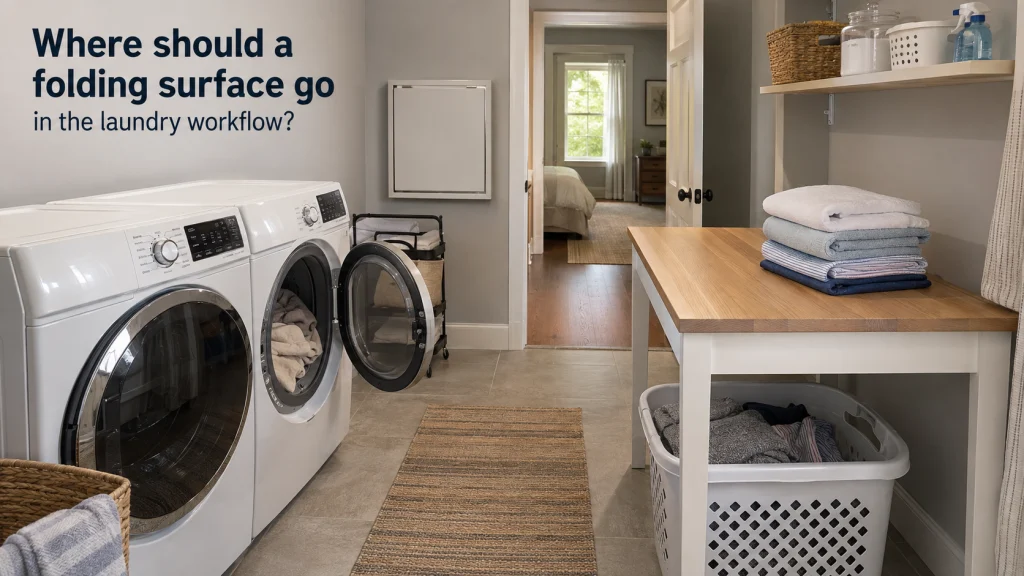
A folding surface only works if it stays available
A laundry folding table can look like an obvious upgrade until it becomes the newest flat place to park detergent, unmatched socks, empty baskets, and whatever else needs a temporary home. That is the first reality check: the table has to be protected as working space, not merely added as furniture. If the surface is usually buried before a load finishes drying, extra square footage does not improve the laundry workflow. Placement and daily availability matter more than owning the largest table that fits against a wall.
The better question is where clean laundry already pauses before it is folded, sorted, hung, or carried away. A useful folding table for laundry should shorten that pause and reduce the number of times a clean load is picked up and moved again. That may point to a fixed table beside the dryer, a wall surface that opens only when needed, a counter over compatible front-load machines, or a mobile top that travels with the load. The rest of the decision comes from protecting appliance access and matching the surface to the route you actually use.

This three-tier metal utility cart gives laundry supplies a separate place so the folding surface can stay clear. Its rolling design makes the supply zone easy to move when the room layout changes. The black finish keeps the recommendation tied to the exact Amazon variant verified for this listing.
Check On AmazonIf you click this link and buy, we earn a commission at no additional cost to you.
Define the job before choosing laundry room furniture
The surface should have one primary job: handling clean laundry after drying. That usually means folding everyday clothes, pairing small items, separating pieces by room or person, and briefly staging stacks before they leave the laundry area. It does not need to solve every storage problem in the room. Once a table is expected to hold bulk supplies, baskets, household tools, and decor at the same time, the actual folding area tends to shrink first.
This distinction also keeps nearby decisions from getting mixed together. If the main problem is the full arrangement of machines, baskets, supplies, and work zones, start with planning the full laundry station before buying another surface. If the need is primarily vertical storage above the machines, that belongs with over-washer and dryer storage, not the folding surface itself. Keeping the jobs separate makes it easier to see whether a new horizontal surface is solving a real bottleneck or simply filling an empty patch of wall.

This two-pack includes two 75-liter laundry baskets with reinforced handles. The hampers are waterproof, freestanding, and collapsible, so they can stage or carry laundry without taking over the folding worktop. The verified variant is the gray 75L x 2 set.
Check On AmazonIf you click this link and buy, we earn a commission at no additional cost to you.
Map where clean clothes leave the dryer and go next
Watch one normal load from the moment the dryer opens. Note where the basket lands, where folding starts, and where finished stacks go next. A smaller surface beside the dryer can beat a larger table across the room because it removes a carry step. In a narrow room, keeping the center walkway open may matter more than maximizing surface area.
Route problems show up only when doors, baskets, and people are included. A table can fit on paper yet block a cabinet door, tighten a loaded-basket turn, or occupy space needed to move an appliance. The surface should sit near the clean-laundry exit without becoming a new obstacle. If every load already leaves the room before folding, a fixed table there may solve nothing.
| Route point | What to watch | What rules out the location |
|---|---|---|
| Dryer exit | Where a clean basket can land immediately after unloading | The basket blocks the dryer door, main walkway, or another appliance |
| Folding stop | Whether the surface is close enough to remove an extra carry step | Every load still has to cross the room before folding starts |
| Put-away path | How finished stacks leave the room | Clean stacks must cross back through the dirty-laundry path or a tight turn |
| Access path | Door swings, washer lids, hookups, and the route needed to move or service the appliances | The surface occupies space that the exact appliance setup needs to stay accessible |
Choose the location before comparing table styles. The useful spot removes a handling step without creating a new obstruction. Test it with doors open and a loaded basket in hand. Then size the surface around what that location can support.

This 25-foot tape measure helps check the dryer exit, basket path, door clearance, and proposed folding location before furniture is added. The blade is self-locking and retractable for repeated room measurements. Fraction markings make it easier to record the dimensions that determine whether the route stays open.
Check On AmazonIf you click this link and buy, we earn a commission at no additional cost to you.
Size the clear work area for a normal load
Do not size the table around the largest pile of laundry your household could possibly produce. Size it around the portion of a normal load that is actually on the surface at one time. Many people fold one item, make a few small stacks, then move those stacks into a basket or directly out of the room. A smaller clear surface can support that routine, while an oversized table may consume space needed for movement or basket parking.
The key measurement is usable surface, not the outside dimensions of the furniture. A deep table may lose working area to a supply bin along the back edge, while a narrower surface kept completely clear may be more productive. Consider the largest items you fold, the number of open stacks, and whether a basket must share the top. There is no universal ideal height or area because comfortable use depends on the user, the room, the load, and the architecture of the surface.
| Surface architecture | What it does well | Main space cost | Best fit |
|---|---|---|---|
| Freestanding fixed table | Keeps a dedicated surface ready all the time | Permanent floor footprint | Rooms with enough circulation space and a reliable folding location |
| Wall-mounted fold-down surface | Returns floor and walkway space when closed | Requires a suitable wall and product-specific installation | Small rooms where folding space is needed only during a load |
| Over-machine surface | Uses the area above compatible front-load machines | Can interfere with controls, access, clearance, or service if poorly planned | Side-by-side front-load layouts that explicitly support the installation |
| Mobile cart or workstation top | Moves with the load and can combine transport with folding | Needs a parking place when not in use | Homes where folding happens in more than one location |
Every architecture trades one convenience for another. A fixed surface gives up floor space. A fold-away or mobile surface adds setup or parking needs. Choose only after the route and usable area are known.

This 33-foot self-locking tape measure helps size the clear work area around a normal laundry load instead of relying on furniture outside dimensions alone. It includes inch and metric scales for checking usable width and depth. The verified black-and-yellow variant also includes a belt clip.
Check On AmazonIf you click this link and buy, we earn a commission at no additional cost to you.
Choose a freestanding table when the floor space can stay committed
A freestanding table stays ready for every load and does not depend on a wall mechanism. It can also leave useful basket space underneath. The trade-off is permanent footprint between loads. That exchange works only when the table does not narrow the aisle or occupy needed appliance-access space.
Before buying, mark the proposed footprint and use the room normally. Open both machines, carry a loaded basket past the spot, and check the tightest turn. This is more revealing than judging an empty room. A fixed table fits best when that location is already the natural clean-laundry stop.
A stable dedicated surface reduces setup
Nothing has to be unfolded or rolled into place before use. That favors households that fold most loads immediately beside the dryer. A stable surface also handles baskets, stacks, and larger linens without extra setup. The advantage disappears if supplies permanently take over the top.
Permanent floor space is the real cost
Storage underneath can make the footprint more useful, but it does not restore circulation space. Table legs and stored baskets still occupy the same path when the room is busy. If the only location is a narrow passage, a fold-away or mobile surface may fit better. Choose fixed furniture for constant availability, not for appearance alone.

The Lifetime four-foot adjustable utility table is designed as a flexible work surface for crafts, events, temporary desks, and household projects. Adjustable height settings can help accommodate different activities, while a folding leg design makes the table easier to store between uses. Its durable top is suited to common indoor and outdoor utility tasks when used within the manufacturer weight guidance. Unlike the original fold-in-half table, this replacement may fold at the legs rather than through the center of the tabletop. Check folded dimensions before choosing it for travel or tight storage.
Check On AmazonIf you click this link and buy, we earn a commission at no additional cost to you.
Choose a wall-mounted fold-down surface when the walkway matters more
A wall-mounted fold-down table gives up instant availability to reclaim floor space between loads. It suits narrow rooms where a permanent table would obstruct normal movement. Compare the open depth, closed projection, wall location, and nearby doors before treating it as space saving. The benefit exists only if closing the surface truly frees the room.
Installation makes this more than a furniture decision. Wall construction, mounting hardware, rated load, and nearby utilities are product and site specific. Exact anchoring and support requirements belong to the product instructions and the actual wall conditions. If the location is not straightforward, professional help or another surface type may be the better plan.
Floor space returns when the surface is closed
The fold-away advantage matters most when the open surface enters a walking path. A short folding session does not require that depth for the rest of the day. Check the room with the table both open and closed because each state creates a different fit problem. The closed state should noticeably improve circulation.
| Surface state | Space it occupies | What to test in the room |
|---|---|---|
| Fixed table | The full footprint remains committed between loads | Normal walking, basket carrying, doors, and appliance access with the table always present |
| Fold-down surface open | The working depth enters the room only during folding | Whether the open surface leaves enough room to stand, unload, fold, and pass safely |
| Fold-down surface closed | Only the folded projection and hardware remain in the room | Whether closing it meaningfully restores the walkway and keeps nearby doors usable |
The real question is whether the room gains useful circulation when folding ends. A closed unit that still conflicts with baskets or doors has little practical advantage. Check the closed projection in the same traffic path used during laundry. If it still creates a pinch point, mobile or no added surface may fit better.
Wall support and installation remain product specific
Similar-looking fold-down tables can require different mounting methods and support conditions. The exact product instructions control the hardware, rated use, and installation requirements. Laundry walls can also contain plumbing, electrical lines, or venting, so guessing what is behind the surface is not a safe shortcut. The buying decision is whether this format fits well enough to justify that installation work.

This 30-by-20-inch wall-mounted table folds down to create a work surface without keeping a full table footprint in the walkway. The verified variant has a white top and white frame. Its fold-down format matches a laundry room where floor space should return after the folding session ends.
Check On AmazonIf you click this link and buy, we earn a commission at no additional cost to you.
Use an over-machine surface only when the appliances allow it
The top of side-by-side front-load machines can look like unused space, and some documented installations allow an under-counter arrangement. That proves the concept can work for particular models, not that every pair can support a folding surface. Controls, ventilation, hookups, service access, and installation instructions still matter. The exact appliance documentation controls the decision.
A surface that traps a control panel, blocks a dispenser, or makes service access harder is not a successful use of space. Check both appliance manuals before treating the machine tops as a permanent foundation. The same caution applies when a countertop support system has its own installation requirements. If the intended arrangement is not supported, keep the folding surface separate.
Front-load machines can create usable top area
Front-load doors move loading to the front, so the area above may remain usable. That can avoid a separate table and keep folding close to the dryer. The idea is most attractive where floor space is limited but side-by-side width is available. Compatibility still comes from exact model documentation.
Top-load lids can eliminate the concept
A top-load washer needs open space above the machine for the lid and normal loading. Manufacturer planning guidance specifically calls for overhead clearance, while exact requirements vary by model. A permanent surface directly above the washer is therefore a poor default. A surface beside the machine or on another wall is usually more realistic.
| Machine layout | Over-machine folding surface | What must be verified |
|---|---|---|
| Side-by-side front-load pair | Potentially workable on compatible installations | Exact installation instructions, controls, dispensers, ventilation, hookups, surface support, and service access |
| Top-load washer | Usually a poor default directly above the washer | Full lid opening, loading access, controls, overhead space, and the exact model requirements |
| Mixed or unusual installation | Do not assume compatibility from appearance alone | Both appliance manuals and any documentation for the intended surface or support system |
Use the table as a screening tool, not permission to cover an appliance. If controls, openings, connections, ventilation, or service access are compromised, move the folding surface elsewhere. A tidy layout is not useful if it makes the machines harder to own. Exact documentation has the final say.
Keep vertical storage as a separate decision
A horizontal folding surface and vertical storage solve different problems. Shelves, racks, and upper cabinets need separate checks around doors, lids, controls, reach, and machine access. If storage is the real need, use the separate discussion of storage above washers and dryers. Keeping the decisions separate prevents one surface from being asked to solve both jobs.
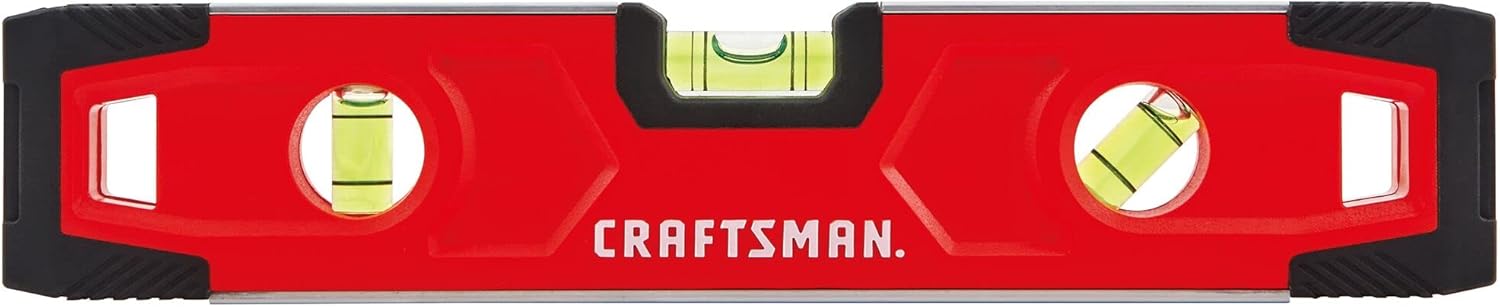
This 9-inch magnetic torpedo level is useful when an over-machine work surface is being planned and the appliance area must stay properly aligned. Its compact length is practical for checking a short countertop or support area. The magnetic design is part of the verified CMHT43191 variant.
Check On AmazonIf you click this link and buy, we earn a commission at no additional cost to you.
Choose a mobile worktop when folding needs to move with the load
A mobile cart or workstation top makes sense when the clean-laundry route changes from load to load. It can collect items at the dryer, provide a temporary surface, then move closer to the put-away destination. A fixed table asks every load to come to one work zone instead. Mobility wins when transport causes more friction than the lack of permanent folding space.
The cart still needs a parking place. Wheels do not erase the footprint, and a cart left in front of a machine can obstruct the room just like fixed furniture. Measure loaded width, turning path, and storage location before judging the folding top. If transport is the priority, a rolling laundry cart may be the better starting point.
Key point: Choose mobility because the load needs to travel, not because wheels automatically make a small room easier to use.
Some garments leave the dryer and go straight onto hangers. A laundry cart with a hanging bar can support that route. Keep hanging capacity separate from the folding-surface decision. The purchase should still remove a repeated step.

This three-section rolling laundry sorter combines load transport with a folding-station top. The Chrome and Gray variant lets clean laundry move with the workstation instead of forcing every load to one fixed table. Because the top is also marketed as an ironing-board surface, pressing should still be treated as a separate task under the product and appliance instructions.
Check On AmazonIf you click this link and buy, we earn a commission at no additional cost to you.
Keep folding and ironing as separate surface decisions
Some laundry furniture is marketed as a folding and ironing station, but those jobs have different requirements. Folding needs a clean, open area for garments, baskets, and finished stacks without asking much from the surface beyond stability and cleanliness. Pressing adds heat, steam, appliance stability, cover materials, and the operating conditions required by the iron or steamer. A convenient folding table should not automatically be treated as a suitable pressing surface just because the product description uses both words.
If ironing is a regular task, compare ironing boards and pressing surfaces by their own requirements. That keeps this decision focused on clean-laundry handling instead of turning one table into a universal workstation. It also prevents a marketing label from overriding surface materials, heat limits, or the appliance instructions that govern safe use. A surface can be excellent for folding and still be the wrong place for repeated heat or steam, so verify the pressing setup separately.

This ironing board provides a dedicated 51-by-19-inch pressing surface instead of asking the laundry folding table to handle heat and steam. The verified model has an aluminum build, an iron rest, adjustable height, and a foldable frame. Keeping this equipment separate preserves the distinction between garment folding and pressing.
Check On AmazonIf you click this link and buy, we earn a commission at no additional cost to you.
Protect the clean worktop from permanent supply storage
A folding surface can fail for a very ordinary reason: everything else starts living on it. Detergent, stain products, hangers, and empty baskets slowly claim the clear area until folding moves elsewhere. That does not necessarily mean the table is too small. It usually means active workspace has become long-term storage.
Give supplies another defined home and reset the surface after the load leaves. It should stay clean for finished garments, open for the next load, and easy to wipe when lint or residue appears. Keep leaking bottles and dirty tools away from clean clothing. If storage is the bigger problem, storage and utility systems for household equipment can frame that broader decision without sacrificing the folding zone.
- Keep the front and center of the worktop free for active folding.
- Move detergent and treatment products to a separate shelf, cabinet, or designated container when possible.
- Wipe the surface when lint, dust, or product residue could transfer to clean fabric.
- Return empty baskets to their parking place instead of storing them permanently on the table.
A protected surface does more work than a larger one that is rarely available. Reset it when the current load leaves, and return supplies and baskets to their own places. That habit preserves the reason the surface was added in the first place. Storage discipline is part of the buying decision, not an afterthought.

This stackable two-tier organizer gives laundry supplies a defined storage location away from the clean folding surface. Its sliding basket-drawer design keeps small items contained while preserving the worktop for active folding. The verified Amazon variant has a chrome finish.
Check On AmazonIf you click this link and buy, we earn a commission at no additional cost to you.
Match the architecture to the bottleneck you actually have
Choose a fixed table when permanent floor space is available and most folding happens beside the dryer. Choose a fold-down surface when the work area is useful but a permanent footprint would hurt circulation. Choose an over-machine surface only when the exact appliances and installation support it. Choose mobile when the load needs to travel and the cart has a practical parking place.
The no-purchase option belongs in the comparison too. If clean laundry already goes directly to another room and the routine works, extra furniture may not reduce any work. A dedicated surface earns its space when it removes handling or protects a useful work zone. The right architecture fixes that friction without creating a new obstacle.
| If this is the recurring problem | Start with this architecture | Verify before buying |
|---|---|---|
| Folding happens beside the dryer and floor space is generous | Freestanding fixed table | Walkway width, door movement, appliance access, and a clear permanent location |
| A table is needed only during folding | Wall-mounted fold-down surface | Open and closed projection, exact mounting requirements, wall suitability, and nearby utilities |
| Front-load machines occupy the only practical work zone | Over-machine surface | Exact appliance manual, controls, dispensers, ventilation, clearances, and service access |
| The load moves to different rooms before put-away | Mobile cart or workstation top | Loaded width, turning path, worktop size, wheel behavior, and parking location |
| Current routine already works without repeated handling | No new surface | Whether a purchase would remove a real step rather than simply add furniture |
Use that final column as the shopping list. Do not stop at the visible surface. Check the room, appliance geometry, movement path, and storage behavior. Those conditions decide whether the purchase remains useful after installation.

A 165-foot green-beam laser distance measure designed for fast indoor and jobsite measurements. The bright green laser improves visibility compared with standard red beams, while the color display keeps readings easy to check. It supports straightforward distance measuring in a compact handheld format and provides a longer working range than the Bosch GLM100-23 it replaces.
Check On AmazonIf you click this link and buy, we earn a commission at no additional cost to you.
Final Thoughts: place the surface at the clean-laundry bottleneck
The strongest placement is usually where clean clothes already stop, not wherever an extra table happens to fit. Start with the dryer exit, the basket path, the usable work area, and the machine access that must remain open. Then choose the architecture that solves that route with the smallest ongoing space penalty. A smaller surface in the right location can be more useful than a large permanent table that interrupts the room.
Before buying, test the location with real doors, baskets, and normal movement, then verify the exact appliance and mounting documentation that applies to the setup. Keep the folding surface separate from vertical storage and pressing decisions unless those jobs genuinely need to share the same equipment. Most importantly, protect the final worktop from becoming permanent storage. The value comes from removing a repeated handling step without adding a space or access problem.

This 16-foot retractable tape measure is useful for the final location check with washer and dryer doors open and a basket moving through the route. It includes both metric and SAE measurements for checking clearances around the proposed folding surface. The verified Amazon variant is turquoise and measures up to 192 inches.
Check On AmazonIf you click this link and buy, we earn a commission at no additional cost to you.
FAQs
📍 Where should a laundry folding table go?
Put it as close as practical to where clean clothes leave the dryer without blocking the walkway or appliance access. The best location is the one that removes a carry step and still stays clear enough to use.
🧺 How much folding surface do I really need?
Size the clear area around a normal load and the number of stacks you keep open at one time. Do not use outside furniture dimensions as a substitute for the work area that will remain clear in daily use.
🚪 Can I put a folding counter over a top-load washer?
A permanent counter above a top-loader often conflicts with lid clearance and normal loading access. Check the exact washer documentation before planning anything above the machine, because required overhead space varies by model.
🧱 Is a wall-mounted fold-down table better for a small laundry room?
It can be when a permanent table would narrow the walkway. Compare both the open working depth and the closed projection, then follow the exact product instructions for wall support and installation.
🛞 When does a mobile folding cart make more sense?
Choose mobility when clean laundry regularly moves to different rooms before folding or put-away. The cart still needs a parking place and a loaded route wide enough to move without becoming another obstacle.
References and Sources
- GE front-load washer specifications: provides a manufacturer example of a front-load washer documented for under-counter installation.
- Whirlpool laundry room sizing guidance: supports checking door movement, top-load lid clearance, walkways, and model-specific installation measurements.