Food processor wattage is useful as a published power specification, but it is not a direct score for chopping quality, dough ability, durability, or overall performance. Higher wattage becomes more meaningful when the workload is demanding and the machines being compared are otherwise similar, yet bowl size, drive design, blade system, stability, and operating limits still change the result. The practical way to shop is to keep wattage on the evidence sheet, then give more weight to exact task testing and manufacturer guidance for the work you actually plan to do. That approach prevents both underbuying for heavy jobs and overpaying for a large number that does not improve your routine.
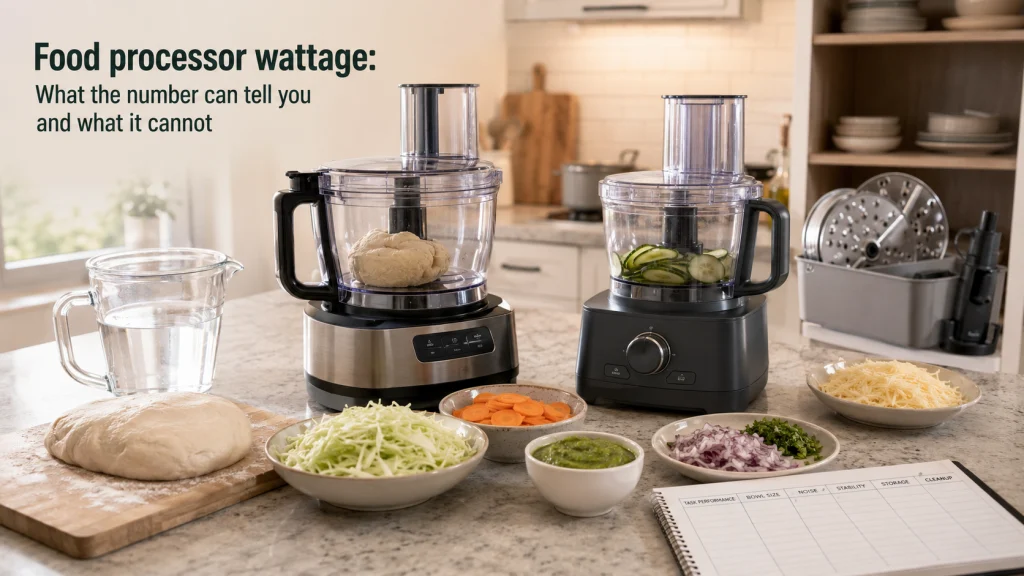
Why wattage advice conflicts so much
Food processor wattage looks like the easiest specification to compare, which is exactly why buying advice often turns it into a shortcut. One page may tell you that a moderate figure is enough for everyday prep, while another pushes a much higher number for hard vegetables, large batches, or dough. The disagreement does not automatically mean one source is careless. It often means different workloads, processor sizes, and definitions of “enough” are being compressed into one number that cannot carry all of those decisions by itself.
The better question is not whether higher wattage is good or bad, but what the published number can actually establish for the machine in front of you. Independent testing is especially useful here because current lab results include strong performers across a broad wattage range, while manufacturer guidance tends to connect higher power with particular heavier workloads. Those two forms of evidence are not interchangeable, and they should not be treated as if they answer the same question. This article stays at buyer level, so it does not convert watts into torque, diagnose motors, estimate internal electrical behavior, or replace the exact operating limits in a processor’s manual.

The Ninja BN601 pairs a 9-cup bowl with a 1000-peak-watt motor and four Auto-iQ programs. It includes a chopping blade, dough blade, and reversible slicing and shredding disc. Those task-specific tools make it useful for checking whether a large headline power figure translates into evidence for the jobs a buyer actually plans to run.
Check On AmazonIf you click this link and buy, we earn a commission at no additional cost to you.
What a wattage number actually tells you
A watt is a unit of power, and a food processor’s published wattage gives you one traceable specification to record when comparing candidates. That makes the number more useful than vague labels such as “high power” or “professional strength,” because you can verify it on a manufacturer page, specification sheet, or manual. It can also provide useful context when a brand offers related machines built around similar bowl sizes and architecture. What it does not do is tell you how much useful cutting performance reaches the food under every load.
That distinction matters because the bowl, blade or disc, drive system, speed control, load size, ingredient resistance, and protection limits all sit between a published power figure and the result on the cutting board. A machine can list a larger number and still deliver uneven chopping, awkward shredding, excessive movement, or poor small-batch control. A lower-numbered machine can also perform a particular task very well if the rest of the system is suited to that job. Treat the specification as context, not as a substitute for evidence about the task you care about.
| Wattage can help establish | Wattage does not prove by itself |
|---|---|
| A published power specification for the exact machine | Uniform chopping or slicing quality |
| One point of comparison among closely related designs | Motor torque at the blade under a particular load |
| Useful context for heavier or longer workloads | Durability, lifespan, or resistance to failure |
| A reason to investigate workload guidance more closely | That a machine is automatically better for every household |
Record the wattage as one verified field, then compare the rest of the machine under the tasks you actually care about. A numerical advantage only becomes useful when the workload evidence shows a practical advantage too. This keeps the specification useful without asking it to predict outcomes it was never designed to prove. It also gives you a cleaner basis for deciding whether extra capability is worth paying for.
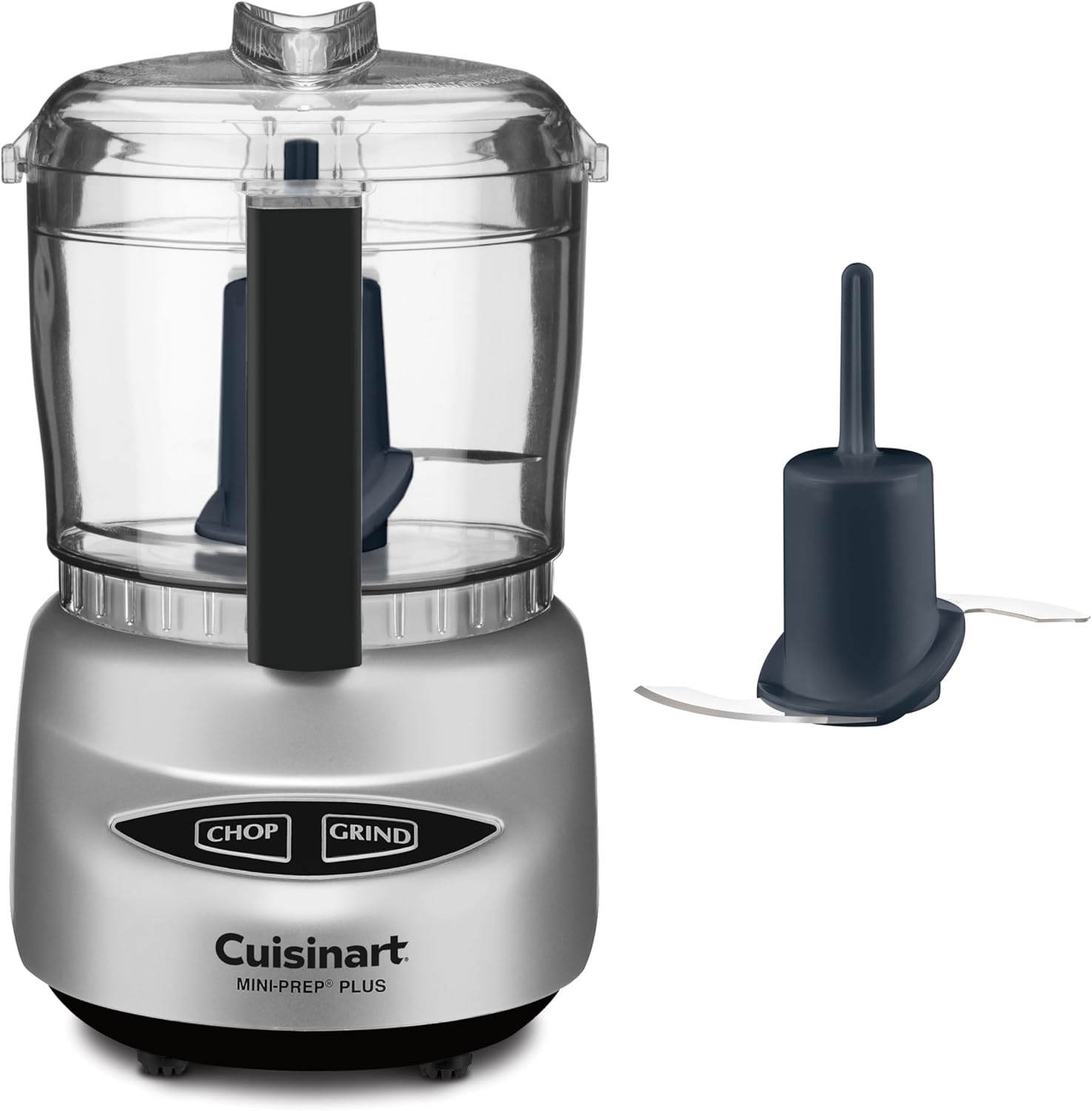
The Cuisinart DLC-2ABC pairs a 24-ounce work bowl with a 250-watt motor for small prep jobs. Its reversible SmartPower blade supports both chopping and grinding. The compact 5 by 7 by 9.25-inch body adds a clear storage and capacity reference alongside the published wattage.
Check On AmazonIf you click this link and buy, we earn a commission at no additional cost to you.
Why size, design, and workload change the comparison
Processor size is one reason a straight watt-to-watt comparison can mislead. A larger bowl is normally expected to accept larger batches, and a machine built for those batches may also be physically heavier, use different gearing or controls, and carry a higher published power figure. Good Housekeeping’s independent testing makes this problem visible: its top performers span a wide wattage range, and its buying advice cautions that wattage is hard to compare in isolation because processor size and weight differ. In other words, the number may partly describe the class of machine rather than cleanly rank the quality of its work.
Workload changes the picture again because chopping an onion, shredding cheese, pureeing a dip, and mixing dense dough do not challenge a processor in the same way. A household that mainly slices vegetables and makes occasional sauces should not inherit the power requirement of someone repeatedly working with large, resistant batches. Bowl capacity also needs its own check, since a larger nominal bowl does not guarantee that every task can use the full stated volume. If you are still deciding what size and feature set fits your routine, the broader food processor guide is the better place to settle those requirements before wattage becomes a deciding field.

The Hamilton Beach 70730 uses a 10-cup bowl and 450-watt motor with two speeds. It includes a bowl scraper and supports slicing, shredding, mincing, and pureeing. Its 8.5 by 10 by 16-inch dimensions give a concrete size reference when comparing capacity, wattage, and storage needs.
Check On AmazonIf you click this link and buy, we earn a commission at no additional cost to you.
When wattage is still useful context
Wattage becomes more informative when the comparison is narrow rather than broad. If two candidates come from a similar size class, use a similar work-bowl layout, and are intended for the same jobs, the published power figure can help identify which one deserves a closer look for demanding loads. The value comes from holding the other variables reasonably steady instead of comparing machines from different size classes and letting the larger number win by default. It is a screening signal, not the result.
Food processor power also matters more when your routine repeatedly pushes beyond short, light prep. Dense mixtures, larger batches, and longer processing sessions give you a reason to care about manufacturer limits and independent signs of strain, slowdown, movement, or uneven results. By contrast, light everyday prep may never use the extra headroom attached to a higher figure. The workload should create the reason to pay more, not the specification by itself.
- Compare wattage only after matching the candidates by approximate size and intended workload.
- Check the exact manual or manufacturer guidance for batch and dough limits when those jobs matter.
- Look for independent task results that show what happened under chopping, slicing, shredding, pureeing, and mixing loads.
- Consider stability, noise, cleanup, dimensions, and storage before paying for extra power you may rarely use.
Imagine two full-size processors with similar bowl capacity and intended workload. One lists higher wattage, but independent slicing and shredding tests show no meaningful advantage, while both handle your normal batch comfortably. In that comparison, the larger number has not earned extra weight in the decision. If the heavier-load tests instead show less slowdown or more consistent results, the power difference becomes relevant because the task evidence explains what it changes.

The Hamilton Beach 70725A combines a 12-cup bowl with a 450-watt motor and two speeds. Its Stack and Snap design simplifies bowl and lid assembly for a full-size processor. Stainless steel blades make it a useful example for comparing capacity, design, and power within a similar workload class.
Check On AmazonIf you click this link and buy, we earn a commission at no additional cost to you.
Put task testing ahead of the headline number
Independent testing is the strongest counterweight to spec-sheet shopping because it shows what a machine actually did under defined tasks. Good testing separates chopping from slicing, shredding, pureeing, mixing, noise, cleaning, and ease of use instead of rolling everything into a claim about a “powerful motor.” Consumer Reports, for example, evaluates food processors on several food-prep tasks and also assesses noise, while TechGearLab publishes task-by-task scores and observations across chopping, mixing, pureeing, shredding, slicing, and cleaning. That separation matters because a machine can be strong at one job and merely average at another. Those results answer questions that the wattage field cannot answer on its own.
The test conditions still matter, so do not reduce independent evidence to another badge. A result is most useful when you can see the task, load, measurement, or scoring method clearly enough to relate it to your kitchen. If dense dough matters to you, a strong puree score is not a substitute; if even slicing is the priority, motor wattage is less useful than evidence from the slicing disc under real produce. The goal is to match evidence to the job instead of collecting the largest specifications.
| Evidence type | What it is good for | What to avoid assuming |
|---|---|---|
| Exact manufacturer specification | Confirming published wattage, bowl size, included tools, and stated operating limits | That the specification proves comparative performance |
| Manufacturer workload guidance | Understanding what the brand says a machine or power level is intended to handle | That the guidance becomes a universal category rule |
| Independent task testing | Comparing results under chopping, slicing, shredding, pureeing, mixing, noise, or cleanup tests | That one task score predicts every other task |
| Your own requirement sheet | Deciding which evidence matters for your batch size, storage, cleanup tolerance, and routine | That a higher specification is automatically useful to you |
Specifications tell you what is published, manufacturer guidance defines intended use or limits, and independent testing checks outcomes. Your own routine decides which of those outcomes deserves the most weight. Keeping those roles separate makes conflicting advice much easier to sort. It also prevents a manufacturer claim or a single test result from being stretched beyond what it actually establishes.
Treat dough as a separate workload
Dough is the case most likely to make shoppers ask how many watts should a food processor have, because a dense mixture can load the machine more heavily than ordinary chopping or slicing. That does not create a safe universal cutoff. Cuisinart’s own buying guidance connects higher motor power with harder ingredients and dense dough, but that guidance is still a manufacturer’s framing of workload, not proof that every processor below a particular number will fail. The exact machine’s dough instructions, batch limit, blade or tool, and operating guidance remain more important than a category-wide rule copied from a buying page.
Independent evidence helps separate a reasonable concern from an invented threshold. TechGearLab reports that dough and other demanding mixing tasks can expose strain in some lower-powered machines, while larger motors in its test group generally showed fewer signs of load under the toughest work. That is useful evidence that power headroom can matter for this workload, but the same testing also shows that performance varies across tasks and designs. If dough is the main reason you are buying the appliance, compare exact dough performance first, then use our stand mixer vs. food processor comparison to decide whether a food processor is even the right appliance class for your routine.

The Cuisinart DFP-14BCNY combines a 14-cup work bowl with a 720-watt motor. Its processing tools support mincing, shredding, pureeing, and kneading dough, so dough can be treated as a distinct workload rather than inferred from watts alone. The large work bowl also keeps batch size visible as a separate comparison field.
Check On AmazonIf you click this link and buy, we earn a commission at no additional cost to you.
Separate manufacturer guidance from independent evidence
Manufacturer guidance is valuable when it stays attached to the manufacturer’s own products and intended workloads. A brand may explain that harder foods, dense dough, or larger full-size machines call for more motor power, and that can tell you how the company positions its range. The mistake is to lift that statement out of context and turn it into a rule for every processor from every brand. Different machines can use different bowl sizes, control strategies, blade systems, drive designs, and published rating conventions, so the manufacturer claim needs a label in your notes rather than a promotion to universal fact.
Independent comparative testing serves a different purpose because it can reveal whether the expected advantage appears in actual processing tasks. Good Housekeeping explicitly notes that its top-performing processors occupy a broad wattage span and warns that wattage alone is difficult to compare, while TechGearLab’s task results show that higher power can help under some heavy loads without making wattage a complete ranking system. Those findings are not contradictory. Together they support a better rule: use manufacturer guidance to understand intended workload, then use independent tests to see whether the machine performs well at the exact job you care about.
Build a candidate evidence sheet before comparing models
A short evidence sheet prevents the wattage column from taking over simply because it is easy to scan. Start with the work you actually repeat, then place published power beside capacity, measured or tested task performance, stability, noise, dimensions, cleanup, and exact manual limits. This also exposes missing evidence quickly. If one candidate has a large wattage number but no trustworthy dough test, while another has documented dough performance and clear batch guidance, the second machine gives you more decision-relevant information even before you decide which one is better.
The same sheet helps control overbuying. A processor that performs your normal chopping and shredding work well, fits your cabinet, and is easy to clean may be the stronger household choice even if another machine carries a larger power figure. Conversely, repeated heavy batches can justify putting more weight on motor headroom and workload evidence than a light-use household would. The point is not to ignore watts, but to force that number to compete with the specifications and test results that change everyday use.
| Field to record | What to verify | Why it changes the decision |
|---|---|---|
| Published wattage | Exact manufacturer specification for the candidate | Provides power context without pretending to prove output quality |
| Usable task capacity | Bowl size plus any task-specific or dough limits | Shows whether the machine can handle your normal batch |
| Task evidence | Chopping, slicing, shredding, pureeing, or mixing result that matches your priorities | Measures the outcome you are actually buying |
| Stability and noise | Independent observations or measurements under load | Affects whether frequent use is comfortable and controlled |
| Dimensions and storage | Base footprint, height, accessory storage, and your available space | Prevents a capable machine from becoming inconvenient to keep and use |
| Cleanup and controls | Part count, assembly, cleaning method, pulse or speed control | Determines how much work the machine adds after prep |
Once this sheet is complete, missing evidence becomes easier to see. A candidate with an impressive power figure but weak documentation for the workload that matters can be set aside until that workload is verified. That is more useful than filling an evidence gap with an assumption about motor size. The sheet turns uncertainty into a specific verification task instead of a reason to guess.

The KitchenAid KFC3516IC has a 3.5-cup work bowl, 240-watt motor, and two speeds plus pulse. Its locking stainless steel multipurpose blade can chop or puree, and the bowl is dishwasher safe. The compact 5.95 by 7 by 8.74-inch body adds storage, capacity, control, and cleanup fields to a candidate evidence sheet.
Check On AmazonIf you click this link and buy, we earn a commission at no additional cost to you.
Why a universal minimum watt rule is the wrong shortcut
A universal rule such as “every household needs at least X watts” assumes that households process the same foods, in similar batch sizes, with comparable machine designs. Those conditions do not hold reliably across the category. Independently tested high performers span a broad wattage range, so a single cutoff is weak evidence for overall quality. A threshold is more defensible only when a primary source attaches it to an exact machine family or workload.
This is also where first-time buyers can spend more than their routine justifies. A higher figure can sound like insurance against regret, yet it may come with a different size class, more weight, a larger footprint, or a higher price. Moderate chopping, slicing, and shredding jobs should be judged by verified results for those tasks. Repeated heavy work deserves a closer look at power headroom, but only alongside the workload evidence and ownership trade-offs that come with it.

The BLACK+DECKER HC150B uses a 1.5-cup bowl and 150-watt motor for very small prep jobs. One-touch pulse control drives its stay-sharp blade without the controls of a full-size processor. Dishwasher-safe removable parts make it a concrete example of why a lower wattage can belong to a smaller, lighter workload rather than define category quality.
Check On AmazonIf you click this link and buy, we earn a commission at no additional cost to you.
Where to go next when wattage is not the deciding factor
Once you stop using watts as a quality score, the rest of the buying decision becomes clearer. Bowl size should match realistic batches, attachments should match the prep jobs you repeat, controls should give you the level of precision you need, and the machine still has to fit the counter or cabinet where it will live. Cleanup matters because a processor that saves a few minutes during prep can lose that advantage if assembly and washing make you avoid using it. Those are ordinary household constraints, but they often separate a useful machine from one that looked impressive only on the specification sheet.
If you have already defined those requirements and are ready to compare current options, our current food processor comparisons are the appropriate next step rather than trying to rank models here by wattage. For a broader check on whether this appliance type fits your kitchen at all, return to the small kitchen appliance decision overview. Keeping those decisions separate protects the purpose of this page: interpret the power number accurately, then move the purchase decision to the evidence that actually matches your workload. That is a much stronger way to shop than treating the biggest wattage figure as the safest choice.

The Cuisinart Pro Custom 11 uses an 11-cup work bowl and includes slicing and shredding discs for full-size prep. Its stainless steel chopping setup supports several distinct food-processing tasks. Dishwasher-safe removable parts add cleanup and included tools to the model comparison instead of reducing the choice to wattage alone.
Check On AmazonIf you click this link and buy, we earn a commission at no additional cost to you.
Final thoughts: keep wattage in context
Wattage belongs on a food processor comparison sheet, especially when heavier workloads or closely matched machines make power differences worth investigating. It does not replace task results, exact manufacturer guidance, capacity checks, or the practical constraints of your own kitchen. Those fields tell you whether the machine actually fits the work you plan to give it. Keep the power figure as supporting evidence rather than the headline verdict.
Before buying, write down your normal batch size and the two or three tasks that matter most, then check how each candidate performs at those jobs. If a higher-powered machine does not improve the work you repeat, fit your space, or reduce meaningful friction, the extra capability may not justify its trade-offs. A smaller or simpler option can be the better buy when the evidence says it already covers the job. That is the point where the specification has done its job without being asked to do more than it can prove.

The Hamilton Beach 72850 uses a 3-cup bowl and 350-watt motor for small-batch chopping. Its stack-and-press design operates by pressing the lid, while stainless steel blades handle dicing, mincing, and pureeing. Dishwasher-safe removable parts keep the comparison focused on light-prep fit as well as the motor specification.
Check On AmazonIf you click this link and buy, we earn a commission at no additional cost to you.
Frequently asked questions
⚡ Does higher wattage mean a better food processor?
No. Higher wattage can provide useful context for demanding loads, but overall performance still depends on processor size, design, controls, blades or discs, stability, and the exact task.
🥕 Is a lower-watt processor enough for chopping and shredding?
It can be, if independent task results show good performance at the batch sizes you use. Compare chopping and shredding evidence directly instead of assuming a lower wattage is automatically inadequate.
🍞 Should I choose a higher wattage if I make dough?
Dough is a heavier workload, so power headroom deserves more attention. Still, use the exact machine’s dough limit, manufacturer instructions, and independent dough testing rather than a universal minimum-watt rule.
📏 Does a larger food processor need more watts?
Larger machines often publish higher power figures, but size and wattage do not move in a perfectly comparable way across designs. Match bowl capacity to your batch first, then compare power and task evidence within a similar size class.
🧾 What should I compare besides wattage?
Compare usable capacity, results for your priority tasks, stability, noise, dimensions, storage, controls, cleanup, included tools, and exact operating limits. Those fields usually explain household fit better than wattage alone.
References and sources
- NIST watt definition: Supports the buyer-level explanation that the watt is a unit of power.
- Cuisinart food processor guidance: Provides a manufacturer example linking motor power with workload while showing why brand guidance should stay in context.
- Good Housekeeping food processor testing: Supports the point that strong performers span a wide wattage range and that wattage is difficult to compare in isolation.
- TechGearLab food processor testing: Provides task-by-task performance, noise, capacity, and motor data used to compare specification claims with observed results.
- Consumer Reports buying guide: Supports the use of independent chopping, slicing, shredding, grating, and noise tests instead of relying on one specification.