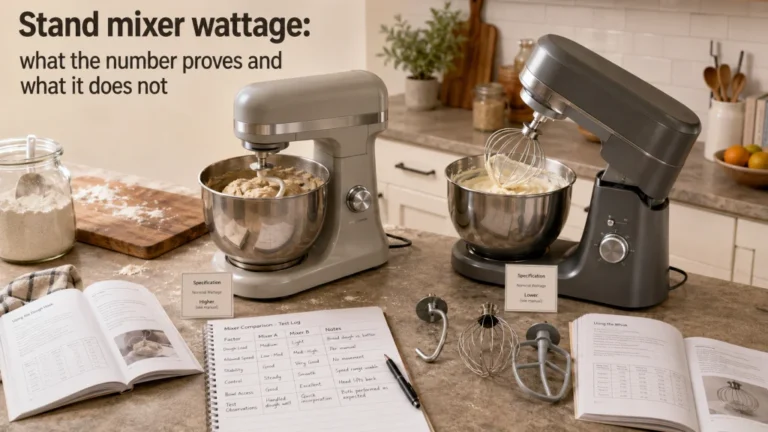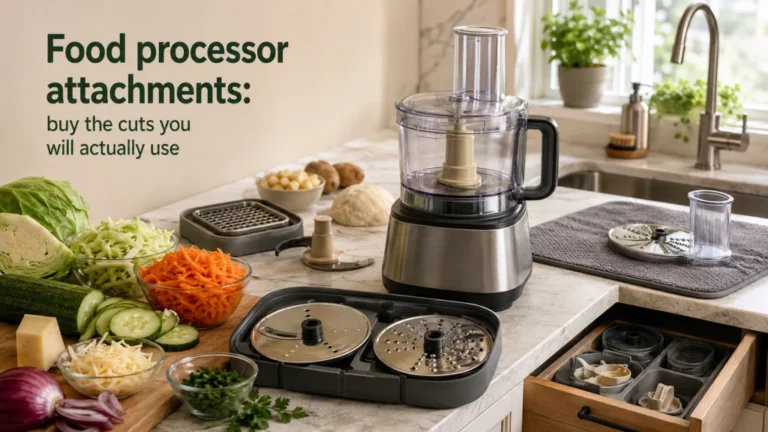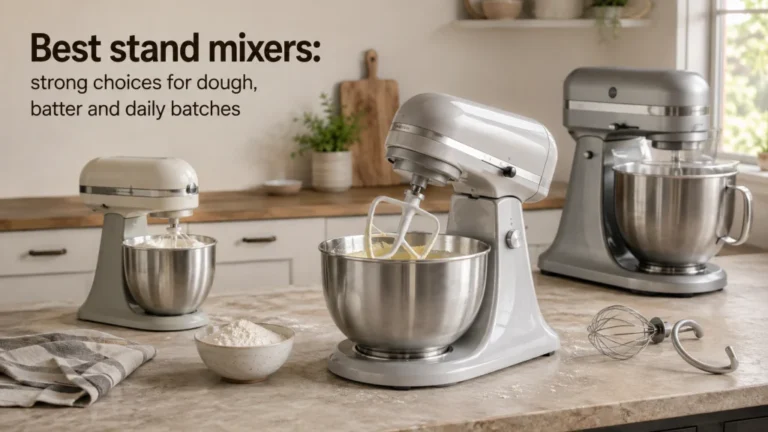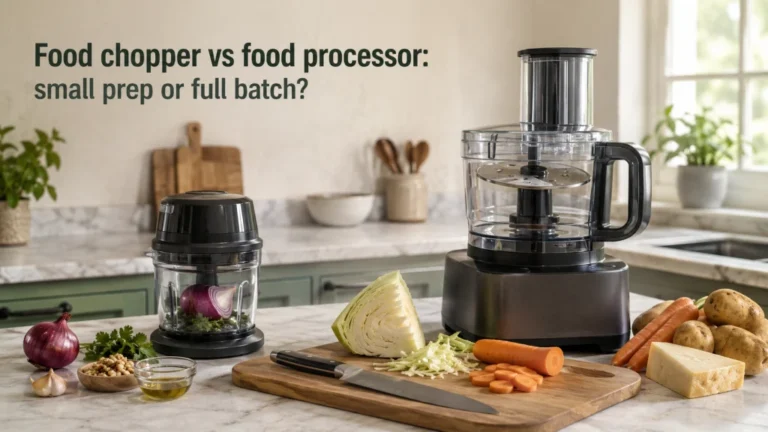
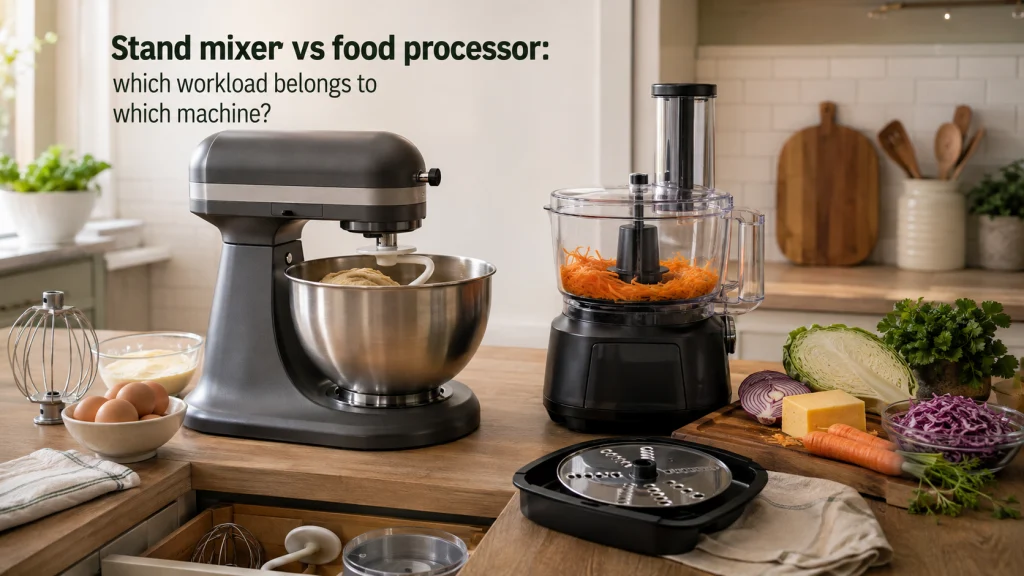
A stand mixer and a food processor can both handle some dough work, but that overlap should not decide which machine earns space in your kitchen. A food processor is built around cutting work such as chopping, slicing, shredding, and puréeing, while a stand mixer is built around sustained bowl work such as whipping, creaming, mixing, and kneading. The better choice is the machine whose native mechanism matches the jobs you repeat most often, with attachments treated as added cost and added storage rather than free capability. If dough is the main reason you are comparing them, batch size, dough type, visibility, control, and the exact machine’s documented limits matter more than wattage.
Start with the overlap task, then look at the rest of the week
Dough is what makes a stand mixer vs food processor comparison look deceptively simple. Both machine types can bring certain doughs together, so a shopper can jump too quickly to motors, bowl sizes, or accessory counts. That shared task hides a more useful distinction: the machines interact with ingredients in different ways. A kitchen that mostly processes vegetables, cheese, nuts, and sauces needs a different base machine from one centered on batter, whipping, and kneading.
That is why the comparison should widen from dough to the whole kitchen routine before money enters the picture. Frequent whipped cream, egg whites, creamed butter and sugar, batters, and bread dough point toward sustained bowl work, while frequent slicing and chopping point elsewhere. A longer feature list does not settle that split, especially when several functions depend on optional hardware. This page stays at the appliance-class level, so exact load limits, attachments, and operating instructions still belong to the manual for the machine you are considering.

The 12-cup sealed bowl handles larger prep sessions while the Big Mouth chute reduces pre-cutting for many foods. A chopping and pureeing blade plus a reversible stainless steel slicing and shredding disc cover the processor tasks emphasized in this section. The 450-watt unit uses Stack and Snap assembly, and its removable parts are dishwasher safe.
Check On AmazonIf you click this link and buy, we earn a commission at no additional cost to you.
The native mechanism tells you what each machine does naturally
A food processor moves ingredients through or around blades and discs, so cutting, slicing, shredding, chopping, and puréeing are natural jobs. A stand mixer moves a beater, whisk, paddle, or dough hook through ingredients in an open bowl, making sustained mixing and aeration more natural. KitchenAid comparison material describes the same basic split, while independent processor testing focuses heavily on cutting and processing tasks. The mechanism is more useful than the feature count because it shows what the base machine does without extra hardware.
That matters when a product page makes both machines look equally versatile. A stand mixer may gain slicing or shredding through attachments, and a processor may include dough or whisking tools, but each extra part changes setup, storage, and cleanup. In a food processor vs stand mixer comparison, first separate what the base machine does on its own from what requires added hardware. That keeps an attractive accessory list from looking like free capability.
| Workload | Food processor | Stand mixer | Main check |
|---|---|---|---|
| Chopping and puréeing | Native blade work | Not a native bowl job | Frequency |
| Slicing and shredding | Native disc work on many models | Usually attachment-added | Attachment burden |
| Whipping and aeration | Model dependent | Native whisk work | Batch and control |
| Creaming and batter | Possible, but not the native strength | Native beater work | Baking frequency |
| Dough | Real overlap with limits | Real overlap with limits | Dough, load, and manual |
The table becomes useful only when matched to your own routine. A household that grates cheese and slices vegetables several times a week may value the processor columns far more than occasional baking features. A frequent baker can read the same table and give more weight to the mixer columns. The point is to rank the jobs before ranking the machines.

The 14-cup work bowl gives this full-size processor room for repeated chopping and prep jobs. It includes a stainless steel slicing disc, shredding disc, and chopping and mixing blade, matching the native cutting mechanisms discussed in this section. Its 720-watt motor keeps the focus on core processor work rather than attachment-added capability.
Check On AmazonIf you click this link and buy, we earn a commission at no additional cost to you.
Repeated cutting work belongs on the food processor side
If your routine includes shredding cheese, slicing vegetables, chopping nuts, breaking down aromatics, or making purées, the processor starts with an architectural advantage. Those jobs use a blade or disc directly instead of asking another appliance to imitate the function through an accessory. Independent processor testing also evaluates slicing, shredding, grating, and chopping as real performance tasks. Claimed bowl capacity alone still does not prove usable capacity, so bowl geometry, feed path, discs, and exact load guidance remain part of the purchase check.
A common first-time mistake is seeing a stand mixer slicing attachment and assuming the mixer now replaces a processor with no trade-off. The attachment may solve the task, but you still have to buy, store, mount, feed, and clean it. If cutting work is frequent, a processor can be the more direct tool even when the mixer reaches a similar result through accessories. Readers whose routine clearly leans this way can continue with the site’s food processor buying guide before comparing individual machines.
| Weekly pattern | Processor fit | Mixer fit |
|---|---|---|
| Frequent slicing or shredding | Strong | Attachment dependent |
| Frequent chopping or purées | Strong | Weak |
| Frequent whipping or creaming | Weak | Strong |
| Frequent bread or pizza dough | Model and load dependent | Model and load dependent |
| Occasional crossover task | Treat it as a bonus unless it is central to your routine | |
Use the matrix as a weighting tool rather than a winner chart. Write down the prep jobs that actually occur in a normal week, then note which rows show up several times and which appear only occasionally. That prevents a specialty function from receiving the same importance as a core prep task. It also gives you a cleaner set of requirements when you move from appliance class to individual models.

The 10-cup bowl includes a built-in scraper that can move ingredients from the bowl sides without stopping the processor. A reversible slicing and shredding disc and an S-blade support slicing, shredding, chopping, mixing, and pureeing. The large feed chute accepts bigger foods, while two speeds plus pulse give straightforward control for repeated cutting prep.
Check On AmazonIf you click this link and buy, we earn a commission at no additional cost to you.
Whipping, creaming, batter, and sustained bowl work favor the stand mixer
A stand mixer’s open bowl and rotating mixing tools make it the more natural fit for jobs that need ongoing agitation rather than cutting. Whipping cream or egg whites, creaming butter and sugar, mixing repeated batters, and working heavier mixtures are all examples where the bowl tool is doing the job directly. Consumer Reports evaluates mixers with tasks such as pancake batter and egg whites, which is a useful reminder that mixer performance is not just a motor specification. The quality of the mixing action, how well the tool reaches the bowl, speed control, and the load itself all affect the result.
This does not mean every stand mixer is automatically suitable for every dough or every large batch. Model design, bowl geometry, dough hook design, speed guidance, load limit, and duty recommendations can differ, so the exact manual is the evidence that matters when the work becomes heavy. Bowl work also has its own practical fit questions, including access under cabinets, the effort of moving a heavy base, and whether the included tools cover the mixtures you make. Those selection details matter after the class-level comparison points toward a mixer, not before.

This tilt-head stand mixer pairs a 4.5-quart stainless steel bowl with 10 speeds for mixing, kneading, and whipping. The included flat beater, dough hook, and wire whip cover the sustained bowl work discussed in this section. Its metal construction and tilt-head format keep the machine centered on countertop mixing with direct bowl access.
Check On AmazonIf you click this link and buy, we earn a commission at no additional cost to you.
Dough is real overlap, but the kind of dough changes the answer
Dough is where a food processor vs mixer comparison needs more than a one-line rule. KitchenAid notes that both classes can handle dough, while Breville emphasizes that their mechanisms work dough differently. A processor uses fast blade action in a closed bowl, while a stand mixer works with a hook in a more visible open bowl. The right choice therefore depends on dough type, batch, recipe method, and exact machine rather than a blanket winner.
For bread-dominant households, load control deserves more attention than headline wattage. A processor can bring some doughs together quickly, but its rapid action leaves less time to observe changes and may come with specific batch or tool guidance. A stand mixer offers more direct visibility, yet its speed and dough-load limits are also model specific. If bread is the repeated workload, use the separate stand mixer for bread dough comparison to define those requirements before shopping.
Key point: Treat dough as a model-specific workload, not as proof that the two appliance classes are interchangeable. Check the exact manual for permitted load, required tool, speed guidance, and operating limits.
Start with the batch you actually make rather than the largest batch you can imagine. Note whether your routine is small pizza dough, repeated loaves, stiff dough, wetter dough, pastry, or several types. Then compare that workload with documented machine limits and decide how much visibility or speed matters to you. Once the dough job is defined precisely, it stops distorting the rest of the appliance decision.

The 9-cup processor includes four Auto-iQ preset programs for chopping, slicing, pureeing, and dough making. A dedicated dough blade gives this model a clearly documented dough workflow alongside its standard processor functions. Its 1000-peak-watt motor and included precision blades make the processor side of the dough overlap concrete at the exact-model level.
Check On AmazonIf you click this link and buy, we earn a commission at no additional cost to you.
Price the attachment system as part of the machine, not as a bonus
Attachment ecosystems can make a stand mixer and food processor look more alike on a product page than they feel in a kitchen. A mixer may add slicing, shredding, grinding, or rolling through separate parts, while a processor may expand with discs, blades, or specialty tools. The useful question is not whether an attachment exists, but whether you will use it often enough to justify its price, storage, setup, and cleanup. Capability stored in a box on a high shelf is not the same as a native tool used every week.
Compatibility must also be verified at the exact system level. A familiar brand name or similar-looking interface does not prove that an accessory fits a specific base, bowl, shaft, or generation. Before valuing an attachment, verify compatibility and confirm what the base machine actually includes. Fewer motor bases do not automatically mean fewer parts or less cabinet space.
- List only attachments you expect to use regularly.
- Separate native tasks from separately purchased capability.
- Verify exact compatibility before assigning value.
- Count storage for every blade, disc, hook, beater, and housing.
- Compare full system cost with two simpler machines.
If only one added function survives that checklist, another solution may be simpler. If several attachments match repeated work, the system approach becomes more defensible because the base earns its space more often. The goal is not to avoid attachments, but to stop counting hypothetical capability as weekly value. That is the difference between useful versatility and overbuying.

This genuine KitchenAid attachment adds slicing and shredding to compatible KitchenAid stand mixers rather than changing the base mixer’s native mechanism. It includes three blades for slicing and shredding plus a two-in-one feed tube for different ingredient sizes. A storage case keeps the blades together, making the added hardware burden visible when comparing a mixer system with a dedicated processor.
Check On AmazonIf you click this link and buy, we earn a commission at no additional cost to you.
Counter space is only the first part of the footprint
Both machine types can become permanent space commitments once you count their real operating footprint. A stand mixer may be heavy enough that frequent cabinet lifting makes it a practical countertop appliance, while a processor still needs accessible storage for its bowl, lid, pusher, blades, and discs. Height, cabinet clearance, outlet reach, and the direction parts are removed matter more than width alone. A machine that technically fits but is unpleasant to retrieve can still be a poor household fit.
Accessory storage can also reverse the apparent advantage of owning one base. A mixer plus several processing attachments may save counter area yet consume more drawer or cabinet volume than expected, and a processor with several discs can create the same problem. Measure the parking spot, operating space, and storage path before buying. Then decide whether the machine will stay out or move after every use.
| Footprint check | Food processor | Stand mixer |
|---|---|---|
| Storage pattern | Cabinet or counter | Often counter for frequent users |
| Loose parts | Bowl, lid, pusher, blades, discs | Bowl, beater, whisk, hook, attachments |
| Operating clearance | Room for bowl, lid, and feed tube | Room for bowl and head or lift movement |
| Hidden space cost | Disc and blade storage | Attachment bodies and accessories |
This comparison matters most when two large bases would crowd a small kitchen. One multi-function system is not automatically better, because space saved at the counter can reappear as accessory clutter. The broader small kitchen appliances overview can help compare this footprint with the rest of your countertop equipment. A realistic storage plan belongs in the purchase decision from the start.

These eight self-adhesive sliders attach beneath small kitchen appliances to make countertop repositioning easier. Each slider measures about 0.79 by 0.79 inches, and Amazon lists hardwood and tile among the recommended surfaces. The PTFE sliding surface is marketed for common countertop appliances including mixers, coffee makers, and air fryers.
Check On AmazonIf you click this link and buy, we earn a commission at no additional cost to you.
Cleanup changes which machine feels convenient after the first week
A processor can finish cutting work quickly, but the cleanup path may include a bowl, lid, pusher, blade or disc, and food trapped around seams or the center assembly. A stand mixer may leave you with a bowl and one mixing tool for a simple batter, yet optional attachments can add housings, feed parts, cutters, or other pieces that change that picture. Neither class owns an automatic cleanup advantage across every task. The right comparison is the complete after-use routine for the job you repeat, including safe blade handling and whatever the exact manual allows in the dishwasher.
This is one reason community discussions about owning both machines often focus on workflow rather than pure capability. People notice whether changing attachments interrupts prep, whether a processor creates several small parts to wash, and whether a heavy mixer is left out because moving it is more annoying than cleaning it. Those reports are useful for identifying friction, but they do not prove a universal winner because model design and household routine vary widely. Treat cleanup as a repeated time cost, then choose the system whose mess matches the work it saves.

The set includes one larger brush and one smaller detail brush for cleaning different surfaces and tight spaces. Durable nylon bristles handle scrubbing, while the smaller brush includes a wiper blade for reaching narrow crevices. Both brushes have soft, non-slip grips that support controlled cleaning around seams, edges, and other small areas.
Check On AmazonIf you click this link and buy, we earn a commission at no additional cost to you.
Choose the processor, the stand mixer, or both from repeated workload
Choose a food processor first when cutting work is the clear center of your routine and dough is secondary. That household gets direct value from slicing, shredding, chopping, and puréeing without turning another base into a cutting system through accessories. If occasional dough fits the processor’s documented method and load, that extra capability may be enough to keep the kitchen to one large machine. The case is strongest when the processor’s core prep jobs already justify its bowl, blades, discs, and cleanup.
Choose a stand mixer first when whipping, creaming, batter work, and kneading dominate, especially when an open bowl and hands-off mixing improve the way you bake. Choose both when cutting and mixing each occupy enough of the routine that one machine would need a costly or awkward workaround for the other job. Two bases are not automatically excessive, and one base is not automatically efficient. Compare the time, space, and parts each setup adds to the tasks you care about most.

This 4-quart stand mixer uses planetary mixing action and seven speeds to cover batter, dough, and other bowl work. It comes with a whisk, flat beater, dough hook, and splash guard, so the core mixing tools are included with the base. The 300-watt mixer also has an easy-carry handle for moving the machine between storage and the work surface.
Check On AmazonIf you click this link and buy, we earn a commission at no additional cost to you.
For processor dough, define the load before comparing models
If dough is part of the reason you want a food processor, turn that use case into a specific load before looking at models. Record the dough type, normal batch, how often you make it, and whether the manual calls for a particular blade, speed, or maximum quantity. A processor that handles one modest dough successfully is not automatically suitable for larger, stiffer, or more frequent batches. Exact manual guidance should outrank wattage, nominal bowl capacity, and broad marketing language about dough capability.
Once those requirements are clear, add the processor checks that affect ordinary prep: usable bowl behavior, feed path, included discs and blades, safe storage for sharp parts, and cleanup. That gives you a processor brief built around both cutting work and the dough job you actually expect it to handle. At that point, current food processor recommendations can be compared against a real requirement set instead of a generic feature list. If the dough demand exceeds documented processor limits, move that workload back to the mixer side rather than assuming a larger motor number fixes the mismatch.
Move to stand mixer selection only after mixing wins the class decision
If the comparison points clearly toward a stand mixer, the next question is no longer whether a processor can cover some of the same jobs. Now the checks shift to mixer format, bowl access, clearance, weight, included tools, control, and the kinds of mixtures you make most often. Those details can change household fit even when the stand mixer is the right appliance class. Avoid duplicating a full mixer buying process inside this comparison, because that would blur the decision the page is meant to settle.
The site’s overview of types of mixers is the next step when you need to compare stand mixers with other mixer formats and narrow the class further. Bread-heavy households should also keep the exact dough load and operating guidance from the earlier section in view rather than treating all stand mixers as equivalent. A good class decision can still lead to a poor purchase if clearance, weight, bowl access, or documented load limits do not fit the kitchen. Separate those model-level checks from the processor comparison, then evaluate them on their own evidence.
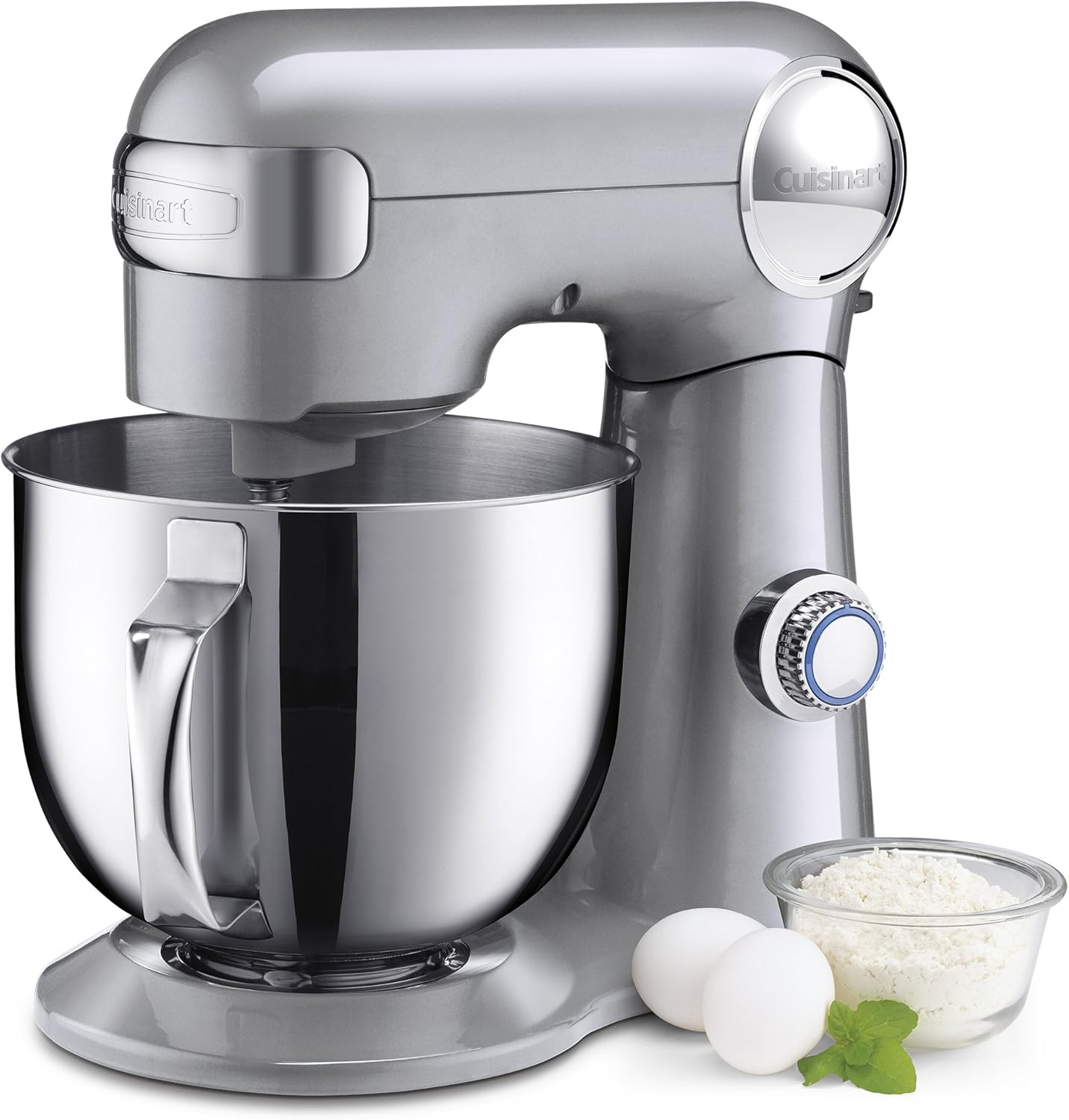
This 5.5-quart stand mixer combines a 500-watt motor with 12 speeds for a wide range of bowl work. It includes a chef’s whisk, dough hook, flat mixing paddle, and splash guard, so the core tool set is clear before extra accessories enter the decision. The tilt-back head and stainless steel bowl make bowl access and included capacity concrete model-level checks.
Check On AmazonIf you click this link and buy, we earn a commission at no additional cost to you.
Final thoughts: choose around the work that repeats
Dough explains why the two machines are easy to confuse, but the purchase still has to survive the rest of the kitchen routine. First identify whether your main jobs need cutting tools or sustained bowl mixing, then check whether the overlap tasks fit documented limits. After that, count the parts, storage space, and cleanup each setup creates. Power claims and accessory totals are useful only after those practical checks are settled.
A food processor makes more sense when its blades and discs address most of the prep you want to automate, while a stand mixer makes more sense when bowl mixing is the larger source of effort. Dough can belong to either side, but the exact batch, dough type, control preference, and manual guidance decide whether that overlap is useful. Owning both is reasonable when each base solves a distinct set of frequent jobs. Owning one is reasonable when the compromises, extra attachments, and storage demands stay genuinely small.

This digital kitchen scale measures up to 11 pounds or 5,000 grams and reads in ounces, pounds and ounces, or grams. The tare function lets you zero a container before weighing ingredients, which helps define an actual batch instead of relying on a vague size label. Its two-button controls and sealed control panel keep routine weighing straightforward during baking and prep.
Check On AmazonIf you click this link and buy, we earn a commission at no additional cost to you.
FAQs
The most common questions come from the two places where these machines overlap: dough and optional accessories. A shared function does not make the underlying mechanisms identical, and an available attachment does not prove it is the most convenient way to do the job. Use the exact machine documentation when capacity, load, compatibility, or cleaning instructions can change the answer. The short answers below keep those boundaries in place.
Use these answers as a final filter rather than a second buying system. If both cutting and mixing matter, compare the full setup each option requires instead of counting functions on the box. If space forces one base, prioritize the mechanism tied to the jobs you most want the appliance to take over. Then verify the exact model before assuming the overlap will cover everything else.
🍞 Is a food processor or stand mixer better for bread dough?
Neither class wins for every dough. Compare the exact dough and batch with documented load, tool, speed, and operating guidance, then decide whether processor speed or mixer visibility better fits your routine.
🥕 Can a stand mixer replace a food processor for slicing and shredding?
Some stand mixers can add those functions through compatible attachments. Count the attachment’s price, storage, setup, and cleanup before treating it as a processor replacement.
🥣 Can a food processor replace a stand mixer for baking?
It can cover some baking tasks, including certain doughs and mixtures, but not every whipping, creaming, batter, or kneading workflow. Frequent bakers should identify their repeated tasks before deciding the overlap is enough.
📦 Which machine is easier to store in a small kitchen?
It depends on the base, weight, accessories, and retrieval path. Count all bowls, blades, discs, beaters, hooks, and attachments instead of comparing base dimensions alone.
🧼 Which one is easier to clean?
A simple mixer job may involve only a bowl and one tool, while processor work often adds a lid, pusher, and blade or disc. Compare the full cleanup path for your repeated task and follow the exact manual for dishwasher-safe parts.
References and sources
The source list is intentionally short because most of this comparison is based on appliance mechanics and household workflow. Manufacturer material verifies the cutting-versus-mixing distinction and the fact that both classes overlap on dough. It is not treated as proof that one brand is universally superior. Exact limits still belong to the documentation for the machine being considered.
Independent testing is used as a check on the tasks commonly used to evaluate each class. Mixer testing includes mixing and whipping, while processor testing includes slicing, shredding, grating, and chopping. That supports the mechanical distinction without turning the article into a ranking. No source is included simply to increase external link count.
- KitchenAid dough comparison: supports the documented dough overlap and core mechanism split.
- Breville dough comparison: supports the explanation that mechanism and dough type change the decision.
- Consumer Reports mixer buying guide: supports batter and whipping as meaningful mixer test tasks.
- Consumer Reports food processor buying guide: supports the focus on cutting performance, capacity, and processor trade-offs.