LiDAR and camera systems solve overlapping but different problems in a robot vacuum, so the sensor name alone does not tell you how well the machine will navigate or avoid clutter. LiDAR is especially useful for distance-based mapping and localization, while cameras can add visual information that helps some systems recognize objects, but implementation matters more than the label. The practical buying decision comes down to your lighting, furniture clearance, tolerance for cords and toys on the floor, privacy preferences, and independent evidence of navigation and avoidance performance. The goal is to choose the measured behavior your home needs rather than assuming one sensor architecture is automatically better.
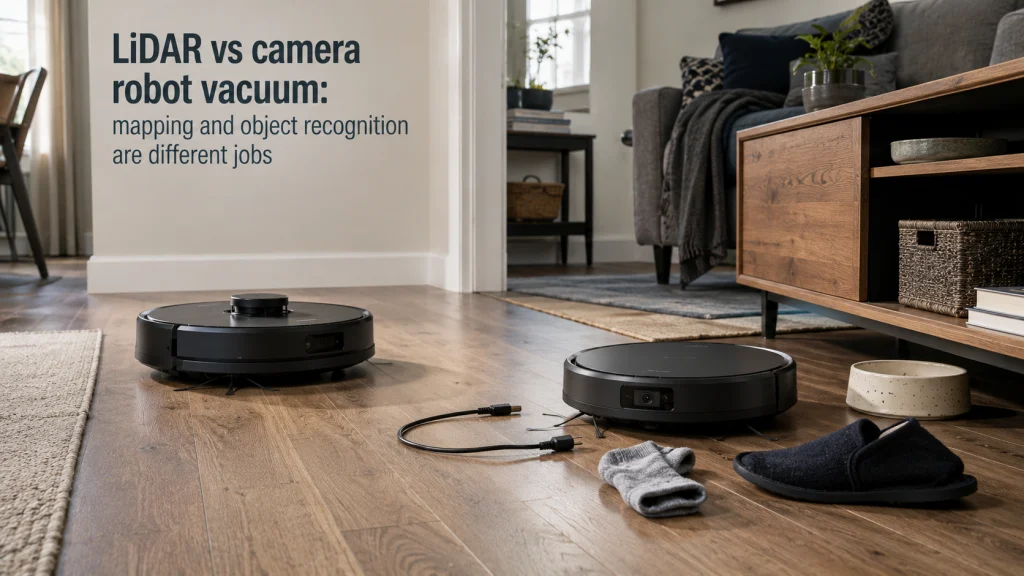
A good map can still leave a cord in trouble
Put two robot-vacuum spec sheets side by side and the feature labels can make the choice look simpler than it is: one says LiDAR navigation, another says an AI camera, and a third lists both. When I compare a LiDAR vs camera robot vacuum, I would not treat any of those labels as the verdict because mapping a room and recognizing a cable are different jobs. A robot can localize itself cleanly and draw an orderly map while still driving into a thin charging cord. Another can recognize selected objects with a front camera while relying on a different sensor for room-scale navigation.
That mismatch is the buyer problem to decode before comparing sensor acronyms. If your floors are usually clear, systematic navigation and stable localization may matter more than advanced object classification. If cords, socks, toys, pet bowls, or other low-profile items routinely stay out, the shortlist should give obstacle behavior its own check instead of assuming the mapping sensor handles it. The broader robot vacuum buying guide covers the rest of the purchase decision, while this comparison stays with sensor architecture, lighting, clearance, recognition, privacy, and the evidence that separates those jobs.

Smart AI navigation detects cables, toys, and pet obstacles in real time. The X12 combines up to 22,000Pa suction with an OZMO Roller self-washing mop system. Its bagless OmniCyclone station handles automatic emptying while PowerBoost charging supports longer cleaning sessions.
Check On AmazonIf you click this link and buy, we earn a commission at no additional cost to you.
What LiDAR, camera navigation, and common sensor combinations actually do
LiDAR measures distance by sending light out and reading its return, which gives a robot useful spatial information without relying on ordinary room images. Camera navigation, often associated with visual SLAM or vSLAM, uses image frames and visual landmarks to estimate position as the robot moves. Structured light projects a light pattern and reads the reflected pattern to help describe nearby shapes, while time-of-flight, or ToF, measures how long emitted light takes to return. These technologies can be used for navigation, near-field obstacle detection, or both, depending on the design.
The important detail is that a robot may combine several of them. A top or embedded LiDAR system may handle mapping and localization while a front-facing camera, structured-light sensor, ToF sensor, infrared sensor, or bumper handles closer obstacles. A camera-based robot may also use other proximity and motion sensors rather than navigating from vision alone. That is why a simple camera vs LiDAR robot vacuum label can hide the part of the sensor stack that actually affects cords, furniture legs, dark areas, and physical fit.
| Sensor approach | What it can contribute | What the label does not prove |
|---|---|---|
| LiDAR | Distance measurement, room mapping, localization, and systematic path planning | Reliable recognition of every small or low-profile floor hazard |
| Camera or vSLAM | Visual landmarks for navigation and, in some designs, image-based object recognition | Equal low-light performance or equal recognition accuracy across models |
| Structured light or ToF | Close-range shape, depth, or distance information for nearby obstacles | That the robot will correctly classify or avoid every household object |
| Combined sensor stack | Different sensors can cover different navigation and avoidance jobs | Better real-world performance without independent testing |
Use the table as a vocabulary check, not as a ranking. The buyer-level question is always what work each sensor is doing on the exact robot and whether testing shows that the complete system performs well. Two machines can list similar hardware and still behave differently because placement, software, processing, firmware, and avoidance strategy also matter. Sensor construction narrows expectations, but it does not finish the comparison.

Reactive AI uses structured light and an RGB camera to recognize 108 obstacle types, while RetractSense LiDAR supports navigation. The 3.14-inch body is designed to reach beneath low furniture. It also combines 22,000Pa suction with automatic hot-water mop washing and warm-air drying.
Check On AmazonIf you click this link and buy, we earn a commission at no additional cost to you.

PreciSense LiDAR supports mapping while structured-light sensors handle close obstacle detection. The robot delivers 12,000Pa suction and uses a dual anti-tangle brush system. Its multifunction dock self-empties dust, washes and dries the mops, and refills the water tank.
Check On AmazonIf you click this link and buy, we earn a commission at no additional cost to you.
Lighting matters, but not every camera system behaves the same way
Distance-based LiDAR does not need ordinary visible room light in the same way a conventional camera does, which is one reason it can be attractive for cleaning in dim rooms. Camera systems depend more heavily on the visual information available to them, especially when image recognition is part of the avoidance system. Some designs compensate with onboard illumination, infrared assistance, or additional depth sensors, so it is too broad to say that every camera robot simply fails in the dark. The exact sensor stack and the manufacturer’s documented operating behavior matter more than a one-line rule.
Independent test methodology reinforces that caution because obstacle detection is affected by object size, material, floor type, angle, and lighting as well as sensor type. A bright toy standing upright is not the same challenge as a dark cable, a flat sock, or an object partly hidden by carpet fibers. If you regularly run the robot after lights are off, check whether its recognition system includes its own illumination and then look for tests performed under conditions that resemble your home. Low-light capability is a buying field to verify, not a reason to declare all camera navigation weak.
AI obstacle avoidance detects more than 100 objects, including wires and toys, for cleaning during the day or at night. The robot provides 8,000Pa suction and dual mops with 12 mm auto-lift for carpet transitions. Its Omni station washes and dries the mops, self-empties dust, and refills water.
Check On AmazonIf you click this link and buy, we earn a commission at no additional cost to you.
Robot height can matter more than the sensor name under low furniture
A raised LiDAR turret can increase the robot’s overall height, which may be irrelevant in an open room but decisive under a low sofa, bed frame, cabinet toe kick, or other tight clearance. Embedded, side-mounted, solid-state, and retractable designs can change that physical trade-off, but the word LiDAR alone does not tell you where the sensor sits. Camera-led designs may allow a lower top profile in some cases, yet they can still have other housings or sensors that affect fit. The exact exterior height is therefore a real household measurement, not a feature-list detail.
Before buying, measure the lowest furniture opening you actually want the robot to enter and compare it with the exact model height, allowing for uneven flooring, rugs, and furniture sag rather than assuming a paper-thin margin is enough. A shorter robot that reaches more floor can be more useful than a technically impressive system that is permanently blocked from a large area. Conversely, if nearly all furniture has generous clearance, sacrificing proven navigation performance just to gain a slightly lower profile may solve a problem you do not have. Physical access belongs beside lighting and obstacle behavior in the sensor decision.

The 3.14-inch profile uses the StarSight Autonomous System without a raised LDS unit, helping it reach under low furniture. Advanced 3D sensing and VertiBeam obstacle avoidance handle cables and irregular furniture. The robot also provides 22,000Pa suction with zero-tangling brush hardware.
Check On AmazonIf you click this link and buy, we earn a commission at no additional cost to you.
Room-scale mapping is really a localization problem
For daily cleaning, the practical value of mapping is not a pretty floor plan but reliable knowledge of where the robot is and where it has already cleaned. LiDAR is well suited to distance-based localization because it can repeatedly measure room geometry and nearby surfaces without depending on normal room illumination. Visual systems can also localize effectively by tracking recognizable features and motion across image frames, particularly when the environment gives them useful visual landmarks. Software quality and sensor fusion still matter, so the architecture should be treated as a starting advantage rather than a guaranteed outcome.
For a buyer, navigation evidence becomes useful when it shows coverage, route efficiency, repeatability, battery use, and whether the robot finishes a fixed floor plan without rescue. Vacuum Wars, for example, describes using the same mapped floor plan and combining efficiency, battery use, and coverage in its navigation assessment. Those measurements reveal whether the robot can turn its map into a dependable cleaning route rather than merely create a map in the first place. If two machines both support room maps but one repeatedly misses reachable floor or spends far longer retracing paths, that difference affects everyday cleaning even before obstacle recognition enters the comparison.

The MOVA V50 Ultra Complete combines 24,000Pa suction with FlexiRise navigation and multiple anti-tangle mechanisms for handling hair and debris. Its multifunction station supports hot-water mop self-cleaning and hot-air drying, while the robot can adjust its navigation hardware to reach lower spaces. With cleaning, navigation, mopping, and station functions spread across several control layers, it is a useful model for checking exactly which routines remain available when app or network access is limited.
Check On AmazonIf you click this link and buy, we earn a commission at no additional cost to you.
Object recognition and low-profile hazards need independent evidence
A top-mounted navigation sensor can understand walls and furniture while still having a poor view of a thin object close to the floor. That is why modern robots may add front-facing cameras, structured light, ToF, infrared, or other near-field sensors specifically for obstacle work. Recognition adds another layer because detecting that something exists is different from identifying it as a cord, sock, shoe, pet bowl, or another known object. Even then, recognition is useful only if the robot’s response keeps the object out of the brush path without creating frequent false detours.
RTINGS makes this distinction measurable by testing common household hazards in fixed positions on both bare floor and carpet, including shoes, socks, cords, a pet bowl, and simulated pet waste. Its scoring separates avoidance from intervention, which is valuable because a robot that eventually notices a hazard after getting tangled has not delivered the same ownership experience as one that steers around it cleanly. For homes where floor pickup before every run is the main frustration, compare documented results from robot vacuum obstacle avoidance testing rather than assuming a camera, laser, or AI label guarantees success. This is the clearest example of why sensor specifications and household outcomes need separate columns in your buying notes.
Privacy is a separate buying field when cameras are involved
A camera introduces a different privacy question from a distance-only LiDAR sensor because visual data may contain recognizable details from inside the home. That does not mean every camera-equipped robot uploads images, stores video, or uses the cloud in the same way. Data handling can vary by model, feature, account setting, app function, and firmware, so privacy claims need model-specific documentation rather than assumptions based on the presence of a lens. If privacy matters to you, check what is processed locally, what is transmitted, what can be stored, and whether camera-related features can be disabled.
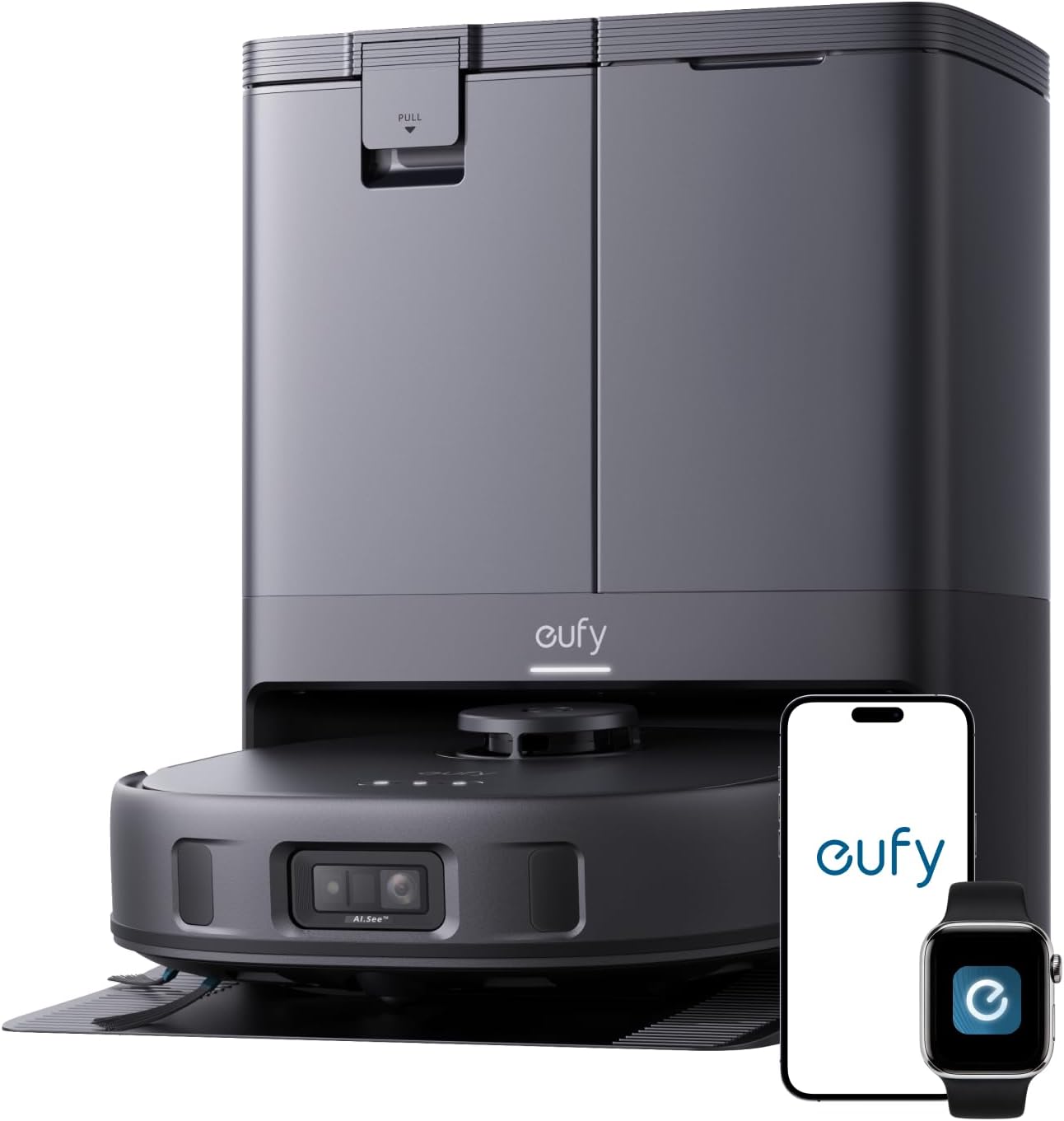
A useful evidence boundary is visible in eufy’s support documentation for one camera-based obstacle-recognition system, which states that its recognition processing is local and that the relevant data is not uploaded to the cloud. That is evidence for that documented implementation, not permission to generalize the same behavior to every eufy model or every camera robot. The dedicated robot vacuum privacy article is the better place to evaluate data handling, app permissions, account features, and current manufacturer policies in detail. For this comparison, keep privacy as a model-specific buying field instead of reducing the choice to “camera bad” or “LiDAR safe.”

LiDAR navigation handles mapping and obstacle detection without using a camera, directly addressing camera-sensitive privacy preferences. The C28 provides 15,000Pa suction and a HydroJet roller mop that cleans itself while mopping. Its all-in-one station empties dust, washes the mop, dries it with hot air, and collects wastewater.
Check On AmazonIf you click this link and buy, we earn a commission at no additional cost to you.
Combined sensor systems can cover more jobs, but they still need test evidence
A combined sensor system makes intuitive sense because room-scale navigation and close-range obstacle detection benefit from different kinds of information. LiDAR can handle geometry and localization while a front camera or depth sensor watches for objects that sit below the main scan plane. Structured light or ToF can add depth information, and onboard lighting can support a vision system in dim spaces. On paper, that stack can address more household situations than a single sensor working alone.
The trade-off is that a longer sensor list can hide how responsibilities are divided. A front depth sensor may be excellent at detecting a raised object but less useful with a thin cable, while a vision system may recognize a familiar item yet still need a clear enough view and a timely steering response. Placement, field of view, processing, and path-planning behavior determine whether those inputs work together or simply coexist on the specification sheet. A combined architecture is most convincing when each added sensor addresses a household problem you actually have instead of adding complexity that never changes the cleaning routine.

Structured-light sensors navigate around cables, toys, and furniture legs while PreciSense LiDAR builds real-time 3D maps. The system recognizes more than 200 object types day or night and supports up to four floor plans. It also uses 20,000Pa suction with a self-cleaning SpiraFlow roller mop.
Check On AmazonIf you click this link and buy, we earn a commission at no additional cost to you.
Choose the sensor approach from the problem your home actually creates
For anyone asking whether a robot vacuum should use LiDAR or a camera, start with the failure you most want to prevent. LiDAR-led navigation is a strong direction when room-scale mapping, dim-room operation, and systematic localization are high priorities, provided the robot still fits under the furniture you want cleaned. Camera or vision-heavy systems make more sense when visual object recognition is especially important and the exact implementation suits your lighting and privacy requirements. A combined system makes sense when you genuinely need both jobs handled well, not merely because the feature list is longer.
Your floor habits can change that answer quickly. A mostly clear home with generous furniture clearance may get little value from an elaborate recognition stack, while a busy floor with cords, toys, socks, and pet-related obstacles makes low-profile hazard handling much more important. Privacy-sensitive buyers should decide what camera-related data handling they will accept before a visual feature becomes a selling point. The choice is therefore a fit decision across lighting, clutter, clearance, recognition need, and privacy rather than a universal contest between LiDAR and cameras.
- Favor proven LiDAR-led navigation when stable mapping and low-light room localization are the main concerns.
- Favor proven vision or camera-assisted recognition when identifying household objects is a priority and privacy documentation is acceptable.
- Favor a combined sensor stack when independent testing shows that it delivers both efficient navigation and strong obstacle avoidance.
- Reject any option that fails your actual furniture clearance, privacy requirements, or intervention tolerance regardless of sensor type.
Use the checklist to narrow the architecture before comparing the rest of the machine. Once that direction is clear, floor type, dock needs, maintenance, noise, and budget still decide whether the robot is a good household fit. A sophisticated sensor system cannot compensate for a dock you cannot place, a body that cannot reach important floor area, or ownership work you do not want. The broader home cleaning appliance decision framework is useful when those ownership trade-offs become the next question.

PreciSense LiDAR scans 360 degrees and creates detailed maps in real time for systematic navigation. The QV 35A combines 8,000Pa suction with smart obstacle avoidance and anti-tangle brushes. Its all-in-one dock automatically empties dust, refills water, washes the mops, and dries them.
Check On AmazonIf you click this link and buy, we earn a commission at no additional cost to you.
Use specifications to predict capability, then use tests to judge behavior
Specifications and tests answer different questions, so I would keep them in separate columns while building a shortlist. The specification sheet establishes construction facts such as whether the robot uses LiDAR, a camera, structured light, ToF, onboard illumination, or an embedded rather than raised sensor. Those facts can predict likely strengths, physical constraints, and which functions deserve closer scrutiny. They cannot establish how efficiently the robot covers a room, how often it needs rescue, or whether a thin household hazard stays out of the brush path.
Then check whether the test method resembles the decision you are making. RTINGS uses a structured obstacle course with low-profile household objects and records avoidance and intervention, while Vacuum Wars documents repeatable navigation and multi-object procedures on a controlled layout. A useful test tells you what floor, objects, lighting, route, and success criteria were involved rather than presenting a score without context. Keeping those evidence types separate lets a promising architecture stay on the shortlist without turning the specification itself into proof of household performance.

The Q10 S5+ lists 10,000Pa suction, obstacle avoidance, sonic mopping, and an auto-lifting mop system in one package. Dual anti-tangle brushes target long hair and pet fur. Its self-emptying dock is rated for up to 70 days of dust storage before routine bag service.
Check On AmazonIf you click this link and buy, we earn a commission at no additional cost to you.
Move from sensor choice to the next household decision
Once the sensor direction fits your home, move to the question that remains unresolved. If you need to know how rooms are saved, edited, divided, or scheduled, continue with mapping features and app behavior rather than adding more sensor theory. If cords, socks, pet-related hazards, or floor pickup before each run are the concern, compare obstacle-avoidance results under similar conditions. This keeps one strong capability from disguising a different weakness that would still create work after purchase.
Privacy deserves the same separation because recognition capability does not tell you how visual data is stored, transmitted, or exposed through account features. Buyers still comparing the whole robot should also weigh cleaning performance, dock burden, maintenance, noise, fit, and cost before committing. A sensor choice can remove the wrong candidates, but it does not finish the ownership decision. The goal is to arrive at a shortlist whose navigation architecture fits the home without letting that one feature eclipse everything else the robot has to do.

The E28 combines 20,000Pa suction with a HydroJet roller that self-cleans continuously while mopping. A detachable deep carpet cleaner extends the system beyond routine floor cleaning to fabric surfaces. Its all-in-one station handles dust emptying, mop washing, and water refilling for lower day-to-day maintenance.
Check On AmazonIf you click this link and buy, we earn a commission at no additional cost to you.
Final Thoughts: buy the measured behavior, not the sensor acronym
LiDAR, vision, and combined sensor systems each make sense for different household priorities. A dim home with mostly clear floors creates a different navigation problem from a bright, cluttered room where cords and small objects are routinely left out. Low furniture can make sensor placement decisive, while a camera-related privacy preference can remove an otherwise capable option before performance is even compared. There is no useful universal winner because the cost of a poor match shows up as inaccessible floor, extra pickup, rescues, or settings you do not want to use.
Start with the household conditions you cannot change easily: lighting, lowest clearance, recurring clutter, object-recognition need, and privacy preference. Verify that the exact robot architecture can address those conditions, then check whether its documented navigation and avoidance results are strong enough for your tolerance for intervention. After that, judge the rest of the machine on cleaning, dock placement, maintenance, noise, and cost. The best sensor choice is the one that removes a real source of friction without creating a different one elsewhere in the routine.

The E25 combines 20,000Pa suction with HydroJet self-cleaning roller mopping for mixed vacuum-and-mop routines. AI obstacle avoidance and an extendable side brush address clutter and edge cleaning rather than relying on a sensor label alone. Its all-in-one station and zero-tangle design reduce routine dock and brush maintenance.
Check On AmazonIf you click this link and buy, we earn a commission at no additional cost to you.
FAQs
🌙 Does LiDAR work better than a camera in a dark room?
LiDAR does not rely on ordinary visible room light in the same way a conventional camera does, so it has an inherent advantage for distance-based localization in darkness. Some camera systems add their own illumination or other sensors, so verify the exact model instead of assuming every camera robot performs the same way.
🔌 Will a LiDAR robot vacuum avoid cords?
Not automatically. A navigation LiDAR sensor can map a room well while low cords remain a separate obstacle-detection challenge, so look for front-facing avoidance hardware and independent cord tests.
📷 Does a camera robot vacuum always send images to the cloud?
No. Data handling varies by model and feature, and some documented systems process recognition locally, so check the current manufacturer privacy and support information for the exact robot you are considering.
🛋️ Is a camera robot vacuum usually shorter than a LiDAR model?
It can be, especially when the alternative uses a raised LiDAR turret, but modern embedded and other low-profile LiDAR designs make the old rule less reliable. Compare the exact robot height with the lowest furniture opening you want it to enter.
🧦 Which sensor is better for socks, toys, and pet-related obstacles?
No single sensor label guarantees better avoidance. Use independent tests with low-profile household objects because placement, software, recognition, and the complete sensor stack determine whether the robot actually avoids them.
References and Sources
- RTINGS obstacle avoidance testing: Documents sensor categories, household test obstacles, avoidance scoring, and intervention methodology.
- Vacuum Wars test methodology: Explains fixed-floor-plan navigation measurements and repeatable multi-object obstacle testing.
- eufy AI.See support: Provides a model-specific example of local camera-based object recognition and stated cloud-handling behavior.
- Narwal LiDAR and camera explanation: Supports the manufacturer-level distinction between laser distance sensing, camera navigation, lighting dependence, and privacy considerations.