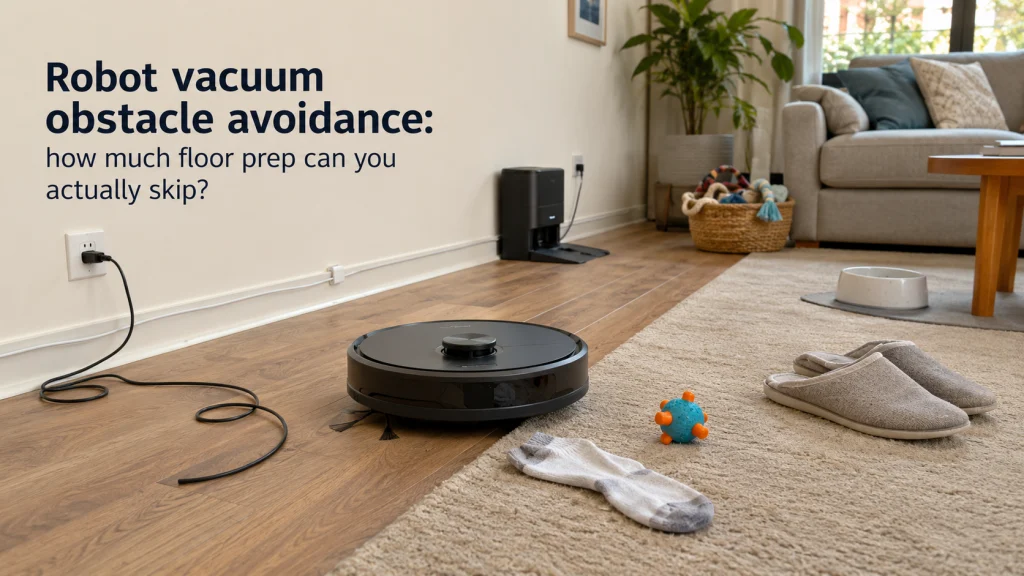
Robot vacuum obstacle avoidance is most useful when it reduces the amount of floor pickup you have to do before every run, not when it merely adds an AI label to the box. Independent tests show that cords, flat socks, small toys, reflective pet bowls, and pet waste can challenge robots very differently, so the exact objects in your home matter more than a generic recognition count. The practical buying question is how often the robot avoids those objects without getting stuck, swallowing them, pushing them, or asking for help. By the end, you should be able to turn test results and sensor claims into a realistic floor-prep requirement for your household.
The real upgrade is less pre-cleaning before the robot cleans
The irony of robot vacuum obstacle avoidance is that the feature matters most when your floor is not already prepared for a robot. If every charging cable, sock, pet toy, and stray cloth has to be picked up first, the machine may still save vacuuming effort, but it has not removed much of the setup work. A stronger system can reduce that babysitting burden, yet no current approach deserves to be treated as permission to ignore every hazard. The useful question is therefore not whether a robot has AI, but how much floor preparation still remains after you account for the objects your home actually leaves behind.
That shifts the buying decision away from a yes-or-no feature checkbox and toward intervention risk. A household with clear floors may be satisfied with basic avoidance because the robot rarely meets a loose cord or small toy, while a home with children, pets, hobby materials, or charging cables across traffic areas asks much more of the system. The stronger the consequence of a miss, the more evidence you should demand from independent testing before paying extra. If obstacle avoidance is only one part of your decision, the broader robot vacuum buying guide helps weigh it against cleaning performance, dock features, maintenance, and household fit.

The L60 Ultra FE combines obstacle avoidance with 360-degree navigation for automated room cleaning. Its 30,000Pa suction and TriCut brush are designed to pick up dust, hair, litter, and daily debris. The Smart PowerDock washes and dries mops, empties dust, refills water and solution, and supports fast charging.
Check On AmazonIf you click this link and buy, we earn a commission at no additional cost to you.
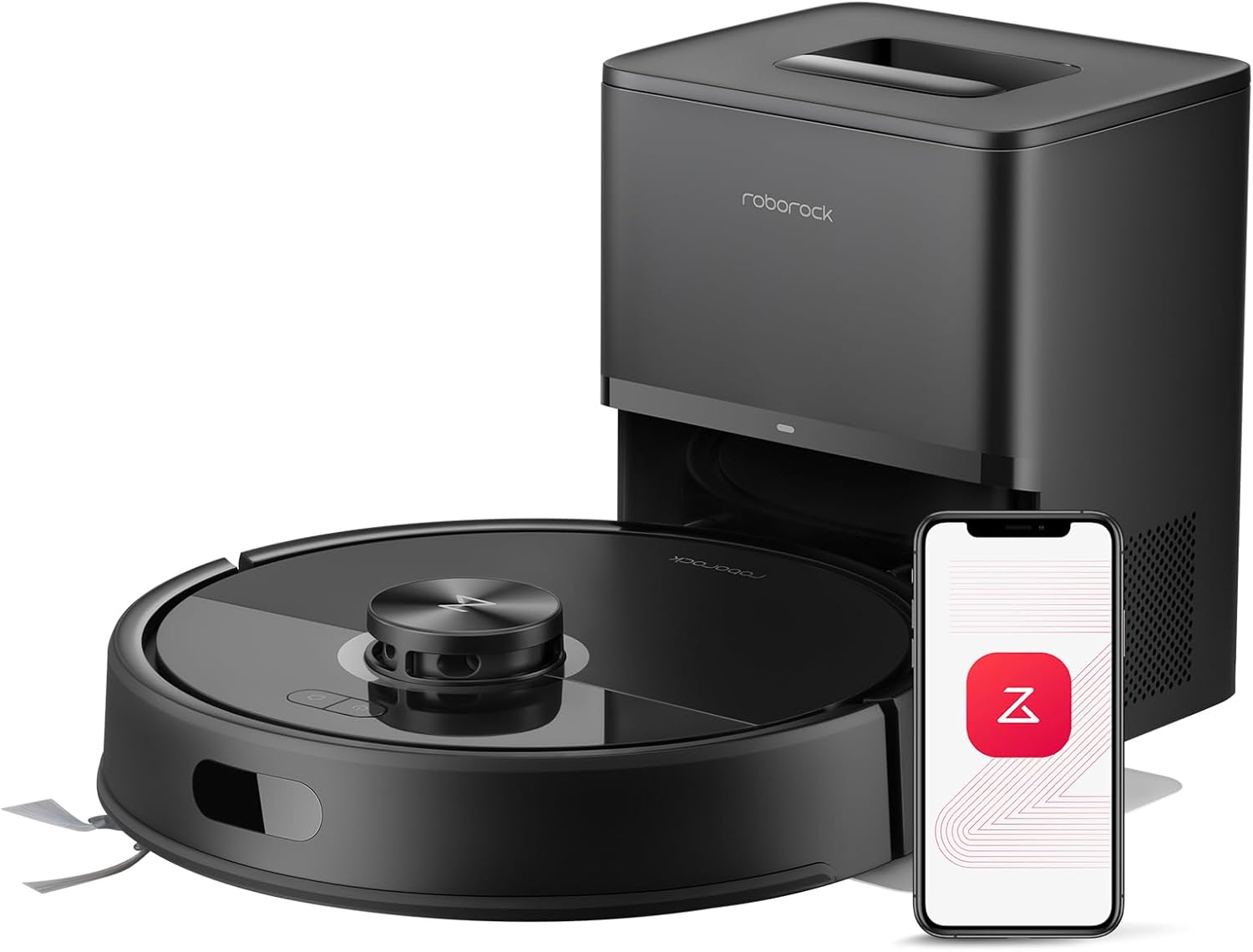
The Q7 M5+ uses PreciSense LiDAR navigation to map rooms and plan cleaning routes. Its 10,000Pa suction and dual anti-tangle system target debris and pet hair on hard floors and carpet. App and voice controls add scheduled cleaning and hands-free operation, making its navigation features useful to evaluate separately from small-object avoidance.
Check On AmazonIf you click this link and buy, we earn a commission at no additional cost to you.
Robot vacuum object avoidance is a three-step process
Detection, recognition, and successful avoidance are related, but they are not the same result. Detection means the robot senses that something is in front of it, recognition means the software classifies what that object might be, and avoidance means the robot changes its path without creating a new problem. A robot may detect a shoe without knowing what it is, or correctly label a sock and still clip it with a side brush during the turn. For the owner, only the final behavior determines whether the run continues without rescue.
This is where marketing counts can become distracting. A claim that a system recognizes many object types describes the size of a recognition library or a laboratory result, but it does not by itself show how consistently the robot avoids those objects in a mixed room. Independent testing is more useful when it reports contact, entanglement, pushing, stopping, or required intervention rather than only whether an object icon appeared in an app. The practical sequence is simple: the robot has to see enough of the object, interpret it correctly enough, and react early enough for the brushes and wheels to miss it.

Saros 10R uses advanced 3D obstacle detection to navigate around cables, furniture, and other obstacles. Its StarSight 2.0 system combines navigation and obstacle-avoidance functions in the same cleaning platform. The robot also provides 22,000Pa suction, zero-tangling technology, and an automated dock with self-emptying and hot-air drying.
Check On AmazonIf you click this link and buy, we earn a commission at no additional cost to you.
Low-profile clutter deserves more attention than furniture legs
Large furniture legs are not a demanding obstacle-avoidance test because they present a tall, stable target that basic navigation and bump sensing can usually handle. The harder household objects are the ones that sit close to the floor, change shape, blend into the surface, or can be pulled into a brush before the robot realizes what happened. Cables, drawstrings, flat socks, lightweight cloth, and small toys belong in a different risk class from a sofa leg. A reflective pet bowl adds another complication because even a light push can spill water, while the robot itself may remain technically unstuck.
The matrix below is more useful than asking whether a robot avoids obstacles in general. It separates sensing difficulty from the consequence of a miss, which is what matters when deciding how much pre-cleaning you can skip. Shoes near a wall may tolerate occasional contact, while a charging cable across the route can wrap around the brushroll and stop the run. Let the highest-consequence objects set your minimum requirement even when they appear less often.
| Household obstacle | Why it can be difficult | What a miss can cause | Pre-cleaning stance |
|---|---|---|---|
| Charging cable or drawstring | Thin, flexible, low profile, and easy to blend into flooring | Brush entanglement, dragged object, or stranded robot | Keep picking it up unless exact-model testing is consistently strong on cords |
| Flat sock or small cloth | Soft shape with little height, especially difficult on carpet | Fabric can be pulled under the robot or into the brushroll | Expect some pickup unless testing shows reliable cloth avoidance |
| Small toy | Size, color, and shape vary widely | Contact, pushing, ingestion of small pieces, or missed cleaning around clutter | Judge by toy size and exact test evidence, not an AI label |
| Pet bowl | Reflective or angled surfaces can complicate sensing | Pushing or spilled water even if the robot keeps moving | Use a stable placement or exclusion zone when consequences matter |
| Furniture leg | Tall and stable compared with floor clutter | Usually a light bump or route adjustment | Basic navigation is often enough for this class of obstacle |
Use the table as a household inventory, not a promise that every object behaves the same way. A dark cable on carpet, a bright cable on hard flooring, and a loose loop from a desk can present different sensing problems. The later an object is detected, the less room the robot has to turn before a brush, wheel, or mop reaches it. That is why low-profile tests tell you more than watching a robot steer around chairs.

The L40s Ultra AE includes precise 3DAdapt obstacle avoidance for navigating household clutter. Its 19,000Pa suction and TriCut brush support debris and hair pickup across supported floor types. The all-in-one station adds automatic dust emptying, mop washing, hot-air drying, and water refilling to reduce routine maintenance.
Check On AmazonIf you click this link and buy, we earn a commission at no additional cost to you.
Robot vacuum hazard avoidance needs a stricter standard for pet waste
Pet waste is not just another object-recognition example because the cost of a single miss can be far higher than bumping a shoe. A robot that touches solid waste can carry contamination into the wheels, brushes, underside, and additional floor areas before anyone notices, so a system that succeeds most of the time may still be unacceptable for unattended runs in a high-risk home. Independent test methods reflect this consequence by treating contact with simulated pet waste more severely than a casual touch against ordinary clutter. That is the right mindset for the buyer as well: consequence should influence the standard, not only average success rate.
No obstacle-avoidance feature should be presented as a safety guarantee around pets or hazardous material. If pet accidents are a realistic possibility, a quick floor check before an unattended run remains the lower-risk routine even when the robot has strong test results, and scheduled runs may need to avoid times when nobody can inspect the area first. Also keep stair and drop protection separate from this discussion because cliff sensing is a different safety function with model-specific limitations. The sensible goal is risk reduction and fewer interventions, not a promise that the robot can safely interpret every unexpected mess.

Saros 20 uses StarSight Autonomous System 2.0 with advanced 3D ToF sensors for real-time mapping. Its RGB camera is designed to recognize more than 300 obstacles so the robot can reduce interruptions around clutter. The model also combines 36,000Pa suction with carpet and pet-hair cleaning features.
Check On AmazonIf you click this link and buy, we earn a commission at no additional cost to you.
Camera, structured light, ToF, and LiDAR labels still need performance evidence
Sensor names describe how a robot gathers information, but they do not tell you how well the complete system behaves in your home. Structured-light systems project infrared information to estimate the shape or distance of objects, camera systems can add visual classification, and time-of-flight sensing can estimate distance from reflected light. LiDAR is widely used for mapping and may also contribute to obstacle sensing, yet a room-navigation LiDAR system should not automatically be treated as small-object recognition. Software, sensor placement, reaction logic, lighting, and the size of the object all sit between the hardware label and the actual outcome.
Independent results are especially useful because two robots with superficially similar sensor descriptions can produce different intervention rates. Manufacturer pages are still valuable for documenting what hardware is claimed, what object classes are listed, whether a camera is present, and whether the maker specifies lighting or size limitations, but those pages are not substitutes for a repeatable obstacle course. For a deeper look at the architecture trade-offs, the separate comparison of LiDAR vs camera robot vacuum systems keeps the sensor discussion from overwhelming this buying decision. Here, the rule is simpler: use the label to understand what the robot is trying to sense, then use exact-model tests to judge whether it actually avoids the clutter that matters.

Qrevo Edge 2 uses Reactive AI with structured light, an RGB camera, and an LED light for obstacle recognition. The system is designed to recognize and avoid more than 280 object types in complex home environments. Its 25,000Pa suction and zero-tangle design add cleaning performance for carpet and pet-hair use.
Check On AmazonIf you click this link and buy, we earn a commission at no additional cost to you.
Read avoidance rate and intervention rate together
A good test tells you more than how many objects a robot passed. RTINGS separates avoidance from intervention on bare floor and carpet, tests cords, socks, shoes, a pet bowl, and simulated pet waste, and uses the worst repeated run for scoring. Vacuum Wars uses a standardized obstacle course and awards points for successfully avoided objects across models. The methods differ, but both observe behavior rather than relying on a manufacturer recognition count.
Avoidance rate tells you whether the robot stayed clear, while intervention rate tells you whether a human had to rescue the run. A robot can brush a low-risk object and recover, or avoid most items but fail on one cable that stops the machine. For unattended cleaning, intervention matters because the job remains incomplete until someone returns. The decoder below translates those signals without pretending that one score describes every room.
| Test signal | What it tells you | What it does not prove |
|---|---|---|
| High avoidance rate | The robot usually steers around the tested objects | That every object, floor, lighting condition, or firmware version will behave the same way |
| Low intervention rate | The robot usually completes encounters without needing rescue | That it never touches, nudges, or cleans less effectively around clutter |
| Strong cord result | The tested model handled a thin, entanglement-prone hazard well under that setup | That every cable color, thickness, loop, or placement is safe to leave down |
| Strong pet-waste result | The model avoided the simulated test objects under the disclosed conditions | A zero-risk guarantee for real pet accidents |
| Object-recognition count | The maker claims the system can identify many classes of objects | Consistent real-world avoidance or a low intervention rate |
When tests disagree, look for the condition that changed before deciding one source is wrong. Carpet can hide a sock profile, lighting can change camera input, placement can reduce reaction distance, and firmware can alter behavior. A useful test discloses objects, surfaces, settings, and intervention rules clearly enough to show its boundary. Look for evidence that resembles the clutter pattern you want to stop managing by hand.

The L50 Ultra combines AI processing with 3D structured light for obstacle detection and path planning. Its system is designed to detect and avoid more than 180 obstacle types, including shoes, furniture, and cables. The model also provides 19,500Pa suction and a HyperStream detangling DuoBrush.
Check On AmazonIf you click this link and buy, we earn a commission at no additional cost to you.
Lighting and floor surface matter only when the evidence shows they matter
It is tempting to make broad rules such as cameras struggle in the dark or structured light solves low-light cleaning, but those statements can become too crude for buying decisions. Some camera-based systems include illumination or additional depth sensing, while some non-camera systems still struggle with very small objects despite working without visible light. Carpet can also change the visual and physical profile of a sock or cable compared with the same item on a smooth floor. The exact model, sensor combination, software, and test setup should therefore control the claim.
This is one reason independent test videos and disclosed conditions are worth reading rather than relying on a feature grid. If the test includes both carpet and bare floor, repeated runs, and difficult objects, you can see whether a weakness is broad or tied to one surface. If a manufacturer states a minimum object size, low-light condition, or setup recommendation, treat that as a boundary rather than evidence that all smaller or darker obstacles will be handled safely. The safest summary is conditional: buy for demonstrated performance in conditions close to your home, and keep pre-cleaning the objects that fall outside the evidence.

The Shark Matrix Clean AV2511AE uses 360-degree LiDAR navigation to map and navigate the home, including in the dark. It is specified for carpet and hard floors and includes obstacle avoidance and smart mapping. Its bagless self-empty base holds up to 60 days of dirt and debris.
Check On AmazonIf you click this link and buy, we earn a commission at no additional cost to you.
Decide how much floor preparation is actually acceptable
Obstacle avoidance earns its price by removing repeated work, so start with the work you are tired of doing. If your normal prep is a quick glance for one charging cord, paying heavily for premium recognition may not change the routine enough to matter. If you currently spend several minutes collecting socks, pet toys, cables, and craft materials before every scheduled run, stronger avoidance can produce a much larger convenience gain. The value is not the number of sensors; it is the number of recurring interventions and pickup tasks those sensors reliably eliminate.
Divide floor items into three groups: always pick up, prefer the robot to avoid, and safe to ignore. Pet waste, liquid, fragile connected cords, and tiny pieces that could be swallowed usually belong in the first group unless another control removes the risk. Shoes and larger toys can move into the second group when exact-model tests are strong, while furniture legs usually fit the third. This creates a realistic definition of hands-off cleaning without pretending nothing ever needs attention.
- Always pick up: anything hazardous, wet, fragile, easily entangled, or costly if dragged.
- Prefer the robot to avoid: socks, ordinary toys, slippers, pet toys, and other clutter that appears often but is not dangerous.
- Usually safe to leave: stable furniture and large objects the navigation system can reliably route around.
Apply the classification to your normal floor state, not an idealized room. Reliable handling of the second group can be worthwhile even though the first group remains your responsibility. A cable-managed, clutter-light home may gain little from paying for stronger recognition. That is a valid no-upgrade outcome because the feature should remove repeated work, not manufacture a reason to spend more.

Qrevo S5V combines Reactive Tech obstacle recognition with PreciSense LiDAR navigation. App controls support multi-floor mapping, scheduling, and no-go zones for managing repeat cleaning routes. The robot also provides 12,000Pa suction, dual zero-tangle brushes, spinning mops, and an automated dock for emptying, washing, drying, and refilling.
Check On AmazonIf you click this link and buy, we earn a commission at no additional cost to you.
Set basic, strong, or high-priority requirements from your household risk
A basic requirement fits homes where floors are normally clear and the main expectation is smooth routing around walls, furniture, and occasional larger objects. A strong requirement fits homes where cords, socks, slippers, or toys are common enough that repeated pickup undermines the convenience of scheduled cleaning. A high-priority requirement is justified when a missed object can create a severe mess, damage an attached cable, or strand the robot while nobody is home. These levels are not price tiers because a costly robot can still test poorly on the obstacle class you care about.
Start with household risk, then move to sensor package and price. Exact-model testing matters more as the consequence of a miss rises and unattended autonomy becomes more valuable. If evidence is thin, inconsistent, or limited to a recognition claim, treat the capability as unproven for that hazard. The broader home cleaning appliances overview helps if you are still deciding whether a robot vacuum is the right equipment type at all.
| Requirement level | Typical household | Evidence to demand | Expected floor prep |
|---|---|---|---|
| Basic | Mostly clear floors, few loose cables, rare small clutter | Competent navigation plus reasonable obstacle handling | Pick up known traps before the run |
| Strong | Regular socks, toys, slippers, pet toys, or charging cables | Independent testing on the same object classes with low intervention | Quick hazard check rather than full-room tidying |
| High priority | Pet-accident risk, unattended schedules, fragile or costly floor-level hazards | Repeated exact-model results, disclosed conditions, and no reliance on recognition counts alone | Keep high-consequence hazards in the pickup or exclusion-zone routine |
The best fit is the lowest requirement level that removes enough repeated work without assigning the robot risks it cannot control reliably. That may mean stronger avoidance, better cable routing, a no-go zone, or a brief floor check. Each option is more sensible than treating autonomy as absolute and finding the limit during an unattended run. Choose the requirement first, then reject models whose independent evidence does not meet it.

Q10 S5+ uses ReactiveTech structured-light obstacle avoidance to navigate around clutter during cleaning. It combines 10,000Pa suction with sonic mopping, dual anti-tangle brushes, and automatic mop lifting. Its self-emptying station uses a 2.7-liter dust bag rated for up to seven weeks of hands-free cleaning.
Check On AmazonIf you click this link and buy, we earn a commission at no additional cost to you.
Final Thoughts: pay for less babysitting only when the tests support it
Good obstacle avoidance is not permission to stop looking at the floor forever. Its value is reducing recurring pickup and rescue work when exact-model tests show strong handling of the cords, socks, toys, bowls, or other clutter your home actually produces. Treat pet waste and other high-consequence hazards more strictly, especially when lighting, surface, object size, or firmware can change performance. The feature earns its price only when that evidence removes meaningful work from your routine.
If your floors are already managed, a simpler system may be enough. If clutter regularly interrupts scheduled cleaning, stronger verified avoidance can be a real convenience upgrade. Keep the high-risk items in your own pickup routine and let testing decide which ordinary clutter the robot can reasonably handle. Paying for less babysitting makes sense only when the evidence supports less babysitting.

The L40 Ultra Gen 2 uses Smart Pathfinder and 3DAdapt technologies to map the home and avoid obstacles such as shoes. Its 25,000Pa suction works with extendable edge-cleaning hardware for corners and wall edges. The all-in-one self-cleaning dock and four carpet modes reduce routine intervention across mixed-floor cleaning.
Check On AmazonIf you click this link and buy, we earn a commission at no additional cost to you.
Move to sensor theory or product comparisons only after the requirement is clear
Once you know the obstacle classes that matter, the next article should match the unanswered part of the decision rather than restarting the same comparison. Use the LiDAR vs camera robot vacuum comparison when you want to understand sensor architecture, privacy trade-offs, and why mapping hardware is not identical to object recognition. Use best robot vacuums when you are ready to compare current machines across cleaning, navigation, avoidance, dock automation, and ownership burden. That order prevents a long feature list from distracting you before the household requirement has been defined.
Pet owners may also need to separate obstacle risk from hair pickup because the robot that is strongest at avoiding a pet toy is not automatically the one that handles shedding best. The best robot vacuum for pet hair comparison owns that cleaning-performance question, while this page stays focused on intervention and floor prep. Keep those jobs separate when shortlisting so one impressive feature does not hide weakness somewhere else. A robot earns a place in the final comparison only after its evidence matches the hazards, surfaces, and level of supervision your home can realistically provide.

The Qrevo QV 35A combines smart obstacle avoidance with 8,000Pa suction and anti-tangle brushes. Its all-in-one dock automatically empties dust, refills water, washes mop pads, and dries them. Dual spinning mops run at up to 200 RPM, giving buyers a concrete mix of navigation, cleaning, and dock automation features to compare.
Check On AmazonIf you click this link and buy, we earn a commission at no additional cost to you.
FAQs
🔌 Can a robot vacuum reliably avoid charging cables?
Some models perform very well on cord tests, but cable color, thickness, placement, floor surface, and sensor system can still change the result. Check exact-model independent testing and keep fragile or high-consequence cables off the floor unless the evidence is consistently strong.
🧦 Why are socks difficult for robot vacuums to avoid?
A flat sock has little height and can blend into carpet or flooring, so the robot may detect it late or not at all. Cloth also deforms easily, which makes a miss more likely to become a brushroll entanglement rather than a simple bump.
🐾 Can obstacle avoidance prevent a robot from running over pet waste?
Strong systems can reduce the risk, but no obstacle-avoidance feature should be treated as a zero-risk guarantee. If pet accidents are plausible, inspect the floor before unattended cleaning and use exact-model test evidence rather than a general AI claim.
🧹 How much should I still pick up before a robot vacuum runs?
Keep picking up hazardous, wet, fragile, or easily entangled items, then decide which ordinary clutter you expect the robot to handle. The right level of prep is the one that keeps high-consequence risks controlled while still removing enough repeated tidying to make automation worthwhile.
References and Sources
- RTINGS obstacle avoidance testing: Documents repeated tests with cords, socks, shoes, a pet bowl, simulated pet waste, avoidance rates, and intervention rates.
- Vacuum Wars test methodology: Explains its standardized multi-object obstacle course and how successful avoidance is scored.
- Vacuum Wars robot vacuum buyer guide: Provides current aggregate obstacle-avoidance results across different sensor packages while noting model-level variation.
- Xiaomi robot vacuum sensor FAQ: Documents structured-light and camera-based obstacle-sensing hardware as manufacturer claims.
- Dreame obstacle-avoidance hardware: Documents a manufacturer implementation combining an RGB camera with 3D ToF sensing.