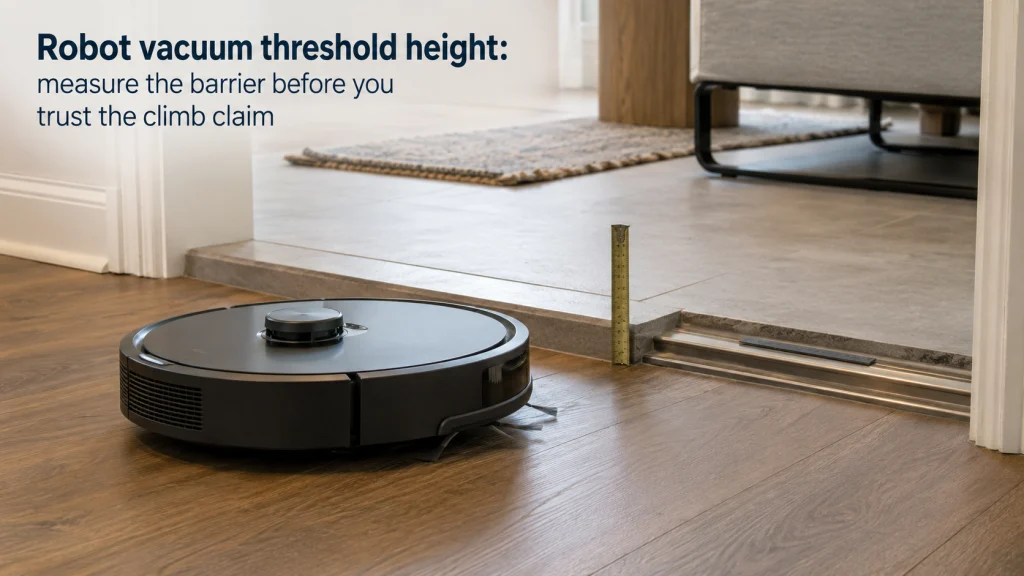
Robot vacuum threshold height is useful only when the number describes the same kind of barrier you have at home. A square doorway lip, a stepped sliding-door track, a rug edge, and a U-shaped furniture base can all be the same height while demanding very different climbing behavior. Measure the barrier from the approach floor, record its profile and approach space, then compare those details with the exact model’s single-threshold claim and independent test conditions. That process tells you whether the robot can actually move between the rooms you expect it to clean without routine rescues.
A bigger climb number can describe the wrong obstacle
A headline claiming several inches of obstacle crossing sounds decisive until you put that number beside a real doorway. One home may have a single square metal lip, while another has a two-tier sliding-door track with a flat landing between the tiers. The listed threshold height can describe either situation, and the larger number may apply only to the stepped version. Before trusting the maximum, identify the shape that the robot actually has to cross.
This is why a robot vacuum threshold should be treated as a fit problem before it becomes a feature comparison. The robot needs enough mechanical lift, wheel contact, traction, and room to approach the barrier in the way its climbing system expects. A machine can map the room perfectly and still stop at the doorway because its chassis cannot get over the edge. The practical question is not which model advertises the biggest number, but whether the evidence matches your barrier geometry.

Roborock Qrevo CurvX combines 22,000 Pa suction with a 3.14-inch ultra-slim body. Its AdaptiLift chassis is designed to change chassis height while Reactive AI recognizes obstacles. The system also includes zero-tangling brushes and automatic hot-water mop washing and drying.
Check On AmazonIf you click this link and buy, we earn a commission at no additional cost to you.
Treat threshold height as physical fit, not navigation
Threshold crossing belongs in the same early fit check as robot height or dock clearance. If the robot cannot move from the kitchen into the living room, a better map does not restore that floor coverage. The threshold is part of the route, not a minor specification to check at the end. A broader robot vacuum buying guide can handle the rest of the purchase after the doorway passes this fit check.
The distinction also protects you from comparing unrelated capabilities. Navigation decides where the robot intends to go, obstacle avoidance affects how it handles small objects and hazards, and threshold climbing determines whether the chassis can cross a raised transition on the same level. Those systems can interact, but one does not replace another. When the barrier is physically too tall or badly shaped for the exact model, software cannot create missing wheel reach or ground clearance.

Roborock Saros 10R pairs 22,000 Pa suction with a 3.14-inch slim body. Its zero-tangle system helps manage hair while the dock washes the mops with hot water. The robot also includes edge-cleaning capability for broader floor coverage.
Check On AmazonIf you click this link and buy, we earn a commission at no additional cost to you.
Measure the barrier the robot must cross
Measure the doorway from the side the robot will actually approach, because two directions can produce different climbs. A transition may be nearly flush from one room and noticeably raised from the other, especially where flooring thickness changes. Record the tallest vertical rise, but do not stop there. Width, edge shape, surface grip, and the amount of open floor in front of the threshold can change whether the wheels ever reach a useful pulling position.
A short home measurement check prevents the common mistake of matching two height numbers without matching geometry. Use a rigid ruler or tape measure against the lower floor and inspect the barrier from wheel level. If the track has several tiers, measure each rise and the horizontal landing between them. Keep those numbers beside the exact product page or test result so the obstacle type stays consistent.
Record vertical height from the approach floor
For a single lip, measure from the floor surface where the front wheels start to the top of the lip. Do not measure from a nearby rug pad, grout dip, or decorative trim that the robot will not actually roll across. If the floor is uneven, check more than one point along the path because the effective rise can change by several millimeters. The largest realistic rise in the robot’s travel line is the number that should drive the comparison.
Record width, bevel, and whether the transition has tiers
A square edge demands a more abrupt lift than a beveled transition of the same total height. A stepped track may let the robot climb one rise, settle its wheels on a landing, and then climb again, which is why some manufacturers publish a larger double-layer figure. Measure the top surface or landing between tiers instead of assuming two small steps automatically qualify for the advertised combined limit. If the robot cannot place its wheels where the test condition expects, the total height number is not a valid comparison.
Note surface grip and approach space
Wheel traction matters most when the robot is partly lifted and needs the drive wheels to pull the body forward. Smooth metal, glossy tile, loose mats, or dusty track surfaces can produce a different result from a secure wood test surface even at the same height. Also check whether a wall, cabinet, chair leg, or narrow hallway forces the robot to meet the threshold at an angle. The more restricted the approach, the less confidently you should treat a laboratory maximum as guaranteed real-home clearance.
- Measure the rise from each direction the robot may travel.
- Record whether the edge is square, rounded, beveled, or stepped.
- Measure the horizontal landing between tiers on a multi-step track.
- Note slippery surfaces, loose coverings, and narrow approach space.
- Photograph the barrier from floor level so the geometry is easy to compare later.
Those notes create a physical profile instead of one number with missing context. Keep that profile beside the model evidence. Match each measurement to the same obstacle type. Then separate single-layer claims from stepped claims.

CRAFTSMAN CMHT37225 is a 25-foot retractable tape measure with a self-locking blade. Fraction markings on the blade make common dimensions easier to read. A rubber overmold provides added grip while taking measurements.
Check On AmazonIf you click this link and buy, we earn a commission at no additional cost to you.
Separate single-threshold claims from stepped claims
A single-threshold claim describes one vertical barrier, while a double-layer or stepped claim assumes the robot can complete the climb in stages. The combined stepped number can be much larger because the robot is not lifting itself over the full height in one motion. Some specifications also require a minimum landing width between the two rises, which makes the geometry part of the claim. Treating the combined figure as a single vertical-wall limit can make a doorway look compatible when it is not.
Dreame’s X60 Max Ultra Complete is an evidence example, not a recommendation, because its specification separates a 45 mm single-layer step from an 88 mm double-layer step. Dreame also requires the lower step’s top surface to exceed 230 mm for that double-layer condition. Vacuum Wars tested the same model on a single barrier and reported a 51 mm clearance. Both numbers are useful, but they answer different questions and belong in separate columns.
| Evidence field | What it tells you | What it does not prove |
|---|---|---|
| Claimed single-layer limit | The manufacturer’s stated maximum for one rise under its conditions | That every edge shape, surface, or approach angle at that height will work |
| Claimed double-layer limit | The stated capability for a stepped barrier that meets the required tier geometry | That the same total height can be crossed as one vertical lip |
| Independent single-barrier result | What the tested unit cleared under the disclosed test surface and method | That your threshold has identical traction, width, edge shape, and approach room |
Compare geometry with geometry, not one maximum number with another. Match the claim type first. Keep single and stepped evidence separate. Then older assumptions about one universal threshold limit become easier to place in context.

Roborock Qrevo Curv 2 Flow combines 20,000 Pa suction with a SpiraFlow real-time self-cleaning roller mop. Dual zero-tangle brushes and AI obstacle avoidance address hair and objects during cleaning. The dock heat-washes and dries the mop, while the robot includes carpet-protection features.
Check On AmazonIf you click this link and buy, we earn a commission at no additional cost to you.
Why the old 20 mm rule no longer describes the whole market
About 20 mm, or roughly 0.8 inches, remains a useful reference point for many conventional robot vacuums. It is still common to see models whose published obstacle-crossing ability sits near that range, and a low doorway strip may fit comfortably within it. The mistake is turning that reference into a universal ceiling for every current design. Newer liftable and leg-assisted chassis systems have moved some machines well beyond the old class, so a blanket answer can now be wrong in both directions.
The opposite mistake is assuming every modern robot has inherited those higher capabilities. A newer app, stronger suction number, camera system, or self-cleaning dock says nothing by itself about how high the chassis can climb. Robot vacuum climbing height remains model specific, and some product pages split single and stepped limits while others publish only a general obstacle figure. If your home depends on one difficult doorway, verify that exact field instead of treating generation, price, or feature count as a substitute.

Roborock Q7 L5 delivers 8,000 Pa suction and combines vacuuming with mopping. Its LiDAR navigation scans the home and saves multiple floor maps. Dual anti-tangle brushes and automatic recharging support routine cleaning with less manual intervention.
Check On AmazonIf you click this link and buy, we earn a commission at no additional cost to you.
Decode the hardware that changes climbing behavior
Higher threshold claims are not created by suction power. Crossing depends on body position, wheel contact, traction, and underside clearance. Some designs rely on wheel size and suspension, while others actively raise the chassis or add leverage. The mechanism helps explain why similarly sized robots can have very different climbing limits.
Roborock’s Saros Z70 documentation describes an AdaptiLift chassis with independently adjustable three-wheel control and a 40 mm double-layer crossing claim. Dreame’s X60 documentation uses retractable legs and a swing-arm motor for its higher climbing figures. Neither description proves fit for your floor plan. It simply identifies the mechanism behind the claim so you can compare it with relevant test behavior.
Wheel size and suspension travel
Larger drive wheels can reach farther up an edge and maintain contact while the chassis changes angle. Suspension travel helps the wheels stay planted when one side of the robot is higher than the other, which can preserve traction over uneven transitions. Tread material and wheel loading also matter because spinning wheels do not create useful climb even when the geometry is theoretically possible. These details are rarely as easy to compare as a published height figure, so observed test behavior is especially useful here.
Liftable or adaptive chassis systems
A liftable chassis can raise the body or a portion of it to create additional clearance at the front, rear, or side. That movement may help the robot nose over a barrier that would otherwise catch the bumper or underside. It can also change how the main wheels meet a thick carpet or U-shaped furniture base, although those are not identical obstacles. The buyer should still verify the stated use case because a chassis-lift label does not establish one universal climbing height.
Actuator or leg-assisted designs
Leg-assisted systems add a more deliberate lifting action when the robot encounters a tall step. The front can be raised until the main wheels reach a surface where they can pull the rest of the chassis over. This can materially increase the single-edge limit compared with a conventional suspension-only design. It also makes test geometry important, since a controlled square barrier may produce a different sequence from a narrow metal track, soft rug edge, or awkward diagonal approach.

Roborock Saros Z70 combines 22,000 Pa suction with a 3.14-inch ultra-slim body. Its AdaptiLift chassis and FlexiArm Riser technology are built into the mobility system. The robot also includes AI obstacle avoidance and an automatic dock for mop washing and drying.
Check On AmazonIf you click this link and buy, we earn a commission at no additional cost to you.
Use independent tests that match the exact barrier type
An independent threshold test is most useful when the method is visible and repeatable. Vacuum Wars starts at 19 mm and adds strips of about 6 mm until the robot can no longer clear a secured barrier on smooth wood. That creates a consistent single-step result across tested models. It cannot recreate every doorway, but it is more useful than an unexplained claim that a robot climbs well.
Read the test result beside the manufacturer’s claim rather than replacing one with the other. A model that clears slightly more than its official single-step rating in one controlled test still has not proven it will cross a slippery track at a diagonal angle in your hallway. Likewise, a failure near the test maximum does not mean a lower beveled threshold in your home will fail. Use the test to narrow uncertainty, not to erase the differences between your floor and the test setup.

The MOVA V50 Ultra Complete combines 24,000Pa suction with FlexiRise navigation and multiple anti-tangle mechanisms for handling hair and debris. Its multifunction station supports hot-water mop self-cleaning and hot-air drying, while the robot can adjust its navigation hardware to reach lower spaces. With cleaning, navigation, mopping, and station functions spread across several control layers, it is a useful model for checking exactly which routines remain available when app or network access is limited.
Check On AmazonIf you click this link and buy, we earn a commission at no additional cost to you.
Treat tracks, rug lips, furniture bases, and room transitions differently
A sliding-door track can behave like a double threshold if it has two distinct rises with enough stable surface between them. A U-shaped chair or table base may present a narrow metal tube that the robot must mount and descend without getting high-centered. A thick rug edge can compress under the wheels, changing the effective angle as the robot climbs. A doorway transition strip may be simpler than all three, even when its measured height looks similar on paper.
Advice about getting a robot vacuum over thresholds often becomes too generic. The same height does not guarantee the same contact point, traction, underside clearance, or landing space, so classify the barrier before using a specification. If several problem spots exist, measure each one rather than assuming the tallest is automatically the hardest. A slightly lower square metal edge can be more troublesome than a taller beveled transition with good approach room.
- Single doorway lip: prioritize the exact single-layer limit and square-edge test behavior.
- Stepped sliding track: compare each tier and the landing width with the manufacturer’s double-layer conditions.
- Rug edge: consider compression, pile height, loose edges, and whether mops or brushes alter clearance.
- U-shaped furniture base: check narrow-bar clearance and the risk of the chassis centering on the base.
- Uneven floor transition: measure along the actual wheel path, not only at the visually highest point.
That classification turns a vague climbing claim into a practical fit check. Keep the barrier type beside the measurement. Use app behavior as a separate field. That way, physical crossing does not get confused with software that only changes the approach.

The Saker 10-inch contour gauge is designed to copy irregular shapes for tracing and dimension checks. Its adjustable locking mechanism holds the copied profile in place. The tool can be used around pipes, frames, ducts, tiles, laminate, carpet, and other shaped surfaces.
Check On AmazonIf you click this link and buy, we earn a commission at no additional cost to you.
Keep mapping labels separate from physical climbing ability
Some apps let you mark a passable threshold, ramp, or similar transition so the robot can use a different approach strategy. That setting can help a capable machine recognize where it should prepare to cross, but it does not increase wheel diameter or chassis travel. Dreame support documentation makes this distinction visible by offering threshold and ramp labels while separately giving model-specific obstacle guidance. If the robot is mechanically short of the barrier, an app label should not be treated as a hardware upgrade.
This separation is also useful when diagnosing why a route fails. If the robot reaches the doorway, attempts the climb, and physically cannot get over it, start with the barrier and chassis evidence in this article. If it never routes toward the correct room, the issue belongs with robot vacuum mapping; if cables, socks, or other small hazards are the real concern, use the robot vacuum obstacle avoidance decision instead. Keeping those jobs separate prevents a software feature list from hiding a straightforward fit failure.
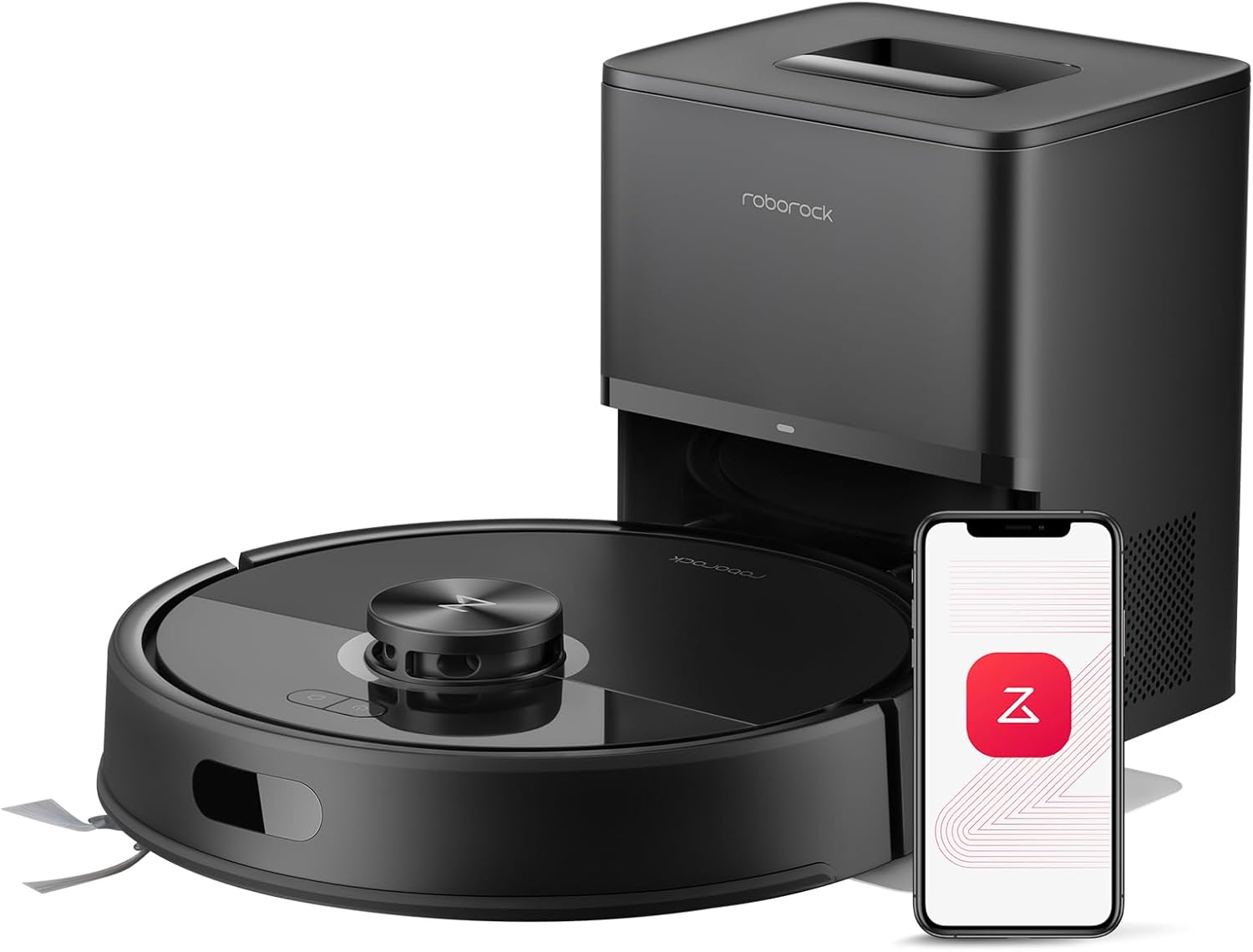
Roborock Q7 M5+ combines 10,000 Pa suction with PreciSense LiDAR navigation and app control. Its dual anti-tangle system is designed for pet hair and carpet. The self-emptying dock uses a 2.7-liter bag and is designed for extended intervals between manual emptying.
Check On AmazonIf you click this link and buy, we earn a commission at no additional cost to you.
Use ramps only within exact model guidance and safe floor geometry
A ramp can turn a sharp rise into a gentler approach, but it is not a universal DIY fix. Dreame support for compatible series specifies a 12-degree maximum ramp angle and warns against fall risk at the entrance or exit. That guidance is model specific, not permission to copy the setup for every robot. Check the exact manual or support page before adding a permanent threshold aid.
Stairs require a harder boundary because a crossing aid near a drop can create a new hazard. Do not disable cliff sensors, rely on a virtual zone as the only fall protection, or build an unstable ramp that can move under the robot. If the manufacturer does not approve the setup for that model and location, treat the threshold as impassable or choose a different route. The goal is less intervention, not a clever workaround that requires watching every cleaning run.

Klein Tools 935DAG measures 0 to 90-degree and 0 to 180-degree angle ranges. Its magnetic base and V-groove edges help position the gauge on compatible metal and rounded surfaces. The unit has an IP42 rating and includes a soft case and two AAA batteries.
Check On AmazonIf you click this link and buy, we earn a commission at no additional cost to you.
Build a candidate check before comparing the rest of the features
Once the barrier is measured, give every candidate the same fields. Record the claimed single-layer limit, relevant double-layer limit, and the closest independent result beside the home measurements you already took. Add the consequence of failure, since one retry is different from being stranded outside the dock room. This turns threshold crossing into a pass or fail requirement instead of a marketing bonus.
Do not reward missing information. If a manufacturer publishes only a vague obstacle number and the doorway is essential to whole-floor cleaning, mark the fit as unverified rather than assuming the most favorable interpretation. If the independent test uses a single square barrier and your home has a stepped track, keep those rows separate and look for the tier conditions. A candidate should move forward only when the evidence matches closely enough for the household’s tolerance for rescue and missed rooms.
| Check | What to record | Decision use |
|---|---|---|
| Home barrier | Height, tiers, landing width, edge profile, surface, approach space | Defines the obstacle the evidence must match |
| Single-layer claim | Exact maximum and any stated conditions | Primary field for one vertical lip |
| Double-layer claim | Per-tier heights, combined limit, required spacing or landing | Relevant only for a truly stepped barrier |
| Independent result | Barrier type, tested height, surface, attempts, disclosed method | Checks whether measured behavior supports the claim |
| Rescue risk | Whether failure blocks a room, blocks docking, or only affects an optional area | Sets how much uncertainty the household can accept |
If two robots clear the measured requirement with credible margin, threshold height can stop dominating the purchase. Mark the physical fit as passed. Keep the measurement in your notes. Then compare cleaning performance, maintenance, dock fit, obstacle handling, and other ownership features.

Roborock Qrevo S5V delivers 12,000 Pa suction with FlexiArm edge mopping. Its dual zero-tangle system and smart obstacle avoidance support mixed-floor cleaning. The robot lifts its mops by 10 mm and uses a dock for automatic mop washing, drying, and self-emptying.
Check On AmazonIf you click this link and buy, we earn a commission at no additional cost to you.

Roborock Q10 S5+ combines 10,000 Pa suction with obstacle avoidance and sonic mopping. Its dual anti-tangle design addresses hair while automatic mop lifting helps with carpet transitions. The self-emptying station is designed to reduce how often the dust bin needs manual attention.
Check On AmazonIf you click this link and buy, we earn a commission at no additional cost to you.
Final thoughts: measure the barrier before you buy
A threshold specification becomes useful only after the home obstacle has been reduced to the same geometry the claim describes. Measure the rise from the approach floor, record whether it is single or stepped, note the landing width and surface, and check how much room the robot has to approach. Then compare the exact single-layer or double-layer claim with an independent test that uses a similar barrier. That sequence is more reliable than treating the largest advertised number as a universal climbing limit.
The decision can be simple once the evidence lines up. If the barrier fits comfortably inside a verified single-step capability, threshold height can move down the priority list. If the fit depends on a stepped claim whose required landing your track does not provide, keep looking or treat that room as outside the automated route. A robot vacuum should reduce repeated household intervention, and that starts with proving it can physically reach the floor you expect it to clean.

Roborock QV 35A combines 8,000 Pa suction with smart obstacle avoidance and anti-tangle brushes. Its spinning mops work with an all-in-one dock that washes mopping pads and refills water. The dock also handles dust emptying and drying for a more automated cleaning routine.
Check On AmazonIf you click this link and buy, we earn a commission at no additional cost to you.
FAQs
📏 How do I measure a door threshold for a robot vacuum?
Measure vertically from the approach floor to the highest point the robot must climb. If the barrier has multiple tiers, record each rise and the horizontal landing between them instead of using only the total height.
🚪 Can a robot vacuum cross a 1-inch threshold?
Some models can, but many conventional robots cannot. Verify the exact model’s single-layer specification and look for an independent single-barrier test before assuming a 1-inch doorway will be passable.
🛞 Why can a robot cross one threshold but fail on another at the same height?
Edge shape, traction, landing width, approach angle, and underside clearance can all change the climb. A beveled wood transition and a square metal track can behave very differently even when a ruler shows the same height.
🗺️ Does marking a threshold in the app make the robot climb higher?
No. A threshold label may change routing or approach behavior on supported models, but it does not increase the robot’s mechanical lift, wheel reach, or chassis clearance.
🪜 Is a ramp a safe way to help a robot vacuum over a threshold?
Only when the exact model guidance supports a ramp and the location does not create a fall path. Follow the manufacturer’s angle, placement, and safety instructions rather than improvising a ramp near stairs or another drop.
References and sources
- Vacuum Wars threshold testing: Supports the single-versus-double distinction and reported single-barrier test results.
- Dreame X60 specifications: Verifies the model’s separate single-layer and double-layer threshold claims and the required stepped geometry.
- Roborock AdaptiLift documentation: Supports the description of independently adjustable chassis lifting and the listed double-layer crossing capability.
- Dreame threshold and ramp support: Verifies app threshold labels, ramp guidance, angle limits, and fall-risk cautions for supported series.