A personal blender makes the most sense when one drink is the normal batch and the blending cup can also be the cup you carry or drink from. A full-size countertop blender becomes more useful when the household regularly needs multiple servings, larger batches, or a wider range of non-smoothie jobs. Smoothie quality still matters, but fibrous greens, frozen fruit, seeds, thickness, batch size, cleanup, and storage tell you more than the word smoothie by itself. The right choice is the class that matches your repeated workload without forcing you to manage more vessel, more counter space, or more accessories than you actually use.
Start with the vessel, not the smoothie label
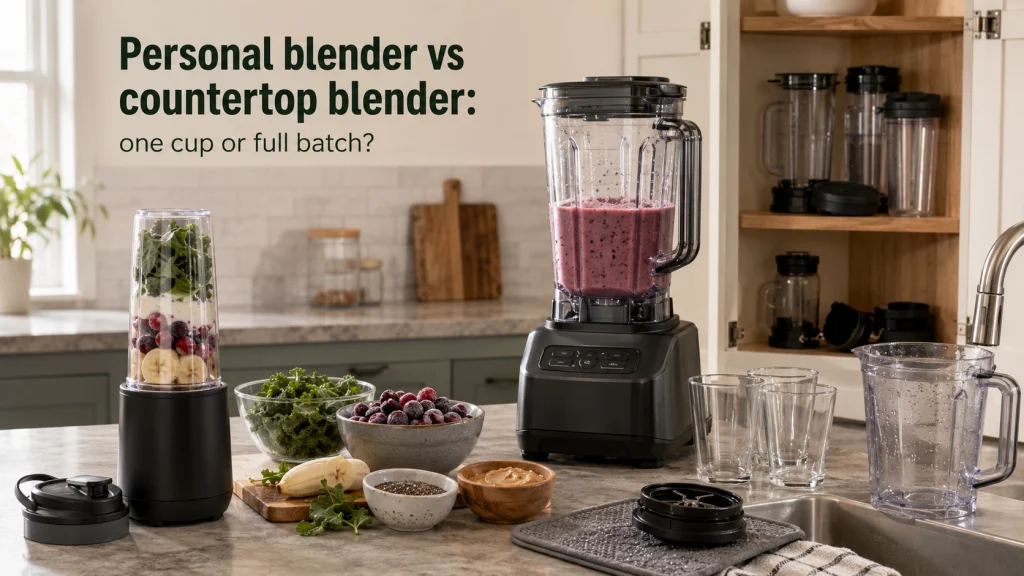
The personal blender vs countertop blender decision gets much easier when you picture what happens after the blades stop. With a personal blender, the blending cup can often become the drinking vessel, so one serving can move from ingredients to blend to lid without being poured into another container. That is a real workflow advantage for a person who makes one breakfast smoothie, one protein shake, or one small blended drink at a time. It matters much less on the morning when two or three people want a serving and the first cup has to be emptied, rinsed, reloaded, and run again.
A full-size pitcher reverses that trade-off because the vessel is built around a batch rather than a single drink. One larger blend can serve several glasses, and the extra room can be useful when the mixture needs space to circulate instead of being packed tightly into a small cup. The cost is that the pitcher is another object to pour from, wash, dry, and store, even when you only wanted one modest serving. Treat smoothies as one workload inside the class decision, then ask whether your normal morning looks more like one cup leaving the kitchen or one pitcher serving the household.

The BN301 uses a 900-peak-watt push-to-blend motor and includes three 20-ounce blending cups. Two spout lids support blending and drinking from the same personal-size vessel, while the storage lid adds another way to use a finished batch. The removable cups, lids, and blade assembly are dishwasher safe.
Check On AmazonIf you click this link and buy, we earn a commission at no additional cost to you.
Define the two classes by vessel and normal batch workflow
A personal blender is best understood as a compact motor base paired with a smaller blending cup that is meant for limited portions and often doubles as a drinking or travel container. A full-size countertop blender uses a larger pitcher and is generally designed around broader batch work, more room for ingredients, and serving from the pitcher into separate containers. Consumer testing organizations separate these classes because the vessel size, loading pattern, convenience, and test conditions are not the same. That distinction is more useful than assuming one class is simply a weaker or stronger version of the other.
The confusing part is that the market now includes compact machines with strong motors, large personal cups, and full-size systems that also accept smaller cups. That overlap is exactly why class labels should not replace an exact check of the vessel, fill line, blade assembly, controls, and approved uses. If you are comparing a countertop blender vs personal blender, start with the batch you actually make most often and the container you want to handle afterward. Then use how to choose a blender for your broader kitchen routine when you need to compare this choice with other blender types rather than only these two jar-style classes.

The BL660 combines a 72-ounce full-size pitcher with two 16-ounce to-go cups and spout lids. Its 1100-watt motor base supports three functions for frozen drinks, smoothies, sauces, and related blending jobs. The mixed vessel set makes it a useful example of why exact included containers matter more than a simple personal-versus-countertop label.
Check On AmazonIf you click this link and buy, we earn a commission at no additional cost to you.
Compare single-serving and multiple-serving jobs before motor specifications
The first useful comparison is not advertised wattage, preset count, or the number of blades shown in a product photo. It is how many servings you normally make in one run, how full the vessel becomes with your usual ingredients, and whether repeated batches would annoy you enough to change your routine. A one-person household that blends one drink most mornings may gain little from a large pitcher if it mostly sits half empty. A household making breakfast for several people can have the opposite problem because a small cup turns one job into a sequence of loading, blending, emptying, and reloading.
Independent testing also shows why motor numbers alone are a poor shortcut for the class decision. Performance depends on the interaction between the motor, blade design, vessel shape, ingredient load, and batch size, so two blenders with similar power claims can behave differently with the same kind of food. A personal blender can be excellent at its intended small batch without being the right tool for a family-size workload, while a full-size blender can be capable yet inconvenient for a small daily portion. Start with the batch pattern, then treat power as one specification to evaluate inside that pattern rather than the answer by itself.
| Normal job | Personal blender fit | Full-size countertop fit |
|---|---|---|
| One drink for one person | Strong fit when the cup is also the drinking vessel | Useful when the larger pitcher brings another frequent benefit |
| Two or more servings at once | May require repeated batches | Natural fit when the batch fits the pitcher |
| Very thick or heavily loaded blend | Depends on cup space and model capability | More room can help, but model performance still matters |
| Occasional single serving, frequent larger jobs | Convenient for the small job, but potentially duplicative | Often simpler for the repeated larger workload |
The table is a routing tool, not a claim that one vessel size guarantees better blending. If your normal portion nearly fills a personal cup before liquid and frozen ingredients have room to move, the nominal capacity may be less useful than it looks. If your normal portion barely covers the bottom of a large pitcher, a full-size model still needs to prove that it performs well with small batches. Use your recurring serving size as the first filter, then check the exact container limits and the way that specific blender handles your actual ingredient load.
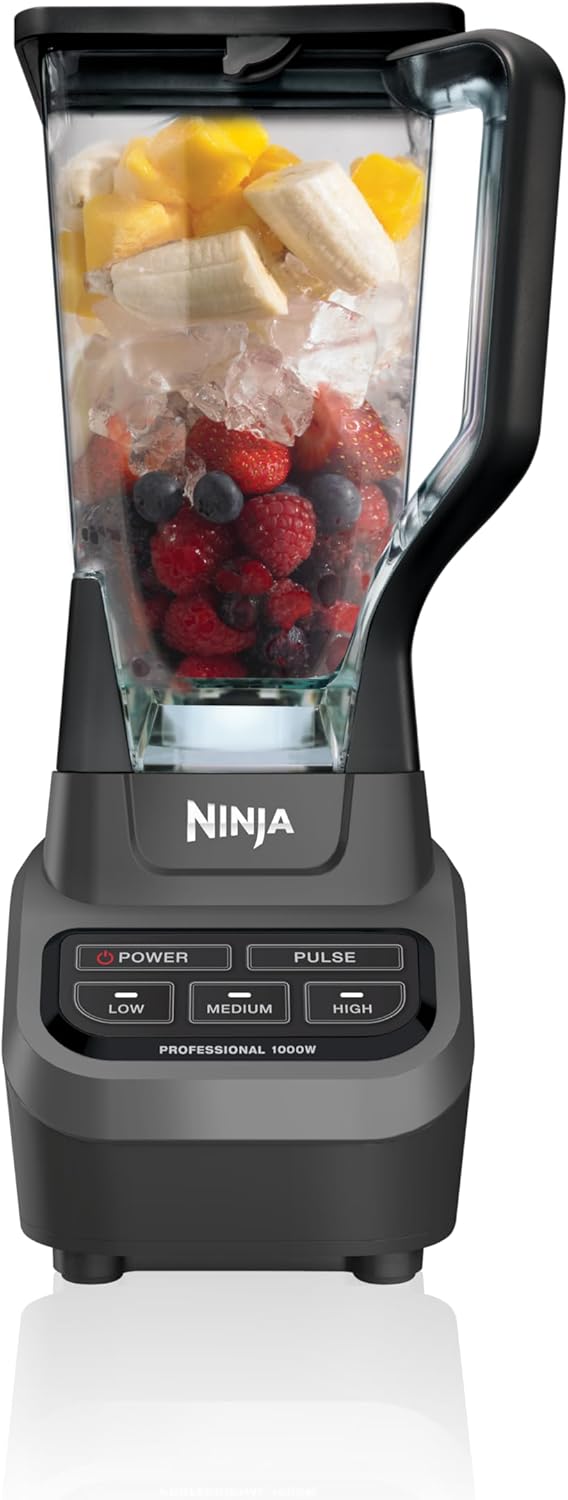
The BL610 is a full-size countertop blender with a 72-ounce pitcher and a 1000-watt motor. Its Total Crushing blades are designed for ice, smoothies, sauces, and other pitcher-size blending work. The large vessel makes this model relevant when one batch needs to serve more than a single personal cup.
Check On AmazonIf you click this link and buy, we earn a commission at no additional cost to you.
Judge smoothie workload by what goes into the cup
A smoothie made from soft fruit, yogurt, and enough liquid is a different workload from one packed with kale, frozen berries, seeds, nut butter, and very little liquid. Current independent blender testing deliberately uses difficult ingredients such as fibrous greens, frozen fruit, and ice because those ingredients expose differences that a simple drink may not reveal. RTINGS also tests fibrous ingredients at different batch sizes, which is useful because some full-size blenders handle a large load differently from a small one. Good Housekeeping uses repeatable smoothie and frozen-drink procedures for the same reason: texture should be judged under a defined ingredient load, not inferred from a motor label.
This is where the personal blender vs full-size blender comparison needs to stay conditional. A strong personal model can produce an excellent small smoothie, and a full-size machine is not automatically smoother merely because its pitcher is larger. The buying question is whether your repeated ingredients fit comfortably, circulate well, and reach the texture you expect without constant stopping, shaking, adding liquid, or dividing the recipe into smaller loads. If leafy greens, frozen fruit, seeds, or very thick blends are part of the routine, compare actual test conditions and the exact vessel rather than assuming the product class answers the performance question for you.

The BN401 is a personal blender with an 1100-peak-watt motor, Auto-iQ operation, and two 24-ounce cups. It is designed for smoothies and other single-serve blends that can include whole fruits and vegetables. The two to-go cups keep the workload centered on personal-size batches rather than a shared pitcher.
Check On AmazonIf you click this link and buy, we earn a commission at no additional cost to you.
Do not reduce the decision to smoothies
A blender that earns its counter or cabinet space should match more than the easiest job you can imagine for it. Personal cups can be useful for small portions of dressings, dips, sauces, or similar tasks when the ingredients and model are appropriate, but the smaller vessel also limits how much can be processed in one run. A full-size pitcher gives you more batch room and may come with controls or accessories that broaden the work it can do, although those features still need to be judged by the exact model. The important question is not whether a class can theoretically perform a task, but whether that task occurs often enough in your kitchen to justify the vessel and cleanup it brings.
Think about the jobs that recur after the smoothie phase of the week is over. If you regularly want larger sauces, multiple servings of blended mixtures, or other pitcher-size work, a full-size countertop machine can avoid the frustration of repeating a small-cup cycle several times. If nearly every use is a single cold drink or a small portion, broader capability may be something you pay for and store without using. For a wider look at countertop features and current shopping criteria, compare full-size blender options by the jobs they actually need to perform rather than treating a bigger machine as the automatic upgrade.

The SS401 combines a full-size blending and food-processing pitcher with additional blending accessories and seven functions. Its processing setup supports jobs beyond basic smoothies, including slicing, shredding, grating, and other food-prep tasks. This broader system illustrates how a countertop blender can earn space through recurring non-smoothie work rather than pitcher size alone.
Check On AmazonIf you click this link and buy, we earn a commission at no additional cost to you.
Keep hot-liquid capability model-specific
Hot liquids are one place where a class-level shortcut can become a safety problem. A manufacturer may approve hot blending in one vented pitcher while prohibiting it in a smaller sealed cup within the same product family, so vessel size and brand name are not enough to prove capability. Steam and pressure need a safe path to escape, and the exact lid, container, blade interface, fill limit, and operating instructions control what is allowed. Never assume that a cup can blend hot ingredients because it can hold a warm drink afterward, and never infer permission from a marketing photo or from the fact that another container on the same base is vented.
For this comparison, treat hot blending as an exact-model verification step rather than a point automatically awarded to every full-size blender or denied to every compact one. Check the owner’s manual or manufacturer support page for the exact vessel you plan to use, including whether hot ingredients are allowed, whether the lid must be vented in a particular way, and whether a different container is required. If the documentation is unclear, the safe conclusion is that capability has not been established. That keeps the buying decision grounded in evidence and prevents a useful cold-drink blender from being pushed into a job its container was not designed to handle.

The Vitamix 5200 is a 64-ounce full-size blender listed for smoothies, soups, ice cream, and other kitchen tasks. It uses stainless-steel blades and variable-speed control, and the container is designed around full-size pitcher use. Its soup capability is model-specific, which makes it a better fit here than assuming every full-size or personal vessel handles hot ingredients the same way.
Check On AmazonIf you click this link and buy, we earn a commission at no additional cost to you.
Compare cleanup from loading to drinking to washing
Personal blenders often look easier to clean because the vessel is smaller, but the real advantage comes from reducing handoffs rather than from cup size alone. When you blend in the same cup you drink from, you can eliminate the pour into a separate glass and the extra item that would need to be washed. That convenience shrinks quickly if the household makes several servings and the same cup must be unloaded and rinsed between batches. Removable blade assemblies, fixed blades, gasket areas, lids, straws, and dishwasher instructions also change the cleanup burden, so the exact part design matters more than the class label.
A full-size pitcher adds a pour step, yet one large batch can still create less total work than making several personal-cup batches back to back. The pitcher may also be easier to rinse when it has a wide opening and enough room to reach the interior, while a narrow cup can be easy to shake clean but awkward around threads or blade parts. Dishwasher-safe claims should be checked part by part because the cup, lid, blade assembly, and motor base do not necessarily share the same care instructions. Compare the full sequence from loading through final drying, especially if the blender will be used every day rather than only on weekends.
| Workflow step | Personal blender | Full-size countertop blender |
|---|---|---|
| Load | Easy for one portion, tighter for bulky ingredients | More room for larger loads |
| Blend | Usually centered on one cup | Usually centered on one larger batch |
| Drink or serve | Cup may be the drinking vessel | Usually requires pouring to another vessel |
| Clean | Smaller parts, but repeated batches add washing | Larger pitcher, but one batch may replace several cycles |
Use the workflow comparison to count repeated handling, not to declare one class universally easier. One cup that goes from base to refrigerator to cup holder can be a meaningful convenience, while three small batches for the same breakfast can erase it. A pitcher that feels oversized for one serving may be exactly right when it replaces multiple blending cycles. The cleanup winner is the setup that leaves you with the least repeated work for the batch you make most often.

The Power Elite uses a 40-ounce glass jar, removable blades, and a lid that can be handled as separate cleanup parts. Its jar, lid, and blades are dishwasher safe, while the motor base stays outside the wash cycle. The 700-watt blender also offers 12 functions, so cleanup can be weighed against the range of jobs the pitcher handles.
Check On AmazonIf you click this link and buy, we earn a commission at no additional cost to you.
Measure storage around the real parts, not just the base
A compact motor base does not automatically mean a small storage footprint once cups, lids, blade assemblies, and spare accessories are included. Personal systems can scatter into several narrow parts that are easy to tuck into a cabinet individually but annoying to keep together. Full-size blenders concentrate more of the bulk in the base and pitcher, which can be simpler to manage if they have a permanent counter spot and harder if they must be lifted into a cabinet after every use. Measure the appliance in the state you will actually store it, including the pitcher, lid, cord, and any cup or blade component you need for your normal routine.
Counter height matters too because a blender can technically fit under a cabinet while still leaving too little room to remove the lid, lift the pitcher, or load ingredients comfortably. Cabinet storage creates a different question: whether you are willing to lift the machine out and reassemble it every time you want one drink. The better fit is the one whose storage routine matches how often you use it, not the one with the smaller marketing footprint. If dimensions are already driving the decision, use blender sizes and physical fit checks to compare the measurements that actually control counter and cabinet use.

The QB3001SS is a compact personal blender with a 700-watt motor and two 16-ounce cups. The system also includes cup lids, so storage involves more than the footprint of the motor base by itself. Its small-vessel format is useful for readers comparing whether the whole set can live conveniently in a cabinet or on a limited counter.
Check On AmazonIf you click this link and buy, we earn a commission at no additional cost to you.
Treat extra cups, lids, and accessories as workflow parts
More cups and lids can make a personal blender easier to share, pack, or use repeatedly before the dishwasher runs, but bundle size is not value by itself. Every extra vessel needs a place to dry and a place to live, and replacement compatibility can depend on the exact model rather than on a cup that merely looks similar. A second cup is valuable when it prevents a real bottleneck, such as one person taking the only cup out of the house while another wants to blend. It is clutter when the original cup already covers the routine and the extras spend most of their time nested in the back of a cabinet.
Full-size systems can create the same problem through accessory bundles that combine pitchers, personal cups, specialized lids, or other attachments. A larger box can look like a better deal while quietly creating more assembly, more parts to wash, and more compatibility to track. Before paying for an accessory set, name the repeated job each piece removes and where the part will be stored between uses. If you cannot assign a frequent task to an accessory, treat it as optional inventory rather than as evidence that the blender is a better fit.

This Magic Bullet set includes a 250-watt motor base, multiple cups, resealable lids, lip rings, and a to-go lid. The bundled pieces let a household assign different cups and lids to blending, storing, or carrying a finished portion. Because the set contains several separate parts, its value depends on whether those accessories solve repeated workflow needs rather than simply increasing the item count.
Check On AmazonIf you click this link and buy, we earn a commission at no additional cost to you.
Choose personal, countertop, or both around the repeated job
A personal blender is the cleaner choice when one cold drink or one small portion is the dominant use, the cup-as-vessel workflow saves you a real step, and your normal ingredients fit without crowding the fill limit. A full-size countertop blender is more convincing when multiple servings, larger batches, or broader pitcher-size work happen often enough to justify the extra footprint. Owning both can make sense when those routines are genuinely separate and frequent, but two machines should solve two recurring problems rather than duplicate one easy smoothie. The decision is strongest when each appliance has a clear job and a clear storage place before you buy it.
Budget should follow that same logic because the cheapest purchase can still be poor value if it adds repeated work, while the more expensive class can be wasteful if its extra capacity is rarely used. Do not pay for a bigger pitcher solely because it seems more capable, and do not choose a compact cup solely because it looks easier to clean. Compare normal batch, difficult ingredients, storage, cleanup, and broader uses as one system. Then choose the smallest and simplest setup that handles the work you actually repeat without forcing you into multiple batches or unused capacity.
- Start here: Is one small serving your normal job?
- Yes: If the cup can also be your drinking vessel and your usual ingredients fit the exact model limits, choose a personal blender.
- No: Move to the next question.
- Do you regularly make multiple servings or larger pitcher-size batches?
- Yes: Choose a full-size countertop blender when one larger batch removes repeated loading and washing.
- No: Move to the next question.
- Are both the single-serve and larger-batch workflows frequent?
- Yes: Consider both only when each setup removes a recurring inconvenience that one machine cannot solve cleanly.
- No: Keep one blender class and avoid paying for duplicated capacity or accessories.
- Does your current blender already handle the repeated job without meaningful friction?
- Yes: Keep it. Buying neither is a valid outcome.
- No: Choose the class that removes the specific batch, cleanup, or storage problem you identified above.
Buying neither is easy to ignore, but it belongs in a useful comparison. A new appliance should remove enough recurring friction to justify its cost, storage, cleaning, and accessories. One unusual recipe rarely justifies a second blender class. A routine that consistently needs larger batches or broader blending jobs is a stronger reason to switch.

The NBR-0601WM is a 600-watt personal blender built around a 24-ounce cup. It is listed for shakes, smoothies, food prep, and frozen blending, keeping the normal workload in a single-serve format. That makes it a concrete option when the repeated job is one modest portion rather than a multi-serving pitcher batch.
Check On AmazonIf you click this link and buy, we earn a commission at no additional cost to you.
Know when this comparison is the wrong one
Personal does not mean portable, and that distinction matters if your real requirement is blending away from an outlet. A corded personal blender can be compact and easy to carry, yet it still depends on normal kitchen power and should not be chosen for a battery-away-from-home use case. If cordless use is the actual requirement, move to how to choose a portable blender for battery-powered use instead of stretching this comparison beyond its scope. That keeps the decision focused on the right constraint rather than treating every small cup blender as the same product type.
If you already know you want a personal format and are now shopping current models, compare current personal blenders by their tested small-batch strengths. If you are still deciding whether a blender is the right small kitchen appliance for the job at all, start with the broader small kitchen appliance decision before narrowing to a vessel class. Product rankings, exact dimensions, and battery use each deserve their own comparison because they answer different questions. Keeping those questions separate prevents a class decision from turning into a long list of unrelated features.

The Hamilton Beach 51182 is battery powered and USB rechargeable, so it is designed for blending without staying connected to a wall outlet. It uses a 16-ounce travel jar with a leakproof lid and six stainless-steel blades. That cordless design fits readers whose real requirement is portable, away-from-outlet use rather than merely choosing a smaller corded personal blender.
Check On AmazonIf you click this link and buy, we earn a commission at no additional cost to you.
Final thoughts: verify the workflow before you buy
By the end of this comparison, the useful question is no longer which blender class sounds more capable. It is whether the exact vessel, controls, approved uses, and cleanup parts support the routine you are trying to simplify. Check fill limits against your usual ingredients, confirm difficult workloads with credible testing, and verify hot-liquid permission from the exact manufacturer instructions. Those checks turn a broad class comparison into a purchase decision you can defend after the novelty of a new appliance wears off.
Storage deserves a final check because awkward storage can undermine otherwise good performance. Measure the assembled height, decide where the cups and lids will live, and make sure the parts you expect to use are actually included or compatible with the exact system. If the setup solves a repeated problem without creating a new storage or cleaning problem, the upgrade has a clear purpose. If it does not, keeping the simpler setup is often the more practical choice.

The BN701 is a full-size countertop blender with a 72-ounce pitcher, a 1400-peak-watt motor, and three Auto-iQ presets. Its Total Crushing blades target smoothies, frozen drinks, and ice-cream-style blending, and the removable parts are dishwasher safe. The model gives readers a specific vessel, control set, and cleanup arrangement to verify against their own repeated workflow before buying.
Check On AmazonIf you click this link and buy, we earn a commission at no additional cost to you.
FAQs
🥤 Is a personal blender enough if I only make smoothies?
It can be enough when you normally make one serving and your usual greens, frozen fruit, seeds, and thickness fit the exact cup and model capability. If you regularly need several servings or repeated batches, a full-size pitcher may create a simpler routine.
🧊 Is a full-size blender always better with frozen fruit and ice?
No. Independent tests show meaningful performance differences within both classes, so judge the exact model under a workload that resembles yours. Vessel shape, blade design, batch size, and ingredient load can matter as much as the class label.
🧼 Are personal blenders always easier to clean?
Not always. One cup can reduce pouring and dish count, but several back-to-back batches can create more repeated washing than one pitcher batch. Check whether the blade assembly, lid, cup, and other removable parts match the cleanup routine you prefer.
🔥 Can I blend hot soup in a personal blender cup?
Only when the exact manufacturer instructions approve hot blending in that exact vessel. Some systems allow hot ingredients in a vented pitcher while prohibiting them in smaller cups, so do not infer permission from brand, size, or motor power.
📦 Should I buy both a personal and a full-size blender?
Buy both only when single-serve and larger-batch blending are both frequent enough to justify two vessels or two machines. If one format can handle nearly all of your repeated work without annoying compromises, the second appliance may only add storage and cleanup.
References and sources
- Consumer Reports blender buying guide: Supports blender class distinctions and buying criteria beyond wattage alone.
- RTINGS blender test methodology: Supports fibrous-ingredient, batch-size, and crushed-ice performance testing.
- Good Housekeeping personal blender testing: Supports repeatable personal-blender smoothie, frozen-drink, usability, and cleaning tests.
- Vitamix product support FAQ: Supports checking hot-liquid permission for the exact container.