A food processor can arrive with a caddy full of blades, discs, and specialty pieces, but included does not automatically mean useful. The attachments worth paying for are the ones that replace repeated prep jobs often enough to justify their setup, washing, drying, and storage. Core tools such as the multipurpose blade and slicing or shredding discs usually cover more routine work, while dicing, dough, julienne, fry, and whisking tools earn their place only for narrower workloads. The practical buying test is simple: identify the cuts you repeat, verify exact compatibility, and count the ownership work before paying for a larger accessory package.
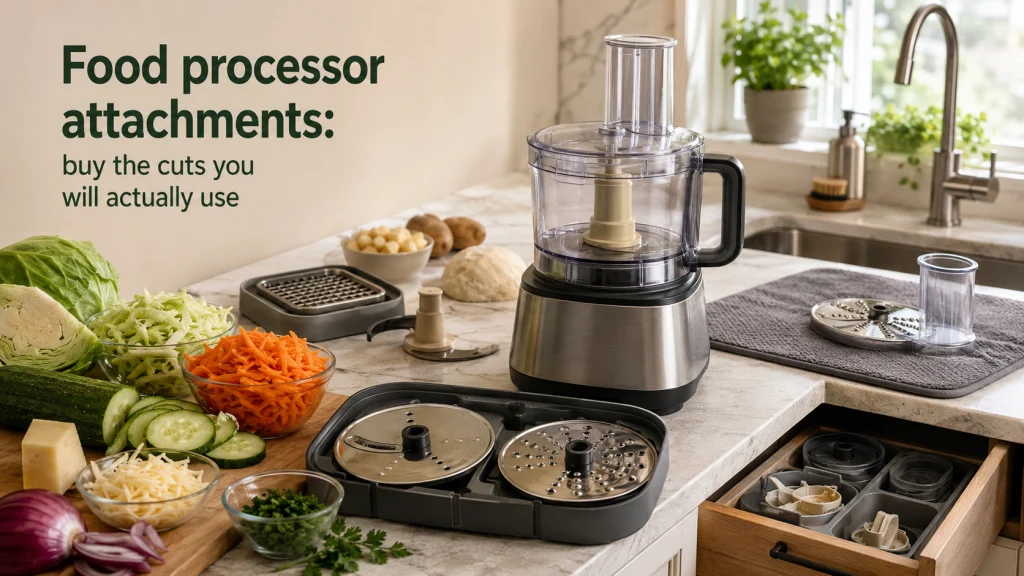
Separate included pieces from attachments you will actually use
Food processor attachments can make a product page look generous before the machine has chopped a single onion. A storage caddy filled with discs feels like extra value, but the useful question is how many of those cuts your household already makes often enough to want help. A slicing disc used every week can change prep time and consistency; a specialty disc used twice a year mostly changes cabinet density. Count repeated jobs first, then let the accessory count mean something.
That is also why a simpler processor can be the better purchase even when another package includes more food processor accessories. The right comparison is not two pieces versus eight pieces, but which manual jobs each piece replaces and how much handling it adds before and after processing. If the larger set forces you to unpack a caddy, wash several parts, and find permanent storage, that burden belongs in the buying decision. This page stays with attachment value, compatibility, cleanup, and storage rather than blade technique, sharpening, repair, or replacement-part catalogs. For the machine-level decision after that audit, the food processor guide keeps the rest of the purchase in view.
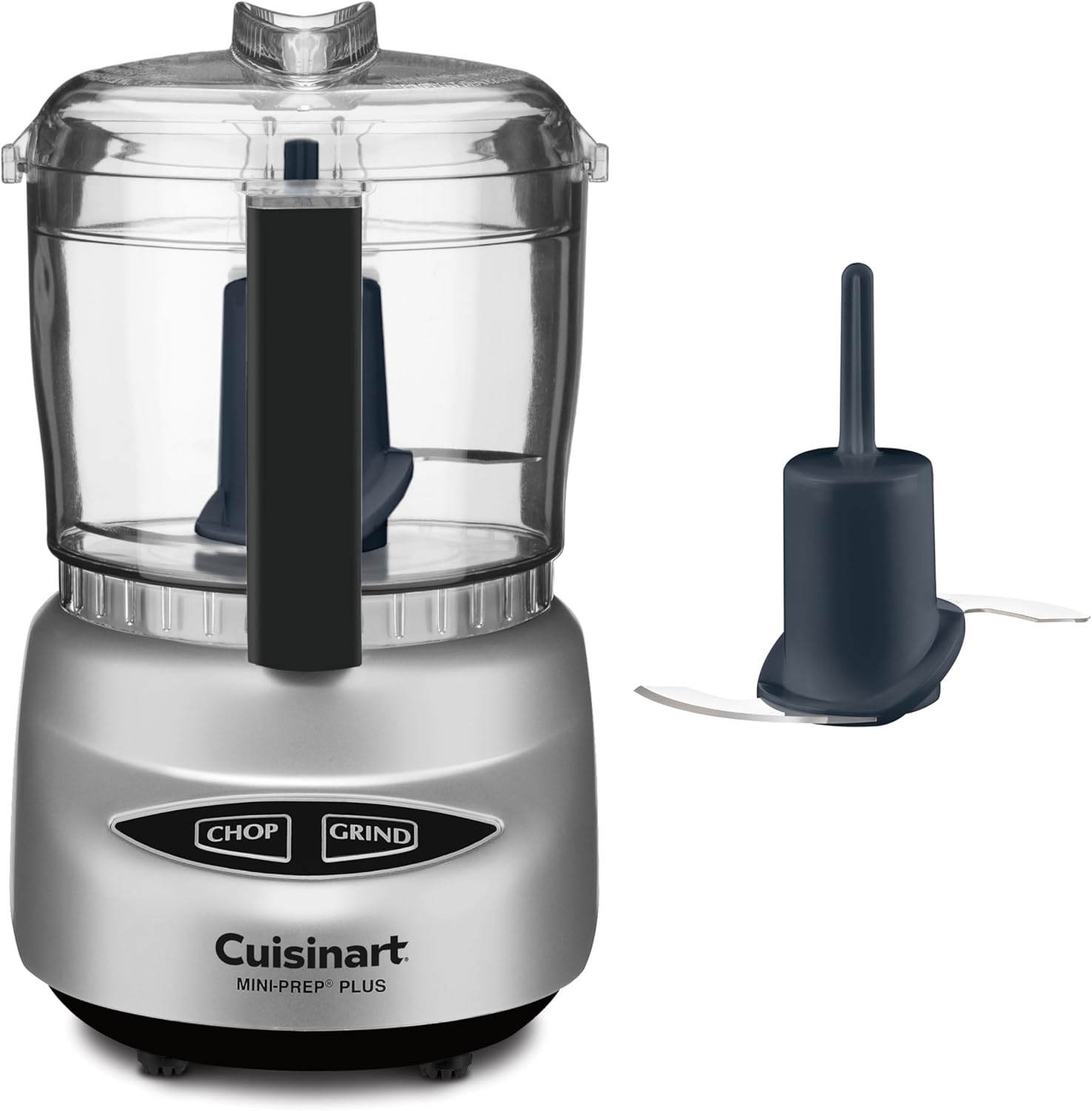
This 24-ounce Mini-Prep Plus uses a 250-watt motor and a reversible stainless steel blade for chop and grind functions. The package includes the work bowl, lid, reversible blade, and spatula. The bowl and lid are dishwasher safe for simpler cleanup.
Check On AmazonIf you click this link and buy, we earn a commission at no additional cost to you.
Separate core processing tools from specialty attachments
The most useful distinction is between tools that expand everyday processing and tools that buy a narrower shape or technique. A multipurpose S-blade handles chopping, mixing, and pureeing, while slicing and shredding discs handle repeated feed-tube work that a bowl blade cannot reproduce in the same form. Dicing grids, dough blades, julienne discs, fry discs, and whisking tools can be valuable, but their value depends much more heavily on the household’s menu and batch size. A piece is specialty because the job is narrower, not because the attachment is automatically unnecessary.
This map is a better starting point than counting the number of parts in the box. The same attachment can move from “skip” to “worth paying for” when the repeated job changes. It also prevents a common first-time-buyer mistake: assuming that a premium package must be more useful because it includes more pieces. Capability matters only when it matches work you actually want the processor to take over.
| Attachment class | Typical job | What makes it valuable | What can make it clutter |
|---|---|---|---|
| Multipurpose S-blade | Chopping, mixing, pureeing | Broad use across many recipes | Little extra value if the processor itself is rarely used |
| Slicing or shredding disc | Repeated slices or shreds through the feed tube | Frequent salads, slaws, cheese prep, or vegetable batches | Small quantities that are faster with a knife or grater |
| Dicing kit | Uniform cubes through a grid system | Large, repeated batches where uniform dice matters | Grid cleanup and extra assembly for small batches |
| Dough blade | Mixing and kneading dough | Regular dough workloads within the processor’s instructions | Occasional baking or a better-suited appliance already in use |
| Julienne, fry, or whisking tool | Specialized cuts or mixing action | A repeated task that replaces a separate manual tool | Rare use, awkward storage, or an easier tool already owned |
Use the table as a workload filter, not a ranking of good and bad attachments. Core tools deserve attention first because they cover broader prep patterns, while specialty tools need a stronger reason to justify space and cleanup. If you cannot name the repeated job an attachment replaces, do not count it as purchase value yet. That rule keeps a long accessory list from doing the thinking for you.

The BN601 pairs a 9-cup processor bowl with a 1000-peak-watt motor. Four Auto-iQ programs cover chopping, slicing, pureeing, and dough making. The package includes three blades plus a food chute and pusher.
Check On AmazonIf you click this link and buy, we earn a commission at no additional cost to you.
Start with what the multipurpose S-blade already covers
The multipurpose S-blade is the baseline against which extra attachments should be judged. Manufacturer guidance commonly assigns this blade chopping, mixing, and pureeing work, which means it already covers a broad range of tasks inside the bowl. If your normal prep is onions, nuts, dips, sauces, crumb mixtures, or other jobs where exact slice shape is not the goal, the standard blade may already do most of what you need. Paying for more discs will not improve a workload that never needed those cuts in the first place.
The important limit is shape and consistency, not a vague idea that one blade can do everything. An S-blade can reduce food into smaller pieces, but it does not turn repeated feed-tube slicing or shredding into the same kind of output as a dedicated disc. That is where food processor blades and discs stop being interchangeable and start representing different workflows. Before adding another piece, ask whether you need a new capability or simply a different result from a task the S-blade already handles adequately.

This 8-cup BLACK+DECKER processor uses a 450-watt motor and a stainless steel S-blade. The listing supports chopping, mincing, slicing, shredding, grinding, and pureeing tasks. A shredding disc is included alongside the S-blade for jobs that need a different cut.
Check On AmazonIf you click this link and buy, we earn a commission at no additional cost to you.
Judge slicing and shredding discs by repeated feed-tube work
Slicing and shredding discs tend to justify themselves when the household repeatedly processes enough food for the feed tube to be faster or more consistent than manual prep. Think cabbage for slaw, potatoes for layered dishes, vegetables for large salads, or blocks of firm cheese that would otherwise go across a box grater. The benefit is replacing a recurring knife, mandoline, or grater job at useful volume. If the normal task is half a carrot or a few cucumber coins, assembly and washing can erase the advantage.
Disc design also varies, so the exact model still matters when a specific thickness or reversible function is part of the purchase reason. Some systems use one reversible disc, while others use separate or adjustable discs, and one listing should not be assumed to match a related model. That difference affects capability and storage because one versatile disc may replace several fixed pieces. When comparing packages, write down the cut you repeat, the manual tool it replaces, and how much food you normally process before calling a disc essential.
| Repeated job | Current manual tool | Normal batch | Attachment earns value when… |
|---|---|---|---|
| Shredded vegetables | Box grater | Several cups at once | The disc replaces enough hand work to justify setup and cleanup |
| Even vegetable slices | Knife or mandoline | Multiple whole vegetables | Consistency and throughput matter repeatedly |
| Occasional garnish | Knife | Small amount | Usually not enough volume to make another disc worthwhile |
This worksheet turns a feature into a household job instead of a checkbox. If you dislike grating large batches or prepare the same sliced ingredients often, a disc can remove genuine friction. If you rarely make those cuts, the same attachment may stay in the cabinet. Frequency and batch size convert technical capability into purchase value.

The Hamilton Beach 70730 has a 10-cup bowl and dedicated slicing and shredding capability. It also handles mincing and pureeing for broader prep work. Its built-in bowl scraper can move ingredients from the sides without stopping to remove the lid.
Check On AmazonIf you click this link and buy, we earn a commission at no additional cost to you.
Make dicing kits earn their extra setup and grid cleanup
A dicing kit is attractive because uniform cubes are a visible upgrade over rough chopping, but it also adds a more specific workflow. The value rises when you routinely dice large batches for soups, stews, salads, meal prep, or other repeat jobs where size consistency matters. For a single onion or small side dish, a knife may create less total work once assembly and cleanup are counted. The question is whether your normal batch is large enough to make the grid worth involving.
Grid systems also create a cleanup condition that flat discs do not have to the same degree: food can lodge around openings and intersections, so the exact manual’s cleaning instructions matter. Do not assume a kit is dishwasher-safe, easy to clear, or compatible with another model just because the pieces look similar. A dicing attachment therefore buys a cut shape, an assembly routine, and a cleaning routine. If uniform dice is not a repeated need, paying for all three is hard to justify.
Key point: Treat a dicing kit as a batch-size tool. It makes the most sense when uniform cubes are frequent enough that the saved knife work consistently outweighs the extra grid handling, washing, drying, and storage.
The practical check is easy to run before shopping: look at the largest dicing task you do repeatedly, not the most ambitious task you might do someday. Then compare that batch with how willing you are to assemble and clean another set of parts. This keeps the decision grounded in actual prep instead of the appeal of perfect cubes. It also makes optional dicing kits easier to postpone until the need proves itself.

The Paradice 16 includes 8 mm, 12 mm, and 16 mm dicing attachments that slice and then dice ingredients into cubes. Its accessory set also includes an adjustable slicer, reversible shredder, French fry disc, S-blade, dough blade, and mini bowl. Separate storage boxes hold the attachments and cleaning utensils.
Check On AmazonIf you click this link and buy, we earn a commission at no additional cost to you.
Treat a dough blade as a workload-specific tool, not a baking upgrade
A dough blade is designed around dough work rather than general chopping, but its presence does not prove that the processor is the right appliance for every mixing or kneading routine. The processor’s bowl size, motor behavior, dough limits, and exact manual instructions still control what the machine is intended to handle. If dough is occasional and small, an extra blade may add more storage than convenience. If dough is frequent, the decision needs to move beyond the existence of the blade and into batch size, cleanup, control, and the kind of mixing you actually do.
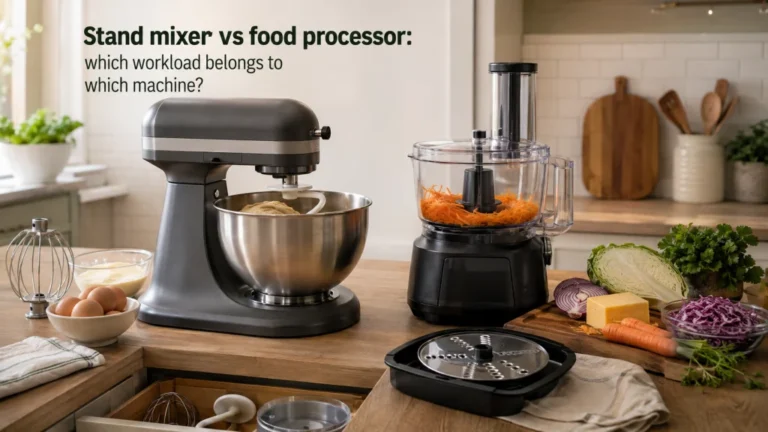
This is where appliance class matters more than accessory count. A food processor can be very efficient for some dough tasks, while a stand mixer offers a different bowl, mixing action, and workflow that may fit repeated baking better. Readers deciding between those two approaches should compare the full routines in stand mixer vs food processor rather than treating a dough blade as proof of equivalence. If the processor still fits the job after that comparison, verify the exact model’s dough instructions before using the attachment as a buying reason.

The DFP-14BCNY combines a 14-cup work bowl with a 720-watt motor. Its current Amazon listing includes kneading dough among its supported processing jobs. The same model is also listed for mincing, shredding, and pureeing, so dough is one workload within a broader processor.
Check On AmazonIf you click this link and buy, we earn a commission at no additional cost to you.
Price julienne, fry, whisking, and other specialty tools as separate capabilities
Specialty tools are easiest to judge when each one is mentally removed from the bundle and treated as a separate purchase. A julienne or fry disc buys a particular cut shape, while a whisking or emulsifying tool buys a different mixing action from the main blade. Some systems also offer a mini bowl for smaller processing jobs, a citrus-juicing attachment, or blender-style accessories that extend the machine beyond its standard bowl work. Each can be useful, but only if that specific job happens often enough to justify another part to assemble, wash, dry, and store.
This is especially important in small kitchens, where a mini bowl or specialty attachment may look compact by itself while the combined collection of discs, stems, grids, pushers, bowls, and cases becomes a second appliance footprint. A piece that replaces a frequently used hand tool or separate small appliance can deserve that space; one that duplicates a whisk, citrus juicer, knife, or blender you already reach for comfortably may not. The broader small kitchen appliances decision is always partly about what earns permanent storage. Judge each specialty capability by the job it replaces and the space it consumes, not by how impressive the bundle looks when everything is laid out together.
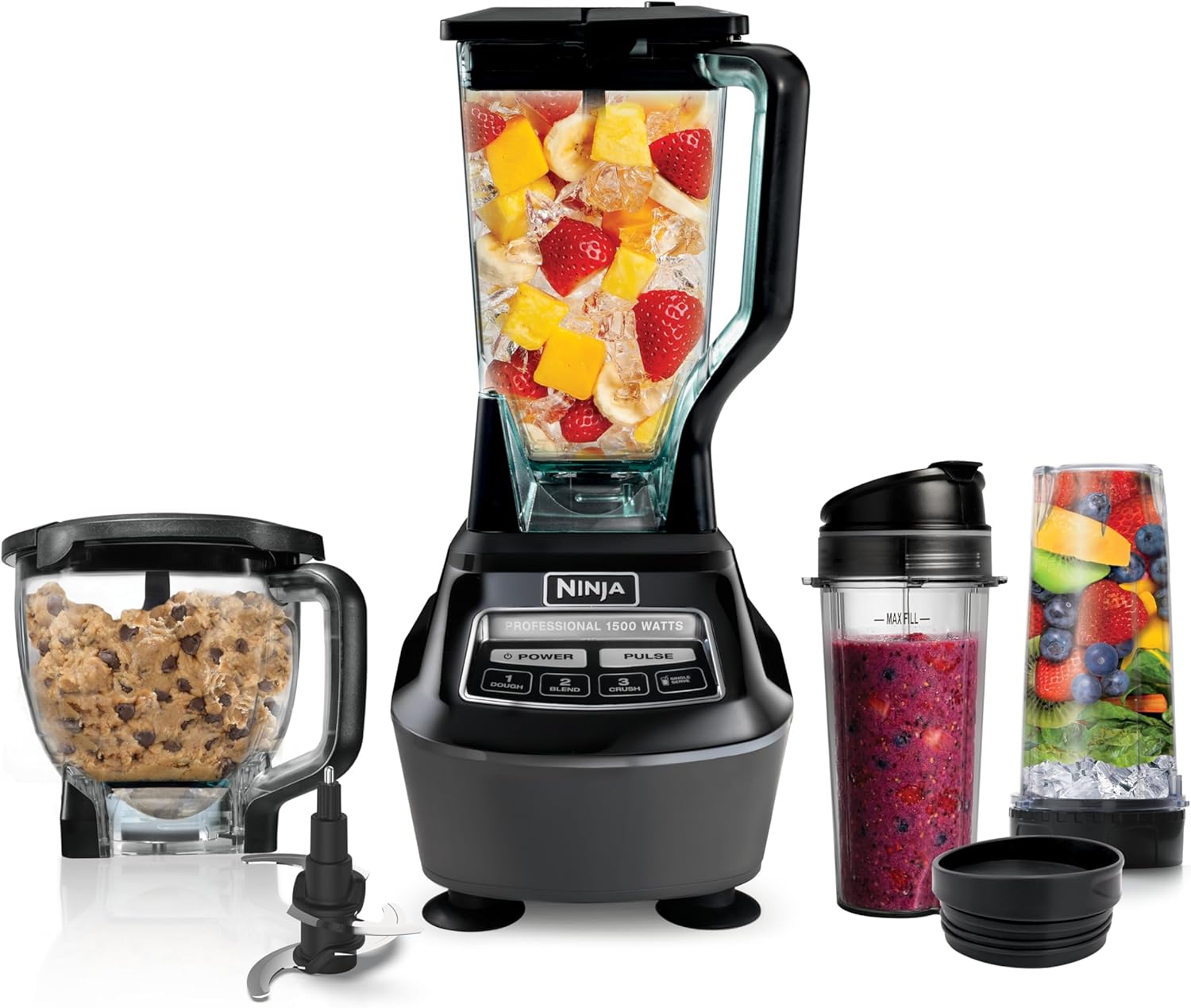
The BL770 combines an 8-cup food processor bowl with a 72-ounce blender pitcher and two 16-ounce to-go cups. Its 1500-watt system is listed for salsa, dough, shakes, and frozen drinks. The processor bowl supports food-prep jobs while the pitcher and cups support blended drinks.
Check On AmazonIf you click this link and buy, we earn a commission at no additional cost to you.
Verify compatibility and included status at the exact model level
Attachment compatibility is not a visual matching exercise. Related processors can use different bowls, drive interfaces, lids, stems, disc supports, or accessory systems, so a part name alone does not prove fit. Listings can also show optional accessories beside included pieces, making a package look broader than what actually ships. If an attachment is part of your purchase reason, verify the exact model number and the exact included or compatible part before paying.
Compatibility also matters after purchase because replacement or optional accessories can change the ownership cost of a processor. A low initial price matters less if the attachment you need is unavailable, requires a separate kit, or only works with another variant. Manufacturer documentation should take priority over family-name assumptions, photos, marketplace titles, or similar model names. Keep the check narrow and specific so the evidence answers the exact fit question you are asking.
- Confirm the processor’s exact model number.
- Confirm whether the attachment is included, optional, or sold only in a kit.
- Match the manufacturer’s compatibility statement to that exact model.
- Check whether the attachment requires a specific lid, stem, bowl, pusher, or storage component.
- Read the model manual for assembly, cleaning, handling, and operating limits that differ by attachment.
Do this verification before giving an accessory value in your comparison. If you cannot confirm that the piece fits the exact machine, treat it as unavailable until proven otherwise. That prevents a common mistake: paying for capability the actual processor cannot use. Exact compatibility is part of fit, not a detail to solve after checkout.

The DLC-8SBCYP1 is an 11-cup Pro Custom processor with a 625-watt motor. Its exact package includes a chopping and mixing blade, 2 mm shredding disc, 4 mm slicing disc, detachable disc stem, flat cover, and pushers. Its extra-large feed tube is designed to hold whole fruits and vegetables.
Check On AmazonIf you click this link and buy, we earn a commission at no additional cost to you.
Add washing, drying, safe handling, and storage volume to the value calculation
Attachment value changes after the food leaves the bowl. Every extra disc or grid must be removed, cleaned according to the exact manual, dried, and stored with sharp edges protected. A caddy can make that routine cleaner, but it occupies space and may change whether the processor fits the cabinet. Accessories scattered across several drawers create a different ownership routine from parts that stay with the machine.
Cleaning burden also scales differently by attachment type. A flat slicing disc has a different cleanup job from a dicing grid, while dough leaves different residue from dry shredding, so one universal cleanup score is not useful. What matters is whether the total routine fits the frequency of the job. A fast cut followed by an irritating wash and drying routine can still lose time on a small batch.
Ownership check: Before paying for a larger accessory set, identify where every piece will live, how it will be washed under the exact model instructions, where it will dry, and whether the storage system keeps sharp parts protected without making the processor harder to access.
Forgotten accessories are often a storage problem disguised as a feature problem. If pieces are awkward to retrieve, the knife, grater, or whisk already within reach usually wins. A compact, organized set can therefore be more useful than a larger collection with no sensible home. The better package is the one whose repeated tools remain easy to use and put away.

The GC10-S package includes an 8-cup stainless steel bowl and an 8-cup glass bowl. It also ships with two blade sets and a cleaning brush. The model provides two speeds and an overheat-protection indicator.
Check On AmazonIf you click this link and buy, we earn a commission at no additional cost to you.
Use buy-with, buy-later, and skip outcomes instead of buying every capability now
You do not have to settle every attachment decision at the same time you choose the processor. Core tools that match obvious weekly jobs can justify buying with the machine, while optional specialty pieces can wait until repeated use proves that the missing capability is genuinely inconvenient. That approach works well when a simpler package is available and compatible accessories can be verified later. It protects cabinet space and budget without closing the door on future capability.
The skip outcome matters just as much. If an attachment duplicates a manual tool you like, serves a rare recipe, or creates too much cleanup, skipping it is not losing value. It is refusing to pay for unused complexity. The table turns that decision into a repeatable filter.
| Outcome | Use it when… | Evidence you should have |
|---|---|---|
| Buy with the processor | The cut or task is frequent and the attachment replaces meaningful manual work | Confirmed compatibility, realistic batch need, storage plan, and acceptable cleanup |
| Buy later | The capability sounds useful but the repeated need is not proven yet | Verified optional availability and a clear trigger for adding it later |
| Skip | The task is rare, small, duplicated, or easier with a tool already owned | No repeated workload strong enough to justify cost and ownership burden |
This filter also keeps feature creep from quietly moving you into a larger, more expensive processor than your actual work requires. If one specialty attachment is driving the upgrade, compare the whole package penalty with the value of that repeated job. Sometimes the bigger package still wins, but now the reason is visible. Sometimes the simpler processor and a manual tool are enough.

The Hamilton Beach 72850 is a 3-cup electric chopper with a 350-watt motor. Its listing centers on chopping, mincing, and pureeing jobs. The 3-cup model is sold as a compact mini food processor and vegetable chopper.
Check On AmazonIf you click this link and buy, we earn a commission at no additional cost to you.
Compare current processor packages only after the attachment audit
Once you know which cuts and tasks matter, current processor packages become much easier to compare. A long accessory list stops being automatically impressive, and a simpler model no longer looks incomplete if its included tools match your recurring prep. You can focus on the exact package, usable capacity, feed-tube design, storage, cleanup, controls, and other machine-level factors that matter after the attachments have passed the workload test. This sequence keeps the purchase centered on household fit rather than the size of the accessory photo.
If you are ready to compare machines, the best food processors page is the next step because the attachment audit gives you a requirement list to bring into that comparison. Look for the models that include or support the few capabilities you actually need, then verify the exact package instead of assuming every variant is identical. If two machines remain close, the one with fewer useful parts may still be the better fit when it stores more easily and creates less cleanup. The goal is not to own every possible cut, but to buy a processor that handles the cuts your household repeats without adding a box of neglected hardware.

The Ganiza GC10 uses a 450-watt motor and includes two 8-cup bowls, one glass and one stainless steel. The package includes two sets of bi-level stainless steel blades and two processing speeds. The current black GC10 variant is identified as the 8 Cup+8 Cup package.
Check On AmazonIf you click this link and buy, we earn a commission at no additional cost to you.
Final thoughts: pay for the cuts you repeat, not the pieces in the box
By the time you compare packages, the useful attachments should already be obvious from your prep routine. Core tools can carry most everyday processing, while specialty pieces need a clear job that makes their extra handling worthwhile. Dicing, dough, julienne, fry, whisking, mini-bowl, and other add-on capabilities can all make sense in the right household, but they are not interchangeable forms of value. The package should fit the work, not the other way around.
Before buying, confirm the exact model, included parts, compatibility, storage system, and cleaning instructions for the attachments that influence your choice. Then decide which capabilities belong in the initial purchase, which can wait, and which you can leave out entirely. That gives you a processor setup built around the prep you actually do instead of the largest accessory count on the product page. Fewer parts can be the smarter purchase when every part earns its place.

The ECH-4SV is a 4-cup chopper and grinder with an auto-reversing SmartPower blade. Touch-pad controls provide its operating interface, and the removable parts are listed as dishwasher safe. The ECH-4SV is sold as a 4-cup small food processor for small jobs.
Check On AmazonIf you click this link and buy, we earn a commission at no additional cost to you.
Frequently Asked Questions
🔪 Which food processor attachment is the most useful?
For many households, the multipurpose S-blade earns the most use because it covers chopping, mixing, and pureeing. Slicing and shredding discs become especially valuable when those cuts are frequent and the batches are large enough to justify setup.
🥕 Is a dicing attachment worth paying extra for?
It can be if you regularly dice large batches and uniform cubes matter to your prep. For small or occasional jobs, the extra grid assembly and cleanup may make a knife the simpler choice.
🍞 Do I need a dough blade if my processor includes one?
Not automatically. Use it only if dough is a repeated workload that fits the exact processor’s instructions, and compare the full routine with other mixing methods you already use.
📦 Should I choose the processor with the largest accessory set?
No. Choose the package whose included or compatible attachments match repeated jobs, then count storage and cleanup before treating extra pieces as value.
🧩 Are food processor attachments universal?
No. Compatibility can depend on the exact model, bowl, lid, drive system, stem, and accessory kit, so verify the manufacturer’s compatibility information before buying a separate attachment.
🧼 Does dishwasher-safe labeling make an attachment low-maintenance?
Not by itself. The exact manual controls cleaning instructions, and you still need to consider food trapped in grids or crevices, drying, safe handling, and where the part will be stored.
References and Sources
- CHOICE attachment analysis: Supports the distinction between frequently useful core attachments and specialty options such as small bowls, juicing tools, and other pieces that may add storage burden without regular use.
- KitchenAid blade and attachment guide: Verifies common functions of S-blades, slicing and shredding discs, dough blades, dicing systems, and model-dependent accessory configurations.
- Cuisinart food processor guide: Supports common blade and disc functions and the need to distinguish standard, optional, and higher-feature attachment systems.