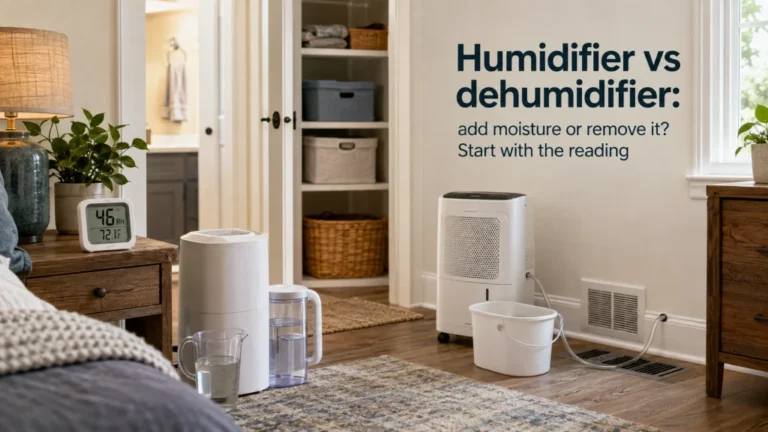
Using a humidifier well is less about producing a dramatic mist plume and more about controlling what happens to the room after moisture is added. The practical routine is to confirm the setup requirements, place and fill the unit correctly, run it at a measured output, watch room humidity and surfaces, then handle standing water as directed. Water type, additives, clearances, filters, and auto modes can vary by design, so manufacturer instructions still control those details. The goal is enough moisture without creating damp surfaces, mineral residue, stale water, or another maintenance problem.
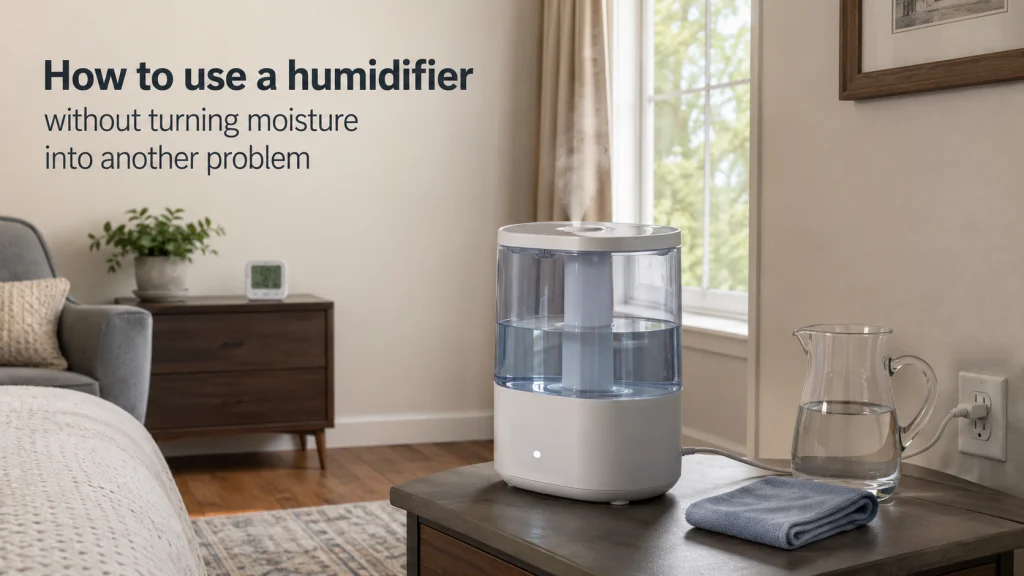
A humidifier needs a feedback loop, not a high setting
Learning how to use a humidifier starts with one correction: more visible mist does not automatically mean better use. Moisture accumulates while the unit runs, so the room has to tell you when the output is enough. Fill the unit, start it, check relative humidity and nearby surfaces, then adjust the output rather than leaving it on high by habit. Treating the machine like a fan ignores the fact that its output changes the room over time.
| Step | What to check | Next decision |
|---|---|---|
| Fill | Correct water, fill point, no spills | Reassemble and place securely |
| Run | Normal operation, no leaks | Let the room respond |
| Measure | Room RH and nearby surfaces | Compare conditions with the setting |
| Adjust | Too dry, stable, or becoming damp | Raise, hold, lower, or pause output |
| Empty | Standing water and care instructions | Refill fresh or dry for storage |
The useful signal is room condition, not how impressive the plume looks. EPA guidance recommends using a humidifier only when conditions require it and reducing use when condensation or wet surfaces appear, which makes a hygrometer or reliable built-in humidity reading part of the operating decision. This closed loop also answers the practical question of how you use a humidifier without creating a second problem: measure the effect and respond to it. If you are still choosing the appliance rather than operating one, the humidifier buying guide belongs before this day-to-day routine.

TempPro TP50 is a digital indoor hygrometer and room thermometer. It displays both room temperature and relative humidity on one screen. The listing positions it for indoor monitoring in homes, offices, greenhouses, and RVs.
Check On AmazonIf you click this link and buy, we earn a commission at no additional cost to you.
Identify the humidifier type and read the model instructions first
Before filling anything, identify whether the unit is ultrasonic, evaporative, impeller, warm mist, steam vaporizer, or another design named by the manufacturer. The type affects water handling, filters or wicks, mineral behavior, heat, and sometimes approved accessory use. A control labeled auto may use a humidity sensor, while another model may offer only manual output levels. Product-specific instructions should settle those differences before generic advice does.
Read the setup, filling, operating, cleaning, and storage sections together so you know the permitted fill opening, maximum level, required assembly, surface restrictions, and safety warnings. Warm-mist and steam designs also require attention to hot-water and steam hazards. Do not infer permission from a similar-looking model, especially for additives, replacement parts, or placement clearances. If the unit seems mismatched to the room, use the article on what size humidifier you need instead of trying to solve a sizing problem with a higher setting.

This Levoit cool-mist humidifier has a 6-liter tank and smart-app control. The listing specifies up to 60 hours of runtime and a 26 dB operating figure. It also includes top-fill access, auto mode, sleep mode, and an essential-oil feature.
Check On AmazonIf you click this link and buy, we earn a commission at no additional cost to you.
Place the unit where the manual permits and moisture can disperse safely
How to use a humidifier in a room begins with placement because water leaving the tank has to go somewhere. Use a firm, stable surface approved for the unit, and keep it out of a traffic path where a person, child, or pet can pull the cord or knock it over. Product instructions may specify wall clearance, floor versus tabletop use, mist direction, or restrictions around bedding and furniture. Follow those limits instead of copying a universal distance from a different design.
- Confirm the approved surface and any required clearances.
- Keep the power connection and nearby electronics away from drips and directed mist.
- Keep children and pets away from hot steam, the tank, cord, and unstable edges.
- Make sure intake and outlet areas are not blocked.
- Recheck walls, flooring, furniture, and fabrics after the unit has run.
Placement is successful when the machine stays stable and nearby materials stay dry during normal use. A convenient nightstand is a poor location if the plume lands on a wall, laptop, headboard, or bedding, just as a shelf is poor if it traps moisture. If the surroundings become damp, reduce output, reduce use, or relocate the unit within the model’s permitted setup. Moving it closer to the object you want to humidify can make local wetting worse rather than improve room control.

This silicone mat measures 18.5 by 11.5 inches and has raised edges. The listing describes it as waterproof and BPA-free. It is designed to sit under food and water bowls to help contain spills on the surrounding floor or surface.
Check On AmazonIf you click this link and buy, we earn a commission at no additional cost to you.
Fill with the water the design allows and stop at the correct level
The EPA recommends water with low mineral content because ultrasonic and impeller designs can disperse minerals from their water into the air. Distilled water can reduce mineral input, while some models may provide or recommend demineralization components. That does not create one universal water rule for every humidifier, so check the manufacturer’s stated water requirements for your unit. Use the water type it allows rather than assuming a rule from another design applies to yours.
Use the actual fill opening and maximum line instead of pouring water into a grille, mist outlet, electrical base, or another convenient-looking opening. After filling, seat the tank, cap, float, wick housing, or other removable parts exactly as instructed and wipe spills before connecting power. If you see a chalky film on furniture, follow the separate diagnosis for humidifier white dust rather than changing unrelated humidity settings. A careful fill routine checks water type, fill point, assembly, and leaks before the unit starts running.

This OXO measuring cup holds 4 cups. Angled interior markings are designed to be read from above and include ounces and milliliters. The listing also specifies a non-slip grip and dishwasher-safe construction.
Check On AmazonIf you click this link and buy, we earn a commission at no additional cost to you.
Keep oils, medications, and other additives out unless the model approves a method
A humidifier tank is not automatically an ingredient reservoir. Essential oils, inhalants, medications, fragrances, cleaners, and other additives should stay out unless the manufacturer specifically permits them and says where they belong. Some models use a separate tray, pad, cup, or accessory area, which is different from permission to pour a substance into the water. If the instructions are silent, do not invent a dosing method from a diffuser or another humidifier.
Key point: Use plain water unless the product instructions name an approved additive method. A separate tray, pad, cup, or compartment does not automatically change what belongs in the tank. Use only the route the manufacturer identifies for that design. If no additive method is approved, do not improvise one.
This matters because residues can create a cleaning, material, or warranty problem when they enter a path that was designed only for water. It also keeps the appliance’s job clear: a humidifier adds moisture, while a scent device is designed around a different function and material path. The humidifier vs diffuser comparison is the better route when fragrance is the real goal. Medication dosing and treatment advice are outside this article, so do not turn the appliance into a medical device based on an unsourced recipe.

This URPOWER diffuser has a 100 mL capacity and uses ultrasonic mist for fragrance. The listing includes seven-color LED lighting. It is marketed as an aromatherapy scent diffuser for bedrooms, offices, and other personal spaces.
Check On AmazonIf you click this link and buy, we earn a commission at no additional cost to you.
Start at a moderate or auto setting, then verify the room humidity
Once the unit is filled and placed correctly, start with a moderate output or the model’s normal auto mode instead of assuming maximum output is necessary. EPA guidance says not to humidify above 50 percent indoor relative humidity and notes that a hygrometer can measure room humidity. A built-in humidistat can be useful, but its reading represents the sensor where the machine is located rather than every point in the room. A separate hygrometer can help when the built-in value seems inconsistent with the rest of the space.
Do not chase one universal runtime because room volume, outdoor weather, heating, ventilation, doors, and starting humidity all change the result. A unit may need a long run in one room and much less in another, while auto mode may cycle on and off instead of running continuously. Overnight use is reasonable only when the product permits it, the unit is stable and not leaking, and humidity remains controlled. The operating condition matters more than the number of hours on the clock. If normal use requires maximum output, constant refilling, or repeated manual correction, that friction can point to a poor size, tank-capacity, or control fit rather than bad operating technique.

This AcuRite monitor combines an indoor humidity sensor with an indoor temperature sensor. It records daily high and low temperature and humidity values and shows a humidity-level icon. The housing supports tabletop placement or magnetic mounting.
Check On AmazonIf you click this link and buy, we earn a commission at no additional cost to you.
Adjust output from room readings and surfaces, not from mist appearance
A visible plume gives immediate proof that an ultrasonic or mist-producing model is running, but it does not prove that the room needs more moisture. Better signals are relative humidity and whether windows, walls, furniture, flooring, or fabrics are beginning to collect moisture. If the room remains dry and surfaces stay dry, a higher output may be reasonable within the manual’s range. If humidity rises quickly or nearby materials become damp, lower the output rather than judging performance by mist size.
Evaporative designs make the point obvious because much of their moisture output may be invisible. Think of the output control as a valve, not a performance score: higher is useful only when conditions call for more moisture. Auto modes can reduce manual adjustment, but they do not remove the need to inspect the room and respect the product limits. If a unit seems unable to affect the room at a reasonable setting, separate a possible sizing mismatch from a possible no-output problem before changing everything at once. Frequent babysitting of an otherwise healthy unit is also useful buying information because a dependable humidistat or better-matched output range may matter more to you next time than another decorative feature.

Govee H5075 measures room temperature and humidity and connects to the Govee app over Bluetooth. The listing specifies remote monitoring up to 164 feet and smart alerts. It also includes two years of data storage with export.
Check On AmazonIf you click this link and buy, we earn a commission at no additional cost to you.
Treat persistent condensation as a stop-and-reassess signal
Wet windows, damp walls, soggy fabric, or a wet area around the unit are not signs that the humidifier is working especially well. They show that moisture is collecting where it should not. EPA guidance says to reduce output, use the humidifier intermittently if output cannot be reduced, relocate it when appropriate, and avoid allowing absorbent materials to become damp. Check the room RH, output, ventilation, mist direction, and placement carefully instead of continuing at the same setting.
Warning: Stop and unplug the unit if it leaks into electrical areas, has a damaged cord, sparks, smokes, smells burned, overheats, or behaves in an uncontrolled way. Keep your hands dry when disconnecting power. Do not open the housing for internal electrical or mechanical repair. Use the manufacturer’s service path or qualified service instead.
Do not respond to condensation by moving the humidifier closer to the bed, wall, plant, or other object you wanted to affect. That can increase local wetting while doing nothing to improve the room feedback loop. Condensation may reveal excessive output, poor placement, or a unit that is too large for a small closed space. Lower the moisture load first, then change the setup only within the placement limits for that unit.

This digital indoor monitor combines temperature and humidity readings. The listing identifies a 4-inch touchscreen display. It also includes a backlit screen for easier viewing of room conditions.
Check On AmazonIf you click this link and buy, we earn a commission at no additional cost to you.
Refill with fresh water and do not let standing water become the routine
Portable humidifiers need a water routine after the run is over, not just another top-off. EPA guidance recommends emptying the tank, wiping surfaces dry, and refilling portable humidifiers daily to reduce microorganism growth, while console designs should follow the manufacturer’s water-changing instructions. Unplug before required water-handling steps and wipe drips from the base and surrounding surface. Fresh water and a repeatable empty-and-refill habit are part of normal operation.
Daily water handling is not the same as the full cleaning procedure. Descaling, disinfecting, wick care, filter replacement, and detailed component cleaning belong to the product-specific care instructions and the separate article on how to clean a humidifier. If the unit uses a wick, filter, cartridge, or other consumable, include that part in your ownership routine instead of waiting until performance changes dramatically. Keeping daily water care separate from periodic maintenance makes both jobs easier to follow. If frequent refills, awkward tank access, or recurring consumables become the part you resent most, treat those as concrete capacity and maintenance criteria when comparing a replacement.

This pack contains 24 reusable microfiber cleaning cloths measuring 16 by 12 inches. The listing describes them as ultra-absorbent, lint-free, streak-free, and non-abrasive. The cloths are washable for repeated use.
Check On AmazonIf you click this link and buy, we earn a commission at no additional cost to you.
Send mineral residue and full cleaning to the right maintenance path
White residue near a humidifier and film inside the tank are related to ownership, but they are not the same question as normal output control. Ultrasonic and impeller units can disperse minerals from water, so a white-dust problem should send you toward the water source, exact design, and any manufacturer-approved demineralization option. The article on humidifier white dust handles that diagnosis in more detail. Changing the humidity setting alone does not identify what the residue is or why it appeared.
Full cleaning also deserves its own workflow because the correct method depends on the tank, base, heating chamber, wick, filter, and other parts the unit actually uses. Do not pour a cleaner into the operating water path simply because another appliance uses that chemical. Product care instructions should identify what can be scrubbed, soaked, rinsed, wiped, replaced, or kept dry, while the humidifier cleaning process covers the maintenance decision separately. Owner-level care ends where the manufacturer reserves work for service personnel.

This reusable Scotch-Brite bottle brush is designed for glassware, water bottles, shaker bottles, and similar containers. The listing describes a non-slip handle and durable construction. The brush can be cleaned on the top rack of a dishwasher.
Check On AmazonIf you click this link and buy, we earn a commission at no additional cost to you.
Route no-output behavior to troubleshooting instead of opening the housing
If the humidifier stops producing visible mist or seems to stop adding moisture, first confirm what normal output should look like for that type. Not every design produces a visible plume, so appearance alone can mislabel normal operation as a failure. Then check owner-level basics such as water level, tank seating, float position, wick or filter status, reset conditions, output setting, and any indicator the product instructions explain. Those checks are different from disassembling a motor, heater, control board, or sealed internal part.
The article on a humidifier not producing mist handles that symptom without turning it into professional repair instruction. If the manufacturer calls for an owner reset or accessible cleaning step, follow it, but stop when the instructions point to service. A leak into the electrical base, burning odor, sparks, smoke, overheating, damaged cord, or uncontrolled operation is a stop condition rather than an invitation to remove screws. Separate room sizing, normal invisible output, and actual malfunction before deciding what failed.

TempPro TP49 is a compact digital indoor hygrometer and room thermometer. It displays room temperature and humidity. The listing positions it as a mini monitor for indoor temperature and humidity conditions.
Check On AmazonIf you click this link and buy, we earn a commission at no additional cost to you.
Shut down and store the unit dry when regular use ends
Seasonal shutdown should leave the humidifier clean and dry rather than full of leftover water. EPA guidance recommends cleaning when the product will not be used frequently, making sure parts are dry before storage, and dealing with used filters or demineralization components as directed. Check the storage instructions for which parts should be discarded, replaced, cleaned, or retained. Do not seal a damp tank, wick, or base in a cabinet and expect storage to finish the drying job.
Before the next use, check for dust, damaged seals, hardened deposits, cracked plastic, cord damage, stale consumables, or parts that were reassembled incorrectly. Follow any required first-use or post-storage cleaning step before filling. If the unit spent its last season running constantly, creating condensation, or demanding awkward refills, reconsider whether the type or size fits the room instead of repeating the same routine. The broader heating, cooling, and air quality equipment overview can help place that decision in the larger room-comfort picture.

This set includes six clear storage bins with lids, each sized at 19 quarts. The clear design makes stored contents easier to identify. The bins use a nestable design to save space when empty and are marketed for linens, decor, closet storage, and supplies.
Check On AmazonIf you click this link and buy, we earn a commission at no additional cost to you.
Final thoughts: run the humidifier from room feedback, not visible mist
The simplest reliable routine is fill, run, measure, adjust, empty, and maintain. Use product-specific instructions to settle water, placement, additives, filters, clearances, and safety details, then use room humidity and surface conditions to decide how much output is needed. Lower or stop the output when condensation or dampness appears, and keep standing water from becoming the default between uses. A humidifier should solve a dry-room problem without quietly creating a wet-surface, mineral, cleaning, or electrical problem beside it.
If the workflow feels difficult, identify which part is causing the friction before buying accessories or changing settings. Repeated refills, awkward tank handling, constant output adjustment, consumable upkeep, or a unit that regularly overshoots the room are also useful buying criteria for a future replacement. Room sizing, white dust, cleaning, and no-output symptoms still have different causes, so keep those decisions separate instead of treating every frustration as a feature problem. The right fit is the one that maintains the needed room condition without creating unnecessary work or damage.

This SwitchBot monitor measures indoor temperature and humidity and connects over Bluetooth for app control. The listing specifies a large LCD display and notification alerts. It also includes two years of data storage with export.
Check On AmazonIf you click this link and buy, we earn a commission at no additional cost to you.
FAQs
💧 What water should I put in a humidifier?
Check your model’s water instructions first. Lower-mineral water can reduce mineral release and scale, especially with ultrasonic or impeller designs, but not every design has the same water requirement.
📊 How do I know when the room has enough humidity?
Use a built-in humidistat or a separate hygrometer and watch nearby surfaces. EPA guidance says not to exceed 50 percent RH and to reduce use if condensation or dampness appears.
🌙 Can I leave a humidifier on overnight?
Only when the product permits that use and the unit is stable, not leaking, safely placed, and keeping room humidity controlled. Overnight use still requires the same humidity and condensation boundaries used during the day.
🧴 Can I put essential oils in the water tank?
Do not add them unless the manufacturer specifically approves that method for the unit. If the humidifier provides a separate aroma tray, pad, or cup, use only that approved route.
🪟 What should I do if the windows start getting wet?
Lower the output, reduce run time, and check the room humidity and placement. Persistent condensation is a signal to reduce the moisture load, not to keep running at the same setting.
🧼 Do I need to empty the humidifier every day?
EPA guidance recommends emptying, drying, and refilling portable humidifiers daily. Console or other designs should follow the manufacturer’s specific water-changing instructions.
References and sources
- EPA use and care of home humidifiers: supports lower-mineral water, daily water handling, humidity limits, condensation response, cleaning, and dry storage guidance.
- Honeywell humidifier setup and placement: provides manufacturer-level examples of stable placement, additive restrictions, moderate startup settings, and room monitoring.