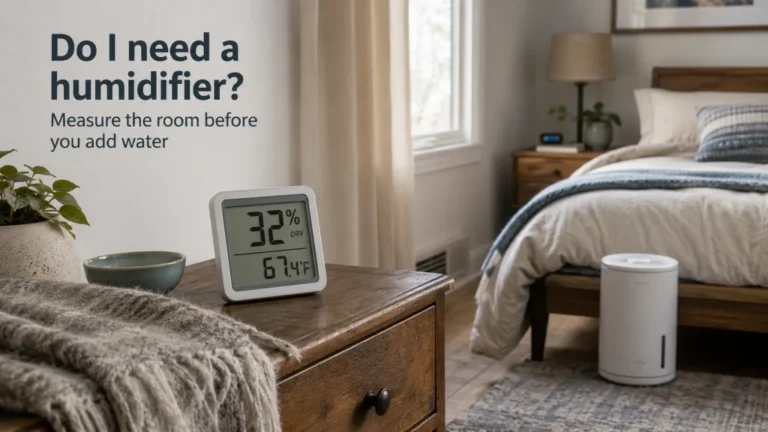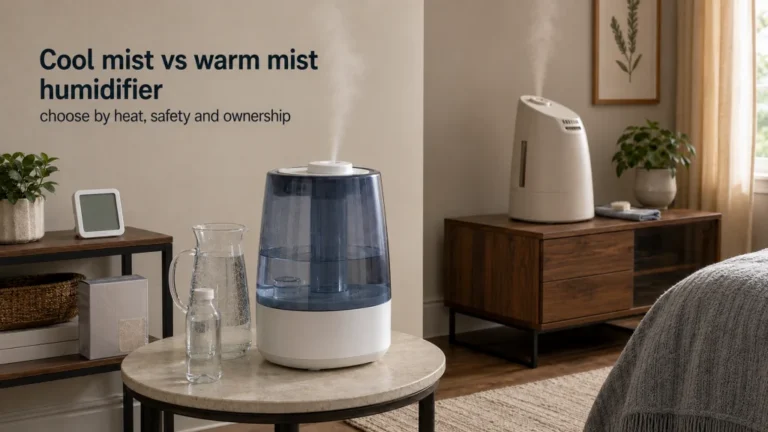
A humidifier and a diffuser can produce nearly identical-looking mist while being built for different household jobs. A humidifier is chosen to add meaningful moisture to room air, while a diffuser is primarily chosen to disperse scent, so the visible plume alone does not tell you which device you need. Essential-oil compatibility is also model-specific: some humidifiers forbid oil in the water tank, some provide a separate aroma tray, and a smaller group explicitly allow oil in the tank. Buy for the job first, then follow the exact device instructions for what may go into its reservoir.
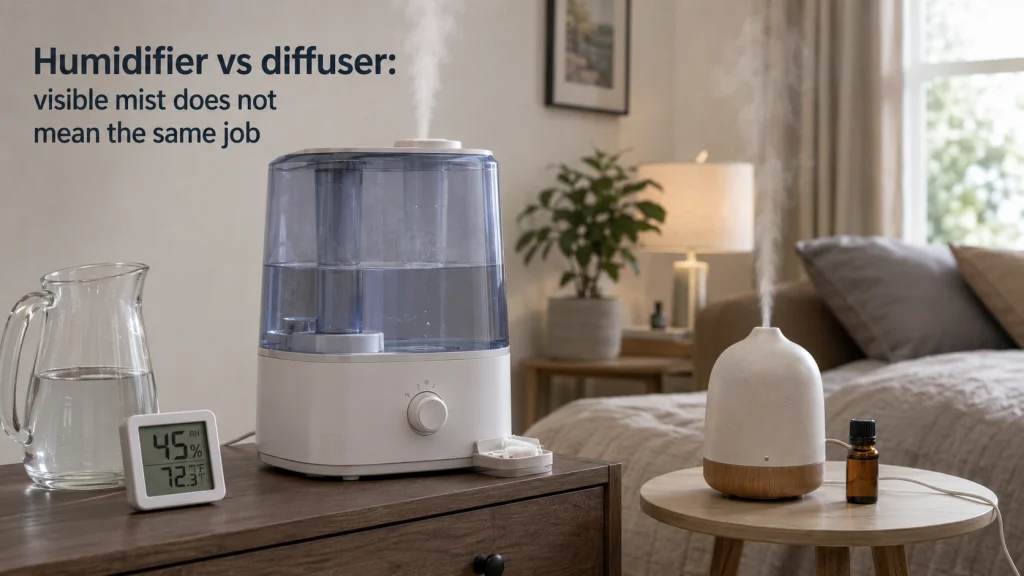
The same-looking mist can be doing a different job
Put a small ultrasonic humidifier beside a water-based aroma diffuser and the plumes can look almost interchangeable. That visual similarity is why a humidifier vs diffuser comparison should start with purpose rather than appearance. If the household problem is dry room air, the device needs to add enough water to the space to change moisture conditions in a useful way. If the goal is fragrance, the device needs to be designed to disperse scent safely according to its own instructions.
The mistake is treating visible mist as proof of equivalent performance. A small diffuser may release some water because water is part of its operating method, but that does not automatically make it a practical room humidifier. Likewise, a mist-producing humidifier is not automatically an aroma appliance just because the tank looks similar to a diffuser reservoir. The purchasing question is therefore not which plume looks stronger on a product photo, but which device is designed, sized, and documented for the job you actually want done.

This 500 mL ASAKUKI unit is sold as an essential-oil diffuser for home use. It includes remote-control operation and seven LED light colors. The listing describes a quiet cool-mist diffuser for bedrooms, living rooms, and offices.
Check On AmazonIf you click this link and buy, we earn a commission at no additional cost to you.
Define the job before comparing features
A household humidifier is fundamentally moisture-control equipment. Its useful specifications are the ones that help you judge whether it can serve the intended room and routine, such as moisture output, intended coverage, control method, refill burden, cleaning access, and the amount of water you will handle. Decorative lighting or an aroma feature may be pleasant, but neither proves that the unit can perform the humidification job. Start with the dry-air problem, the room, and the desired operating routine, then compare machines that are actually designed around that purpose.
An essential oil diffuser is primarily a scent-dispersal device, even when water and ultrasonic mist are part of the design. Its buying questions tend to center on whether the exact unit is intended for oils, how its reservoir and scent system are cleaned, and how much area the manufacturer expects the fragrance output to serve. That is why an essential oil diffuser vs humidifier decision should not be reduced to tank shape or the word “ultrasonic.” The mechanism may overlap, but the design goal can still be different. Liquid compatibility, output scale, and the ownership routine must be checked separately.

The TP50 combines a digital indoor thermometer and hygrometer in one room meter. Its display provides temperature and humidity readings together. It has a tabletop stand, a magnetic back, and a Fahrenheit or Celsius selector.
Check On AmazonIf you click this link and buy, we earn a commission at no additional cost to you.
Compare reservoir and output scale without using a fake cutoff
Larger water capacity often points toward a longer humidification routine, while smaller reservoirs are common in aroma diffusers, but there is no trustworthy universal tank-size line that turns one device class into the other. Product categories overlap, compact humidifiers exist, and combination units deliberately blur the labels. The better evidence is the manufacturer’s stated purpose plus the specifications that describe output, coverage, operating duration, and refill expectations. Capacity tells you how much water the device can hold, not by itself what job the manufacturer engineered it to perform.
The same caution applies to runtime claims. A device can run for many hours by releasing a very small amount of liquid, so long runtime does not prove strong room humidification. Conversely, a humidifier with a moderate tank can still be appropriate if its output and control strategy fit the room and the household is comfortable with its refill cycle. When comparing a diffuser vs humidifier, use capacity as one piece of the ownership picture, then verify what the device is actually expected to put into the air.
| Decision point | Humidifier | Diffuser |
|---|---|---|
| Primary household job | Add moisture to room air | Disperse fragrance or aroma |
| What to verify | Output, intended room coverage, controls, refill and cleaning routine | Oil compatibility, scent system, reservoir care, intended fragrance area |
| What tank size proves | How much water it can hold | How much liquid its operating cycle can hold |
| What visible mist proves | Only that a mist-producing design is operating | Only that a mist-producing design is operating |
The practical takeaway is to compare task evidence before visual similarities. If a listing gives you pretty plume photos but does not clearly state the device purpose or the operating information needed for your room, that is missing decision evidence rather than a reason to guess. A label can start the shortlist, but the manual and specifications should finish it. That approach also prevents a small scent device from being purchased for a moisture problem it was never designed to solve.

The Dreo HM713S uses a 6-liter tank and provides both warm and cool mist. Its listing specifies output up to 500 mL per hour and runtime up to 60 hours. A smart humidity sensor works with app control plus Alexa and Google voice control.
Check On AmazonIf you click this link and buy, we earn a commission at no additional cost to you.
Do not assume a diffuser can meaningfully humidify a room
A water-based diffuser does release some moisture because its mist contains water, but “releases water” and “works as a room humidifier” are not the same claim. Humidification is a room-level job, so the relevant question is whether the device is designed to add enough moisture for the intended space and whether the manufacturer provides humidification-oriented output or coverage guidance. A diffuser bought primarily for scent may not provide that evidence at all. If the reason for shopping is dry indoor air, choose from devices sold and documented for humidification rather than hoping a fragrance appliance will do both jobs adequately.
This distinction also keeps expectations realistic in smaller spaces. A bedside diffuser may create a visible plume near the unit, yet the plume’s visibility does not show how much the overall room humidity has changed. If measurable room moisture is the goal, use a hygrometer to understand the room condition and evaluate a humidifier designed for that scale of work. The broader heating, cooling and air quality equipment overview can help place humidification in the larger home-comfort decision instead of treating any mist-producing gadget as equivalent.

This AcuRite unit combines indoor temperature and humidity monitoring in one digital display. It records daily high and low indoor temperature levels. Its comfort indicator also shows whether the measured humidity is low, high, or in the ideal range.
Check On AmazonIf you click this link and buy, we earn a commission at no additional cost to you.
Do not assume a humidifier tank accepts essential oils
The reverse mistake is just as common: a buyer sees a cool-mist humidifier, notices that an oil diffuser also uses water, and assumes a few drops of oil can go into the humidifier tank. That is not a safe universal shortcut because additive compatibility depends on the exact materials, water path, misting system, and manufacturer instructions. Honeywell’s HUL525, for example, provides a separate essential-oil tray while explicitly prohibiting essential oils and other additives in the water tank. The correct rule is simple: no oil goes into a humidifier reservoir unless the exact model documentation says that reservoir is designed for it.
This is also why generic advice such as “ultrasonic humidifiers can use oils” is too broad. Honeywell’s HUL530 shows the opposite model-specific outcome: its documentation explicitly permits essential oil in the tank and reservoir and also provides a separate oil tray for a subtler scent path. Two products from the same broad appliance family therefore have different liquid rules. If you already own a humidifier and want fragrance, check the exact model page or manual before adding anything beyond the approved liquid, and use the humidifier operating instructions for the owner-level steps that apply after the device has been chosen.

This Vicks 3-in-1 model combines a cool-mist humidifier, an essential-oil diffuser function, and a color-changing night light. The listing also documents compatibility with Vicks SleepyTime VapoPads. The selected White variant is listed specifically as a nursery humidifier.
Check On AmazonIf you click this link and buy, we earn a commission at no additional cost to you.
Treat combination labels as a claim that still needs proof
A product labeled “humidifier and diffuser” may genuinely be designed for both jobs, but the label does not tell you how the two functions are implemented. One combination design may keep oil out of the water path by using a separate pad or tray. Another may use oil-resistant tank materials and explicitly allow oil in the reservoir. A third may use the word “diffuser” loosely while offering little evidence about scent handling beyond marketing copy, so the exact manual matters more than the front-of-box phrase.
For a combination product, verify each job separately. Confirm that the humidification side has the output, controls, and room guidance you need, then confirm exactly where scent material is permitted and how that area is cleaned. If one half of the combination is poorly documented, treat that as an unknown rather than assuming the missing capability. A true two-purpose device can be convenient when both jobs are used often, but it earns that convenience only when both functions are explicitly supported and the extra cleaning does not create more work than two simpler devices would.

The Levoit Dual 150 combines a 3-liter cool-mist humidifier with an essential-oil diffuser feature. Its listing documents a top-fill design for the water tank. A 360-degree nozzle is also specified for directing the ultrasonic mist.
Check On AmazonIf you click this link and buy, we earn a commission at no additional cost to you.
Use three additive outcomes instead of one universal oil rule
Essential-oil compatibility becomes much easier to handle when you stop looking for one rule that applies to every humidifier. The owner decision normally lands in one of three documented outcomes, and each outcome tells you exactly where the oil belongs or whether it belongs in the device at all. This approach is safer for the appliance and clearer for the buyer because it makes permission an evidence question, not a guess based on appearance. It also prevents a separate aroma tray from being mistaken for permission to pour oil into the water reservoir.
- Oil forbidden in the water system: use only the liquid the manual specifies for the tank and reservoir.
- Separate aroma tray or pad: put oil only in that dedicated area and follow its cleaning or replacement instructions.
- Tank compatibility explicitly approved: follow the exact model directions for the reservoir and do not extend that permission to other humidifiers.
Before using any additive, verify the model number on the appliance rather than relying on a family name, a similar-looking listing, or a manual for a neighboring model. Then find the section that names the tank, reservoir, tray, pad, medicine cup, or other specific interface and read what liquids are allowed there. If the instructions are silent or ambiguous, do not improvise with oil, fragrance, alcohol, medication, or household mixtures. The absence of a prohibition is not the same as documented compatibility.

The Dreo HM735S has an 11-liter tank and a separately named Aroma Box. Its listing specifies coverage up to 700 square feet and runtime up to 100 hours. Auto Mode, app control, and remote control are also documented for this exact model.
Check On AmazonIf you click this link and buy, we earn a commission at no additional cost to you.
Scent compatibility changes the cleaning job
Plain-water humidifier care already involves regular emptying, drying, and model-specific cleaning, so adding a scent function can create another surface or component to maintain. A separate oil tray or pad keeps fragrance material out of the main water path, but that tray can still collect residue and may need wiping or pad replacement according to the manufacturer’s directions. A tank that is explicitly designed for oil creates a different cleaning path because the approved scent material contacts the reservoir itself. That does not make either design automatically better; it changes where residue can collect and what the owner must clean.
Think about that workload before paying extra for a combination feature. If fragrance is occasional, a dedicated tray that can be ignored during plain-water use may be simpler than routinely scenting the main reservoir. If the device is used only as a humidifier, introducing oils adds a cleaning variable that provides no benefit to the moisture-control job. For general water-side care and mineral-residue handling, follow the exact manual and the steps in humidifier cleaning and maintenance rather than borrowing cleaning instructions from a diffuser.

These Amazon Basics microfiber cloths measure 16 by 12 inches and come in a 24-pack. Amazon lists them as ultra-absorbent, lint-free, streak-free, and non-abrasive. They are reusable and washable and come in blue, white, and yellow.
Check On AmazonIf you click this link and buy, we earn a commission at no additional cost to you.
Keep fragrance claims and exposure advice outside the buying decision
This comparison is about household equipment purpose and compatibility, not about recommending essential oils for sleep, congestion, mood, pets, children, or any therapeutic outcome. Those questions require a different evidence standard and can involve individual sensitivity, exposure, and medical or veterinary considerations that a humidifier buying article should not try to settle. Here, the useful decision is narrower: decide whether you need measurable room humidification, scent diffusion, or a documented combination device. Then follow the manufacturer’s liquid and placement instructions for the exact model.
The same boundary applies to home mixtures and improvised scent recipes. A water tank is not a general-purpose fragrance container, so alcohol, medications, cleaners, concentrated fragrance, or other additives do not belong there unless the manufacturer explicitly approves that substance for that location. A separate aroma tray also does not change the rules for the reservoir itself. Keeping the decision this narrow makes the purchase easier: choose the right device class, then use only the liquids and scent path the product was designed to handle.
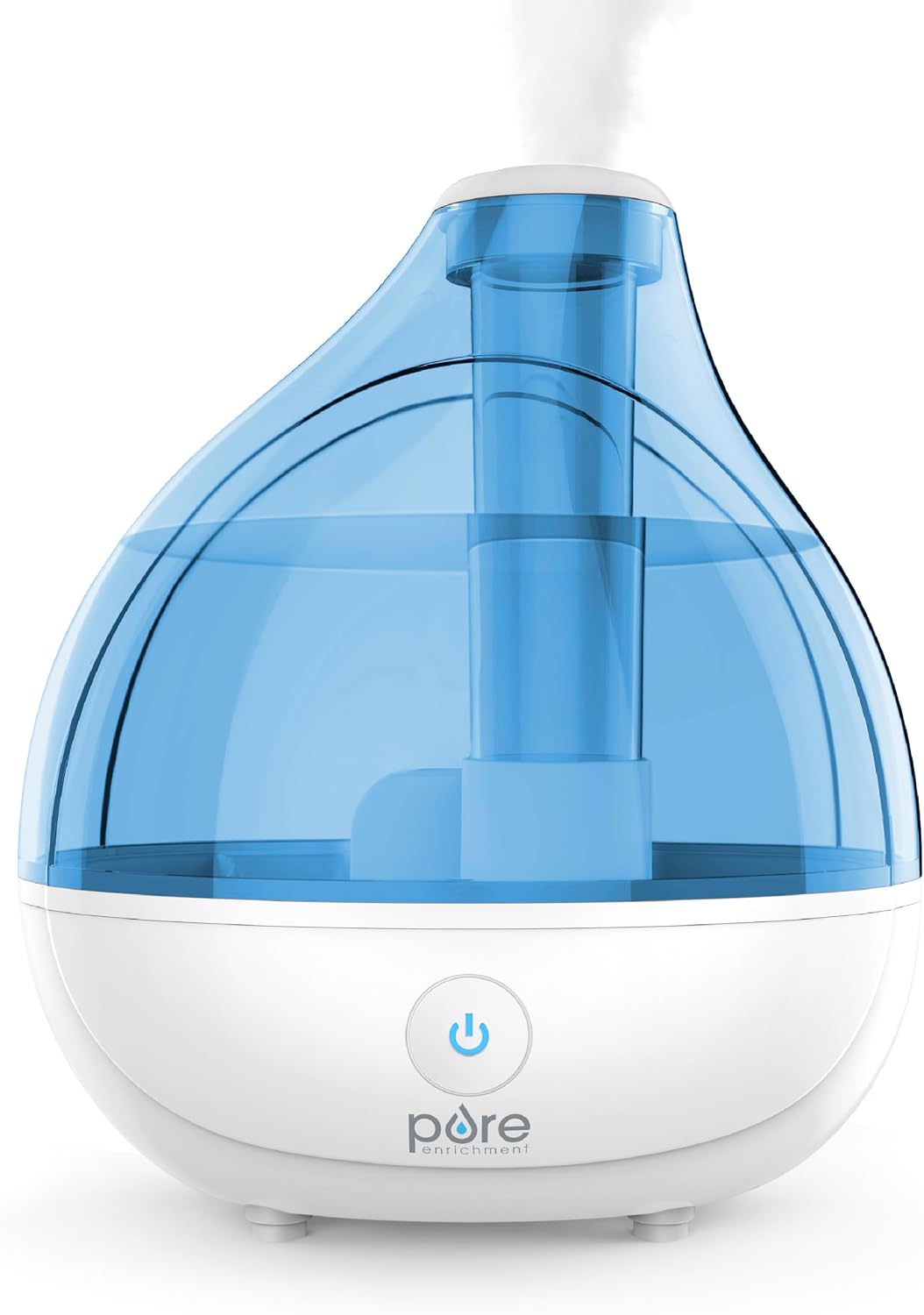
The MistAire is a 1.5-liter ultrasonic cool-mist humidifier. Its product information specifies up to 25 hours of runtime and automatic shutoff. The listing also specifies a 250-square-foot floor area and touch controls.
Check On AmazonIf you click this link and buy, we earn a commission at no additional cost to you.
Choose the device by the result you actually need
If you are deciding between a humidifier or diffuser, start with the result that would make the purchase successful. Choose a humidifier when the core job is adding moisture to dry room air and you are willing to manage its water, placement, refill, and cleaning routine. Choose a diffuser when the core job is scent and the exact diffuser is designed for the fragrance material you intend to use. Consider a combination product only when you genuinely want both functions and can verify both the humidification capability and the scent-handling instructions.
There is also a valid no-purchase outcome. If room humidity is already where you want it, buying a humidifier merely because a diffuser plume looks pleasant adds water handling and cleaning without solving a moisture problem. If fragrance is not important, paying for an aroma system on a humidifier may add parts you will never use. For readers who do need room humidification, the humidifier buying guide continues the decision into room fit, capacity, controls, refill burden, cleaning, and features that are actually worth paying for.

This InnoGear set centers on a 150 mL essential-oil diffuser and includes two fragrance oils. The diffuser uses a USB Type-C interface and provides automatic shutoff. Its listing also specifies eight light colors and cool-mist operation.
Check On AmazonIf you click this link and buy, we earn a commission at no additional cost to you.
Verify the manual before pouring anything into the device
Before a bottle of oil goes anywhere near the device, match the model number to its own manual or manufacturer support page. Closely related products can share housings and marketing language while using different tanks, trays, plastics, and scent systems. Look for wording that names both the approved substance and the part where it belongs, then note any cleaning or replacement steps tied to that feature. If the instructions mention an aroma tray but say nothing about oil in the reservoir, treat those as two separate systems.
- Match the model number on the appliance to the manual or manufacturer support page.
- Identify whether the instructions mention the tank, reservoir, aroma tray, pad, cup, or another dedicated scent component.
- Confirm whether oil is prohibited, permitted only in a separate scent area, or explicitly permitted in the water system.
- Check the cleaning instructions for every part that contacts the approved scent material.
- Do not transfer one model’s permission to another model that merely looks similar.
This check also turns vague marketing into a simple buying test. An “aroma” badge is useful only when the documentation explains how the scent feature works and what extra cleaning it creates. If that routine sounds like work you would rarely use, the feature may not be worth paying for. A clear, ordinary device that does one needed job well can be the better household fit.

The Levoit Classic 160 has a 2.5-liter water tank and an easy top-fill design. Its listing specifies runtime up to 25 hours at the lowest level. A 360-degree rotating nozzle, automatic shutoff, and an included cleaning brush are also documented.
Check On AmazonIf you click this link and buy, we earn a commission at no additional cost to you.
Final Thoughts: buy for the job, then follow the liquid rules
Visible mist is a poor way to decide between a humidifier and a diffuser. Choose a humidifier for room moisture, a diffuser for scent, or a combination unit only when both functions are clearly documented and useful to your routine. Start with the household result you need, then compare the output, controls, refill work, and cleaning routine that support that result. A familiar-looking plume should never outrank those practical checks.
Oil handling should be a final fit check, not the reason to blur two product categories together. If scent matters, make sure the chosen device provides a clearly documented scent path that you are willing to clean and maintain. If scent does not matter, skip the extra feature and the extra routine that comes with it. The simplest good purchase is still the one that solves the intended job without creating unnecessary work.

This Holikme set includes brushes for bottles, narrow tubes, spouts, and other small openings. The package includes 16-inch and 14-inch long-handle bottle brushes plus a 12.6-inch tube brush. It also includes a 10-inch sponge brush and a 4.3-inch spout-cleaning brush.
Check On AmazonIf you click this link and buy, we earn a commission at no additional cost to you.
FAQs
💧 Can a diffuser replace a humidifier?
Do not assume it can. A water-based diffuser releases some moisture, but a humidifier is designed and specified for room humidification, so use the device purpose and output guidance rather than visible mist as proof.
🌿 Can I put essential oils in a humidifier?
Only if the exact model instructions permit it in the exact location you plan to use. Some models prohibit oil in the tank, some use a separate aroma tray, and some explicitly allow oil in the reservoir.
🫧 Is an ultrasonic diffuser the same as an ultrasonic humidifier?
No. They may use a similar mist-making method, but the intended job, output scale, liquid compatibility, controls, and cleaning routine can differ.
📖 How do I know whether my humidifier has an aroma tray?
Match the model number to its manual or manufacturer support page and look for a specifically named oil tray, aroma pad, or scent compartment. Do not assume a removable recess or similar-looking part is intended for oil.
🧼 Does using essential oil make a combination device harder to clean?
It can add another cleaning task because oil residue may contact a tray, pad, or an approved reservoir. Follow the exact cleaning instructions for every surface that the manufacturer allows the oil to contact.
🏠 Which should I buy if my main concern is dry room air?
Choose a humidifier designed for the room and routine rather than relying on a diffuser’s water mist. Compare output, intended coverage, refill burden, controls, cleaning access, and the space available for the unit.
References and Sources
- CHOICE humidifier buying guidance: Supports the device-purpose distinction between humidifiers that increase room humidity and diffusers that primarily disperse essential-oil aroma.
- Honeywell HUL525 documentation: Verifies that this model uses a separate essential-oil tray and prohibits essential oils or additives in the water tank.
- Honeywell HUL530 documentation: Verifies that this model explicitly permits essential oil in its tank or dedicated oil tray, demonstrating model-specific compatibility.