A dry iron keeps the appliance simple because there is no built-in water tank, steam chamber, or scale-control routine to manage. A steam iron adds moisture at the soleplate, which can make stubborn creases in cotton, linen, and heavier fabrics easier to relax, but that extra capability also adds filling, water-quality, anti-calc, and possible drip concerns. The practical choice is not which type has more features, but whether your regular ironing workload uses steam often enough to justify the added system. You should finish with a clear reason to choose dry heat, built-in steam, or a steam iron that you use mostly with the steam switched off.
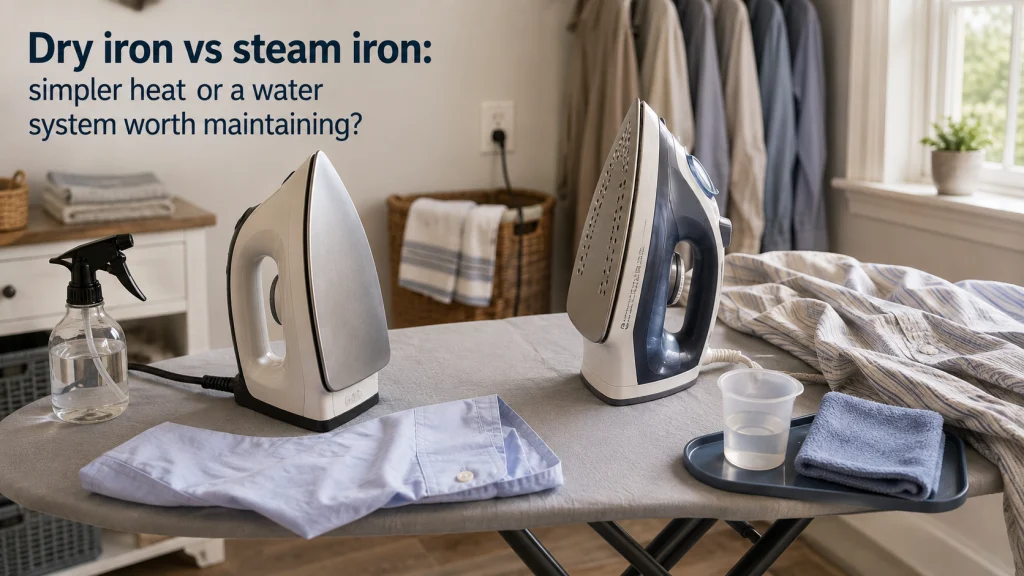
Make the built-in water system earn its place
The useful way to frame dry iron vs steam iron is simple: a dry iron gives you controlled heat and pressure, while a steam iron adds a built-in way to deliver moisture where the crease is fighting back. That moisture can be valuable on a basket full of cotton shirts, linen napkins, denim, or other fabrics that hold deeper wrinkles. It matters much less when most of your ironing is quick touch-up work on easy-to-press garments. More capability is useful only when the household actually calls on it.
The trade-off appears after the pressing is finished. A dry iron has no tank to fill, no steam path to keep clear, and no water left inside the appliance to think about before storage. A steam iron adds those ownership tasks in exchange for on-demand moisture, and exact water and cleaning instructions can differ by model. If you want a broader requirement checklist after deciding that built-in steam makes sense, the next step is how to choose a steam iron for your actual ironing routine.
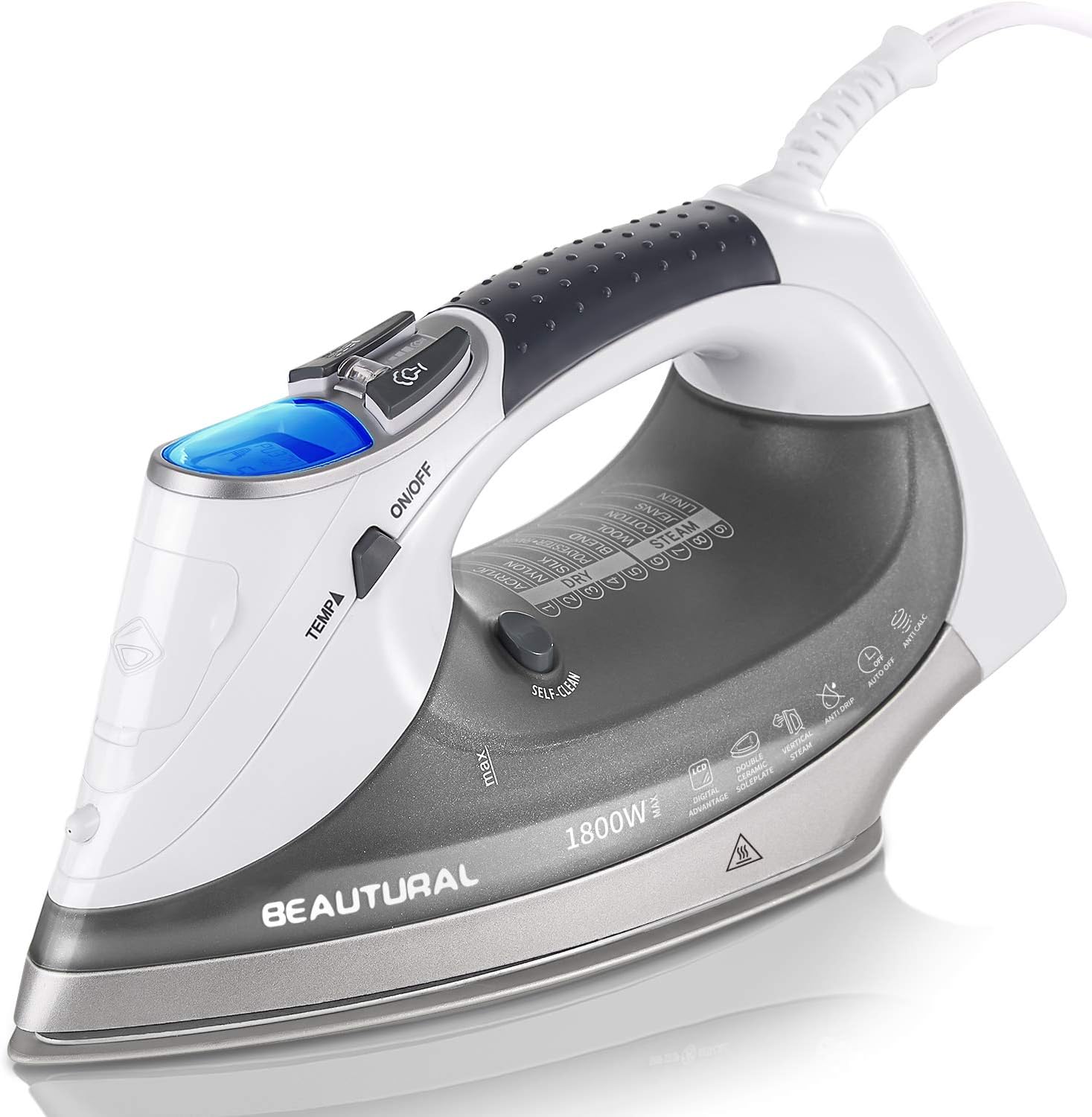
This 1800-watt steam iron combines strong steam output with a double-layer ceramic-coated soleplate for smooth everyday ironing across a range of fabrics. Its digital LCD screen provides nine preset temperature settings, while burst steam, anti-drip, anti-calc, and self-cleaning functions support both wrinkle removal and routine maintenance. A three-way automatic shutoff adds an extra safety feature when the iron is left unattended.
Check On AmazonIf you click this link and buy, we earn a commission at no additional cost to you.
Define the two systems without assuming price or weight
A true dry iron is fundamentally a heated soleplate with temperature control and no built-in steam tank. A conventional steam iron combines the heated soleplate with a water reservoir and steam outlets, so it can use dry heat, steam, or a burst function when the design allows it. That mechanical difference is dependable enough to guide the first decision. Price, weight, wattage, soleplate material, cord design, and control layout are not dependable class traits because they vary from one model to another.
This is where many comparisons become less useful than they look. Calling every dry iron light and every steam iron heavy turns a model-level detail into a category rule, while calling every steam iron expensive ignores basic models that may cost less than specialized dry irons. The better comparison starts with the water system, then checks the exact appliance for weight, temperature controls, soleplate shape, safety shutoff behavior, cord arrangement, and storage fit. Those model details can easily change which iron feels simpler in your hand even when the basic mechanism stays the same.
| Decision field | Dry iron | Steam iron |
|---|---|---|
| Built-in water tank | No | Yes |
| Moisture delivered through the iron | No | Yes, when steam is enabled |
| Scale-related maintenance | No internal steam system to descale | Depends on water and the exact anti-calc design |
| Can press with heat only | Yes | Often yes, if the model allows steam to be switched off |
| Weight, soleplate, controls, price | Verify by model | Verify by model |
The table is useful because it separates the class difference from the shopping details that must still be verified. If two irons both fit your hand, board, budget, and storage space, the remaining question is whether built-in moisture changes enough of your pressing workload to matter. That is where fabric type and wrinkle severity become more important than the label on the box. The water system should solve a repeated problem, not merely add another feature to maintain.

This F67E-T model can iron with steam or dry heat, making the two operating modes easy to compare in one appliance. Its aluminum soleplate works with seven temperature settings for different fabrics. An anti-drip feature is included for steam operation.
Check On AmazonIf you click this link and buy, we earn a commission at no additional cost to you.
What added moisture changes on stubborn creases
Steam helps because moisture and heat work together to relax fibers that resist a dry pass. Independent steam-iron testing commonly includes cotton and linen because these fabrics make crease-removal differences easier to expose, and manufacturers likewise position steam as the tool for deeper wrinkles rather than light surface rumpling. That does not mean every steam iron will outperform every dry iron, since steam output, soleplate design, temperature behavior, and the fabric itself still matter. It means the steam system gives the iron another way to attack the crease without relying only on repeated heat and pressure.
A household with frequent cotton dress shirts, linen table pieces, heavier pants, or deeply wrinkled loads is more likely to use that extra capability enough to notice it. Someone who irons one lightly wrinkled shirt before work may not gain nearly as much, especially if filling and emptying the tank becomes more work than the steam saves. This is the capability side of the steam iron vs dry iron decision: count how often the hard wrinkles appear, not how impressive the steam specification looks. A feature that sits unused for most sessions does not become more valuable because it is built in.

The DW5280 is a 1725W steam iron designed to deliver built-in moisture while pressing. Its conventional iron format delivers steam through the soleplate while you work on stubborn wrinkles. Rowenta also equips this model with anti-drip protection to help manage unwanted water release.
Check On AmazonIf you click this link and buy, we earn a commission at no additional cost to you.
Heat and pressure can already do much of the precision work
Not every ironing job is a moisture problem. Sharp collars, cuffs, trouser edges, small touch-ups, and areas where you want direct control can depend more on steady heat, soleplate placement, pressure, and the correct garment-care setting than on continuous steam. A dry iron can be attractive here because there is less going on inside the appliance and no need to fill a tank for a small pressing job. The simplicity is especially noticeable when the iron is stored, pulled out briefly, used, and put away again.
External moisture can also be enough in some households, but it should not be treated as a universal substitute for built-in steam. A spray bottle can dampen a difficult area before pressing, yet it does not reproduce every steam pattern, burst function, or soleplate delivery system found in a steam iron. It also adds a separate item to keep nearby and requires a little more judgment about how much moisture the fabric needs. The practical question is whether occasional external moisture is acceptable for your difficult creases, or whether you want the moisture delivered from the iron itself throughout a longer session.

This 10.1-ounce continuous mister provides a separate way to add moisture before a dry pass. Amazon lists ironing among the bottle's intended household uses. Keeping moisture in a separate bottle lets you dampen selected areas without requiring a built-in steam tank.
Check On AmazonIf you click this link and buy, we earn a commission at no additional cost to you.
Water, scale, anti-calc care, and drip risk belong in the buying decision
The water tank is not a free feature. Once water enters a heated appliance, mineral buildup, tank filling, storage habits, anti-calc parts, and cleaning instructions become part of ownership, and hard water can accelerate scale formation. Manufacturer guidance also shows why generic water advice is risky: some models are designed around tap water, while support instructions may recommend a particular mix or another water choice under hard-water conditions. The safe rule is to follow the exact manual instead of assuming that distilled water, softened water, vinegar, or a commercial descaler is correct for every iron.
Dripping deserves the same measured treatment. Anti-drip features can reduce water release under some operating conditions, but a feature label does not prove that a particular iron will never spit or leak, and community discussions repeatedly show that buyers worry about this failure mode. If water appears where the manual says it should not, especially around electrical areas, stop using the iron and follow the manufacturer or qualified-service path rather than improvising a repair. For the routine side of ownership, use the model-specific advice in what water to use in a steam iron and how to clean a steam iron safely at owner level.
| Added capability | What it can reduce | What it adds to ownership |
|---|---|---|
| Continuous steam | Effort on repeated stubborn creases | Water filling and steam-system care |
| Steam burst | Extra work on localized difficult wrinkles | More dependence on correct water and clean steam paths |
| Anti-calc system | Some scale-management burden | Model-specific cleaning or collector care |
| Anti-drip design | Some unwanted water release under intended conditions | Still requires correct settings, water, and troubleshooting if leakage occurs |
This ledger is the part that gets lost when the comparison stops at wrinkle removal. Built-in steam can save effort during pressing, but it transfers some work to filling, water selection, cleaning, and troubleshooting. For a frequent user that can be an excellent trade, while an occasional user may prefer to remove the water system entirely. Your answer should come from that exchange of work, not from a blanket claim that one type is more advanced.

This 1250W steam iron includes adjustable steam, a spray function, and a burst setting for wrinkle work. Its anti-drip system addresses water spotting, while anti-calc and self-clean functions support steam-path maintenance. The 6.42-fluid-ounce water tank provides the reservoir for those steam features.
Check On AmazonIf you click this link and buy, we earn a commission at no additional cost to you.
A steam iron used dry still comes with a steam system
Many steam irons allow the steam control to be switched off so the soleplate can press with dry heat. That gives a mixed wardrobe one appliance for dry pressing and for harder creases that benefit from moisture. Choosing steam therefore does not mean steaming every garment. The exact dry-use procedure, including whether the tank should be empty, still depends on the model.
The middle-ground option makes sense only if you value that flexibility. Even with steam switched off, the appliance still contains the tank and steam hardware that distinguish it from a dry-only iron. If steam would be used only occasionally, compare that flexibility with the simplicity of adding moisture separately when needed. Using a steam iron mostly dry is a valid outcome, but it does not erase the ownership differences between the two designs.

This 1200W Hamilton Beach iron uses a stainless steel soleplate and adjustable steam controls. The steam control can be turned off for dry ironing, matching a routine that uses built-in steam only when needed. An 8-foot retractable cord helps simplify storage after use.
Check On AmazonIf you click this link and buy, we earn a commission at no additional cost to you.
Simplicity means fewer systems, not a guaranteed longer lifespan
A dry iron has a simplicity advantage because it lacks the reservoir and steam-delivery system that create water-related care. Fewer systems can mean fewer owner tasks, but they do not prove that every dry iron will outlast every steam iron. Cords, controls, soleplates, thermostatic components, and other parts can fail on either type. Without comparable durability data for specific models, the lifespan claim should stop there.
Owner frustration is still relevant even when it cannot be converted into a failure-rate statistic. Reports about drips, residue, scale, and cleaning show why maintenance tolerance belongs in the purchase decision. They do not prove that a particular steam iron is unreliable or that a dry iron is automatically durable. If low-maintenance ownership is a priority, choosing the design with fewer water-related parts is a reasonable preference on its own.

This compact Newbealer model is a dry iron with no steam system. It supports 100-240V input and uses a ceramic soleplate for direct heat pressing. Because it has no built-in steam function, there is no water tank or steam path to maintain.
Check On AmazonIf you click this link and buy, we earn a commission at no additional cost to you.
Check weight, soleplate, and temperature control at model level
Once you choose the mechanism, do not let the class label decide everything else. An iron can still be a poor fit if it feels awkward when full, has controls you dislike, catches around buttons, or stores badly in the space you have. Check weight in the state you will actually use the iron, including water when appropriate. Compare soleplate shape, tip precision, vent layout, cord position, and temperature controls on the exact model.
Garment labels and manufacturer instructions still control how much heat a fabric can tolerate. Steam is not automatically gentler, and dry heat is not automatically safer, because the wrong setting or prolonged contact can damage fabric with either type. If built-in steam wins the class decision, current steam iron comparisons can narrow the model field without replacing your own fit checks. The mechanism chooses the lane; the exact appliance still has to work in your hand, storage space, and routine.
Choose dry, choose steam, or keep steam mostly off
There is no universal winner because moisture becomes valuable only when the workload uses it. Dry heat makes the strongest case when most garments press easily and you want the shortest path from storage to ironing. Built-in steam becomes more compelling when stubborn cotton, linen, heavier fabrics, or frequent pressing sessions repeatedly need added moisture. A mostly-dry steam iron sits between those outcomes for someone who wants steam available without using it every session.
Follow the decision path from the work you repeat most often, not from the longest feature list. Start with wrinkle severity, then ask how often you want moisture delivered by the iron itself. After that, test your tolerance for the added water system and whether a suitable dry-only option is actually available where you shop. If a rare garment is the only reason you are leaning toward steam, do not let that occasional case dictate every ordinary ironing session.
- Do most of your garments press cleanly with heat and pressure alone?
- Yes: choose a dry iron if you want the simplest appliance and occasional external moisture is acceptable.
- No: continue to the next question.
- Do stubborn creases appear often enough that you want moisture delivered from the soleplate?
- Yes: choose a steam iron if the extra capability saves repeated effort often enough to justify the water system.
- No, only occasionally: compare a dry iron plus separate moisture with a steam iron that you intend to use mostly dry.
- Are you comfortable owning the tank, water rules, and model-specific care even during periods when steam is rarely used?
- Yes: the mostly-dry steam option keeps future flexibility.
- No: favor dry-only simplicity if a suitable dry iron is available.
- Is dry-only availability too limited for your required weight, controls, storage, or budget?
- Yes: a steam iron with a documented dry setting can be the practical fallback.
- No: choose between the two systems on workload and ownership burden rather than feature count.
This tree turns the dry or steam iron question into a sequence of trade-offs instead of a one-line winner. The right choice removes more repeated work than it creates across normal use. Built-in steam deserves its place when it repeatedly saves effort on difficult creases. When it would mostly sit unused, either dry-only simplicity or a mostly-dry steam setup may be the cleaner fit.

The IR06V uses SmartSteam control to regulate steam according to the selected temperature setting. Its stainless steel soleplate is paired with spray mist and steam burst buttons for added moisture control. A dual-position cord and vertical-steam function give the model additional flexibility across different pressing routines.
Check On AmazonIf you click this link and buy, we earn a commission at no additional cost to you.
If steam wins, define the water and maintenance requirements before buying
Choosing steam narrows the class, but it does not finish the purchase. Verify what water the exact model accepts, how its scale-control system works, whether the tank is convenient to handle, and what the manual requires after use. The important part is knowing the care routine before you buy rather than discovering it after scale or dripping becomes a problem. A steam feature is easier to justify when both its pressing benefit and its upkeep are clear.
Now compare that routine with how often difficult garments actually reach the board. Frequent steam use can make a modest care routine feel worthwhile, while rare use can make the same routine feel like unnecessary overhead. The broader garment care equipment overview can help if the decision has widened beyond conventional irons into another garment-care tool. Keep separate steam generators and garment steamers outside this comparison because they solve a different equipment decision.

This 1200W steam iron uses a stainless steel soleplate and an 8-foot retractable cord. It includes anti-drip protection, spray mist, steam boost, and vertical steaming for normal garment care. An auto-clean function supports the maintenance side of choosing a water-based iron.
Check On AmazonIf you click this link and buy, we earn a commission at no additional cost to you.
Final Thoughts: pay for built-in steam when the wrinkle workload uses it
A dry iron is not the lesser choice simply because it has fewer features. For the right household, removing the tank, steam channels, water rules, and scale care is exactly the point, especially when heat and pressure already handle most garments. A steam iron earns its extra complexity when built-in moisture repeatedly reduces the effort needed for stubborn wrinkles. The decision becomes much easier once you count recurring jobs instead of comparing feature lists.
Whichever type you choose, keep the model-level checks separate from the class decision. Verify weight, soleplate, temperature control, water instructions, cleaning steps, storage, and safety behavior on the exact iron rather than assuming they come with the label. Do not invent a lifespan advantage for either class, and do not treat anti-drip or anti-calc marketing as a reason to ignore the manual. The better iron is the one whose useful work matches your garments while its ownership work still feels reasonable.

The D3030 is a 1600W steam iron with a stainless steel soleplate and adjustable steam and temperature controls. Its 4-ounce water capacity supports the built-in steam system, while an 8-foot cord provides working reach. Auto-clean and automatic shutoff features add model-level maintenance and safety functions to the overall ownership trade-off.
Check On AmazonIf you click this link and buy, we earn a commission at no additional cost to you.
FAQs
💧 Can I use a steam iron without water?
Many steam irons can press with the steam switched off, but the exact dry-use procedure depends on the model. Check the manual for the steam control position and whether the tank should be empty.
👕 Is steam better for cotton and linen?
Steam can make stubborn creases in cotton and linen easier to relax because it adds moisture to heat and pressure. The actual result still depends on steam output, temperature, soleplate behavior, and the garment instructions.
🧴 Can a spray bottle replace a steam iron?
It can be enough for households that need moisture only occasionally, but it does not duplicate every built-in steam or burst system. Treat it as a simpler workflow option, not a universal performance equivalent.
🪨 Does hard water matter with a steam iron?
Yes, hard water can increase scale buildup. Use the exact model’s water and anti-calc instructions rather than assuming one water type or descaling method is safe for every iron.
⚖️ Are dry irons always lighter than steam irons?
No. The tank can add weight to a steam design, especially when filled, but total weight varies by model. Compare the actual listed weight and handling rather than treating weight as a class rule.
🔧 Do dry irons last longer than steam irons?
A dry iron has fewer water-related parts to maintain, but that does not prove a universal lifespan advantage. Durability depends on the exact design, components, use, care, and available model-specific evidence.
References and Sources
- Rowenta dry and steam comparison: Supports the mechanism difference, built-in moisture trade-off, and the fact that many steam irons can operate with steam turned off.
- Which? steam iron testing: Supports the importance of crease removal, steam output, limescale resistance, weight, filling, controls, and ease of use as separate performance fields.
- Philips water guidance: Supports the need to follow model-specific water instructions and the connection between hard water and faster scale buildup.
- Philips descaling guidance: Supports model-specific anti-calc and cleaning routines rather than a universal descaling method.