A strong review score does not prove that an appliance belongs in a particular home. The better pre-purchase test is whether the product can move through the delivery path, fit the operating space, work with the household routine, and be handled comfortably by the people who will use it. Those constraints can matter more than extra capacity, more features, or a premium reputation. The goal is to judge the appliance and the house together before performance becomes the only thing under consideration.
Product quality and household fit answer different questions
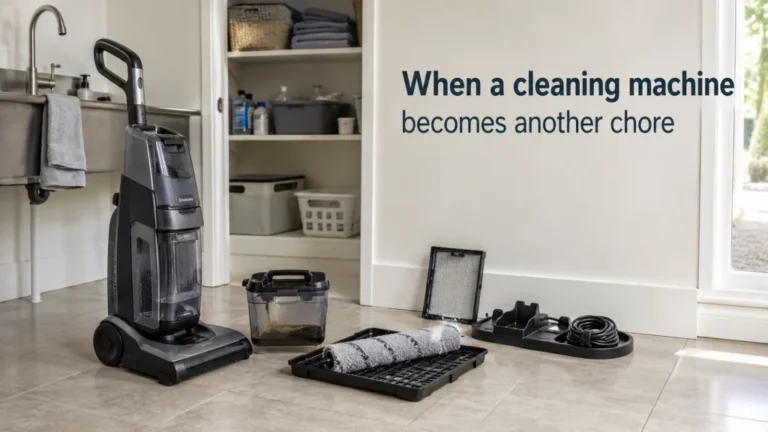
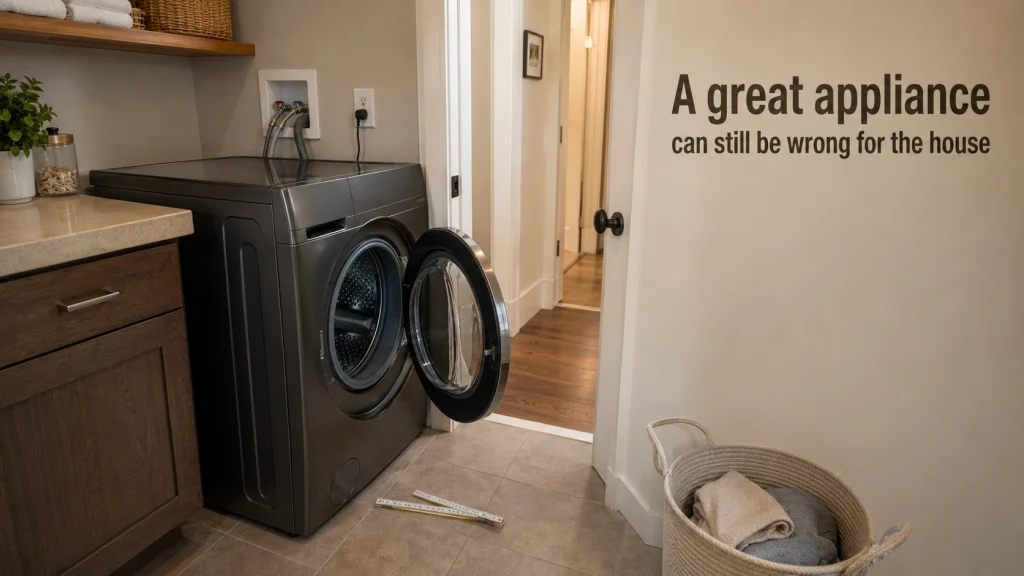
A great appliance can still be wrong for the house even when the reviews are fair and the product performs exactly as promised. A well-reviewed washer can be a poor purchase if its depth fights the laundry space, just as a capable vacuum can be a poor match for a home where its size and handling add more friction than its extra capability removes. Neither example means the product is bad. It means product quality and household fit are separate questions, and both have to be answered before buying.
Reviews are useful for learning how a product behaves under the conditions the reviewer considered, but they cannot know the exact doorway, closet, counter, floor plan, storage route, or shared routine in your home. That is why I trust a clear physical or routine constraint more than a generic badge that tries to name one product for everyone. The appliance has its own specifications, but the house has specifications too. A purchase becomes convincing only when those two sets of limits can live together without creating avoidable work.
Start with the path into the house, not the feature list
The first fit question happens before normal use begins: can the appliance actually travel from the delivery point to the place where it will live? Doorways matter, but so do hallway turns, stairs, landings, elevator openings, railings, and any other point where a large box or machine has to change direction. A destination opening can look generous while the route to it is the real restriction. If you want to know whether an appliance will fit, the delivery route deserves the same attention as the final space.
This matters because measuring for appliance delivery is not only about finding one narrow doorway. A turn can require more maneuvering room than a straight passage, and a stair or landing can limit how the appliance is carried even when its listed width seems acceptable. Packaging can also affect how much room the product needs during delivery, so the bare product dimensions do not tell the whole story. The practical habit is simple: think through the entire route before allowing features, finish, or capacity to dominate the decision.
The point is not to turn appliance shopping into a construction project. It is to identify a hard physical constraint early enough that you do not waste time comparing products that cannot reach their destination sensibly. When exact clearances, removal of doors, or installation requirements become relevant, use the specific product documentation and the delivery or installation provider’s requirements rather than assuming one rule applies to every machine. A good product is still the wrong candidate if the route itself creates a problem that the product cannot solve.
Then check the operating space, not just the empty opening
Getting an appliance into place is only the beginning. The operating space has to support the way the product opens, loads, vents, drains, plugs in, gets cleaned, and is reached during normal use. That makes appliance size and space requirements broader than a simple width-by-height check. A machine that technically occupies the available footprint can still interfere with a cabinet door, block a walkway, consume the only useful prep area, or become awkward to clean because there is no comfortable access around it.
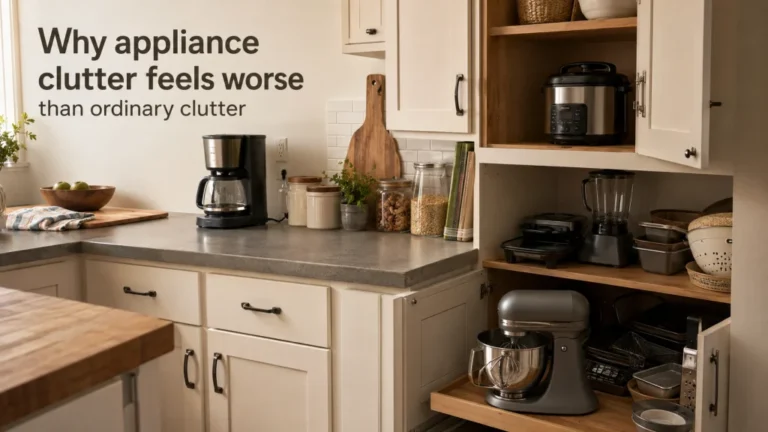
Countertop equipment makes this especially easy to underestimate because the purchase can feel small compared with a major appliance. A machine may fit on the counter and still take over the exact patch of space used for chopping, sorting, folding, serving, or staging other daily tasks. If the plan is to store it instead, the storage path becomes part of the fit question: how far it travels, how often it is lifted, and what has to move before it can come out. The right footprint is therefore the footprint the household can live with, not merely the footprint that can be squeezed into an empty rectangle.
Add the routine before paying for extra capacity or features
Once the physical fit works, the next question is whether the appliance matches the amount and frequency of work the household actually gives it. Extra capacity can be useful when larger loads are normal, but it is less persuasive when those loads are rare and the larger machine demands more space every day. The same logic applies to attachments, presets, specialty modes, and premium controls. A feature earns its place when it reduces meaningful work often enough to justify whatever space, setup, cleanup, or learning it adds.
This is where a simple product spec, house spec, and routine spec mindset is useful. The product may offer more capacity, the house may have limited storage, and the routine may involve small frequent jobs rather than large occasional ones. None of those facts is decisive by itself, but together they can make a lower-capacity machine the better fit. The important question is not whether the bigger model can do more, but whether the household will use that extra capability often enough to pay for its footprint in daily life.
Three-part fit check: Product spec tells you what the appliance can do. House spec tells you where it can travel, operate, and stay. Routine spec tells you how often its capacity, controls, cleanup, and storage burden will matter in ordinary use.
Future-proofing becomes overbuying when the future outranks the house
Buying a little extra capability can be reasonable, but future-proofing becomes shaky when a hypothetical future use case overrides a current physical constraint. The larger machine might handle an imagined bigger workload later, yet today it still has to pass through the doorway, live in the available space, and fit the routine that exists now. Paying for unused capacity is one issue. Giving permanent space to a future scenario that may never arrive is a more important one because the household absorbs that compromise every day.
A useful way to keep this in proportion is to separate likely changes from vague possibilities. If the household already has a clear reason to expect larger loads or a different routine, some extra capacity may be sensible. If the justification is only that the bigger model might be useful someday, the current house should get more weight in the decision. A present constraint is real evidence, while a hypothetical future should have to earn the right to overrule it.
Review scores cannot weight your floor plan and routine for you
A review score compresses many different trade-offs into one number, which makes it useful for sorting but weak for deciding what matters most. Two owners can give the same rating for opposite reasons: one may love the capacity despite the bulk, while another may accept less capacity because the machine is easier to store and handle. The tactical move is to stop treating the score as the conclusion and start reading for the constraint you already know could break the purchase. That turns reviews into evidence for a specific decision instead of a popularity contest.
Search within reviews for the issues that matter to your use case, such as bulk, access, noise, setup, cleanup, storage, or handling. Pay attention to the conditions behind both praise and complaints, because a problem reported in a very different home or routine may not transfer to yours. Features that attract repeated enthusiasm are still irrelevant if your normal workload does not need them. Reviews become much more useful when they help confirm or challenge a known constraint rather than deciding the whole purchase for you.
Trace the appliance from delivery to use to storage before comparing features
One pre-purchase habit catches many of these conflicts without turning shopping into a spreadsheet exercise. Mentally walk the product through three stages: how it enters the home, how it operates during a normal task, and what happens when the task is over. That sequence forces the house and routine into the decision before the feature list gets all the attention. It also exposes the difference between a product that fits once and a product that fits repeatedly.
The exercise works for large and small equipment because the questions stay practical. A laundry machine has a delivery route and operating clearance, while a countertop machine has a retrieval route, working footprint, cleanup routine, and storage destination. A vacuum has to move through the floors and obstacles it will actually clean, not an imaginary open room. The product type changes, but the fit logic remains the same.
- Delivery: Can the product and its packaging move through the realistic path to the destination?
- Normal use: Does it open, move, load, empty, or operate without fighting nearby space or household activity?
- Reset: What has to be cleaned, emptied, unplugged, folded, moved, or put away after the job?
- Storage: If it does not stay out, is the storage location easy enough that the appliance will still be used at the intended frequency?
- Shared routine: Can the people expected to use it comfortably handle the weight, reach, controls, noise, and reset work?
If one of those stages looks awkward, that does not automatically disqualify the appliance. It tells you where the real trade-off sits and whether the product’s advantages are strong enough to justify it. A machine that creates one small inconvenience for a job done rarely may still make sense, while the same inconvenience repeated every day can become the deciding factor. That is a more useful comparison than asking which product has the longest feature list.
Final Thoughts: the house and household are part of the specification
A good appliance does not become a bad product just because it is wrong for one home. The mismatch can come from the delivery path, operating footprint, storage route, workload, noise, handling, or the way several people share the same space. Treating those limits as real specifications makes the buying decision clearer, not more negative. It gives product quality the right context instead of asking it to solve a problem the house itself creates.
Before paying for more capacity or more features, verify the parts of the decision that cannot be changed by a strong review score. Make sure the appliance can reach its destination, live in its space, support the normal routine, and be handled without adding more friction than it removes. If a smaller, simpler, or lower-spec option does that better, choosing it is not settling. It is recognizing that the best experience is the one that fits the home you actually have.
FAQs
The most useful appliance-fit questions are usually less about rankings and more about the home itself. Readers often need to know what to measure, how much weight to give a review, and whether choosing a smaller model means giving something important up. The answers below keep those decisions at household level rather than pretending one specification decides everything. Exact installation and clearance requirements still belong to the documentation for the specific product being considered.
Use these questions as a final screen after narrowing down a product type, not as a substitute for checking the actual model. A general fit principle can tell you what to inspect, but it cannot prove that a particular machine will pass through a doorway or work in a specific opening. The same goes for storage, noise, and handling because each home gives those factors a different weight. The goal is to find the constraint that could make an otherwise good appliance wrong for your house before you buy it.
📏 How do I know if an appliance will really fit?
Check both the path to the destination and the space where the appliance will operate. The exact model documentation should control any required installation clearance, opening, connection, or access detail.
🚪 Should I measure the doorway or the appliance space first?
Both matter because a product can fit the final opening and still be difficult or impossible to move through the route to it. Treat the narrowest doorway, turn, stair, landing, or other access point as part of the fit check.
⭐ Can I trust a highly rated appliance to work well in my home?
A high rating can tell you that many owners liked the product, but it cannot account for your floor plan, storage, noise tolerance, workload, or handling needs. Read the reasons behind the rating and compare them with the constraints that matter in your home.
📦 Is a bigger appliance worth it for future needs?
It can be if the future need is realistic and the larger product still fits the house comfortably now. If extra size solves only a hypothetical problem while creating a current space or handling problem, the trade-off is harder to justify.
🔇 How much should appliance noise matter before buying?
Give noise more weight when the appliance will operate near sleeping, working, or shared quiet space. The same product can be an easy fit in one floor plan and an irritating one in another because placement changes how disruptive the sound feels.
🧹 Can a smaller appliance be the better choice even if it has fewer features?
Yes, when it handles the normal workload while reducing storage, handling, setup, or reset friction. Fewer features are not a disadvantage if the missing features were unlikely to matter in the household routine.