A cleaning machine can make the visible job easier while quietly adding another round of work after the floor, rug, or surface already looks finished. The useful question is not whether the machine needs maintenance, because nearly every cleaning tool does, but whether its setup, reset, drying, charging, and storage still leave the household with less total work. Frequent small cleanups can make even a simple reset feel disproportionately annoying, while a higher-maintenance machine can still earn its place if it replaces harder scrubbing or several separate tools. The goal is to judge convenience by the whole routine, including what happens before the machine comes out and after it goes away.
Count the whole chore, not just the cleaning pass
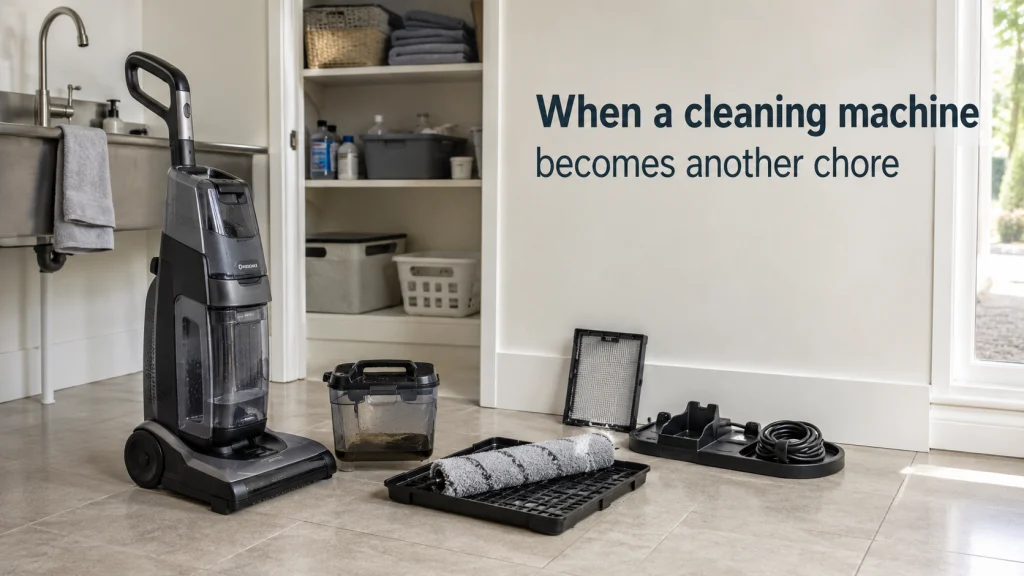
There is a particular kind of annoyance that arrives when the visible mess is gone but the cleaning job is not actually finished. The floor looks better, yet there may still be a dirty-water tank to empty, a roller to rinse, hair to pull from a brush, a hose to drain, a filter to check, a cord to wrap, or damp parts that cannot go straight back into a closed cabinet. That is the point when a cleaning machine becomes another chore instead of feeling like a clean handoff from effort to result. The frustration is not petty, because the household still has to finish the equipment before it can finish the task.
For many households, cleaning machine maintenance after use is the point where convenience is either confirmed or lost. A machine that removes stubborn grime, reduces bending, combines jobs, or makes a difficult surface manageable may deserve a longer reset, while a machine used for tiny everyday messes faces a harder test. The cleanup attached to the tool can begin to feel larger than the mess that triggered it. So did the machine reduce the total chore, or did it only move the work to a different part of the routine?
I count cleanup as part of the cleaning time because the household cannot simply stop when the machine stops moving. A realistic workload begins with getting the equipment ready, continues through the active cleaning pass, and ends only after the machine is reset and put where it belongs. That broader view explains why two tools that seem equally fast while running can feel completely different to own. One may disappear back into a closet with almost no thought, while the other leaves several small obligations behind.
Total chore load includes every recurring step the product creates around the visible task. The exact list changes by machine, but a step that seems trivial by itself can matter once it becomes part of every use. Instead of judging convenience only by how quickly the machine picks up dirt, count the actions that routinely belong to the same job. That makes the hidden work visible before it turns into the part everyone resents.
- Getting the machine, attachments, solution, cord, hose, or charged battery ready.
- Doing the actual vacuuming, washing, extracting, mopping, or spot cleaning.
- Emptying collected dirt or dirty water and removing hair or debris from accessible parts.
- Rinsing or checking owner-serviceable components when the exact manual calls for it.
- Leaving washable or wet components in an appropriate place to dry before closed storage.
- Returning the machine, accessories, cord, hose, charger, and supplies to storage.
That list is not an argument for avoiding equipment that needs upkeep. It shows where the labor actually lands and whether the machine is trading harder work for easier work or simply creating a new tail end to every cleaning session. Some of that added effort may be a fair exchange, especially when the machine handles a job that would otherwise be slower or more physical. The point is to count it before calling the product convenient.
Wet cleaning and dry vacuuming leave different kinds of work behind
A dry vacuum and a wet floor-cleaning machine do not create the same kind of reset, even when both are described as convenient. Dry pickup usually concentrates the mess in a bin or bag, with brushes, filters, and hair wrap becoming separate maintenance concerns as the machine is used. Wet cleaning adds another state to manage because water, residue, washable parts, and damp components may remain after the floor itself is finished. That does not make wet cleaning equipment a bad choice, but it changes what “done” means in the household routine.
Wet floor cleaner maintenance can make that difference especially obvious once storage enters the picture. A dry machine may be ready to return to its normal spot once its immediate owner-level reset is complete, while a machine with wet removable parts may need open space before everything can be reassembled or enclosed. A small laundry area or crowded utility closet can make that extra stage more irritating than it would be in a home with a nearby sink and generous drying space. The practical comparison is not dry versus wet as a winner and loser; it is which reset pattern fits the room, frequency, and tolerance of the household using it.
Frequent little jobs make small reset tasks feel much larger
A cleanup step does not have to be difficult to become irritating. Repetition changes how a household experiences effort, especially when the machine comes out for crumbs, tracked-in dirt, pet messes, or small patches that never felt like a major cleaning event in the first place. If every short use opens another chain of emptying, rinsing, checking, drying, charging, or reorganizing, the reset can start to dominate the memory of using the machine. The issue is not laziness; it is the mismatch between the size of the original problem and the ritual required to close it out.
Occasional deeper cleaning can reverse that calculation. A more involved reset may feel perfectly reasonable when the machine has replaced hand scrubbing, several tools, repeated passes, or an awkward manual process. Frequency therefore belongs beside cleaning performance whenever convenience is judged. A machine that is pleasant for a larger periodic job can still be the wrong tool for constant small messes, while a simpler machine with fewer capabilities may be the one people actually reach for without hesitation.
Necessary maintenance is not the same as bad design friction
Some reset work exists for a good reason, and the same principle applies to wet/dry vacuum maintenance. Filters collect debris, brush rolls encounter hair, dirty tanks hold what was removed from the floor, and washable components cannot simply be treated as if nothing happened during use. Skipping model-required care is not a fair way to judge whether a machine is convenient, because maintenance can be part of keeping the product operating as intended. The exact cleaning, drying, replacement, and storage steps should come from the manual for the model in front of you rather than from a generic routine copied from another machine.
Design friction is a different problem because it describes how hard the machine makes that necessary work. Awkward latches, narrow openings, parts that are unpleasant to reach, accessories with no sensible storage place, or a reset sequence that creates extra drips and handling can make ordinary upkeep feel heavier than it needs to be. That is one reason a broad look at home cleaning appliances should include ownership workflow instead of stopping at suction, scrubbing action, or feature count. Maintenance may be unavoidable, but the amount of friction wrapped around it still matters when deciding whether the machine fits the household.
Drying and storage are part of the job, even when they happen offstage
Wet components create a strange accounting problem because the active chore can feel finished while the equipment is still occupying space. A roller, pad, removable tank, hose, or other washable owner-serviceable part may need to remain out rather than being immediately sealed into a cabinet, depending on the exact manual and component. That turns drying space into a real ownership requirement, not a decorative afterthought. If the only available landing spot is a kitchen counter or a narrow laundry shelf that is already busy, the machine keeps demanding attention after the floor is clean.
Storage can create the same kind of hidden work even without water. A long cord that has to be wrapped neatly, a hose that fights the closet, loose attachments that need another bin, or a charger that occupies the only convenient outlet all add small handling steps. None of those details sounds decisive in isolation, which is exactly why they are easy to overlook before buying. Taken together, they determine whether the product fits naturally into the home or becomes an object that must be managed every time it is used.
A higher-maintenance machine can still earn its place
Floor washer maintenance, or any other recurring after-use burden, should not become a reason to praise the simplest tool automatically. Some machines ask for more care because they are doing a job that would otherwise involve harder scrubbing, repeated passes, more bending, or several separate tools. If that exchange matters to the household, the extra upkeep may be entirely reasonable. The maintenance only becomes a bad bargain when the effort it adds is out of proportion to the effort it removes.
This is where the household’s actual mess matters more than a generic convenience label. Frequent tracked-in grime can justify a machine that asks for a more involved finish, while light dust on mostly clear hard floors may not. The same product can therefore feel liberating in one routine and fussy in another without either household being wrong. What earns the machine its place is not low maintenance by itself, but a trade that solves the more annoying side of the work.
Rehearse the after-use routine before buying
Feature lists make it easy to picture the satisfying middle of a cleaning session and skip the less glamorous minutes around it. A better pre-purchase habit is to mentally continue the scene past the clean floor: where does the dirty material go, what has to come apart, what stays wet, what needs power, and where does everything live afterward? That quick rehearsal exposes friction that suction claims, brush counts, and convenience features cannot show. It also helps distinguish a machine that fits the home from one that merely looks capable on paper.
The useful question is simple: after this machine completes its job and is put away, is there less work left in my routine than before? The answer should include frequency, because a tolerable finish after a larger weekly task can become maddening when repeated for tiny daily messes. It should also include the room itself, especially when drying space, outlets, shelves, or closet clearance are tight. Thinking through the end of the job before buying is often more revealing than adding one more feature to the comparison list.
Final Thoughts: convenience counts after the machine is put away
A spotless floor can hide a badly matched routine. If the machine repeatedly leaves behind a string of small tasks that no one wants to finish, that friction deserves weight alongside cleaning performance. Necessary upkeep is not a flaw by itself, but it still has to fit the frequency, space, and habits of the household. Convenience is strongest when the equipment solves the mess without creating a second routine that everyone tries to postpone.
Frustration is useful evidence here because it points to where the workflow is breaking down. Sometimes the answer is simply accepting reasonable care for a machine that saves much harder work, and sometimes it is recognizing that the product asks too much for the jobs it usually handles. Either way, the clean surface should not be the only finish line. The chore ends when the equipment is ready for the next use and the household can move on.
FAQs
The most useful questions about cleaning-machine upkeep are usually not about whether maintenance exists at all. They are about how much work the machine adds around the job, how often that work repeats, and whether the household has a sensible place to handle it. Those answers depend on the exact equipment and the routine it is expected to replace. A good decision keeps the whole workflow in view instead of judging the machine only while it is actively cleaning.
Model-specific maintenance should always come from the exact manual because filters, tanks, rollers, hoses, docks, and washable parts do not all have the same requirements. The questions below stay at the household-decision level rather than prescribing a generic maintenance procedure. They are meant to help separate normal upkeep from a workflow that feels needlessly burdensome. If a specific step or component is unclear, use the instructions for the exact model rather than assuming another machine works the same way.
🧹 Is it normal for a cleaning machine to need work after every use?
It can be, especially when the machine collects dirty water, hair, debris, or uses washable components. What is normal depends on the exact model, so use its manual for the required reset rather than applying a generic routine.
💧 Why do wet cleaning machines feel like more work afterward?
Wet equipment can add emptying, rinsing, draining, and drying to the end of the visible cleaning job. The burden depends on the design, the parts involved, available drying space, and how frequently the machine is used.
🌀 Does self-cleaning mean I can put the machine away immediately?
Not necessarily. A self-cleaning function may automate part of the reset, but the exact manual still determines what must be emptied, checked, dried, or stored afterward.
📦 Should storage space affect which cleaning machine I use?
Yes, because storage is part of the ownership routine. Consider the machine, cord, hose, attachments, charger, supplies, and any removable parts that cannot return directly to closed storage after use.
⚖️ How do I know whether the maintenance is worth it?
Compare the complete routine with the work the machine replaces. Extra upkeep can be reasonable when the equipment removes harder scrubbing, repeated passes, or several separate tools, but it may feel excessive for very small jobs.
🏠 What changes when several people share the same cleaning machine?
The reset can become invisible labor if one person cleans and another person later deals with the machine. Shared households benefit from treating normal reset and storage as part of using the equipment, not as a separate chore for whoever notices it.