Appliance recall data is useful when it stays tied to a specific product, hazard, affected group, and remedy. A current CPSC snapshot can show which household-equipment records and hazard labels appear in a defined sample, but those counts still do not become failure rates without comparable exposure data. The practical takeaway is to use recall records for model verification and corrective action, while treating category and brand rankings with much more skepticism.
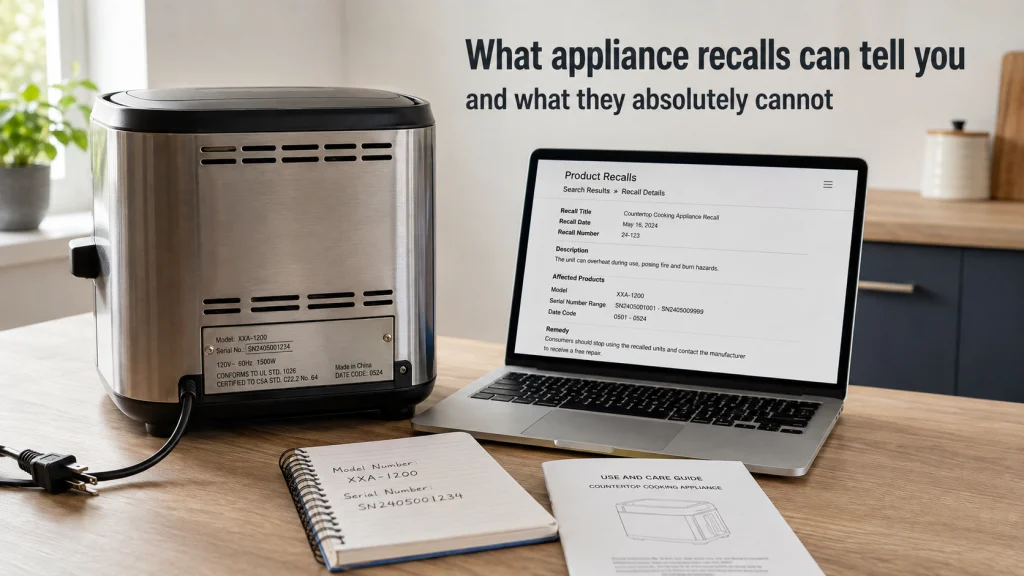
Five recalls do not mean five times the risk
What appliance recalls can tell you is much narrower than a simple count suggests: five notices for one appliance type and one for another do not make the first type five times more dangerous. A recall record tells you that a corrective action was announced for a defined product group, but it does not tell you how many comparable products were sold, how many remain in service, or how much operating time those products accumulated. Without that denominator, a raw count cannot become a failure rate. It is a count of recall actions, not a probability of harm.
This distinction matters because scary numbers are easy to compare and hard to interpret. A widely sold product can generate a large affected-unit count even when incidents are uncommon, while a narrowly sold product can have a small recall count that still deserves immediate attention from owners. CPSC also makes clear that each recall applies to the specific products identified in that notice, not automatically to every similar product from the same company. I would rather use the record to answer “Is this exact appliance affected, and what does CPSC say to do?” than stretch it into a brand verdict the data cannot support.
What the current CPSC recall snapshot actually shows
CPSC publishes recall records with product identification, hazard wording, affected-unit information, remedy details, consumer contact information, and other fields when they are available. The agency also provides machine-readable recall access and says the recall data on its public listing is updated as new notices are announced. That makes the dataset useful for a reproducible descriptive check, as long as the scope is defined before the counting starts. It does not supply the sales, installed-base, or use-time denominator needed for a failure-rate calculation.
For the quantitative snapshot here, I screened the 20 most recent CPSC recall notices available in the listing at review time and kept only equipment that fits this site’s kitchen, cleaning, laundry and garment-care, or home-comfort scope. Furniture, toys, sports equipment, personal-care devices, decor, standalone power products, and products outside ordinary household-equipment use were excluded. I counted each recall notice once, preserved the hazard wording used by CPSC, and did not merge affected-unit totals with incident reports. That left four household-equipment recall records in scope.
Reproducible snapshot method: start with the 20 most recent CPSC recall notices, screen every record against the same four household-equipment groups, exclude out-of-scope products before counting, count recall notices rather than affected units, preserve the published hazard wording, and keep warnings separate from recalls.
| Household-equipment group | Recall records in the snapshot | Hazard labels represented |
|---|---|---|
| Kitchen equipment | 1 | Fire and burn hazards: 1 |
| Cleaning equipment | 3 | Shock and electrocution hazards: 3 |
| Laundry and garment care | 0 | None in this 20-notice sample |
| Home comfort | 0 | None in this 20-notice sample |
The hazard count is therefore simple but real: three of the four in-scope records carry shock and electrocution hazard language, while one carries fire and burn hazard language. In this sample, cleaning equipment accounts for three records and kitchen equipment for one, with no qualifying laundry or home-comfort records. Those numbers describe this bounded snapshot only. They are not evidence that cleaning equipment is generally more dangerous, and the zeroes do not prove that laundry or home-comfort equipment is safer.
The category split also closes an important quality-control question. I tested all four household-equipment groups defined for this snapshot rather than dropping categories that produced no qualifying records, and the empty groups remain visible instead of being hidden. A larger rolling window could produce a richer cross-tab, but it would not solve the missing-denominator problem by itself. The value of this snapshot is that the counting method is explicit enough to repeat and narrow enough that its limits remain obvious.
The same hazard label can describe very different appliance problems
“Fire hazard” looks like a single category, but the mechanism behind that label can differ sharply from one recall to another. CPSC has described cordless vacuum recalls involving lithium-ion batteries that can overheat and ignite, electric heater recalls involving fan problems that can lead to overheating, and dehumidifier recalls involving units that can overheat, smoke, or catch fire. The label is useful because it tells the owner what type of harm the corrective action is intended to address. It does not mean the products share the same defect, incident pattern, exposure, or remedy.
Kitchen equipment shows the same problem with oversimplification. Air fryer recalls in the CPSC archive have included overheating electrical connections as well as mechanical parts that can break during use and create burn hazards. Two notices can both contain the word “burn” while describing different failure paths and different owner actions. That is why the hazard line should be read together with the product description, affected model information, and remedy. The practical question is not merely which label appears, but what specific condition caused CPSC and the recalling firm to act.
| Example household equipment | What the recall record can establish | What it cannot establish |
|---|---|---|
| Cordless vacuum | A defined battery-related overheating and ignition hazard, affected units, and a stated remedy. | The fire rate for all cordless vacuums or all vacuums from the same brand. |
| Electric room heater | A defined overheating path tied to identified products and a stated consumer action. | The probability that any space heater will overheat in a typical home. |
| Dehumidifier | A documented recall history involving overheating and fire concerns for identified models. | The safety of every dehumidifier or a fair comparison with products that sold in different volumes. |
| Air fryer | A recall can identify whether the hazard comes from overheating, a component failure, or another specific condition. | A category-wide conclusion that air fryers are more or less dangerous than another kitchen appliance. |
The table is deliberately about evidence boundaries rather than winners and losers. A recall notice becomes useful when you connect its hazard wording to the exact product identification and the remedy CPSC publishes. Once you detach the hazard label from those details, the data gets much easier to sensationalize. For a household owner, specificity is more valuable than a dramatic ranking.
The missing denominator is the biggest limitation
A failure rate needs both a numerator and a denominator. Recall data can give you a numerator-like count, such as the number of recall notices, affected units, or reported incidents listed in a notice, but it does not automatically give you the number of comparable products exposed to the same conditions. It also does not tell you how long those products were used, how intensely they were used, or how many unaffected units remained in service. Without that exposure information, dividing one recall count by another does not create a meaningful household risk comparison.
Imagine one countertop appliance sold in enormous volume and another sold to a much smaller market. The first could have more recalls or more affected units simply because there were many more units in circulation, while the second could look quiet because fewer products existed to begin with. The reverse can happen too, especially when one recall covers a broad production run and another covers a narrow serial range. Unless sales, installed base, time in service, and comparable definitions are available, raw recall counts are not the denominator people often assume they are.
Affected units are not the same thing as incidents
The “units” figure in a recall notice describes how many products are included in the corrective action, not how many products failed. A notice can cover hundreds of thousands of units because a design, component, production range, or compliance issue applies across a large group. The incident section is a different field and may report a much smaller number of overheating events, fires, injuries, or other complaints. Treating the affected-unit total as an incident count can inflate the apparent scale of observed failures by orders of magnitude.
This is one of the easiest mistakes to make when scanning headlines. A large unit total tells an owner that the remedy may apply to a broad population of products and that model verification matters, but it does not say that every included unit has shown the defect. Conversely, a smaller unit count does not make a recall unimportant for someone who owns the exact affected model. The owner-level decision remains binary and specific: either your product falls inside the recalled group or it does not.
A recall record and its remedy are two different things to check
Finding a recall is only the first half of the job. CPSC’s current five-year remedy table lists 1,055 refund entries, 525 repair entries, 336 replacement entries, 22 disposal entries, 11 entries with no remedy available, and 8 entries for new instructions. CPSC also warns that one recall can contain more than one remedy, so these are remedy-entry counts rather than a count of unique recalled products. That distinction matters because a remedy table answers a different question from a hazard table.
Remedy information can also change as company circumstances or program availability change, which is why an old screenshot or copied news story is a weak place to stop. A dataset row may be enough to count a published remedy label, but an owner still needs the current CPSC notice for the exact model before deciding what to do. If that notice says to stop using the equipment, arrange a repair, seek a refund, replace it, or dispose of it, the current instruction takes priority over a summary article. Data analysis helps locate the record; the live recall page controls the owner action.
How a shopper or owner should use appliance recall data
Recall data is most useful when it changes a specific verification step. Before buying a used appliance, confirm the brand and model against the CPSC database rather than relying on appearance or the seller’s description. For an appliance already in your home, photograph the rating label so the model, serial number, and other identifiers are available when a notice uses a narrower production range. If a possible match appears, read the official notice closely enough to confirm that your exact unit is included before acting on a headline alone.
The same routine works after a purchase because recalls can be announced long after a product enters a home. CPSC specifically notes that one company recall does not automatically make the company’s other similar products unsafe, so the model-level check matters more than guilt by association. It is also unlawful to sell a recalled product unless the required remedy has been applied where resale is permitted. The goal is not to become a recall archivist; it is to keep enough identifying information that a real notice can be matched to the equipment you actually own.
- Find the brand, exact model number, and serial or production code when the notice uses one.
- Search the official CPSC recall database, not only retailer posts or news headlines.
- Match the identifying range before assuming that a similar-looking appliance is included.
- Read the hazard and remedy together so you understand both the problem and the required next step.
- Follow the current recall instructions when they tell consumers to stop use, repair, replace, return, or dispose of the product.
- Do not resell a recalled appliance unless the official remedy has been completed and resale is lawful.
This checklist is intentionally simple because recall decisions should not depend on statistical guesswork once you have an exact product match. The database helps you move from a vague safety concern to a specific notice with a defined consumer action. That is far more actionable than asking whether one brand has a larger lifetime recall count than another. Model verification beats brand fear almost every time the dataset lacks comparable exposure data.
Conclusions this article refuses to make from recall counts
The four in-scope records in the current snapshot are descriptive observations, not a safety ranking. I will not call cleaning equipment the riskiest group because three records happened to land there, and I will not call kitchen or laundry equipment safer because neither appeared in this small slice. I also will not name a safest brand from raw recall counts or turn affected-unit totals into injury probability. Each of those conclusions needs exposure information that this dataset does not provide.
The absence of a matching recall is not a safety certificate either. It only means the search did not produce a matching CPSC recall under the identifying information and search conditions used. Product mix, sales volume, time in service, reporting history, and recall scope can all change what appears in a count. The useful conclusion is narrower: a matching recall can confirm an official corrective action for a defined product group.
- Do not infer the safest brand from the fewest recall notices.
- Do not infer the riskiest appliance type from the most recall notices.
- Do not treat affected units as confirmed failures or incidents.
- Do not treat no matching recall as proof that an appliance has no safety problem.
- Do not ignore the exact remedy because a product still appears to operate normally.
These limits do not weaken the dataset. They keep a descriptive record from being forced into a risk model it was never designed to support. For a household owner, the stronger question is whether the exact model is affected and what the current remedy requires. That is a smaller claim, but it is also the one the evidence can actually carry.
Final Thoughts: use recall data as a verification tool, not a fear score
The current snapshot shows why a real count is more useful than a vague warning, but also why the count needs a boundary around it. Four of the 20 reviewed recall notices fit the household-equipment scope, with three cleaning records and one kitchen record. That is enough to describe what appeared in the sample and to show which hazard labels appeared most often within it. It is not enough to rank categories or brands by safety.
For an owner or shopper, the next step stays product-specific. Match the brand, model, serial or production information when CPSC provides it, then read the current hazard and remedy on the official notice. Keep affected units separate from incidents and keep recall counts separate from failure rates. Used that way, recall data becomes a practical verification system instead of a scary-number scoreboard.
FAQs
🔎 How do I know if my appliance has been recalled?
Find the brand and exact model information on the appliance label, then search the official CPSC recall database. If the notice lists serial numbers, production codes, or another identifying range, match those details before assuming your unit is included.
📊 Does a higher recall count mean a brand is less safe?
No. Raw recall counts do not provide the number of comparable units sold, units still in use, or operating exposure, so they cannot establish a brand failure rate by themselves.
🏷️ If one model is recalled, are similar models from the same company unsafe?
Not automatically. CPSC states that a recall applies to the specific products identified in the announcement, so check the exact model and any serial or production range listed.
🧯 Can I keep using a recalled appliance if it seems normal?
Follow the official recall notice. If CPSC or the recalling firm tells consumers to stop using the product, normal operation so far is not a reason to ignore that instruction.
🔧 Does every recall come with a repair?
No. Recall remedies vary and can include repair, replacement, refund, disposal, or new instructions, so read the current notice for the exact product rather than assuming the remedy.
♻️ Can I sell an appliance after I learn it was recalled?
Do not sell a recalled product as-is. CPSC says selling recalled products is unlawful, although a product may be resold after the official remedy has been applied when the applicable requirements allow it.
References and Sources
- CPSC recalls and product safety warnings: Supports the current recall listing, hazard wording, affected-unit fields, and remedy counts used in this article.
- CPSC recall feed: Supports the chronological recall sequence used to complete the bounded 20-notice snapshot.
- CPSC pressure washer recalls: Supports the three cleaning-equipment records grouped under shock and electrocution hazards.
- CPSC electrical smoke recalls: Supports the kitchen-equipment minifridge record grouped under fire and burn hazards.
- CPSC data: Confirms that CPSC provides public recall data and machine-readable access for analysis.