Buying a small appliance is usually framed as a question of price, features, and convenience, but every machine eventually becomes a physical object that still has to go somewhere. EPA’s small-appliance waste data for 2018, the latest year in this published series, puts generated waste at about 2.2 million tons, with most of that material landfilled rather than recycled. That figure does not tell us why individual appliances were discarded, so it should not be used as proof that products failed early or that buyers made bad choices. It does, however, make one neglected part of ownership harder to ignore: what happens to a durable object after it stops earning its place in the household.
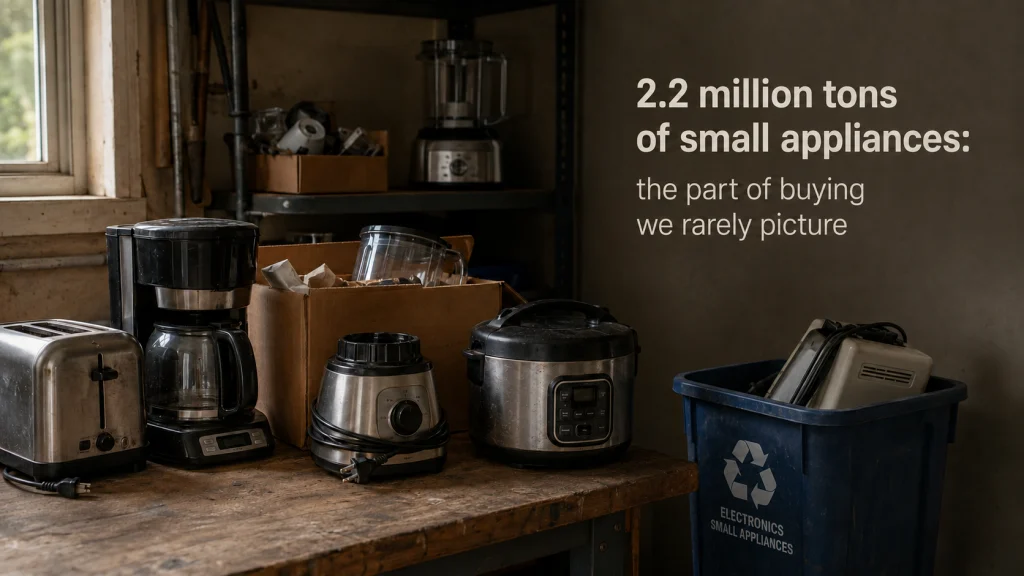
The appliance leaves the shopping cart long before it leaves the world
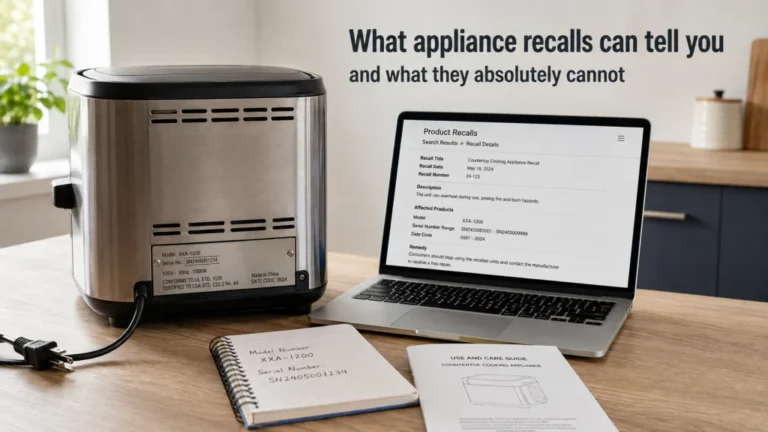
A new toaster, blender, coffee maker, or countertop cooker can feel almost weightless at the moment of purchase. The box comes home, the machine earns a place on the counter or in a cabinet, and the purchase decision seems finished. EPA’s historical municipal solid waste data gives that story a much heavier ending: the agency estimated about 2.2 million tons of small-appliance waste in the latest published row of that series. The number is not a verdict on appliances, but it is a reminder that the object remains after the excitement, usefulness, or tolerance for keeping it changes.
That physical afterlife matters because household equipment does not vanish when it stops being convenient. It may sit unused for months, move from a counter to a high shelf, get donated, enter a recycling stream, go through combustion with energy recovery, or end up in a landfill. None of those outcomes automatically makes the original purchase foolish, because an appliance can deliver years of valuable use before reaching the end of its useful life. The more useful question is whether disposal belongs in the way we think about buying from the beginning rather than appearing only when an unwanted machine is already taking up space.
What EPA counts as a small appliance in this waste dataset
EPA’s product-specific waste page uses a practical household-goods grouping rather than every possible meaning of the phrase “small appliance.” The agency gives examples such as toasters, hair dryers, and electric coffee pots, and it places this group within durable goods in municipal solid waste. EPA says its durable-goods analysis generally concerns products expected to last three years or more, although it notes exceptions to that broad definition. That context matters because the waste figure is not a count of every corded gadget, every battery-powered device, or every item a retailer might place in a small-appliance aisle.
The dataset is also historical, not a live annual tracker of what households are discarding right now. EPA’s accompanying page explains that shipment information, product weights, material composition, and waste-management estimates are used to build the series. That makes the data useful for understanding scale and waste pathways, but it does not justify turning the latest published row into a current-year estimate. For this article, the number is best treated as a documented snapshot of a large physical stream, not as a precise description of what is happening in any one household today.
Where that small-appliance waste went
EPA’s latest published small-appliance row totals 2.16 million tons of generated waste, which the agency rounds in its text to about 2.2 million tons. Of that total, EPA reports about 5.6 percent recycled, about 18.5 percent combusted with energy recovery, and about 75.9 percent landfilled. Those percentages describe management pathways for the waste stream, not household intentions or product quality. A machine reaching one pathway instead of another tells us where the material went after it became waste, not why the owner stopped using it.
| Waste pathway | EPA share of generated small-appliance waste | What the figure can tell us |
|---|---|---|
| Recycled | About 5.6% | A small share of the measured stream entered recycling. |
| Combusted with energy recovery | About 18.5% | Part of the measured stream was managed through combustion with energy recovery. |
| Landfilled | About 75.9% | Most of the measured stream was reported as landfilled. |
The proportions are uncomfortable partly because small appliances rarely feel large while we are buying them. One compact machine on a counter is easy to imagine as a minor object, yet a national waste stream aggregates millions of individual decisions, replacements, failures, upgrades, and changes in household routines. The table should not be read as a recycling instruction or as evidence that every discarded appliance could have been recycled. Its useful role here is narrower: it shows that the physical end of ownership is substantial enough to deserve a place beside price and features when we think about buying.
Putting 2.2 million tons in perspective without inventing a comparison
Large waste numbers almost invite dramatic comparisons, but those comparisons can become less informative than the original data. Converting the total into imaginary truckloads, stadiums, skyscrapers, or household piles would require extra assumptions about volume, density, packing, or vehicle capacity that the EPA small-appliance table does not provide. The cleanest interpretation is simply that the measured stream is large on a national scale and that most of it was reported as landfilled. That is enough to make the afterlife of these products visible without dressing the number in a metaphor that looks precise but is not.
There is another reason to resist spectacle: the tonnage combines many kinds of small appliances with different sizes, materials, prices, functions, and useful lives. A hair dryer and a countertop cooker are not interchangeable ownership decisions even if both can appear under a broad waste category. The environmental data therefore works best as a boundary around the discussion rather than as a scorecard for any one product type. It tells us that discarded equipment adds up, while leaving the household-level question to be answered by actual use, storage, maintenance, and the value of the work the appliance performs.
The waste data cannot tell us why people got rid of an appliance
The most important limitation in this dataset is also the easiest one to overlook. EPA reports generated waste and management pathways, but the small-appliance table does not identify whether a particular product broke, became obsolete, was replaced by a preferred model, was discarded during a move, or simply stopped earning storage space. It also does not provide an individual lifespan for each toaster, coffee maker, hair dryer, mixer, or other machine represented in the category. Claiming that the tonnage proves poor durability or careless consumer behavior would go beyond what the source supports.
That uncertainty is not a weakness that needs to be filled with guesses. It is a useful line between what the data can establish and what a household should decide for itself. We can say that a large mass of small appliances entered the waste stream and that most of the measured stream was landfilled, but we cannot assign motives to the people behind those objects. Once that distinction is clear, the better buying question becomes less accusatory and more practical: how likely is this machine to become part of a repeated routine rather than another object waiting for a future decision?
Repeated household use matters more than purchase excitement
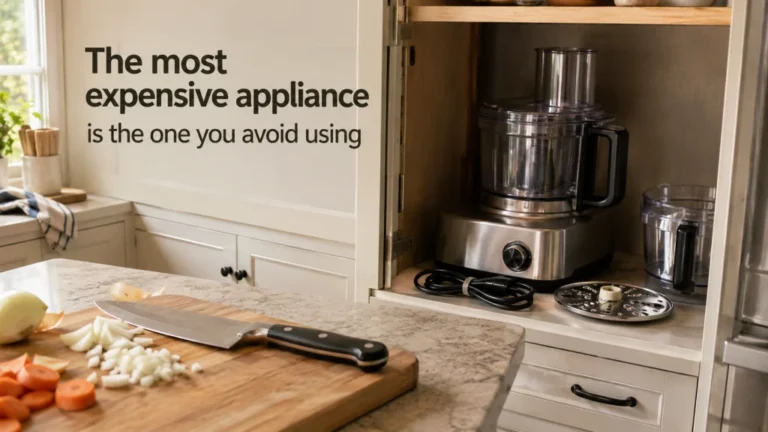
An appliance can look compelling because it promises one excellent result, saves a few minutes, or solves a task that was recently annoying. The harder test is whether that task occurs often enough, and with enough inconvenience, to justify owning a dedicated machine for it. A compact food processor used several times each week may earn its cabinet footprint easily, while another equally capable machine can become hard to justify if its main task appears a few times a year. Frequency is not the only measure of value, but it is one of the clearest ways to separate a household tool from a purchase that mostly survives as stored potential.
Occasional use can still be completely reasonable when the job matters enough. A rarely used appliance may save substantial effort during a seasonal task, accommodate a specific household routine, or handle work that the household otherwise finds difficult or expensive to outsource. That is why I would not reduce responsible buying to a rule that every machine must be used weekly. The more useful standard is whether the appliance has a believable role before it is purchased, which is also the central question when choosing small kitchen appliances for a real household routine.
Single-purpose and multipurpose appliances can both become clutter
It is tempting to assume that a multipurpose appliance is automatically the more responsible purchase because one motor body may replace several specialized machines. Sometimes that is exactly what happens, especially when the household actually uses several functions and the combined machine is easy enough to set up and clean. But versatility on a feature list is not the same as versatility in a kitchen, laundry area, or utility space. A large machine with ten functions can still spend most of its life unused if the owner dislikes its cleanup, finds its accessories awkward to store, or reaches for simpler tools instead.
Single-purpose equipment has the opposite reputation, yet specialization can make sense when the task is frequent and the dedicated design makes the job noticeably easier. A simple appliance that performs one repeated task with little setup may earn its space more convincingly than a premium machine whose extra modes rarely leave the control panel. The waste data cannot choose between those two patterns because it does not track how intensely each discarded product was used. The buyer can, however, ask whether the proposed versatility removes real household work or merely increases the number of features attached to an object that still needs storage and maintenance.
Storage and maintenance are part of the ownership horizon
Unused equipment often becomes a storage problem before it becomes a waste problem. A machine can remain perfectly functional while moving from the counter to a cabinet, from the cabinet to a pantry shelf, and from the pantry shelf to a box because each use now requires more retrieval, assembly, cleaning, or accessory hunting than the household wants to tolerate. That does not mean every stored appliance should be discarded. It means storage friction is useful evidence about whether the object still fits the routine it was purchased to support.
Maintenance creates a similar test because ownership continues between uses. Removable parts need somewhere to live, filters or consumables may need attention, cords have to be managed, and surfaces may need cleaning before the machine can be put away. A product that saves ten minutes during operation but creates fifteen minutes of setup and cleanup can lose its place in a routine even if its core performance is good. Thinking about those before-and-after tasks at purchase time is not pessimism; it is simply a more complete picture of what the appliance asks from the household.
Responsible buying does not mean feeling guilty about useful equipment
The point of putting disposal into the purchase picture is not to make every appliance feel like a moral failure waiting to happen. Household equipment exists because machines can save labor, create consistency, improve access to a task, or make recurring work easier enough that people actually do it. A product that is used heavily and maintained for a long useful life can be a sensible purchase even though it eventually becomes material that must be managed. End of life is a normal property of physical goods, not evidence that ownership was automatically wasteful.
Guilt is also a poor decision tool because it can push people toward simplistic rules such as never buying specialized equipment or always choosing the smallest possible machine. Those rules ignore household size, task difficulty, physical effort, available storage, and how often the product will be used. A larger or more specialized appliance can be the better fit when it meaningfully reduces repeated work and the household has room to own it comfortably. The better standard is proportionality: does the value delivered over the ownership period justify the money, space, maintenance, and eventual disposal attached to the object?
Three questions to ask before another appliance comes home
A reflective article can easily drift into a generic shopping checklist, which is not the goal here. These three questions are deliberately narrow because they connect the waste data back to the moment when a new durable object is about to enter the household. They do not tell you which brand, size, capacity, or feature set to buy. They simply force the purchase to compete with the realities of routine, storage, and ownership instead of with the temporary appeal of a product page.
- What repeated job will this appliance own? Name the task and how often it realistically occurs rather than listing features you might use someday.
- Where will the machine and its parts live between uses? Include the main body, cord, attachments, removable parts, and any supplies that need dedicated space.
- What would make me stop using it? Think about cleanup, setup, weight, noise, awkward storage, maintenance, or a simpler tool that already handles the job well enough.
The answers do not have to favor the cheapest option or the smallest one. A household may decide that a bulky appliance deserves space because it solves an important job repeatedly, while a compact gadget may fail the same test because its function is already covered. What matters is that the appliance enters the home with a defined role rather than a vague promise of future usefulness. That small shift cannot eliminate waste, but it can reduce the number of durable objects bought without a believable ownership plan.
Final thoughts: every appliance eventually becomes a material object
The 2.2 million-ton figure is useful because it makes an easily ignored stage of ownership visible. It does not tell us that small appliances are bad purchases, that most products fail early, or that every discarded machine could have been saved. It tells us that individual objects eventually accumulate into a substantial waste stream, long after the original buying decision has been forgotten. That is enough reason to judge a purchase by the work it is likely to do, not just by the appeal it has at checkout.
For me, that changes the tone of the buying question more than it changes the answer. I would still choose equipment that earns its keep through real household work, even if it is specialized, larger, or useful only for an occasional job that matters. I would be more skeptical of a machine whose strongest argument is feature count or a hypothetical task with no clear place in the household. The goal is not to avoid owning things; it is to give each durable object a convincing reason to come home.
FAQs
♻️ Does the 2.2 million-ton figure mean only 5.6% of every appliance gets recycled?
No. EPA reports that recycling share for the measured small-appliance waste stream in its historical dataset. It should not be treated as a guaranteed outcome for every product or every local waste system.
🧾 Does EPA say why people threw these appliances away?
No. The dataset reports waste generation and management pathways, not the household reason each appliance was discarded. It cannot distinguish breakage, replacement, unwanted ownership, moving, or other motives at the individual-product level.
🏠 Is a rarely used appliance automatically a bad purchase?
No. Occasional use can still justify ownership when the task is valuable enough and the machine saves meaningful effort. The key question is whether that use is real and worth the storage, setup, cleanup, and maintenance the product requires.
🧰 Is a multipurpose appliance always better than several single-purpose machines?
No. A multipurpose machine is useful when the household genuinely uses several functions and tolerates the setup, cleaning, and storage. A simple dedicated appliance may be the better fit when one task happens often and the specialized tool is easier to live with.
📦 Should storage space affect whether I buy a small appliance?
Yes, when storage changes how easy the machine is to retrieve and use. Include the main body, cord, accessories, removable parts, and any consumables in the space calculation rather than measuring only the appliance shell.
References and Sources
- EPA durable-goods product-specific data: Supports the small-appliance category description, historical waste quantities, and recycling, combustion with energy recovery, and landfilling shares used in this article.