A technically capable appliance can still be a poor fit when using it asks for more effort than the household wants to spend on the task. Repeated avoidance is useful information because it points to friction in retrieval, setup, handling, cleanup, storage, or task frequency rather than automatically proving the product is bad. The useful question is not whether the appliance deserves more use because it was expensive, but whether its normal ownership workflow makes sense for the jobs that actually happen at home. Once that distinction is clear, it becomes easier to decide whether to change the workflow, keep the appliance for occasional high-value jobs, or simply stop treating underuse as a personal failure.
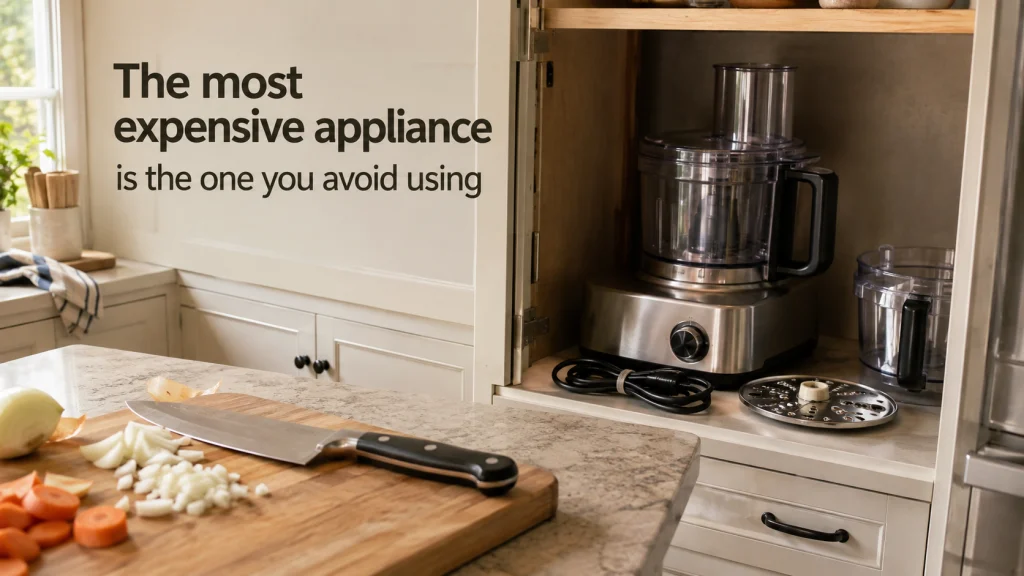
Treat avoidance as information, not a verdict on quality
The most expensive appliance is the one you avoid when using it asks for more effort than the job feels worth. Nothing has to be broken: the machine may work exactly as designed, the reviews may have been strong, and the feature list may still look impressive, yet the household keeps reaching for a simpler tool or postponing the job altogether. That pattern is worth noticing because repeated avoidance often says more about the ownership workflow than about technical capability. A good product can still be the wrong product for the way a household actually lives.
That distinction matters because quality and fit answer different questions. Quality asks whether the product performs its intended function well, while fit asks whether the household can retrieve it, set it up, handle it, finish the task, reset it, and store it without feeling that the job has become larger than it needed to be. A large food processor may be perfectly capable and still lose to a knife for small jobs because the smaller tool reaches the finish line with less ceremony. The useful signal is not guilt about owning the larger machine, but the repeated choice the household makes when the same task appears again.
Start with retrieval and setup friction before blaming the appliance
Many appliances become expensive to use before they are even switched on. A machine stored at the back of a low cabinet may require moving other items, bending, lifting a bulky body, finding an attachment, and clearing enough counter or floor space to begin. None of those steps is dramatic by itself, but together they can turn a small household task into a project. If the alternative tool is already within reach, the easier option naturally starts winning.
Setup friction can be especially revealing when the task itself is short. A vacuum with several attachments may be useful for a full cleaning session, but that does not mean the household will assemble the preferred tool and route a cord or hose for one quick patch of debris. A stand mixer may make sense for a substantial batch while feeling excessive for a small mixing job that can be finished with a bowl and handheld tool. The mistake is treating setup as free, because every step before the useful work begins is part of the real cost of ownership.
- How many items must move before the appliance can be reached?
- Does the appliance need assembly, attachments, a hose, a cord, water, or another setup step before the task begins?
- Does the household need to clear a work surface or floor area every time?
- Is there a simpler tool that starts the same task with much less preparation?
Those questions do not prove that the appliance should leave the home. They simply expose whether the household is avoiding the job itself or avoiding the process required to start the machine. That is a much more useful diagnosis than deciding that an expensive purchase must be used more often to justify its price. It keeps the next decision focused on the real source of friction instead of the amount already spent.
Handling friction can make the job feel larger than it is
Even when retrieval is easy, the appliance may be unpleasant to handle once the task begins. Weight, bulk, maneuverability, a large tank, awkward controls, a stiff hose, or a body that is difficult to reposition can make a capable machine feel oversized for ordinary use. A garment-care appliance with a generous reservoir may reduce refilling, for example, but the added water also increases the weight the user has to move or manage. More capacity can solve one annoyance while quietly creating another.
Scale mismatch creates the same problem in the kitchen. A large appliance can be excellent when the household is preparing a substantial amount of food, yet feel clumsy when the normal job is small and the working bowl, attachments, or footprint exceed what the task needs. The issue is not that large appliances are inherently inconvenient, but that their handling cost must be paid every time they are used. If the household repeatedly chooses a smaller tool because it is easier to control, that choice is evidence about task scale rather than evidence that anyone is using the larger machine incorrectly.
Reset friction matters after the useful part of the job is over
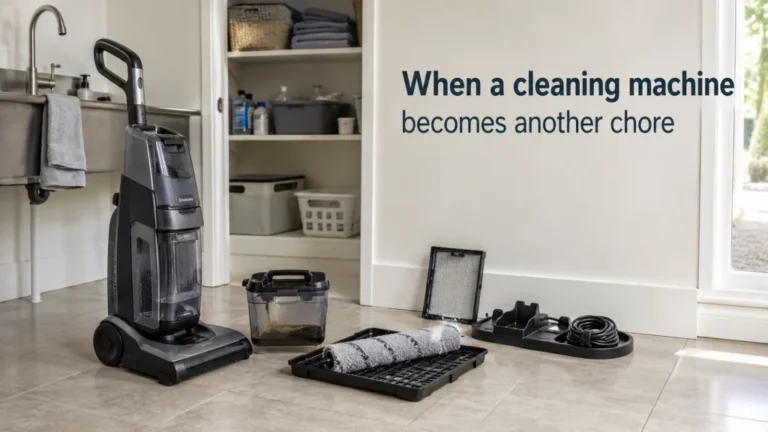
The ownership workflow does not end when the appliance finishes its useful work. Parts may need to be emptied, rinsed, dried, wiped, reassembled, wound, drained, or returned to separate storage locations before the household is truly done. That reset burden can be easy to ignore at purchase because it happens after the satisfying part of the task. In daily life, however, people often remember the ending before they decide whether they want to begin.
This does not mean cleanup should become the automatic explanation for every underused appliance. A machine may be easy to clean but difficult to retrieve, easy to retrieve but awkward to move, or pleasant to operate but badly matched to the amount of work the household usually needs. The point is to count the entire cycle from first reach to final reset instead of measuring convenience only while the motor is running. If the ending consistently feels larger than the result, avoidance can be a rational response to ownership friction rather than a sign that the product lacks quality.
Match activation effort to how often the task actually happens
Not every underused appliance is a mistake. Some equipment is valuable precisely because it handles an occasional job that would otherwise be difficult, slow, or unpleasant, and low use alone does not make that ownership irrational. The better question is whether the effort required to activate the appliance matches the value of the task when that task appears. A bulky carpet-cleaning machine may be reasonable for an occasional deep job even if it is never part of ordinary floor care.
Trouble starts when a high-effort appliance is expected to serve a low-effort, frequently repeated task. If every use requires retrieval, assembly, clearing space, several passes, and a substantial reset, the household may eventually postpone a job that could have been completed with something simpler. That is why frequency matters as much as capability: the more often a task appears, the more often the household pays the startup and reset costs. An appliance does not need to be used constantly to justify its place, but its activation effort should make sense for the jobs it is expected to own.
A higher price can create pressure without creating usefulness
Expensive purchases carry a peculiar emotional weight because the household can start treating usage as a repayment plan. The appliance cost more, so every week of underuse can feel like evidence that the purchase must be defended by forcing it into more tasks. That pressure confuses money already spent with usefulness available now. The price may explain why regret feels sharper, but it does not reduce the weight, shorten the setup, simplify storage, or make a mismatched task suddenly worth doing with that machine.
I have a hard time calling something a bargain if the household keeps avoiding it, even when the product itself is well made. That does not mean an expensive appliance must be discarded the moment it becomes inconvenient, because it may still have a clear occasional role that cheaper tools cannot cover as well. It does mean the household can stop treating frequent use as a moral obligation. A purchase decision belongs to the past, while the ownership decision still has to make sense each time the appliance is reached for.
Separate a wrong workflow from a wrong task match
Repeated avoidance usually deserves one of three interpretations, and they lead to different next steps. The first is a wrong workflow: the appliance may fit the task, but its storage location, accessory arrangement, or setup sequence makes every use harder than necessary. The second is a wrong task match: the machine may simply be too much appliance for the jobs the household repeats most often. The third is an occasional-use match, where the product earns its space because a less frequent job genuinely benefits from its capacity or capability.
Those interpretations are more useful than the binary question of whether the appliance should stay or go. A heavy mixer that is avoided because it lives in an awkward cabinet may become practical if it can be stored where lifting and clearance are easier, while the same mixer may remain unnecessary for a household that almost always handles small batches with a simpler tool. An occasional-use machine can also be completely reasonable when its rare job is valuable enough to justify storage. The goal is to identify which pattern is actually happening before changing the household around the product or changing the product around the household.
Carry the lesson into the next purchase without punishing the current one
The most useful future-purchase lesson is to count effort on both sides of the task, not just capability in the middle. Before buying another appliance, picture where it will live, what must move before it can be used, which parts must be attached, how much handling the normal task requires, and what has to happen before the appliance can go back into storage. That mental walkthrough often exposes friction that a feature list cannot show. It also makes a smaller or simpler option easier to evaluate on its real advantage rather than dismissing it for having fewer features.
This approach does not require turning every purchase into a complicated audit. A household only needs to ask whether the machine reduces enough work, often enough, to justify the space and effort it adds around that work. Sometimes the answer will favor a larger or more capable appliance because the task genuinely uses that capability, and sometimes the answer will favor a simpler tool that is ready sooner and easier to reset. The important change is learning to value a product by the full ownership routine rather than by price, specifications, or the feeling that more capability must always be better.
Final Thoughts: when a good appliance asks too much of your routine
The useful question is not whether the appliance deserves more use because it was expensive or well reviewed. The question is whether its place in the household still makes sense for the work it actually does. A machine that earns its space on a few important jobs can have a legitimate role, while one that complicates an ordinary recurring task may need a different role or workflow. That is a more useful judgment than trying to prove the original purchase was either completely right or completely wrong.
Use the pattern as information rather than punishment. Make access easier when access is the real obstacle, keep specialized equipment for the jobs where it genuinely helps, and stop giving feature count more weight than the routine around the feature. The next purchase should make the normal job easier to begin and easier to finish, not merely look more impressive on paper. That is how an expensive lesson becomes a better household decision instead of a reason to keep forcing an awkward one.
FAQs
Low use can mean several different things, and the distinction matters before changing anything. Some appliances are naturally reserved for uncommon jobs, while others sit unused even though the task they were bought for happens regularly. The first situation may be completely reasonable; the second deserves a closer look at what is making the job harder to start. Price and review scores do not answer that question for the household.
These questions focus on practical tests rather than on whether an appliance has been used often enough to justify itself. A storage change, a narrower job assignment, or a more realistic expectation may solve the problem without another purchase. In other cases, the pattern simply shows that the product asks for more effort than the repeated task warrants. Knowing which situation you have is more useful than counting uses.
💸 Was an expensive appliance a bad purchase if I barely use it?
Not necessarily. Low use can still make sense when the appliance handles an occasional job that matters. Repeated avoidance of a frequent task is more revealing because it can point to a mismatch in setup, handling, storage, or effort. Judge the appliance by the role it actually serves, not by how often its purchase price makes you feel that it should be used.
📦 Should I move an appliance before deciding I do not like using it?
If retrieval is the main obstacle, a better storage position can be a useful test. Move it only if the new location genuinely reduces lifting, clearing, attachment hunting, or another startup step. Then notice whether the household reaches for it more naturally. If avoidance continues, the bigger problem may be handling, task scale, or the work required after use.
⚖️ Can an appliance be too capable for the jobs I normally do?
Yes. Extra capacity or features can add size, handling, setup, or cleanup that does not pay off when the household usually performs smaller tasks. That does not make the appliance poor quality. It means the normal task may not use enough of its capability to justify the extra ownership effort.
🧼 Is cleanup the main reason people stop using appliances?
Cleanup can matter, but it is only one part of the ownership cycle. Retrieval, assembly, weight, maneuverability, storage, and task frequency may be equally important. Look at where resistance appears before assuming washing parts is the whole problem. The most useful fix depends on which step repeatedly makes the household choose another tool.
🧰 When does it make sense to keep an appliance for occasional use?
Keep that role in mind when the occasional task is genuinely valuable and the appliance handles it well enough to justify the space it occupies. Frequent use is not required by itself. What matters is whether the uncommon job is important enough to earn the storage and ownership effort. A narrow but useful role can still be a sensible role.
🛒 What should I remember before buying another appliance?
Count the whole routine from storage to setup to final reset. Picture the ordinary job rather than the most ambitious job the appliance could theoretically handle. Features matter only after the product fits the task frequency, space, handling tolerance, and amount of work the household actually wants it to do. That check makes it easier to recognize when simpler equipment is the better fit.