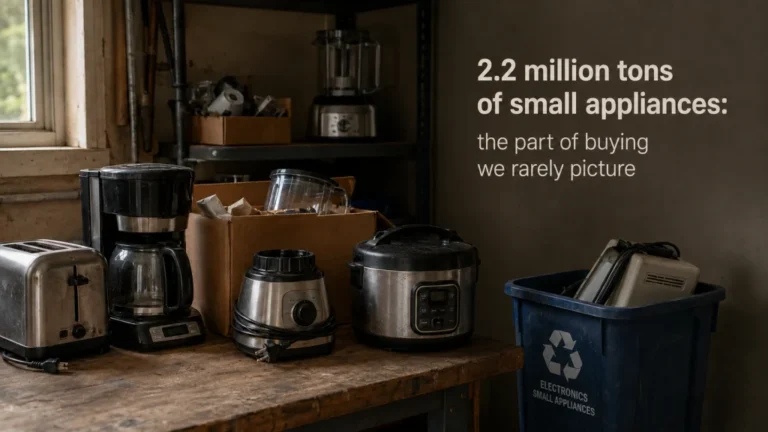
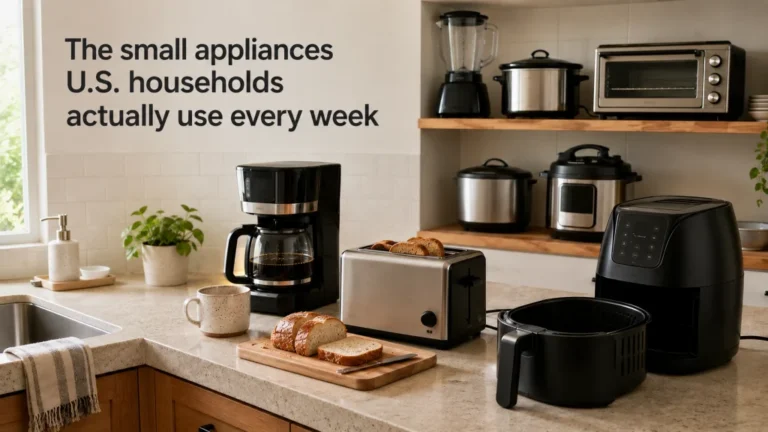
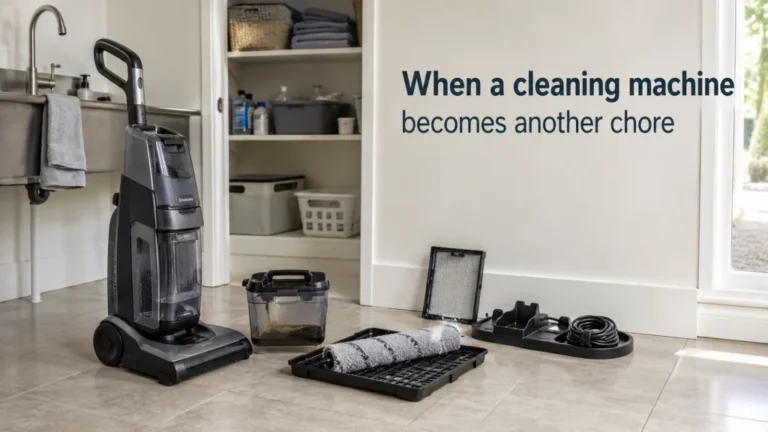
Appliance clutter can be harder to judge than ordinary clutter because each machine usually came home for a real job, cost real money, and may still be useful under the right circumstances. The difficult part is not counting how often something gets used, but separating genuine occasional value from an imagined routine that no longer fits the household. Storage and accessibility also muddy the signal, since an appliance can look unnecessary simply because retrieving it is annoying. The useful outcome is not a smaller collection by default, but a clearer reason for why each appliance still has a place, needs a different place, or no longer matches daily life.
Reasonable purchases can still become difficult clutter
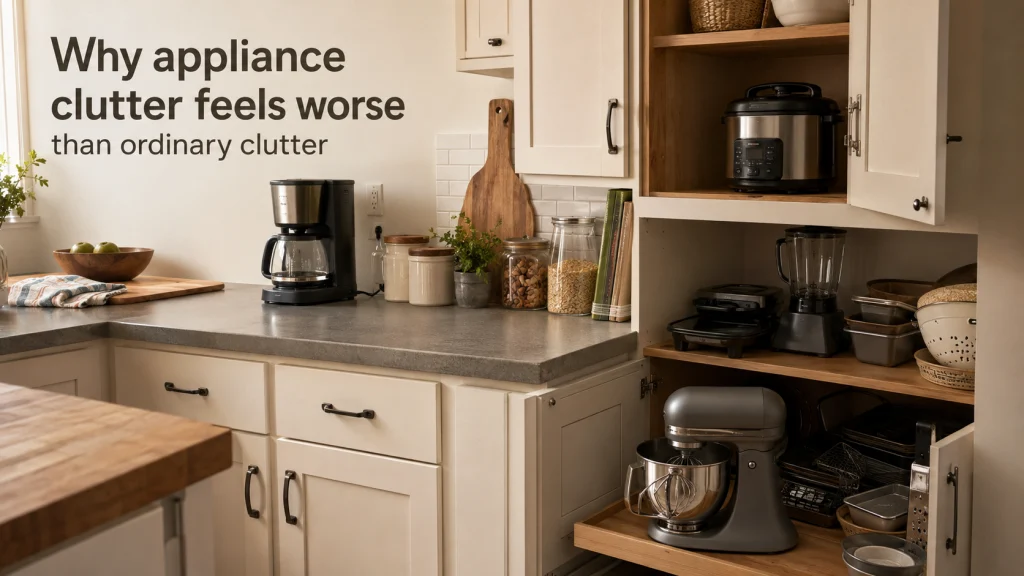
A kitchen counter can hold a blender beside a coffee maker while a slow cooker and stand mixer fill the cabinet below, and every one of them may have been bought for a perfectly sensible job. That ordinary scene helps explain why appliance clutter feels worse than random clutter: the objects are not mysterious extras, but working tools connected to meals, drinks, baking, hosting, or another routine that once made sense. The household may still like every machine and still find that the counter feels crowded or the cabinet has become hard to use. Nothing about that requires the original purchases to have been foolish.
The harder part is that each appliance can still make a plausible case for itself. A waffle maker still makes waffles, a food processor still reduces prep work, and a garment steamer can still handle clothing that needs quick attention, even if those jobs now happen less often or another method has become easier. That makes unused kitchen appliances different from objects with no remaining function at all. The useful question is whether the job, frequency, storage burden, cleanup, and current routine still add up to a place that makes sense.
An unused appliance may still be attached to a real job
Ordinary clutter is easier to dismiss when it has no clear purpose, but an appliance usually points to a task the household can imagine needing again. That possibility matters because “not used lately” and “no longer useful” are not the same condition. A slow cooker used only for large gatherings may sit untouched for long stretches and still earn its space when those gatherings happen. A specialty mixer attachment can be similar if it solves one recurring task that would otherwise be inconvenient enough to matter.
Frequency is useful evidence, but it is weak when treated as a verdict by itself, especially with rarely used kitchen appliances that serve seasonal or event-based tasks. Some household jobs are naturally occasional, and the right question is whether the appliance still serves one of those jobs well enough to justify the space and handling it requires. The answer can change when an alternative already in the home does the same work with little extra effort. It can also change when the original job has quietly disappeared, even though the machine remains perfectly capable of doing it.
Money already spent can make the appliance feel unfinished
Purchase price can make an underused appliance feel as if it still has something to prove. The money is already gone, but the object remains visible, so keeping it can feel like preserving a chance for the purchase to become worthwhile later. That is a familiar sunk-cost pressure, but it does not need to become a financial rule for what stays in the home. The useful question is what the appliance contributes now, not whether future use can retroactively make the original payment feel better.
This is also why a cheap gadget and an expensive machine can create very different hesitation even when they occupy similar space. Price, gift status, perceived quality, and the memory of comparison shopping can all make the decision feel larger than the physical object. Those factors are real parts of the household decision, but they are not proof of current usefulness. It helps to separate what the appliance represents from what it actually does in the routine that exists today.
- The appliance may represent money that already left the budget.
- It may represent a routine the household hoped to build.
- It may represent a task that still happens, but less often than expected.
None of those meanings automatically says keep or let go. They simply explain why the decision can carry more weight than clearing an object with no practical history attached to it. Once that distinction is visible, the appliance can be judged as equipment again rather than as a receipt that still needs defending. That makes room for a more useful comparison between current benefit and current burden.
Counter and cabinet space make underuse hard to ignore
An appliance does not have to be used every day to deserve space, but idle equipment is unusually visible when it occupies working areas. A coffee maker on a deep counter may be almost costless to leave out, while the same footprint can be a constant obstacle in a narrow kitchen where every prep area is contested. Cabinet storage creates its own trade-off because bulky machines can displace cookware, pantry items, or equipment that is used more often. The same appliance can therefore feel perfectly reasonable in one home and disproportionately intrusive in another.
That is why clutter is partly about the value of the space being consumed, not simply the number of objects owned. A large appliance in a low-value storage corner may create less friction than a small appliance that blocks the only convenient work surface. This does not mean clear counters are morally better or that small homes should own fewer tools. It means space has a job too, and the household gets to decide whether the appliance contributes enough to justify occupying that particular part of it.
Accessibility can make a useful appliance look unnecessary
Underuse is easy to read as loss of interest, but sometimes the real problem is retrieval friction. A machine stored behind heavy cookware, above comfortable lifting height, or in another room has to overcome a setup penalty before the task even begins. If it gets used more when it is easy to reach, the underlying job may still be relevant. In that case, the signal is not simply “we do not use this,” but “our current storage arrangement makes using this harder than the job is worth on most days.”
The opposite is useful too. If an appliance remains easy to reach and still goes untouched through situations where it would normally be helpful, that is stronger evidence that the routine may have moved on. Access cannot prove value by itself, but it helps separate storage friction from true lack of demand. That distinction matters because relocation and release solve different problems, and confusing them can lead to getting rid of equipment that still fits a real household task.
| What you notice | What it may mean | What it does not prove |
|---|---|---|
| Use rises when the appliance is easy to reach | Storage friction may be suppressing a real routine | That it deserves permanent counter space |
| It stays unused even when accessible | The original job may matter less now | That the appliance has no occasional value |
| It is retrieved only for one recurring event | It may have a legitimate low-frequency role | That all rarely used appliances should be kept |
The practical use of this comparison is not to turn the kitchen into an experiment. It is to notice whether the barrier is the appliance itself, the task it serves, or the path required to get from storage to use. That keeps the decision focused on actual household behavior rather than a simple usage count. It also prevents accessibility from being mistaken for a universal argument either for keeping something out or for getting rid of it.
“Maybe someday” is not always an excuse
It is tempting to treat every future-use argument as wishful thinking, but some household tasks really are intermittent. Holiday baking, batch food preparation, hosting, garment care before formal events, or seasonal cleaning can create long gaps between legitimate uses. A rule based only on elapsed time would flatten those differences and favor frequent tasks even when an occasional task is important. The better distinction is between a known recurring need and a vague imagined routine with no clear place in current life.
A real occasional use usually has a recognizable trigger. The household can say what the appliance is for, what situation brings it out, and why another available tool is not an easy substitute. An imagined routine tends to stay abstract, such as the belief that one day there will be more baking, more juicing, more elaborate meal prep, or more time for a task that has not fit the household for a long while. Neither deserves ridicule, but they are different kinds of evidence when deciding what still earns space.
Keeping an appliance is a different question from avoiding its use
An appliance can be worth keeping even when the household does not enjoy using it, and it can also be pleasant to use yet no longer worth storing. Those are separate judgments. The issue here is retention: whether the object still deserves a place because of the job it performs, the frequency of that job, the alternatives already available, and the space or handling burden it creates. Why someone delays starting a task with the appliance is a different problem and may involve setup, cleanup, noise, awkward controls, or other friction.
Keeping those questions separate prevents one vague feeling of “we never use it” from standing in for two different decisions. If the task still matters but the machine is consistently avoided, setup, cleanup, noise, awkward controls, or another ownership friction may be the better issue to examine. If the task itself has mostly disappeared, making the appliance easier to reach will not restore a reason to keep it. The cleaner sequence is to decide whether the job still belongs in household life, then judge whether this appliance remains a sensible way to handle it.
There are three reasonable outcomes, not one correct answer
The point of looking closely at appliance clutter is not to push every decision toward removal. Some machines deserve to stay exactly where they are because they solve a recurring job and the space cost is acceptable. Others still have a useful role but are occupying premium space that should go to equipment used more often. A third group belongs to a routine that has faded enough that the object is now being kept mostly for possibility, history, or the hope that the purchase will someday feel more justified.
Those situations lead to three different outcomes: keep, relocate, or let go. That is the practical core of how to decide which kitchen appliances to keep without turning frequency into a rigid rule. Keeping fits a machine with a clear job and acceptable burden, relocation fits a useful machine occupying the wrong space, and letting go fits one whose former role no longer matches current life. What matters is that the reason can be stated in practical terms rather than defended by price, habit, or vague future plans.
- Keep: the appliance still performs a real task that justifies its space and ownership burden.
- Relocate: the task still matters, but the current storage location creates unnecessary friction or consumes more valuable space than it should.
- Let go: the job, routine, or household priority that justified the appliance no longer has a realistic place in current life.
This framework is intentionally neutral because the same appliance can land in different places for different households. A large mixer used several times a year may be an obvious keep in a home that values those baking sessions and has suitable storage, while a smaller machine used slightly more often may still feel burdensome if every use requires moving several other items first. The decision belongs to the actual routine, not to a generic standard of how much equipment a kitchen should contain. That is what makes the answer durable even as habits change.
Appliance clutter is information about the household you actually have
A crowded counter or cabinet can be read as a failure of discipline, but that interpretation is not especially useful. The collection often records earlier routines, changing schedules, gifts, new interests, old interests, limited storage, and practical attempts to solve real tasks. Seeing those layers does not mean every object should stay. It means the clutter can be used as evidence about where purchasing expectations and current household life no longer line up.
That shift matters because it replaces a moral score with a decision problem. Instead of asking whether the kitchen looks sufficiently minimal, ask which appliances still support the way the household cooks, cleans, dresses, hosts, or handles occasional jobs. The answer may still be that too many machines are competing for useful space, but the correction does not have to be shame or an arbitrary purge. It can simply be a more accurate match between equipment, routines, and the space available to support them.
Final Thoughts: know why it still has a place
The goal is not to own fewer appliances for the sake of a cleaner count. It is to know what each machine is doing for the household now, including equipment that earns its place through a genuinely occasional job. Money already spent can explain hesitation, and awkward storage can explain underuse, but neither should substitute for the current role of the machine. A useful keep decision has a clear present-day reason behind it.
If that reason is weak, the next step still does not have to be automatic removal. A better location may solve a real access problem, while a vanished routine may point toward letting the appliance go. Appliance clutter becomes easier to read when those possibilities are separated instead of forced through one frequency rule. The useful target is not a particular number of machines, but a collection whose place in the household can still be explained.
FAQs
🧰 Should I get rid of an appliance if I rarely use it?
Not automatically. Rare use can still be reasonable when the appliance handles a real occasional job, has no easy substitute, and the space it consumes is acceptable.
💵 Does an expensive appliance deserve more time before I let it go?
Price explains why the decision may feel harder, but it does not prove current usefulness. Judge the appliance by the job it serves now, the alternatives you already have, and the burden of keeping it.
📦 What if I would use an appliance more if it were easier to reach?
That suggests storage friction may be part of the problem. Before deciding the appliance has no value, consider whether a more practical location would change its actual use without creating a bigger space problem elsewhere.
🗓️ Is there a good time limit for deciding an appliance is unused?
A universal time limit is too blunt for equipment tied to seasonal or occasional tasks. Look instead for a recognizable recurring use, a realistic trigger for that use, and whether another tool already handles the same job well enough.
🏠 Is appliance clutter mainly a small-kitchen problem?
No. Limited space can make the trade-off more visible, but any household can have equipment that no longer matches its routine, storage priorities, or preferred way of doing a task.