Robot vacuums are worth paying for when they reliably remove a floor-cleaning task that would otherwise happen again and again, not merely because they can map rooms or run from an app. The strongest fit is a home where crumbs, dust, hair, or tracked debris build up often enough for scheduled cleaning to matter and where the robot can run without constant floor preparation. Stairs, above-floor cleaning, periodic deeper vacuuming, brush care, filter care, dock space, and possible mop maintenance still belong to the household. The useful question is therefore how much repeated manual work disappears after those remaining jobs are counted.
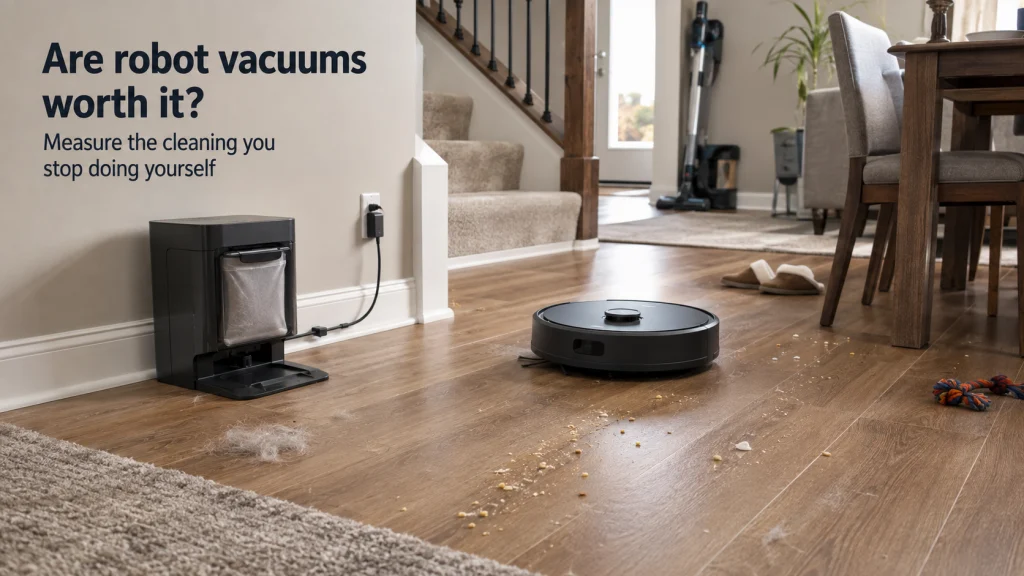
Worth it means less recurring work, not more automation
Are robot vacuums worth it when the advertised promise is hands-free cleaning but somebody still has to clear cords, deal with stairs, maintain brushes, and make room for a dock? They can be, but the value comes from net work removed. A robot that finishes scheduled runs across the areas that get dirty most often can take a repetitive job off the household list. A robot that needs the room staged, gets stranded often, or leaves the important cleaning for another machine may simply move the work around.
The cleanest way to judge the purchase is to start with your existing routine rather than a feature list. Count what you manually vacuum now, how often that debris returns, and which parts of the job a floor robot could realistically take over. Then subtract the work the robot creates, including floor pickup, bin or dock care, brush cleaning, filter service, app attention, and wet-system care if mopping is involved. If the remaining balance is still a meaningful reduction in a chore you actually do, the ownership case starts to make sense.
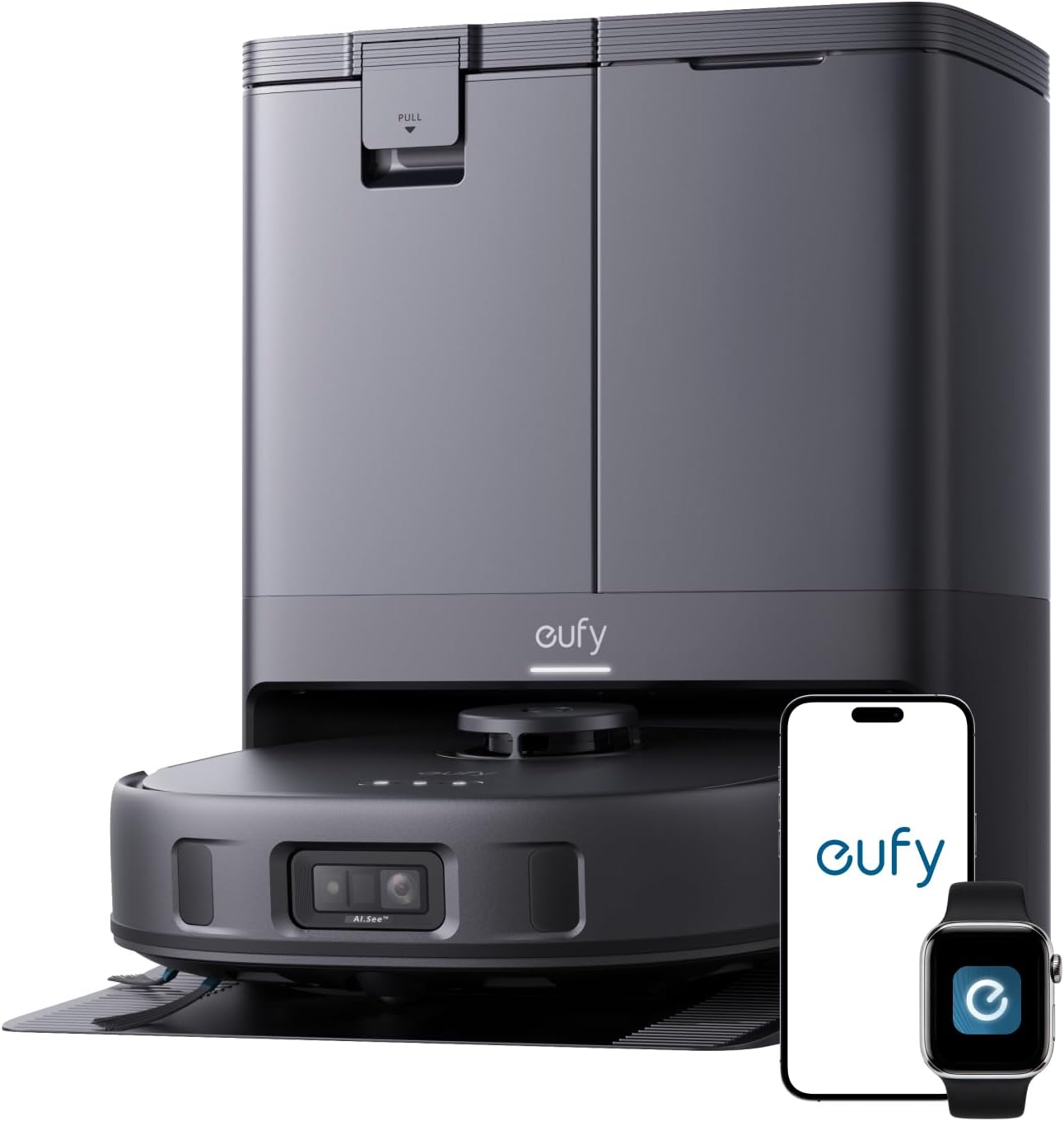
X10 Pro Omni combines scheduled vacuuming and mopping with a station that empties debris, washes and dries mop pads, and handles water for the mop system. Its obstacle-avoidance system is designed to recognize more than 100 common objects, including wires and toys. The self-cleaning roller also helps remove wrapped pet hair, supporting the article's net-work test.
Check On AmazonIf you click this link and buy, we earn a commission at no additional cost to you.
Modern robots can be serious maintenance cleaners
Old impressions of robot vacuums as random bumping gadgets can understate what the category can now do. Vacuum Wars reports testing more than 200 robot vacuums across multiple generations, and its category-level work shows a large improvement in cleaning, navigation, and automation. In one useful benchmark, its best deep-carpet result moved from 76 percent among older robots to 96 percent in its newer testing. That is a ceiling result, not a promise that every robot cleans carpet equally well, but it is strong evidence that the category should not be judged only by early-generation behavior.
The practical strength is repetition. A capable robot can cover accessible floors on a schedule, collect ordinary loose debris, return to its dock, and repeat the routine without a person pushing a floorhead around the room. Organized navigation also makes regular coverage more predictable than older random-navigation designs. This does not make feature count the decision criterion, because a simpler robot that completes the same useful route consistently can remove more household work than a more elaborate machine that fights the layout.

The QV 35A pairs 8,000 Pa suction with an anti-tangle system and smart obstacle avoidance for routine floor maintenance. Its all-in-one dock washes the mops and handles automated service between runs. Dual spinning mops run at 200 RPM, making this a concrete example of how current robots can combine cleaning performance with repeated automation.
Check On AmazonIf you click this link and buy, we earn a commission at no additional cost to you.
Manual cleaning still owns the jobs outside the robot’s reach
A robot vacuum is fundamentally a floor-level machine, so the work it cannot reach should be counted before you assume it replaces another vacuum. Stairs remain manual, as do upholstery, mattresses, shelves, baseboards that need direct attention, car interiors, and debris in places the robot cannot physically enter. Corners and edges may also need periodic touch-up depending on the machine and room geometry. A home with several staircases and substantial above-floor cleaning can therefore keep a manual vacuum busy even if the open floors stay cleaner.
The distinction is easier to see when the jobs are separated instead of asking which machine is better in the abstract. Scheduled surface maintenance is where the robot earns its keep, while concentrated cleanup and flexible reach still favor a manual machine. The table below is a useful starting point, but the exact boundary depends on the floor plan, carpet, furniture clearance, and the specific robot. Treat any task that the robot cannot reach or repeatedly misses as manual work that remains in your routine.
| Cleaning job | Robot can usually handle | Manual work still likely |
|---|---|---|
| Loose dust, crumbs, and hair on accessible floors | Regular scheduled pickup | Spot cleanup after unusual messes |
| Low furniture clearance the robot can enter | Repeated passes without moving a full-size vacuum | Areas too low, narrow, or blocked for the robot |
| Carpeted rooms | Surface maintenance when the model suits the carpet | Periodic deeper cleaning where needed |
| Stairs and above-floor surfaces | None | Handheld, stick, canister, or upright cleaning |
| Edges, corners, and awkward transitions | Varies by model and room geometry | Touch-up where coverage remains incomplete |
The purchase becomes easier to justify when the first column contains jobs you perform frequently and the last column contains jobs you perform only occasionally. If the manual column still represents most of your real cleaning burden, automation may not be the upgrade that changes your routine. A good result is not zero manual cleaning, but a clear reduction in the work that repeats most often. That is why replacement claims should stay conditional rather than universal.

NV356E uses a detachable Lift-Away pod so the same upright can handle stairs and above-floor areas a robot cannot reach. Its HEPA filter and sealed system are designed to trap dust and allergens, while the brushroll can be shut off for hard-floor cleaning. The included crevice and dusting tools extend its reach for furniture and tight areas.
Check On AmazonIf you click this link and buy, we earn a commission at no additional cost to you.
Count how often debris returns before you count dollars
Frequency is one of the strongest predictors of whether automation will feel valuable. A household that sees crumbs after meals, pet hair by the next morning, tracked grit near entrances, or visible dust across hard floors may be repeating the same floor-cleaning task several times between deeper cleans. Scheduling can remove much of that repeated pushing, plugging in, moving room to room, and putting the vacuum away. A low-debris home that already vacuums infrequently has less recurring work available for the robot to remove.
Use a normal week rather than a best-case week. Think about the rooms that actually show debris first, how often you respond to it, and whether you clean the whole floor or only the visible traffic areas. The point is not to calculate a fake number of hours saved, because the value of time and the cleaning baseline differ from home to home. The point is to identify whether there is a recurring task large enough that automation can take a meaningful share of it.
| Recurring task | How often it happens now | Could the robot do it reliably? | Human work that remains | Net effect |
|---|---|---|---|---|
| Kitchen and dining crumbs | Write your real frequency | Yes, partly, or no | Floor pickup, spot cleanup, maintenance | Less work, same work, or more work |
| Pet hair in traffic areas | Write your real frequency | Yes, partly, or no | Brush care and inaccessible areas | Less work, same work, or more work |
| Whole-floor maintenance | Write your real frequency | Yes, partly, or no | Stairs, edges, deeper cleaning | Less work, same work, or more work |
Fill this out before shopping. If you cannot name a repeated cleaning job the robot will take over, the purchase is being justified by the idea of automation rather than by a real household workload. A short list with one or two high-frequency tasks is more convincing than a long list of occasional possibilities. That is a useful reason to wait.

C28 combines 15,000 Pa suction with a HydroJet roller mop for repeated hard-floor maintenance. Its zero-tangle design targets hair pickup, while the station can wash and dry the mop and handle self-emptying and refilling. LiDAR navigation and automatic dock service make it well suited to households judging value by how often routine floor work repeats.
Check On AmazonIf you click this link and buy, we earn a commission at no additional cost to you.
Floor preparation can erase part of the convenience
Obstacle avoidance has improved, but it is not permission to ignore the floor. Vacuum Wars reports that robots in its obstacle-avoidance testing average about 16 avoided obstacles out of 24, and perfect results have been rare. That matters because a charger cable, sock, lightweight toy, or low object can turn an automatic run into a rescue or a skipped patch. The right question is not whether a robot has obstacle avoidance, but whether your normal rooms let that system succeed often enough to reduce intervention.
Some floor pickup is reasonable, especially if it becomes a quick habit rather than a full room reset. The burden becomes questionable when every scheduled run starts with moving several items, lifting lightweight mats, blocking problem furniture, or checking multiple rooms for hazards. Before buying, walk the route at floor level and note what changes from day to day. Pay particular attention to the following conditions:
- Loose charging cords, shoelaces, toys, socks, and other small objects that often stay on the floor.
- Furniture bases, vents, thresholds, or rug edges that could trap a low-profile machine.
- Rooms that are frequently closed, rearranged, or used for temporary storage.
- Pet areas where an unexpected mess would make an unattended run a poor risk.
- Multiple levels that require the robot to be carried if you expect it to clean more than one floor.
A home does not need showroom-clear floors to benefit from a robot. It does need a workable route, or a realistic willingness to create one. The best setup is one where a quick pickup is enough and the robot can then finish without repeated rescue. If clearing the route becomes another substantial cleaning ritual, net work removed can shrink quickly.

X60 Max Ultra Complete uses 35,000 Pa suction and a 3.13-inch body designed to reach under low furniture. Its obstacle-avoidance system is rated to recognize more than 280 object types, which directly addresses the clutter-prep problem in this section. The dock adds self-emptying, refilling, and mop self-cleaning so fewer interruptions are required once the route is clear.
Check On AmazonIf you click this link and buy, we earn a commission at no additional cost to you.
Floor mix matters more than a generic carpet label
Hard flooring is usually a straightforward use case because loose debris stays near the surface and the robot can make frequent passes without a manual floorhead. Carpet needs more care in the decision because pile depth, rug construction, brush design, suction behavior, and the robot’s ability to cross transitions all affect the result. Current testing shows that high-performing robots can do much more on carpet than older machines did. It still does not justify assuming that any robot will handle every carpet, rug fringe, dark rug, or raised threshold in the same way.
Map the home by actual surfaces. A mostly hard-floor first level with a few low-pile rugs gives automation a larger accessible workload than a home dominated by thick carpet, stairs, and small separated rooms. Mixed floors can still be a strong fit, but the exact model needs evidence for the carpet and transition conditions you own. Once you decide automation fits the household at all, the broader robot vacuum buying guide is the better place to compare the features that make a particular robot suit those surfaces.

Saros 10R is specified for hardwood, tile, and carpet and uses 22,000 Pa suction with a dual zero-tangling system. Its 3.14-inch profile and liftable cleaning components are designed to handle mixed surfaces and low furniture. The system also includes carpet-cleaning strategies and automated dock maintenance, making it relevant when floor mix rather than a generic carpet label determines fit.
Check On AmazonIf you click this link and buy, we earn a commission at no additional cost to you.
Pets increase both the payoff and the maintenance risk
Shedding pets can create exactly the kind of recurring debris that makes scheduled cleaning useful. Hair, litter, and tracked particles often return quickly after a manual pass, so frequent automated pickup can keep the baseline cleaner between deeper sessions. The value is not that a robot makes pet cleanup disappear. It is that the same accessible floor area can be revisited without asking someone to start another full vacuuming session.
Pet households also need to count hair around the brush, debris in the dust path, dock capacity, and the risk of running through a pet accident. Anti-tangle designs and obstacle recognition can reduce intervention, but performance varies enough that model-level evidence matters. If the robot requires constant brush cutting or cannot be trusted around the way your pet uses the room, part of the automation benefit is lost. A pet household should therefore judge both pickup frequency and the maintenance created by that pickup, not pet-oriented marketing alone.

DEEBOT X8 PRO OMNI uses 18,000 Pa suction and ZeroTangle 2.0 to reduce hair buildup in the cleaning path. Its OZMO roller mop and OMNI station add washing, drying, refilling, and cleaning-solution dispensing for repeated floor care. AIVI 3D navigation adds obstacle handling, making this model relevant to pet homes where hair pickup and intervention risk both matter.
Check On AmazonIf you click this link and buy, we earn a commission at no additional cost to you.
The dock and consumables become part of the cleaning system
A robot may be compact while its dock is not, so floor space should be measured for the whole system you are considering. The dock needs a practical parking location with power, usable approach space, and enough access for whatever routine the exact system requires. A basic charging base asks for less room and less service, while a self-emptying or mop-service station can transfer work away from the robot but add bags, tanks, trays, and a larger permanent footprint. Convenience is real only when the dock fits the home without creating another awkward object to work around.
Recurring ownership also includes filters, side brushes, main brushes or rollers, dust bags where used, mop pads, cleaning solution where approved, and worn replacement parts. Many current robots also depend on an app for mapping, schedules, room controls, firmware updates, or advanced dock settings, so decide whether account setup, phone access, and a stable home network are acceptable parts of ownership before treating those functions as automatic convenience. Exact maintenance intervals, compatible parts, and app requirements are model-specific, so the manual and manufacturer support information should control those decisions. If emptying the small onboard bin is the friction you most want to remove, the separate question is a self-emptying robot vacuum worth it deserves its own cost-and-maintenance check.

Roborock's official floor cleaning solution is a 16.2-fluid-ounce concentrate for compatible Roborock mopping systems and wet-dry floor cleaners. The listing specifies a 1:200 dilution ratio, so it is a true recurring consumable rather than a general-purpose add-on. It fits this section because dock ownership can include approved cleaning solution alongside bags, filters, brushes, and pads.
Check On AmazonIf you click this link and buy, we earn a commission at no additional cost to you.
Treat mopping as a second workload, not a free bonus
A mop function can add value in homes with compatible hard floors, but vacuuming and mopping should not be bundled into one vague promise of cleaner floors. Basic systems may wipe with a damp pad, while more advanced systems add moving pads, stronger agitation, mop lifting, washing, drying, or water management at the dock. Those differences change both cleaning capability and ownership work. A household that rarely wet-cleans may gain little from paying for a complex mop station that still needs tanks and trays managed.
Start with the floor manufacturer’s care requirements and the exact robot manual, especially for moisture-sensitive surfaces. Then ask what wet-cleaning task you expect the robot to replace: frequent light maintenance, visible footprints, fine dust, or something heavier. Sticky spills, concentrated grime, and areas the robot cannot reach may still need direct manual cleaning. The mop feature is worthwhile when it removes a repeated compatible-floor task often enough to justify its extra setup, maintenance, dock size, and consumables.

This DREAME thermal mop pad is listed for the Matrix Series and X60 Max Ultra. It is a dedicated replacement pad for compatible mopping systems rather than a universal cloth. That makes the extra ownership work visible: a mop feature can add real cleaning value, but it also creates a pad-care and replacement cycle that vacuum-only operation does not.
Check On AmazonIf you click this link and buy, we earn a commission at no additional cost to you.
Use a buy, wait, or skip decision instead of forcing a yes
The answer should change with the household. Buy now makes sense when floor debris returns often, the robot can access a large share of the areas you clean, clutter preparation is manageable, and you are comfortable maintaining the machine. Wait makes sense when automation sounds useful but the route, budget, dock location, floor compatibility, or exact feature needs are still unresolved. Skip is reasonable when manual cleaning is already infrequent, most important surfaces are inaccessible to a robot, or the preparation and maintenance would rival the chore you hoped to remove.
Use the table as a decision filter rather than a scorecard. One serious constraint can matter more than several minor benefits, especially if it stops the robot from completing its route. You do not need every row to say buy before the purchase makes sense. You do need a believable path from the money spent to a repeated task that becomes smaller.
| Outcome | Household pattern | What to verify next |
|---|---|---|
| Buy now | Frequent floor debris, accessible routes, manageable clutter, acceptable maintenance | Exact floor fit, navigation, dock footprint, brush system, and required upkeep |
| Wait | Strong interest, but route, budget, dock space, mopping need, or carpet fit is unclear | Measure the home and define the workload before comparing models |
| Skip | Low cleaning frequency, heavy stairs or inaccessible areas, constant floor clutter, or little manual work to remove | Keep the simpler cleaning system unless the household routine changes |
This is also where budget becomes easier to judge. A lower price does not rescue a poor fit, and a premium price does not create value if the robot cannot complete the routes that matter. Extra automation is worth paying for only when it removes an intervention you expect to face often. Spend only after the buy case is already clear.

The DWHT38130S is a 30-foot tape measure in DEWALT's ATOMIC Compact Series. A 30-foot reach is practical for checking dock location, room dimensions, and the routes that matter before committing to a robot system. It supports the article's buy-wait-skip step by turning vague fit concerns into measurements the household can verify.
Check On AmazonIf you click this link and buy, we earn a commission at no additional cost to you.
Compare cleaning systems only after automation passes the first test
If the buy case is strong, the next decision may be whether the robot should supplement your existing vacuum or change which manual machine you keep. That comparison is different from asking whether automation is worth adding at all. A robot can win on frequency and unattended floor coverage while a regular vacuum wins on stairs, above-floor reach, concentrated messes, and direct control. The household may reasonably keep both because they remove different kinds of work.
Readers at that stage should move to the dedicated robot vacuum vs regular vacuum comparison rather than stretching this buy-or-skip question into a machine-versus-machine verdict. If you are still unsure whether the robot will run often enough or reach enough of your home, stay with the workload test first. A system comparison is useful only after automation itself has passed the household-fit test. The broader home cleaning appliances section can also help when the real need turns out to be a different cleaning tool rather than another floor robot.

CleanView XR Pet 3797V is a 300W cordless vacuum with a removable 24V battery and up to 40 minutes of runtime in standard mode. It converts among stick, handheld, and high-reach configurations and includes three specialized tools. That flexibility complements a robot by keeping stairs, furniture, concentrated messes, and above-floor cleaning in the manual system.
Check On AmazonIf you click this link and buy, we earn a commission at no additional cost to you.
Shop current models only after the household requirements are written down
Once you have decided the category earns a place in the home, model shopping becomes much cleaner. Write down the surfaces, thresholds, pet conditions, clutter level, rooms, dock space, mopping expectation, and maintenance tolerance that came out of the earlier sections. Those requirements are more useful than starting with the highest suction number, the longest feature list, or the most expensive dock. They let you reject machines that solve the wrong problem before marketing details take over the comparison.
At that point, use a current shortlist such as best robot vacuums to compare machines against your written requirements. Specifications and independent tests should be checked at the exact model level because obstacle avoidance, carpet performance, dock functions, included accessories, app requirements, and maintenance systems can differ substantially. Do not assume a feature name proves performance or compatibility by itself. The purpose of the shortlist is to find a machine that passes your home, not to find a universal winner.

Roomba Plus 505 Combo combines LiDAR navigation, obstacle recognition, vacuuming, and dual spinning mop pads in one floor-care system. Its AutoWash Dock self-empties debris, washes the pads, and heat-dries them between cleaning cycles. It is a useful current-model candidate to compare only after the household has written down its floor, clutter, dock, and mopping requirements.
Check On AmazonIf you click this link and buy, we earn a commission at no additional cost to you.
Final thoughts: buy the chore reduction, not the gadget
A robot vacuum earns its place when it can handle the floors that get dirty most often without turning preparation, rescue, or upkeep into another major chore. Frequent debris, accessible routes, manageable clutter, and realistic maintenance expectations strengthen that case. Stairs, deeper periodic cleaning, above-floor work, dock service, and exact floor limitations still stay on the household list. The right outcome can therefore be buy, wait, or skip without treating any of those choices as a failure to adopt newer technology.
Before spending, look at one normal cleaning cycle in your own home and write down what the robot could realistically take over. Measure the dock location, identify problem transitions, decide whether mopping is a real workload, and note any app or network dependence you would be accepting. That gives you a concrete ownership picture instead of a feature-driven one. If the picture still looks simpler than your current routine, the purchase has a practical case.

DEEBOT X11 OmniCyclone combines 19,500 Pa suction with a bagless 60-day station and a self-washing roller mop. Its Zero-Tangle system targets pet hair while smart navigation handles routine route planning. Those automation features matter only when they remove chores the household actually repeats, which matches the article's final reminder to buy chore reduction rather than gadget novelty.
Check On AmazonIf you click this link and buy, we earn a commission at no additional cost to you.
FAQs
🤖 Is a robot vacuum worth it if I already own a cordless vacuum?
It can be if you use the cordless often for routine floor maintenance and want that repeated work automated. If the cordless already handles your floors quickly and infrequently, the robot may remove too little work to justify another appliance.
🏠 Are robotic vacuums worth it in a multi-level home?
They can be, but stairs divide the cleaning area and the robot cannot move itself between levels. Count carrying, separate docks or maps, and the manual stair cleaning before deciding how much work is actually removed.
🐕 Do robot vacuums make sense for pet hair?
Frequent shedding can make scheduled pickup valuable because the debris returns quickly. Check the exact model’s hair pickup, brush design, obstacle avoidance, and maintenance needs rather than relying on a generic pet label.
🧹 Can a robot vacuum replace a regular vacuum?
Not for every home. Stairs, upholstery, concentrated messes, deep carpet work, and other inaccessible areas may still need a regular or handheld vacuum even when the robot handles most routine floor maintenance.
🪢 How much floor clutter is too much for a robot vacuum?
It is too much when clearing the route becomes a substantial chore before most runs or when small objects regularly cause failed cleaning. Judge your normal floor state, not the room after a special cleanup.
🧼 Is the mopping function worth paying for?
It is most useful when you have compatible hard floors and a repeated light wet-cleaning workload. If you mop rarely or the floor requires special care, the extra tanks, pads, dock functions, and maintenance may not earn their cost.
References and sources
- Vacuum Wars robot vacuum testing: Supports the category-level cleaning improvement, navigation, maintenance automation, and obstacle-avoidance evidence used in the article.
- Dyson robot vacuum overview: Supports the practical boundary between routine floor maintenance and deeper or above-floor cleaning tasks.
- ECOVACS robot vacuum overview: Supports current ownership considerations involving floor types, clutter, stairs, routine maintenance, and mopping.